
 By
By 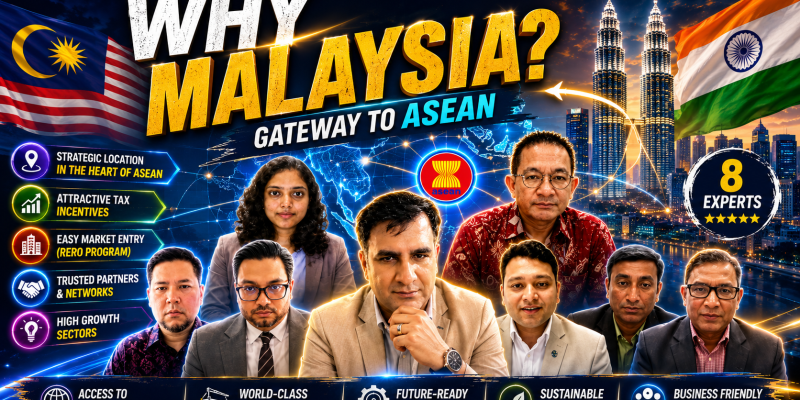
For years, Indian companies have looked west when thinking about global expansion. Dubai. London. Europe. The United States.
But according to some of Malaysia’s leading trade experts, many businesses are overlooking an opportunity much closer to home.
Speaking at the latest World Trade Center Discovery Series, representatives from the World Trade Center Kuala Lumpur, Malaysian Investment Development Authority (MIDA) and Malhttps://www.matrade.gov.my/enaysia External Trade Development Corporation (MATRADE) made one point repeatedly.
“Don’t look at Malaysia alone. Look at Malaysia as the launchpad to the regional market.”
It was a theme that echoed throughout the hour-long discussion.
Rather than viewing Malaysia as a country of 35 million people, the panel encouraged Indian companies to see it as their entry point into ASEAN—a market of nearly 700 million consumers.
As Dr. Irmohizam Ibrahim of the World Trade Center Kuala Lumpur explained, Malaysia offers something every business wants when entering a foreign market.
“Malaysia can serve as a practical soft landing into ASEAN.”
Instead of immediately investing across multiple countries, companies can establish themselves in Malaysia, build relationships, understand customer behaviour and then expand into neighbouring markets with far greater confidence.
That approach, he argued, dramatically reduces market-entry risk.
It’s Not About Exhibitions. It’s About Access.
One of the biggest misconceptions the panel challenged was the role of trade fairs. Many businesses see exhibitions as marketing events. Malaysia sees them differently.
Dr. Ibrahim described them as strategic business platforms.
“Business events are not merely networking platforms. They are strategic platforms that help businesses reduce market entry risk, accelerate relationship building and create pathways for regional growth across ASEAN.”
His reasoning was simple.
Instead of travelling separately to Indonesia, Thailand, Vietnam and the Philippines searching for distributors and customers, companies can meet buyers, investors, government agencies and partners from across Southeast Asia at a single international exhibition in Malaysia.
That makes every business trip significantly more productive.
Malaysia Doesn’t Want Bigger Investments. It Wants Better Ones.
One of the webinar’s biggest revelations came from MIDA. Many governments compete by offering tax incentives based on the size of an investment. Malaysia has changed the rules.
According to MIDA’s Investment Director Shazri Hidayat Abu Shukur, the emphasis has shifted.
“We don’t really look into how much you put into your project. We look into how your company can help the Malaysian ecosystem grow.”
Instead of rewarding capital alone, Malaysia now evaluates companies on the jobs they create, their collaboration with universities, technology transfer, opportunities created for SMEs and their long-term contribution to the country’s economy.
It’s a significant change in philosophy.
You Can Test Malaysia Before Investing
Perhaps the most practical takeaway was that businesses don’t have to dive in immediately. MIDA encourages foreign companies to establish a small Representative Office or Regional Office first. This allows businesses to spend up to two years understanding the market before making a major investment.
As Shazri explained,
“We’ll give two-year approval so you can identify your potential suppliers and clients, build up your confidence and have a comfortable two-foot footing in our country.”
For companies entering Southeast Asia for the first time, that approach removes much of the uncertainty.
The Real Advantage Isn’t Tax. It’s Stability.
One of the moderator’s questions centred around why multinational companies stay in Malaysia for decades.
Shazri’s answer was revealing.
“Malaysia is where companies spend a longer time. It’s not just a place for you to do business. It’s a place for you to stay and make Malaysia your home.”
Companies such as Intel, Samsung and Western Digital have gradually expanded from manufacturing into research, engineering and regional headquarters. That long-term commitment says far more than any investment brochure.
Trust Still Matters More Than Technology
International expansion ultimately comes down to one question. Who can you trust? Rather than relying on internet searches or chance introductions, MATRADE urged companies to work directly with official agencies.
Trade Commissioner Wan Ahmad Tarmizi Wan Idris explained,
“The most important thing is trust. We can help identify genuine players when you come to do business.”
For businesses entering unfamiliar markets, that reassurance could prove invaluable.
Beyond Manufacturing
The webinar also painted a picture of a Malaysia that is rapidly reinventing itself. The country continues to invest heavily in semiconductors, renewable energy, digital infrastructure, artificial intelligence, healthcare, biotechnology and the halal economy.
Dr. Ibrahim believes those sectors are creating entirely new opportunities.
“Malaysia is now strongly promoting the country’s growing digital and AI infrastructure.”
He also highlighted the country’s ambition to become a global leader in halal products and services.
“Malaysia is internationally recognised for its halal certification standards and well-established halal ecosystem.”
Startups Are Finding Their Place
Malaysia’s startup ecosystem is also beginning to attract international attention. Government-backed incubators are now collaborating with Indian startup ecosystems, while companies working in AI, logistics, mobility and drone technology are finding new growth opportunities.
One Malaysian success story highlighted during the webinar was Carsome, which has grown from a startup into one of Southeast Asia’s best-known technology companies. The panel suggested that many more success stories are likely to follow as investment in digital infrastructure accelerates.
One Final Question
As the discussion drew to a close, the moderator asked each panelist the same question.
If an Indian company could take just one step in the next 30 days, what should it be?
The answers couldn’t have been clearer.
Dr. Ibrahim said:
“I would like to invite more Indian delegates to participate in the relevant business events and trade shows in Malaysia.”
Shazri from MIDA kept his answer simple.
“Don’t be afraid. If there are any inquiries, reach out to me. We are more than ready to help you.”
And MATRADE’s Idris offered perhaps the most practical advice of all.
“Come talk to us. Understand the risks. Understand the opportunities, so you can minimise your mistakes when entering the Malaysian market.”
Those three statements neatly summarized the entire webinar.
Malaysia isn’t simply inviting Indian businesses to invest.
It’s inviting them to start a conversation.
And, as the panel repeatedly demonstrated, that conversation could be the first step towards unlocking one of Asia’s fastest-growing regions.
Karnvir Mundrey moderates the Discovery Series with the World Trade Center Bangalore. The series focuses on a country every month, helping Indian businesses discover global opportunities for growth and expansion. See the complete series here.










Comments