
 By
By 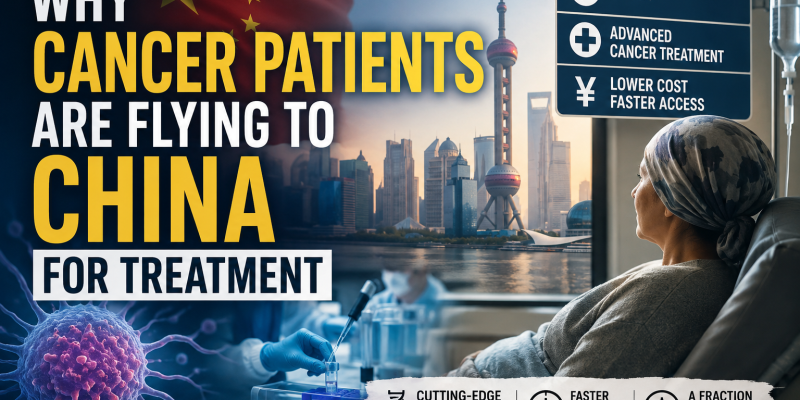
By: Karnvir Mundrey
Cancer patients from Australia and New Zealand are travelling to China for advanced CAR-T cell therapy. Lower costs, faster manufacturing and expanding clinical capacity could turn China into an unexpected global medical destination.
A New Destination for Cutting-Edge Cancer Treatment
For decades, Asian medical tourism has been associated with Thailand’s private hospitals, South Korea’s specialist clinics, Singapore’s healthcare system and India’s comparatively affordable surgery.
China rarely appears on that list.
That perception may now be changing.
Cancer patients from countries including Australia and New Zealand are travelling to Chinese hospitals for CAR-T cell therapy—one of the most advanced and personalised forms of cancer treatment available today. Patients are being attracted not by inexpensive routine procedures, but by sophisticated therapies that may be unavailable, unaffordable or too slow to access in their home countries.
The development represents more than another medical-tourism story. It points towards China’s transformation from a manufacturer of medicines into a serious competitor in biotechnology, clinical research and high-value healthcare.
The Doctor Who Became the Patient
One of the patients was Dr Amanda Harvey from Brisbane.
Harvey had been diagnosed with multiple myeloma, a cancer of plasma cells, seven years earlier. By late 2024, she said she had exhausted the treatment options available to her in Australia.
She was unusually well equipped to investigate alternatives. In addition to being a patient, Harvey is a doctor with a degree in cellular pathology.
Her research led her to CAR-T cell therapy. At the time she began searching, the treatment she needed was not available to her through Australia’s public or private healthcare systems. Treatment in the United States or United Kingdom appeared financially impossible.
She eventually contacted a medical team in Shanghai and travelled to China in 2025.

What Exactly Is CAR-T Cell Therapy?
CAR-T therapy begins with a patient’s own immune cells.
Doctors collect T cells—a type of white blood cell responsible for attacking infected or abnormal cells—from the patient’s blood. In a specialist laboratory, these cells are genetically modified to carry artificial receptors known as chimeric antigen receptors, or CARs.
These receptors help the modified cells identify a particular protein on cancer cells. The engineered cells are multiplied in the laboratory and then infused back into the patient, where they attempt to locate and destroy the cancer.
The US National Cancer Institute describes CAR-T cells as a kind of “living drug” because the treatment is created from the patient’s own cells and may continue multiplying and functioning inside the body. The complete process from cell collection to infusion commonly takes approximately three to five weeks, although timelines differ between products and treatment centres. (Cancer.gov)
The first CAR-T therapy was approved by the US Food and Drug Administration in 2017. The technology is now approved for certain forms of leukaemia, lymphoma and multiple myeloma. The FDA’s July 2026 list of licensed cellular and gene-therapy products includes Abecma and Carvykti, both used for multiple myeloma in specified groups of patients. (Cancer.gov)
CAR-T is not a single universal cancer treatment. Each therapy targets particular biological markers and is approved only for defined cancers and patient groups.
Eight Days to Manufacture Her Cells
After arriving in Shanghai, Harvey underwent three days of investigations, including blood tests, imaging and a bone-marrow aspiration.
Once doctors determined that she was suitable for treatment, her T cells were collected through a process resembling dialysis. The cells were then sent away to be genetically modified and multiplied.
Harvey was later admitted to a major haematology hospital in Shanghai. She received three days of chemotherapy to prepare her immune system before the engineered cells were transported from Beijing and infused into her body.
The infusion itself took approximately 45 minutes.
The striking part of her experience was the manufacturing time. Harvey said her engineered cells were ready eight days after collection. By comparison, she had encountered reports of substantially longer waits in other countries. Her experience should not be treated as a universal comparison—manufacturing periods vary between hospitals, products and individual cases—but in aggressive cancers, reducing delays can be clinically significant.
The Treatment Was Not Easy
CAR-T treatment is sometimes described in language that makes it sound almost effortless: collect cells, reprogramme them and return them to the patient.
The reality can be far more difficult.
Around 12 hours after her infusion, Harvey developed a fever and began feeling seriously unwell. She said the first week was particularly difficult.
After approximately two weeks, however, another bone-marrow test found no detectable myeloma cells. Seven months after returning to Australia, she reported that she remained in complete remission.
Her outcome is encouraging, but an individual patient’s remission cannot establish that one country’s treatment is more effective than another’s. Harvey herself acknowledged that longer-term data on the particular approach used in Shanghai was not yet sufficient to make definitive comparisons with established American and European trials.
That distinction is crucial. A powerful personal story is evidence of what may be possible. It is not a substitute for large, independently assessed clinical studies.
A$1 Million Versus Approximately A$110,000
The most dramatic difference was financial.
Harvey estimated that treatment in the United States or United Kingdom could have cost her approximately A$1 million once treatment, hospitalisation and the possibility of complications were considered.
Her reported expenditure on hospitals and treatment in China was approximately A$110,000, excluding travel, accommodation and day-to-day living costs.
In her case, the Chinese option was roughly one-tenth of the projected Western cost.
This is one patient’s account rather than a standard international price comparison. CAR-T costs depend on the therapy, hospital, duration of admission, complications, insurance coverage and whether treatment is being provided commercially or through a clinical study.
Nevertheless, the gap illustrates an uncomfortable reality: medical innovation has little meaning for a patient who cannot afford it or survive the waiting period.
Why Can China Potentially Do It More Cheaply?
CAR-T therapy is extraordinarily complex because it is not manufactured like an ordinary tablet.
A personalised treatment requires cell collection, genetic modification, laboratory expansion, quality testing, specialist transportation, chemotherapy, infusion and close clinical monitoring. Every patient effectively requires a customised production run.
China has several potential structural advantages.
It has a large population, major urban hospitals, expanding biotechnology companies, substantial manufacturing capacity and a growing pool of patients eligible for clinical research. When laboratories, hospital teams and supply chains operate at scale, the cost of each stage can potentially decline.
China has also actively encouraged pharmaceutical research and clinical trials. According to the BBC report, its regulatory and policy environment has helped it become an important location for cell-therapy studies, while some overseas companies have also begun placing trials there.
The country’s strategy did not begin with CAR-T.
More than a decade ago, China established the Boao Lecheng International Medical Tourism Pilot Zone in Hainan. The zone was designed to provide access, under special arrangements, to certain medicines and medical technologies that were approved overseas but not yet routinely available on the Chinese mainland.
The early attempt to promote China as a medical-tourism destination had limited international success. COVID-19 then closed the country to most foreign visitors for an extended period.
But during those years, China’s domestic pharmaceutical and biotechnology industries continued to grow. It is now trying to combine that scientific capacity with international healthcare demand.
China’s Healthcare Model Is Efficient-but Different
Patients travelling overseas also need to understand that lower cost does not necessarily mean the same style of care.
Harvey described the Chinese hospital system as highly efficient and medically capable, but less focused on the non-clinical support that Australian or European patients might expect.
Nurses concentrated on medical tasks such as taking blood, administering treatment and monitoring patients. Family members were often expected to help with feeding, washing and everyday personal care. Counselling and social-work support were not necessarily incorporated into the treatment journey in the same way.
In Harvey’s words, the system was extremely efficient, but without much “fluffiness”.
This does not automatically suggest lower medical standards. It reflects a different division of responsibilities among hospitals, nurses, patients and families.
For international patients, however, those differences must be understood before travelling—particularly when the treatment can produce sudden and severe complications.
CAR-T Can Cause Life-Threatening Side Effects
CAR-T therapy is not a medical holiday.
Among its most serious complications is cytokine release syndrome, or CRS. This can occur when the newly activated immune cells release large quantities of inflammatory chemicals into the bloodstream.
Symptoms can include very high fever, dangerously low blood pressure and organ dysfunction. Severe cases can be fatal.
Patients may also develop neurological complications known as immune effector cell-associated neurotoxicity syndrome, or ICANS. Warning signs can include confusion, excessive sleepiness, speech problems, seizures or impaired coordination.
Other risks include serious infections, prolonged reductions in blood-cell counts and weakening of normal antibody-producing cells. These dangers are why CAR-T must be administered by trained multidisciplinary teams with access to emergency and intensive-care support. (Cancer.gov)
Any patient considering treatment overseas should ask not only about the therapy but also about the hospital’s ability to manage complications.
The Questions Every International Patient Should Ask
The attraction of a lower price can make proper scrutiny even more important.
Patients should establish whether the proposed treatment has received regulatory approval for their exact condition or is being offered through a clinical trial. They should understand the evidence supporting it, the hospital’s experience, expected manufacturing time and the total cost if complications extend the admission.
They should also ask what happens if manufacturing fails, the cancer progresses before infusion or the patient becomes too ill to continue.
The plan after discharge is equally important. CAR-T patients may require long-term monitoring, infection prevention, vaccination planning and management of delayed side effects.
Harvey’s treatment was undertaken with the involvement of her haematologist in Brisbane. She returned with a detailed discharge summary, and her Australian medical team assumed responsibility for her ongoing care while remaining in contact with the Shanghai doctors.
That coordination may be one of the most important parts of her story.
Travelling for advanced treatment without a qualified doctor at home willing and able to manage the follow-up could create enormous risk.
What China’s Rise Means for India
China’s emerging position should be studied carefully in India.
India has already demonstrated that advanced cell therapy does not have to remain exclusively imported. The country’s domestically developed NexCAR19 was approved for certain relapsed or refractory B-cell cancers and was created with the objective of making CAR-T treatment substantially more affordable than imported alternatives.
But affordability depends on more than discovering a treatment.
It requires specialist laboratories, quality-controlled manufacturing, trained haematologists, intensive-care infrastructure, transportation systems, regulatory clarity, hospital accreditation and long-term patient registries.
China’s lesson is that biotechnology must be treated as an ecosystem rather than merely a collection of promising start-ups.
India has an opportunity to become a trusted destination for advanced cancer treatment, particularly for patients from Asia, Africa and the Middle East. Achieving that position will require investment not only in scientific innovation, but also in scale, transparent outcomes, international patient support and continuity of care.
The Future of Medical Tourism May Be About Science, Not Surgery
Traditional medical tourism was built largely around procedures that could be delivered more cheaply: joint replacements, dental work, cosmetic surgery and cardiac operations.
The next generation may look very different.
Patients could begin travelling not simply because a hospital is cheaper, but because another country can manufacture a personalised treatment more quickly, enrol them in a suitable clinical trial or provide access to technology that their domestic healthcare system has not yet funded.
China’s ambition is part of a wider attempt to change its global identity—from the factory that manufactures other countries’ products to a nation that develops, tests and commercialises technologies of its own. The same pattern is already visible in electric vehicles and artificial intelligence. Chinese policymakers increasingly want it to be visible in medicine as well.
The real story is not that China has discovered a cheap cure for cancer. It has not.
The story is that access to some of the world’s most sophisticated treatments is beginning to be reorganised by manufacturing capacity, clinical speed, national policy and cost.
For patients who have run out of conventional options, that shift is not an abstract economic trend.
It can determine where they travel, what they can afford—and whether they get another chance at life.
Editor’s note: This article is based on information from public medical and regulatory sources. Individual outcomes do not establish the comparative safety or effectiveness of treatment in any country. This article is for general information and does not constitute medical advice. Patients should consult qualified oncologists and haematologists before making treatment decisions.










Comments