
 By
By 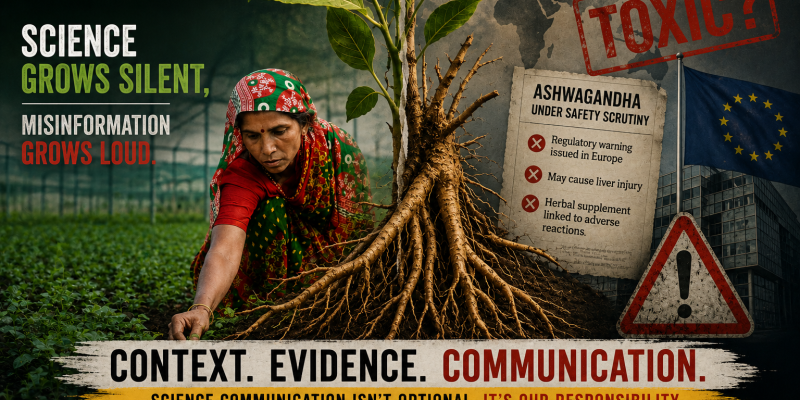
The controversy surrounding Ashwagandha should worry India-not merely because an important Ayurvedic ingredient faces regulatory scrutiny abroad, but because it exposes a deeper institutional failure.
Indian science is often conducted, documented and defended—but rarely communicated.
According to the account surrounding the controversy, European regulators considered toxicity evidence involving Ashwagandha leaves, stems and berries while assessing the safety of Withania somnifera as a whole. Classical Ayurvedic practice, however, distinguishes sharply between different parts of the plant and traditionally uses the root for long-term therapeutic purposes.
Whether every scientific claim in this debate ultimately survives scrutiny is precisely why effective science communication matters.
The international audience should not have to discover these distinctions only after warnings are issued, products are questioned and the reputation of Indian medicine has already been damaged.
Science Communication Is Not Public Relations
Science communication is often misunderstood in India as publicity—press releases about a new laboratory, congratulatory tweets after a discovery or photographs of ministers inaugurating research facilities.
It is much more serious than that. Science communication means explaining:
- what the evidence actually establishes;
- what it does not establish;
- how different studies should be interpreted;
- whether the root, leaf, extract, dosage and method of preparation are scientifically comparable;
- where uncertainties remain;
- and what regulators, doctors, manufacturers and consumers should do next.
Without this explanation, a complex scientific question gets reduced to a frightening headline:
“Ashwagandha may be toxic.”
The distinction between the root and the leaf disappears. The difference between a traditional preparation and a concentrated commercial extract disappears. The difference between an authenticated formulation and an untested supplement disappears.
Once the nuance disappears, fear occupies the space left behind.
Indian Scientists Frequently Communicate Only With Other Scientists
Indian researchers continue to believe that publishing a paper, submitting a dossier or attending a scientific conference completes their responsibility.
It does not.
A scientific finding that cannot be understood by regulators, journalists, doctors, policymakers and ordinary consumers is a finding whose public value remains severely limited.
Indian scientists often write in highly technical language, speak only at specialised conferences and remain unavailable when the public debate becomes controversial. Into that vacuum step supplement companies, social-media influencers, foreign regulators and sensationalist headlines.
The result is predictable: those who communicate most aggressively shape the narrative, whether or not they possess the strongest evidence.
The Government Usually Communicates After the Damage Is Done
The Ashwagandha case also demonstrates the Indian government’s reactive approach.
The Ministry of Ayush reportedly convened an expert committee, distinguished the toxicological evidence concerning aerial parts from evidence concerning the root, and restricted the use of Ashwagandha leaves in classical formulations. It also argued that banning the root because of evidence involving leaves or berries would be scientifically inappropriate.
But where was the sustained international communication campaign? Where were the easily accessible scientific briefs for European regulators? Where were the comparative chemical profiles explaining the differences between the root and aerial parts? Where were the international press conferences, regulator-to-regulator dialogues, multilingual explanatory videos and rapid responses to misleading headlines?
Issuing an advisory is not the same as controlling a scientific narrative.
Uploading a technical dossier to a government website is not communication.
India frequently possesses information but fails to convert it into understanding.
Silence Has Economic Consequences
This failure is not merely academic.
India’s traditional medicine, biotechnology, pharmaceuticals, agriculture and nutraceutical industries depend heavily on international trust.
When India does not explain its own scientific systems, other countries define them for us.
A poorly communicated safety controversy can result in:
- regulatory restrictions;
- loss of exports;
- falling consumer confidence;
- reputational damage to legitimate manufacturers;
- and the global rejection of an entire scientific tradition because of questionable commercial products.
In the Ashwagandha case, the alleged misuse of leaves and other aerial parts by some commercial manufacturers may have allowed the safety concerns surrounding particular extracts to become concerns about the entire plant. The source argues that commercial incentives, inadequate botanical authentication and the failure to preserve traditional pharmacognostic boundaries contributed to the crisis.
That is not only a regulatory failure. It is a communication failure.
Communication Must Also Be Honest
Defending Indian science does not mean shouting that every traditional claim is correct or dismissing every foreign warning as biased.
Good science communication must be rigorous enough to say:
- some adverse-event reports may be genuine;
- some commercial products may be badly formulated;
- traditional use does not automatically prove modern safety;
- concentrated extracts may behave differently from traditional preparations;
- and Indian manufacturers must meet strict standards of authentication, traceability and disclosure.
Credibility comes from acknowledging inconvenient evidence, not hiding it.
India cannot demand that the world respect Ayurveda while allowing vague labels, unverified ingredients and exaggerated therapeutic claims to circulate in its name.
India Needs Science Communicators Inside Its Institutions
Every major Indian scientific institution and ministry should have dedicated teams capable of translating research into clear public communication.
These teams should produce rapid evidence summaries, visual explanations, international media briefings and responses to regulatory controversies. Scientists should be trained to speak to journalists and the public without oversimplifying their findings.
Most importantly, communication should begin before a crisis.
The lesson from Ashwagandha is simple:
Scientific knowledge that remains locked inside journals, committees and government dossiers cannot protect Indian science.
Research creates knowledge.
Regulation creates standards.
But communication creates trust.
And without trust, even good science can lose the argument.
Karnvir Mundrey is the Editor of TheFutureOfPR.com. Reach out at tfofpr@gmail.com or at +918296303806.










Comments