
 By
By 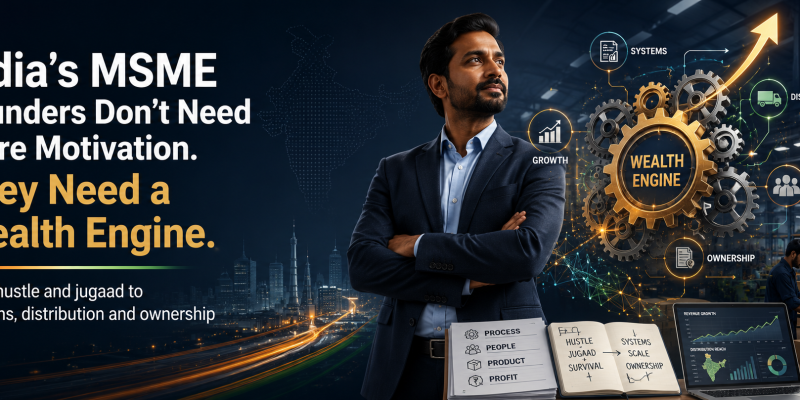
By: Karnvir Mundrey
Why India’s next generation of founder-led businesses must move beyond hustle, jugaad and survival into systems, distribution and ownership
India has never lacked entrepreneurs. From the trader in a crowded market to the manufacturer running a family factory, from the consultant building a practice to the second-generation founder trying to modernise an old business, the country runs on people who know how to work hard, take risks and keep going even when the system makes life unnecessarily difficult. We celebrate this spirit, and rightly so, because much of India’s growth has been built by founders who did not have perfect infrastructure, patient capital, professional teams or predictable regulation, but still managed to create companies, jobs and livelihoods.
Yet there is a hidden problem inside this celebration of entrepreneurship. Many Indian MSME founders have not really built businesses that can run as independent assets; they have built extremely demanding jobs for themselves. These jobs may come with turnover, staff, offices, GST registrations, factories, websites and visiting cards, but they still depend heavily on the founder’s personal phone calls, personal relationships, personal memory, personal energy and personal ability to intervene whenever something goes wrong.
This is why so many founders are exhausted despite appearing successful. They may be respected in their industry, known in their community and admired by their employees, but their lives are still controlled by the business. They handle sales, payment follow-ups, staff issues, customer complaints, bank conversations, vendor negotiations, family expectations and daily firefighting with the same nervous system that started the company years ago. The business may have grown in revenue, but the founder has not grown in freedom.
That is the central challenge facing India’s MSMEs today. The problem is not a lack of ambition, intelligence or hard work. In many cases, the problem is that founders are trapped in the first stage of entrepreneurship, where survival-led execution dominates everything, and they have not yet moved into the second stage, where system-led growth begins. Even fewer have reached the third stage, where the business becomes an asset capable of creating wealth beyond the founder’s direct labour.
The next leap for Indian MSMEs will not come merely from working harder, attending more networking events, posting more randomly on LinkedIn or chasing every new opportunity that appears. It will come from building what may be called a wealth engine: a repeatable system that converts skill into proof, proof into trust, trust into distribution, distribution into revenue, revenue into systems, and systems into ownership.
Wealth is not turnover; wealth is freedom created by assets
Indian entrepreneurs often describe business success through revenue. They say the company is doing ₹5 crore, ₹10 crore, ₹25 crore or ₹100 crore, and those numbers sound impressive because turnover is easy to understand and even easier to announce. But revenue alone can be deeply misleading, because a business can have high turnover and still suffer from weak margins, poor cash flow, high debt, delayed receivables, operational chaos and extreme founder dependence.
The real measure of wealth is not how large the top line looks, but how much freedom the business creates. A founder who cannot step away from the company for ten days without panic has income, but not freedom. A founder who is needed for every key sale, every customer escalation and every internal decision may technically own the company, but in reality the company owns the founder’s time.
Wealth begins when the business starts becoming an asset. That asset may take the form of a trusted brand, a trained team, a repeatable sales system, a strong dealer network, a valuable database, a content library, a subscription model, a documented process, a technology layer, a founder-led media presence or a reputation that brings opportunities without constant chasing. The point is not that the founder becomes irrelevant, but that the founder’s role changes from daily survival to strategic direction.
A luxury car does not prove wealth if the founder is permanently stressed. A bigger office does not prove wealth if the rent increases pressure. A large order book does not prove wealth if every order creates chaos. Real wealth is the ability to make choices, to say no to bad customers, to invest in better systems, to take time to think, and to build something that continues to create value even when the founder is not personally pushing it every hour.
India’s real entrepreneurial inheritance is skill, not property
In India, family businesses often think of inheritance in terms of land, factories, shops, warehouses, customer relationships and goodwill. These things matter, but they are not enough. The most important inheritance in a business family is not physical property; it is skill, judgment and operating wisdom.
A founder who understands sales can rebuild after a setback. A founder who understands distribution can enter new markets. A founder who understands finance can survive difficult cycles. A founder who understands branding can escape commodity pricing. A founder who understands systems can scale beyond personal control. A founder who understands people can build teams that do not collapse under pressure.
This is especially important for second-generation and third-generation MSME families. The next generation may inherit the business, but that does not automatically mean they inherit the founder’s instincts. The first-generation promoter may have built the company through hunger, negotiation, street intelligence, credit discipline, relationship-building and a sharp understanding of customers, but much of that knowledge often remains undocumented inside the founder’s head.
The next generation cannot rely only on inherited assets. They must consciously build a new skill stack suited to the current economy, where buyers search online before they meet, procurement teams compare vendors digitally, global customers expect professional communication, younger employees want clearer systems, and technology is changing how work gets done. The new inheritance must include sales capability, digital credibility, process thinking, financial discipline, export readiness, customer data, founder visibility and the ability to turn expertise into trust.
The old world rewarded proximity and personal relationships, and those still matter deeply in India. But the new world also rewards discoverability, clarity and visible proof. It is no longer enough to be good at what you do; the market must be able to find you, understand you and trust you before the first meeting happens.
The “multiple income streams” myth can become a trap for founders
One of the most dangerous ideas for ambitious founders is the misunderstood belief that rich people have multiple income streams. The idea sounds intelligent, but many entrepreneurs interpret it badly. They assume it means starting many things at once, so a manufacturer starts a café, a consultant starts a course, a trader starts investing in unrelated deals, and a second-generation founder enters three new product categories before fixing the core business.
This is not diversification. It is distraction dressed up as strategy. There is a major difference between owning multiple assets that generate income and personally running multiple active responsibilities. If the founder is required inside every activity, then those are not income streams; they are additional jobs.
Rich people often have multiple income streams because they first built or acquired assets. Those assets may include businesses, real estate, equity, intellectual property, distribution channels, media platforms or financial investments. But before assets exist, scattering attention across too many active projects usually weakens the founder’s ability to build anything properly.
For Indian MSMEs, focus is not a motivational word; it is an economic necessity. The founder must ask what one core engine can make everything else easier. That engine may be one product category, one export market, one industry niche, one flagship service, one dealer network, one B2B webinar platform, one content-led authority channel or one recurring revenue model. Until that engine is strong, new opportunities must be judged carefully because not every opportunity compounds the business.
The danger is that Indian founders are naturally opportunity-rich. They know people, hear about deals, attend events, discover new sectors and get pulled into side conversations constantly. Without a clear engine, they remain busy but do not build momentum. A serious business does not grow by saying yes to everything; it grows by protecting the few things that compound.
Jugaad helped Indian businesses survive, but systems will help them scale
Jugaad has played a major role in Indian entrepreneurship. It helps founders solve problems quickly when resources are limited, infrastructure is weak and formal support systems are unreliable. It creates creativity, resilience and speed, and it has allowed countless Indian businesses to survive where more rigid organizations might have failed.
But there is a stage at which jugaad becomes a ceiling. A jugaad business depends on memory, improvisation and personal intervention, while a scalable business depends on process, training and repeatability. A jugaad business fixes problems after they happen, while a scalable business studies repeated problems and builds systems to prevent them. A jugaad business may survive chaos, but a scalable business reduces chaos.
This is where many MSMEs get stuck. The founder becomes proud of being able to solve everything personally. If a supplier delays, the founder calls. If a client is angry, the founder handles it. If payments are stuck, the founder follows up. If staff are confused, the founder explains again. If dispatch is urgent, the founder stays late. This creates the image of a heroic promoter, but it also creates a fragile organization.
A business cannot scale if the founder’s nervous system is the operating system. Every recurring problem must become a process. Every repeated instruction must become a checklist. Every common customer question must become a document. Every sales objection must become a script. Every founder intervention must become training material. That is how the organization slowly moves from personality-led survival to process-led growth.
Proof is the new PR for Indian MSMEs
For years, Indian businesses could grow through word of mouth, closed networks and long-standing relationships. These still matter, but they are no longer enough. Today, before a buyer meets you, they search for you. Before a distributor takes you seriously, they look for credibility. Before a trade body invites you, they examine your profile. Before a global customer responds, they want signals of professionalism.
This is where many MSMEs lose opportunities despite having real capability. They have factories, technical knowledge, satisfied customers and years of experience, but very little visible proof. Their work exists in the market, but not in a form that can travel. Their expertise is real, but not packaged. Their customer stories are impressive, but undocumented. Their founder’s judgment is valuable, but invisible.
Proof is the new PR. Not empty publicity, not vanity coverage and not exaggerated claims, but organized evidence of competence. A case study is proof. A client testimonial is proof. A founder interview is proof. A plant walkthrough is proof. A technical explainer is proof. A webinar with credible industry voices is proof. A clear website is proof. A strong LinkedIn profile is proof. A before-and-after story is proof.
Many MSMEs say they are not good at marketing, but what they often mean is that they have not organized their proof. Marketing should not be understood as decoration or noise. At its best, marketing is proof made visible to the right people in the right format at the right time.
Founder visibility is trust infrastructure, not vanity
Many traditional Indian founders are uncomfortable with visibility because they believe the work should speak for itself. That belief has dignity, but it is incomplete in the current business environment. In B2B markets, especially for MSMEs, the founder is often the strongest trust asset the company has.
Buyers want to know who is behind the company, what they believe, how deeply they understand the industry, whether they are stable, whether they can be trusted, and whether they will stand by their commitments when something goes wrong. This does not require the founder to behave like a social media influencer. It requires the founder’s judgment to become visible.
Founder visibility should not mean random motivational posts or forced personal branding. It should mean useful industry commentary, honest founder lessons, customer insights, market observations, technical explanations and visible proof of work. The goal is not fame; the goal is trust at scale.
For founder-led Indian companies, this is particularly powerful because the company’s credibility is often closely tied to the founder’s credibility. A silent founder leaves trust unused, while a visible founder turns experience into a market-facing asset.
Distribution is the missing muscle in many Indian MSMEs
Indian MSMEs are often strong at production, service delivery and relationship management, but weak at distribution in the modern sense. Distribution is no longer only about dealers, warehouses and logistics. It is also about the distribution of information, proof, credibility, insight and trust.
A company may have a good product, but if the right buyers do not know about it, the product remains trapped. A founder may have deep expertise, but if that expertise is not shared, it does not create authority. A business may have export potential, but if global buyers cannot understand its capability, it remains local. A service provider may be valuable, but if the offer is unclear, prospects do not convert.
Distribution answers a simple but powerful question: how does the market repeatedly discover, understand and trust you? For an MSME, this cannot be left to occasional referrals or random social media posts. It has to become a system.
One article should become several LinkedIn posts. One webinar should become short clips, a report, a blog post, an email campaign and follow-up material for prospects. One customer success story should become a case study. One founder conversation should become a video, a newsletter and a sales asset. One industry event should become photographs, quotes, insights, follow-up emails and future partnership conversations.
Most businesses are already sitting on content, but they do not recognize it because they think content means creating something artificial for the internet. In reality, content is often simply the intelligent documentation of work already being done.
Every serious MSME now needs a media mindset
The next generation of Indian MSMEs must understand that media is no longer separate from business. A manufacturer is not only a manufacturer; it must also educate the market about quality, reliability, process and application. A consultant is not only a consultant; they must publish insight that proves how they think. A trade body is not only a network; it is a platform for distribution. A founder is not only an operator; the founder is often the chief storyteller of the business.
This does not mean every MSME must become a media company in the conventional sense. It means every serious MSME must build owned credibility. Companies cannot depend only on newspapers, trade shows, referrals or paid ads. They need their own channels through which they can explain, educate, document and build trust.
This may include a founder-led LinkedIn presence, a company blog, a newsletter, YouTube conversations, webinars, client case studies, technical reports, podcasts, WhatsApp communities, searchable content libraries and structured email outreach. The MSME that builds media around its expertise will have a long-term advantage over the MSME that waits passively for enquiries.
For TheFutureOfPR’s world, this is the real future of PR. PR is no longer only about being covered by other people’s media; it is also about building a company’s own trust infrastructure.
The B2B webinar is not an event; it is a business development engine
One of the most underused tools for Indian MSMEs is the strategic B2B webinar. Unfortunately, many webinars are badly designed. They are treated as formal events where speakers talk, attendees listen passively, and everyone disappears after the closing remarks. That is a wasted opportunity.
A properly designed webinar is not merely an event. It is a trust engine, a content engine and a business development engine. It can position a company as a knowledge partner, bring relevant voices into the same room, educate prospects, create content, generate leads, start conversations and produce reusable assets such as articles, clips, quote cards, reports and follow-up campaigns.
This is especially powerful for Indian businesses looking at new markets. An MSME exploring Spain, Belgium, Vietnam, UAE, Australia, Malaysia or any other market does not have to begin with blind cold emails. It can begin with a serious conversation involving trade officials, local experts, Indian exporters, consultants, logistics players, legal experts and industry buyers. The company can host the conversation, capture the insights, publish the article, share the clips, follow up with attendees and convert interest into calls.
This is how content becomes commerce. This is how PR becomes business development. This is how a relatively small company can start behaving like a serious market player.
AI will not replace Indian founders, but founders using AI will beat those who do not
Indian MSMEs do not need to become AI companies, but they do need to become AI-enabled companies. The first and most practical use of AI should not be glamorous. It should be to reduce repetitive thinking and repetitive communication inside the business.
AI can help founders summarize meetings, draft follow-up emails, convert videos into articles, create proposal drafts, generate FAQs, prepare sales scripts, organize customer objections, write SOPs, create training material, repurpose webinars into content, translate communication and document processes that previously existed only in the founder’s mind.
The important point is that AI should not be used to fake expertise. It should be used to multiply real expertise. If a founder has genuine insight, AI can help capture, structure and distribute it. If a business has a clear process, AI can help make that process faster. But if the business is chaotic, AI may simply accelerate the chaos.
The sequence matters. First document the process, then improve it, and only then automate it. AI is leverage, but leverage only works properly when there is something clear to multiply.
India’s MSME problem is not only capital; it is packaging
Many Indian founders believe they need more capital to grow, and in some cases they are absolutely right. Working capital constraints, delayed payments and limited access to reasonably priced finance are real barriers. But in many situations, before capital, the business needs better packaging.
Packaging means making the company understandable, credible and commercially attractive. Can a buyer understand your value in 30 seconds? Can your website create confidence? Can your founder profile build trust? Can your sales deck show proof? Can your case studies demonstrate outcomes? Can your proposal connect your work to business value? Can your numbers tell a coherent story? Can your team explain the company consistently?
Many MSMEs are under-packaged. They have substance, but poor presentation. They have experience, but unclear messaging. They have delivery capability, but weak proof. They have founder credibility, but no visible thought leadership. This is not a superficial problem because, in business, clarity is commercial. If people do not understand you, they delay. If they do not trust you, they negotiate harder. If they cannot explain you internally, they do not refer you. If your value is invisible, your pricing suffers.
Packaging is not pretending to be bigger than you are. It is presenting your real value with discipline.
Founder-led sales must become system-led sales
In many Indian MSMEs, sales depends almost entirely on the founder. The founder knows old customers, understands objections, negotiates pricing, senses who is serious, remembers who pays late, and knows which promises should never be made. This knowledge is valuable, but if it remains only in the founder’s head, the company cannot scale.
Founder-led sales must gradually become system-led sales. The company needs to document who the ideal customer is, what problem it solves, why customers buy, why customers reject, which objections appear repeatedly, what proof should be shown, what questions should be asked, what proposal format works, what follow-up rhythm produces results and which customer segments are actually profitable.
The founder’s instinct must become a playbook. Once it becomes a playbook, other people can learn it. Once other people can learn it, the founder can stop being the only rainmaker. That is when the business begins to move from dependence to scale.
The ₹100-crore ambition needs ₹100-crore architecture
Many Indian founders say they want to build a ₹100-crore company, and there is nothing wrong with that ambition. In fact, India needs more founders who think bigger. But the real question is whether the current operating system of the company can handle that ambition.
Can the sales system handle ₹100 crore? Can the delivery system handle it? Can the finance system manage it? Can the brand command it? Can the team support it? Can the company collect money on time? Can quality remain consistent? Can the founder delegate enough? Can the business generate leads repeatedly without depending only on old relationships?
A ₹100-crore company cannot be built with a ₹5-crore operating system. If ambition grows faster than architecture, growth becomes dangerous. More orders create more chaos, more customers create more complaints, more employees create more confusion, and more revenue creates more working capital pressure. Scaling without systems is not growth; it is stress with better numbers.
The Implementation Plan: How an Indian MSME Founder Can Build a Wealth Engine
The shift from survival-led entrepreneurship to system-led growth does not happen through inspiration. It happens through a disciplined implementation plan that turns the founder’s experience into proof, distribution, processes and assets.
Step 1: Define the founder freedom number
Every founder should begin by defining what business success is supposed to create personally and commercially. This means writing down how much monthly income the founder needs, how much profit the business must generate consistently, how much cash reserve is required, how many days the founder can be away without disruption, what percentage of revenue should come without founder-led selling, and how much revenue should eventually become recurring.
This exercise changes the conversation because the goal is no longer vague growth. The goal becomes freedom, resilience and enterprise value. A founder who defines the freedom number stops chasing revenue blindly and starts building a business that can actually support a better life.
Step 2: Choose one core growth engine
The founder should choose one core growth engine for the next 12 months instead of trying to fix every weakness at once. This engine could be a founder-led LinkedIn authority system, a monthly B2B webinar platform, an export-market-entry program, a dealer development engine, a content-led inbound lead system, a productized service, a sector-specific newsletter or a YouTube-led trust platform.
The test is whether this engine can repeatedly create leads, proof, authority and revenue. If it can, it deserves serious attention. If it cannot, it may be an interesting activity but not a compounding asset.
Step 3: Create a clear outcome-based offer
Most MSMEs describe their work from their own point of view by saying they manufacture something, provide a service, supply a product or operate in a sector. Buyers, however, want to know what problem is being solved, why the company can be trusted, what outcome can be expected and what risk is being reduced.
A company that says it organizes webinars sounds like an event vendor. A company that says it helps B2B firms use expert-led webinars to build authority, attract prospects and start qualified business conversations sounds like a growth partner. A company that says it does PR sounds generic. A company that says it helps founder-led businesses turn expertise, proof and stories into market credibility sounds far more valuable.
The sharper the offer, the easier the sale becomes.
Step 4: Build a proof bank
Every MSME should create a structured proof bank containing case studies, testimonials, client logos, before-and-after examples, media mentions, event photographs, founder interviews, plant videos, technical explainers, delivery metrics, certifications, quality process visuals, FAQs, proposal slides and customer success stories.
This proof bank should feed the website, LinkedIn, sales decks, email campaigns, WhatsApp follow-ups, proposals, webinars, media pitches, investor conversations, dealer onboarding and export outreach. Proof should not remain scattered across phones, old folders, WhatsApp chats and the founder’s memory. It should become a business asset.
Step 5: Build founder visibility with discipline
The founder should publish consistently, but the content must be strategic rather than random. A sensible weekly rhythm could include one post explaining an industry problem, one post sharing a customer insight, one post telling a founder lesson, one post showing proof or a case study, and one short video answering a common buyer question.
This is not vanity content. It is trust-building content. Buyers should feel that they understand the founder’s thinking before they meet the founder, because familiarity reduces friction and visible judgment creates confidence.
Step 6: Convert every event into market-facing content
Indian founders attend conferences, trade shows, chamber meetings, panel discussions, factory visits, delegation meetings and networking events, but much of the value disappears because it is not converted into assets. Every serious event should become a blog post, LinkedIn post, short video, photo story, quote card, newsletter, prospect email, market insight note and follow-up conversation.
The value of an event is not only who the founder meets in the room. The greater value may come from the trust created after the event through intelligent documentation and distribution.
Step 7: Create a simple CRM discipline
No serious growth happens without follow-up. The founder should maintain a simple CRM with the name of the prospect, company, industry, phone, email, source, problem, last conversation, next action, follow-up date, offer discussed, status, potential value and notes.
This may sound basic, but it can transform an MSME because many businesses do not lose leads due to lack of demand. They lose leads because follow-up is weak, inconsistent or dependent on the founder’s memory. A CRM turns opportunity into a managed process.
Step 8: Build one recurring revenue product
Every MSME should ask what part of its business can be sold monthly, quarterly or annually. This could be a monthly advisory retainer, annual maintenance contract, recurring supply agreement, founder visibility package, quarterly market-entry program, yearly sponsorship package, dealer support program, technical support retainer, research subscription or PR visibility retainer.
Recurring revenue reduces anxiety because it gives the business a base from which to plan. A company with recurring revenue is more stable and usually more valuable than a company that must keep hunting for one-time deals every month.
Step 9: Document the founder’s brain
For 30 days, the founder should record or write answers to the questions that repeatedly come up inside the business. These include how the company sells, why customers buy, why customers reject, what mistakes new employees make, what should never be promised, what quality standards matter, how angry customers are handled, how pricing is negotiated and how serious leads are identified.
These answers should become internal playbooks. The founder’s wisdom must leave the founder’s head if the company is to become scalable. A business that depends only on undocumented instinct cannot become an institution.
Step 10: Use AI to reduce repetition, not to fake expertise
Once processes are documented, AI can be used to accelerate repetitive work. It can summarize meetings, draft follow-ups, create first drafts of proposals, convert founder notes into posts, repurpose videos into articles, prepare FAQs, write SOPs, translate communication and turn customer objections into training material.
The principle is simple: do not use AI to pretend to know what you do not know. Use AI to multiply what the business genuinely knows but has failed to organize, document and distribute.
A 90-Day MSME Founder Action Plan
In the first 15 days, the founder should define the freedom number, choose one growth engine, clarify the target customer, rewrite the offer, create the proof bank, set up a CRM and list all existing content, case studies, photographs, videos and testimonials. This first phase is about clarity because unclear businesses waste effort.
From day 16 to day 30, the founder should begin building visibility by publishing three to five times a week, creating one strong case study, improving company messaging, preparing a simple sales deck, contacting warm prospects, requesting testimonials from past clients and recording short videos that answer buyer questions. This phase is about making existing credibility visible.
From day 31 to day 60, the business should focus on distribution by hosting one webinar or expert conversation, converting it into multiple content assets, sending an email update or newsletter to prospects, following up with every attendee, publishing one article per week, creating one downloadable insight note and sending targeted outreach messages. This phase is about turning attention into conversations.
From day 61 to day 90, the founder should focus on systems by documenting the sales process, delivery process, proposal templates, follow-up templates and onboarding checklist. At least one team member should be trained to handle part of the founder’s current role, and one recurring revenue offer should be created. This phase is about reducing founder dependence and converting activity into a repeatable engine.
The New MSME Wealth Engine
The old MSME model was simple: make a product, find a customer, generate revenue and repeat. That model still works at a basic level, but it is not enough for the next stage of Indian entrepreneurship. The new model must move from skill to proof, from proof to content, from content to distribution, from distribution to trust, from trust to leads, from leads to sales, from sales to systems, from systems to recurring revenue, and from recurring revenue to ownership and freedom.
This is not about becoming an influencer. It is about becoming visible enough to be trusted. It is not about abandoning relationships. It is about turning relationships into systems. It is not about replacing the founder. It is about freeing the founder from being the bottleneck. It is not about chasing vanity metrics. It is about building assets that make the business stronger, more valuable and less dependent on daily firefighting.
India’s MSMEs do not lack hunger, resilience or entrepreneurial instinct. What many of them now need is architecture. They need sharper offers, visible proof, stronger distribution, documented systems, recurring revenue and founder-led trust infrastructure. The next generation of Indian companies will not be built only by those who work the hardest, but by those who turn their work into systems that compound.
That is how MSMEs become institutions. That is how founders buy back their time. That is how businesses become wealth engines. And that is how India’s entrepreneurial energy can move from survival to scale.
Karnvir Mundrey is the Editor of TheFutureOfPR.com. Reach out at tfofpr@gmail.com or at +918296303806.





Comments