
 By
By 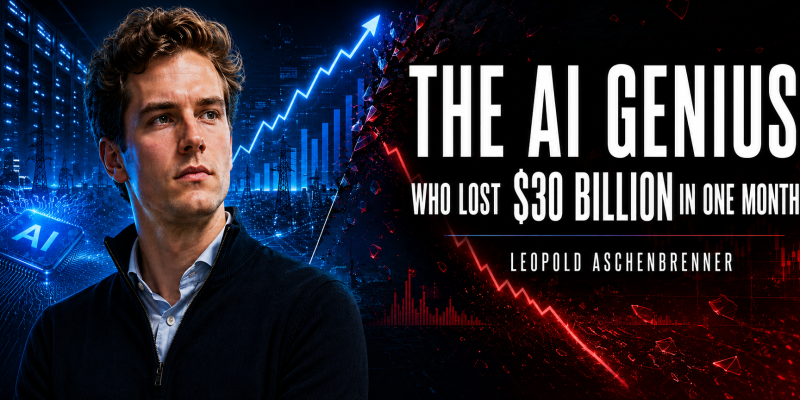
A true story about being right in the wrong way
In July 2026, a 25-year-old had one of the worst weeks anyone has ever had at work.
On Monday he was one of the most successful investors alive. By Thursday he had been forced to sell almost everything he owned. On Saturday, he got married.
His name is Leopold Aschenbrenner. This is his story, and it’s really about a question worth thinking about: what happens when you’re right about something big, but wrong about the timing?
Part 1: The kid who was good at everything
Leopold was born in Germany. Both his parents were doctors. He was clever in the way that makes teachers nervous – he finished university in America at 19, at the very top of his class.
Then he got a job at OpenAI, the company that made ChatGPT. He worked on a team whose job was to figure out how to keep future AI systems safe – how to stay in control of something that might one day be smarter than us.
While he was there, hackers broke into OpenAI’s internal chat system. Leopold wrote a memo to the company’s bosses saying, basically: our security is terrible, and foreign governments could steal our work.
The bosses were not thrilled. He got a warning from HR. A few months later, in April 2024, they fired him. The company said it was because he’d shared a document he shouldn’t have. He said the document was harmless and the real reason was the memo.
Here’s the part that tells you what kind of person he is. On your way out of a company, they often ask you to sign a paper promising you’ll never say anything bad about them. If you sign, you keep your shares. Leopold refused – and walked away from nearly a million dollars – because he wanted to stay free to say what he thought.
Then he sat down and said it.
Part 2: The 165-page essay
In June 2024 he published something called Situational Awareness: The Decade Ahead. It was 165 pages long, it was free, and within weeks it was the most talked-about document in Silicon Valley.
His main argument was surprisingly simple.
Imagine measuring how fast a puppy grows. You weigh it every month, you see it doubling, and you can make a decent guess about how big it’ll be next year. You’re not being magical. You’re just drawing the line forward.
Leopold said we can do the same with AI — but instead of weight, you measure three things:
- How much computer power we throw at AI (going up about 3x a year)
- How much smarter the methods get (also about 3x a year — better recipes, not just bigger ovens)
- How much of the AI’s ability we’ve actually unlocked
That third one was his best idea, and it needs explaining.
He said AI models in 2024 were like a brilliant person who had been tied up. Imagine someone extremely smart, but they can only answer instantly – no thinking time. They can’t use a computer. They can’t remember anything about you. They’ve never seen your school or your homework.
He called this being “hobbled.” And he said if you simply untie the rope – let the AI think for longer, give it tools, let it use a computer, let it learn about your work – you’d get a huge jump in usefulness without needing a fundamentally better AI at all.
He wrote that before AI models that “think before answering” existed. He was right. That part of his essay was genuinely impressive prediction.
Then he drew the lines forward and reached his famous conclusion: AI that can do the job of an AI researcher, by 2027. And once AI can improve AI, things get very fast, very quickly.
Part 3: The gold rush, and the shovels
Now here’s where the money comes in.
There’s an old saying about the California gold rush: the people who got rich weren’t the ones digging for gold. They were the ones selling shovels.
Leopold’s essay had a whole chapter making exactly this point about AI. Forget guessing which AI company wins, he said. AI needs stuff. Enormous buildings full of computers. Memory chips for those computers. And staggering amounts of electricity – he calculated that by 2030, the biggest single AI project might need more than 20% of all the electricity in the United States.
His conclusion: electricity would become the thing everyone runs out of first. Not chips. Power.
And at the very end of that chapter, almost as a joke, he wrote one line in brackets. Roughly: what this means for which stocks to buy, I’ll leave as an exercise for the reader.
He’d just published the treasure map and told everyone to work it out themselves.
Then he went and dug it up himself.
Part 4: The fund
He started an investment fund and named it after the essay: Situational Awareness. Rich, famous people gave him money to invest – including the founders of Stripe.
He bought exactly what his essay said to buy. Power companies. Memory-chip makers. Companies that had been mining Bitcoin and switched to running AI computers instead. Almost nothing in the famous chip companies everyone else was buying.
He also bought a small piece of an AI company called Anthropic when it was worth about $60 billion. A year later it was worth about $965 billion. That one investment grew roughly 15 times over.
It worked ridiculously well. He started with a few hundred million dollars. By early July 2026 he was managing $45 billion. His fund was up 439%. People he’d never met were copying his investments. Newspapers started calling him “the Nostradamus of AI,” after a famous old prophet.
He was 25.
Part 5: How it fell apart in twelve days
To understand what went wrong, you need one word: borrowing.
Say you have ₹100 and you’re sure a stock will rise. You could just buy ₹100 of it. Or you could borrow ₹300 from a bank and buy ₹400 worth.
If it goes up 25%, you make ₹100 instead of ₹25. Brilliant.
But if it goes down 25%, you’ve lost ₹100 – all of your own money. The bank still wants its ₹300 back, and it will make you sell everything immediately to get it. That forced sale is called a margin call.
Leopold had borrowed roughly ₹3 for every ₹1 of his own. Maybe ₹4.
In July 2026, AI stocks fell. Not because anything was actually wrong – the AI companies were still spending record amounts, more than ever. They fell because too many people had bought the same thing. A survey that month found 82% of professional investors said “AI chip stocks” was the most crowded bet in the world.
Picture everyone on a boat rushing to one side for a better view. Eventually the boat tips – and it has nothing to do with what they were looking at.
Leopold’s stocks fell between 27% and 54% in a single month. With his borrowing, that wiped him out. And there’s a cruel twist: he was so big that his own selling pushed prices down further, which triggered more selling. He was making his own problem worse just by trying to escape it.
He’d also bought a kind of insurance for exactly this situation – but it was the wrong insurance. Like buying an umbrella to protect you from a flood. Technically it’s for water. It doesn’t help.
Three big banks demanded their money back at once. He tried everything: asking his investors for more, calling other funds. Two looked at his stocks and said no.
In the end, on 30 July, he sold every single public investment he had – all of it, in one giant deal, to a much bigger fund called Citadel, at a discount.
$45 billion down to about $10 billion. In under a month.
Two days later, he got married.
Part 6: The one thing he got to keep
Here’s the strangest part of the whole story.
His investment in Anthropic – worth about $5 billion, his single best one – survived. And it survived because it was hard to sell.
Think of it this way. Shares in a public company are like cash in your pocket: you can hand them over in a second, so a bank can demand them instantly. A stake in a private company is like your house. There’s no daily price on it. You can’t hand it over on a Tuesday afternoon.
So when the banks came for everything they could grab, they couldn’t grab that.
The thing everyone normally treats as a weakness – being slow and hard to sell – was the only thing that saved him.
Part 7: So what happened to him?
You’d expect him to disappear. He didn’t.
Five days after the disaster, he invested $400 million in a tiny startup called Source Foundry — founded by two Stanford researchers, trying to build better machines for manufacturing computer chips.
Look at what that means. His whole idea was “find the bottleneck – the thing everyone runs out of.” He’d bet on electricity and memory. Now he was betting one level further back: on the machines that make the chips that go in the computers that run the AI.
He hadn’t changed his mind about anything. He’d just moved further up the chain.
And on 7 August, news came out that investors in Silicon Valley were lining up to give him more money – and that he was telling them no, not right now.
Part 8: Was he actually right?
The honest answer is: partly.
Things he got right:
- Companies really are spending unbelievable amounts on AI buildings and chips – even more than he predicted
- Electricity really did become the biggest bottleneck
- “Untying” AI models really did produce the jump he described
- Countries really are spying on each other over AI
Things he got wrong:
- He thought free, open AI models would fall behind. They didn’t – Chinese models are only a few months behind the best
- He thought China would race the US at full speed. China has actually been more cautious than he expected
- He predicted AI would be earning $100 billion a year by mid-2026. The real number is about $60 billion
Still unknown:
- Whether AI can do a researcher’s whole job by 2027. Nobody knows. Expert forecasters have changed their minds in both directions over the past year.
And there’s one criticism cleverer than the rest. Leopold measured AI progress with a scale like: preschooler → primary schooler → smart high-schooler → PhD.
But that’s not a real ruler. A centimetre is always a centimetre. “One step smarter” isn’t anything you can actually measure. So when people argue about whether he was right, they’re partly arguing about a scale that doesn’t really exist – which means the argument can go on forever without anyone winning.
What I think you should take from this
Being right isn’t the same as surviving. Nothing that happened in July proved his idea wrong. AI still needs all that electricity and all those chips. He just borrowed so much money that he needed to be right this month, not this decade. Borrowing turns a long-term opinion into a short-term bet, whether you want it to or not.
A story can become so popular that it changes what it’s describing. His essay convinced thousands of people to buy the same things. That pushed prices up, which made him look brilliant, which attracted more money, which pushed prices higher still. When it reversed, the crowd that had been his greatest advantage became the thing he couldn’t escape. If you ever wondered whether words can move the real world – this is your answer, in both directions.
Judge different parts of an argument separately. Leopold’s essay is really two things stuck together. The first half is careful, numbers-based prediction where he argues hard against his own ideas. The second half is his personal opinion about what governments should do — stated just as confidently, but with far less proof behind it. Most people either swallowed the whole thing or threw the whole thing away. Both are lazy. Good thinking means you’re allowed to say “pages 1–70, yes; pages 71–165, I’m not convinced.”
And one final thing, which is almost funny.
Leopold wrote in his own essay that people shouldn’t get obsessed with exact dates, because dates are the part you’re most likely to get wrong.
Then he put 2027 on the cover.
And ever since, everyone — including the market that nearly destroyed him — has judged him on the year.
This is a true story, assembled from reporting by CNBC, Bloomberg, the Wall Street Journal, the Financial Times and Fortune, and from Leopold Aschenbrenner’s own essay, which anyone can read free at situational-awareness.ai. Some details about his fund come from unnamed sources and haven’t been officially confirmed. Nothing here is advice about money.
Karnvir Mundrey is the Editor of TheFutureOfPR.com. Reach out at tfofpr@gmail.com or at +918296303806.
Subscribe to TheFutureOfPR.com to get great ideas on life, education, health & fitness, real estate, glamour, jewelry, movies, and podcasts! Share this article with people who you think might benefit. They will thank you for it!
Follow TheFutureOfPR.com on Facebook & Twitter.
Karnvir Mundrey is also the producer and host of 4 YouTube channels. Finest Fintalk brings you the latest in Finance, LitInMin for Books, The Health Tips Podcast for health and Atharva Marcom for leadership talks.










Comments