 By
By 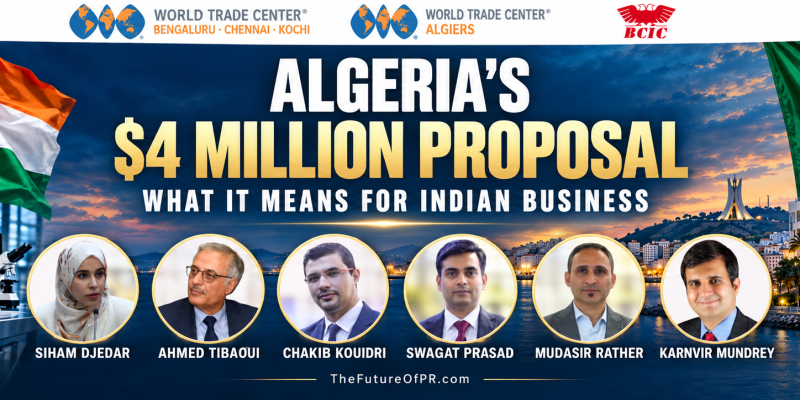
By: Karnvir Mundrey
What Algeria’s officials and two Indian engineers told Indian SMEs on Discovery Series Episode 15, which I moderated on 23 September.
The offer was straightforward. An Indian company with an immunotherapy for blood cancer wanted to sell its technology to an Algerian buyer for $4 million. Pay the fee, hand over the know-how, done.
That sale never happened. What is being drafted instead, according to Ahmed Tibaoui, who heads World Trade Center Algiers and is brokering the deal, is a 50:50 partnership with a private hospital near Algiers. Each side puts in $2 million. The shareholder agreement is now being prepared.
On paper, the Indian company traded $4 million coming in for $2 million going out. Tibaoui told the story near the end of the webinar, after every other speaker had spent an hour circling the same point. Why would a company accept that trade? The answer explains a market that Indian businesses talk about often and study rarely.
Watch the show on YouTube
A warm friendship, a shrinking trade figure
Algeria is Africa’s largest country by area, with nearly 47 million people. India established diplomatic relations in July 1962, the month Algeria won its independence, and President Droupadi Murmu made a state visit to Algiers in October 2024.
The politics are warm. The trade is not. Two-way trade was $2.92 billion in 2018-19. By 2024-25 it had fallen to $1.71 billion, according to figures published by the Indian Embassy in Algiers. That is a drop of roughly 40 per cent. Indian exports fell from $1.30 billion to $947 million over the same period.
In my opening remarks I called it a great friendship with a modest bank balance. The embassy’s own table shows that the balance has been shrinking.
This year, the relationship moved in a direction few expected. After the disruption in the Strait of Hormuz forced India to ration cooking gas, India began importing LPG from Algeria in June, and Indian Oil has finalised a deal with Sonatrach for monthly cargoes in 2027. If your dal was cooked on time this summer, Algeria may deserve a small thank-you.
So Algeria is now selling India more of what it needs. Our episode asked the question in the other direction: should Indian SMEs sell to Algeria, or build there?

If you like what we do, don’t just scroll past! Support the publication!
The verdict: come to build
Five speakers answered, from three Algerian institutions and one Indian company. Mr. Ahmed Tibaoui runs World Trade Center Algiers. Mr. Chakib Kouidri is director general of the Algerian Chamber of Commerce and Industry (CACI). Ms. Siham Djedar is a director at the Algerian Agency for Investment Promotion (AAPI). Mr. Swagat Prasad has spent about a decade helping build pharmaceutical plants in Algeria for EquiNext, an Indian engineering firm, where his colleague Mr. Mudassir runs projects.
Their answers converged. Ms. Djedar allowed that trade is a sensible way to learn the market and find partners. But she said her agency’s priority, and the bigger long-term benefit, lies with companies that settle and produce. Mr. Tibaoui put it most plainly. His advice was not to come to Algeria to sell a product, but to “come to Algeria to build a sustainable market position.”
He granted that product quality matters. But he said the companies that succeed follow a rule of four Ps:
- Perseverance. Study the Algerian market before you try to work in it.
- Presence. Find a reliable Algerian partner, provide proper after-sales service, and follow the project through, not just the sale.
- Patience. Industrial business takes time, especially when tenders or technical qualification are involved.
- Pragmatism. Adapt your offer to what Algerian customers need, instead of exporting the model you sell everywhere else.
Not one of the four Ps is about price. All four are about staying.
Why selling alone runs into a wall
Before the session, several people told me that importing into Algeria means getting onto a list approved by the Ministry of Commerce, with only a couple of approval rounds a year. I put that to Mr. Kouidri.
He called it a cliché. Imports keep growing year after year, he said; what has changed is how they are organised. He described the current controls as transitional, designed to protect companies that have invested their money in Algeria. I could not independently verify the latest import totals, so treat that as his account.
What is documented is the direction of policy. Algeria’s pharmaceutical ministry says local factories now cover about 82 per cent of the country’s medicine needs. Germany’s trade agency, GTAI, reports that importing medicines into Algeria keeps getting harder. The state is steering demand towards whoever makes things locally.
Mr. Kouidri’s pitch for becoming one of those makers rested on two claims. First, he said, Algeria’s energy is among the cheapest in the world, an edge that counts for more as geopolitics pushes energy costs up elsewhere. Second, returns on investment are among the highest in the region. Both are his assessments rather than figures he presented. They are also the bet Algeria is asking investors to make.
The rulebook that rewards builders
Djedar walked through the 2022 investment law that created her agency. Read alongside its implementing decrees, it turns the panel’s advice into arithmetic.
| Rule | What it says | What it means for an Indian SME |
|---|---|---|
| Ownership | Algeria has scrapped the old 49 per cent cap on foreign ownership outside strategic sectors | You can own a non-strategic business outright, or choose a partner on your own terms |
| Profit repatriation | Capital and dividends can be transferred abroad if foreign financing covers at least 25 per cent of the total investment cost | A pure sale earns no transfer guarantee; real equity does |
| Incentives | Three regimes: by sector, by zone, and for “structuring” projects of at least DZD 10 billion with 500 or more direct jobs | VAT and customs-duty exemptions, plus corporate-tax holidays of 3 to 10 years depending on the regime |
| Industrial land | State land is allocated only through AAPI’s digital investor platform | No back channels: apply online and compete on the strength of your file |
| One-stop shops | A national window for major and foreign projects, plus regional windows. Djedar said there are 59 in all, and AAPI is preparing a digital version | Permits, banks and company registration in one place |
Ms. Djedar added that local and foreign investors are treated alike. She also said that land is now awarded to the highest-scoring bid, judged by a council drawn from every sector.
Now go back to the $4 million story. Tibaoui did not explain the company’s reasoning beyond calling it pragmatism. But the rulebook makes the logic visible. A one-off technology sale benefits from none of these provisions. A 50 per cent stake sits well above the 25 per cent repatriation threshold, and the partners plan to apply to AAPI for incentives next. The company swapped a fee for a business.
Where the openings are
The panel pointed to sectors where Algeria wants foreign know-how rather than foreign shipments.
- Medical devices. Mr. Kouidri flagged this as a practical niche for Indian firms. By his estimate, Algeria still imports more than 90 per cent of its medical devices. Its pharmaceutical industry minister has said the country imports some 129,000 pharmaceutical products and wants them made locally.
- Automotive parts. Mr. Kouidri described new car manufacturing taking shape in western Algeria as automakers move closer to European markets. He called spare parts, including for Indian-made motorcycles, a promising market.
- Desalination. Mr. Tibaoui’s advice was to join the ecosystem through maintenance, spare parts and engineering, rather than ship equipment and leave.
- Renewables. Algeria targets 15,000 MW of renewable capacity by 2035. Its first phase covers 3,200 MW, and plants totalling 1,480 MW were scheduled to come online this year.
- Agri-food, tourism and digital. Ms. Djedar named food security and tourism as priorities. Mr. Prasad said AI is now a live conversation in Algeria, and Mr. Kouidri added agritech and fintech.
Medical devices deserve the closest look. The same minister says Algeria already hosts 27 per cent of Africa’s medicine factories. The pharmaceutical base exists, and policy is pushing the devices around it towards local production.
What building looks like on the ground
Mr. Swagat Prasad is the founder and CEO of EquiNext, an Indian firm that engineers pharmaceutical, biotech and medical-device plants. He has worked in Algeria for about ten years and has travelled the country from east to west.
His company designs and builds its systems in India and installs them in Algeria, paid through letters of credit from Algerian clients. It has not repatriated any funds from Algeria so far. Now it is doing what the panel recommended: setting up a local company with an Algerian partner. This summer, EquiNext’s German arm signed a memorandum of understanding with the Algerian firm OPEN DISK at the Algerian-German Economic Forum.
His advice was practical:
- Pick a region first. Algeria is vast, and the east and the west want different things.
- Customise. Algerian specifications are demanding. Indian suppliers can meet them, but only if they tailor the offer.
- Use the network. Ten years ago, finding the right people was hard. Today they are on LinkedIn and reply quickly.
- Visas were not his obstacle. His first visa came within about a week, and long-term visas are available for a fee.
Mr. Mudassir, EquiNext’s vice president for projects, added a caution. In my introduction I had joked that Algerians and Indians share a talent for jugaad, the knack of fixing anything with a screwdriver and a wrench. A clean room, he said, means a clean room: quality is built in by design, regulators set the terms, and there is no room for makeshift fixes.
He also noted that many Algerian clients are new to such facilities. So the work does not end at handover. It continues into running and maintaining the plant, which is one more reason the panel kept talking about presence.
Before you book a ticket
For an Indian SME weighing Algeria, the panel’s practical advice comes down to six steps.
- Talk to AAPI at the idea stage. Ms. Djedar’s advice was to send the agency a short presentation of the project, the sector and the technology. AAPI can also support visa applications through Algeria’s Ministry of Foreign Affairs.
- Look for partners. AAPI’s website runs a partnership exchange, the Bourse de Partenariat, that matches companies offering and seeking partnerships.
- Use the chamber for due diligence. Mr. Kouidri said CACI is present in every city and offered to help vet Algerian partners.
- Go and see. Mr. Tibaoui invited Indian suppliers to WTC Algiers’ subcontracting exhibition from 23 to 26 November, where he said Sonatrach and its affiliates take part. WTC Algiers has long co-organised the ALGEST subcontracting fair; confirm this year’s dates with the organisers.
- Market the usual way, but turn up. Social media, newspapers and TV all work, the panel said. Exhibitions work best.
- Price in the gaps. As far as I can find, India and Algeria still have no double taxation avoidance agreement; the two governments agreed to negotiate one in 2023. And the first direct Air Algérie service to Delhi, announced for late October, was reported in September to have been pulled from schedules. Check before you plan around it.
Chai, coffee and a cheque
I opened the session by joking that between Algerian mid-morning coffee and Indian post-lunch chai, we had enough caffeine to cover a continent. The image fits the panel’s advice: two partners at one table, each bringing something.
Mr. Tibaoui closed with the message he had opened with. Don’t look at Algeria as an export market; look at it as a market for long-term partnership. In my preview piece I argued for selling Algeria the shampoo factory rather than the shampoo. The panel went a step further. The factory works best when you co-own it.
That is why a $4 million sale became a $2 million stake. For an Indian SME, the useful question about Algeria is no longer who will buy your product.
It is who will build it with you.
The Discovery Series is presented by World Trade Center Bengaluru, Chennai and Kochi with the Bangalore Chamber of Industry and Commerce. Episode 16, on Belarus, is on 14 October.
Support The Future Of PR
TheFutureOfPR.com explores the stories behind business, reputation, leadership, investment and global trade-especially the ideas that conventional media often overlooks.
If you enjoy independent reporting, thoughtful analysis and stories from the ground, you can support my work. Your contribution helps fund the continued development of TheFutureOfPR.com.
Click here: buymeacoffee.com/tfofpr to appreciate this writing.
Thank you for helping independent ideas travel further.
Karnvir Mundrey is a narrative strategist and media entrepreneur who helps founders, institutions and international businesses turn complex ideas into influential public stories. He is the Founder of Atharva Lifesciences Consulting Pvt. Ltd. , Atharva Marcom and Founder Editor of TheFutureOfPR.com. He has also authored a book on Nutraceuticals (available on Amazon). Karnvir Mundrey is also the producer and host of 4 YouTube channels. Finest Fintalk brings you the latest in Finance, LitInMin for Books, The Health Tips Podcast for health and Atharva Marcom for leadership talks He is also recognized as India’s longest running podcast host, continuously running since 2006!
Reach out at tfofpr@gmail.com or at +918296303806.
Subscribe to TheFutureOfPR.com to get great ideas on life, education, health & fitness, real estate, glamour, jewelry, movies, and podcasts! Follow TheFutureOfPR.com on Facebook , Twitter and Linkedin!
Join the WhatsApp Group at: https://tinyurl.com/ynj8pyn9
Share this article with people who you think might benefit. They will thank you for it






Comments