
 By
By 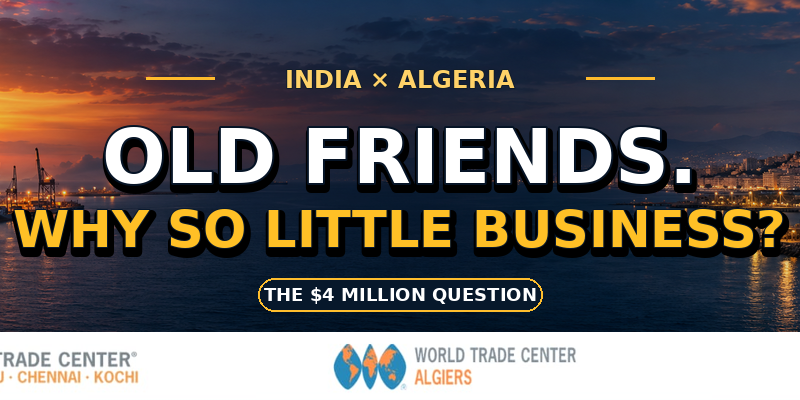
By: Karnvir Mundrey
An unfinished $4 million healthcare venture reveals the opportunity Indian companies could seize-and the uncomfortable work they must do first.
An Indian company came to Algeria with a $4 million proposition: sell an immunotherapy technology for blood cancer.
Then the conversation took a remarkable turn. Instead of an outright sale, the Indian company and an Algerian hospital began discussing a 50:50 venture, with each side investing $2 million.
There is no signed deal. Ahmed Tibaoui, general manager and CEO of World Trade Center Algiers, told our Discovery Series webinar that the shareholder agreement was still being prepared. Yet that unfinished proposal may say more about the future of India–Algeria business than another dozen declarations of friendship.
Because friendship is something we already have. At the start of the webinar, I joked that India and Algeria enjoy a great friendship but a modest bank balance. India supported Algeria’s independence movement, and diplomatic ties go back to 1962. Yet bilateral trade stood at $1.71 billion in 2024–25, down from $2.92 billion in 2018–19.

Did we did a good job promoting Algeria? Encourage us with a donation!
It also gets you to be a part of the WhatsApp Group
That decline ought to bother us. Algeria needs industrial capacity, technology and reliable suppliers. India has companies capable of providing all three. Why, then, do so many potential relationships remain potential?
The answer I heard during the 15th Discovery Series webinar, which I moderated on 23 September 2026, was clear: winning a market demands far more than finding a buyer.
The invoice is the easy part of the story
Mr. Tibaoui offered Indian businesses four words: perseverance, presence, patience and pragmatism. Learn the market. Build a dependable local relationship. Accept that technical qualification and tenders take time. Change the offer when the customer’s needs require it.
His point was blunt. A company that ships a product and disappears leaves somebody else to deal with what happens next-and gives that customer little reason to buy from it again.
Mr. Swagat Prasad of Equinext Solution knows the difference. For roughly ten years, his company has engineered pharmaceutical, biotechnology and medical-device solutions in India for installation in Algeria. He has learned to start with a particular region and a particular customer, because a vast country cannot be approached with one generic pitch.
His colleague Mr. Mudasir Rather brought the question into a pharmaceutical cleanroom. The equipment must be designed and installed to exacting standards. It must then keep working. Who maintains it? Who supplies parts? Who takes responsibility when production stops? A competitive price cannot answer those questions.
Mr. Chakib Kouidri, managing director of the Algerian Chamber of Commerce and Industry, estimated that Algeria imports more than 90% of its medical devices. That is his estimate, and a prospective investor should verify the numbers for its own category. But the commercial question is compelling: can Indian companies help Algeria make, install and maintain more of what it currently imports?
Even an attendee’s question about spare parts for Indian-made motorcycles led to the same answer. Mr. Kouidri pointed to automotive and subcontracting activity and to exhibitions where suppliers could test demand. No one handed out a purchase order. The work begins by finding a buyer with a specific problem and proving that you can solve it.
Ms. Siham Djedar of the Algerian Investment Promotion Agency (AAPI) described priorities including manufacturing, agri-food, pharmaceuticals, biotechnology and renewables. When I asked about desalination, the discussion turned to components, engineering and maintenance. The sectors differ; the test does not. What value will remain in Algeria after the first shipment?
View the complete discussion on YouTube!
The hard questions behind a neat 50:50 figure
Two partners investing $2 million each makes a handsome headline. It does not make a functioning company.
An Indian investor must ask what it can import, who will obtain approvals, how its team will travel, how the venture may be owned and how its returns will eventually be transferred. These are questions to settle before enthusiasm becomes a binding contract.
I challenged Mr. Kouidri on import hurdles that Indian businesses had raised with me. He said Algeria is organising imports to encourage local production and investment. That signals where policy is heading. It does not remove the need to check the rules for the exact product, importer and payment arrangement.
Ms. Djedar said a prospective investor can send AAPI a brief account of its project and potential partners. The agency may consider supporting a visa request through the relevant authorities. It is a useful door to knock on, although the visa process remains a process.
The ownership issue makes the proposed hospital venture especially interesting. AAPI’s guidance says the old general 49:51 rule is now limited to specified strategic activities and imports for resale without transformation. Pharmaceutical industries are listed among the strategic activities, with an exception for certain innovative, high-value products. Whether this particular venture qualifies for an exception was not established in the webinar. The proposed equal shareholding needs project-specific legal scrutiny.
And what of profits? When I asked whether foreign investors could bring them home, Ms. Djedar referred to a 25% financing condition. AAPI specifies that foreign-origin financing must be at least 25% of the total investment for the statutory transfer guarantee. Dividend transfers also involve eligibility, tax, banking and documentation requirements. That number should never be mistaken for a blanket promise that money will move freely.
Mr. Prasad supplied the most useful answer of all: an honest limit to his own experience. Equinext was still establishing an Algerian company. Its earlier projects had been paid through letters of credit from clients, so he had not yet transferred profits from an Algerian entity. He could tell us that an Indian firm can win and deliver difficult projects in Algeria. He did not claim to have passed a test that still lay ahead.
Go with a problem to solve
There are practical places to begin. AAPI’s Bourse de Partenariat allows Algerian and foreign investors to set out projects and partnership needs; AAPI says registration is free and that it facilitates introductions. Its one-stop shops and incentive regimes deserve examination. Kouidri’s Chamber and Tibaoui’s World Trade Center Algiers can help firms make relevant connections.
But no agency can rescue a vague proposition. An Indian SME should arrive with two pages identifying one capability, one Algerian customer group and one region. It should describe the customer’s problem, the support required after delivery and what each partner will contribute. Then it can ask intelligent questions about the rules that apply to that specific project.
The healthcare partnership may be signed, changed or abandoned. For now, it remains a proposal. Its value as a lesson is already real.
India and Algeria have spent decades shaking hands. The companies that finally change the trade figures will be those still answering the phone when a machine stops, a shipment is delayed or a partner needs them to share the risk.
That is when a $4 million sale becomes something worth far more: a business that lasts.
Based on the 23 September 2026 Discovery Series webinar.
Support The Future Of PR
TheFutureOfPR.com explores the stories behind business, reputation, leadership, investment and global trade-especially the ideas that conventional media often overlooks.
If you enjoy independent reporting, thoughtful analysis and stories from the ground, you can support my work. Your contribution helps fund the continued development of TheFutureOfPR.com.
Click here: buymeacoffee.com/tfofpr to appreciate this writing.
Thank you for helping independent ideas travel further.
Karnvir Mundrey is a narrative strategist and media entrepreneur who helps founders, institutions and international businesses turn complex ideas into influential public stories. He is the Founder of Atharva Lifesciences Consulting Pvt. Ltd. , Atharva Marcom and Founder Editor of TheFutureOfPR.com. He has also authored a book on Nutraceuticals (available on Amazon). Karnvir Mundrey is also the producer and host of 4 YouTube channels. Finest Fintalk brings you the latest in Finance, LitInMin for Books, The Health Tips Podcast for health and Atharva Marcom for leadership talks He is also recognized as India’s longest running podcast host, continuously running since 2006!
Reach out at tfofpr@gmail.com or at +918296303806.
Subscribe to TheFutureOfPR.com to get great ideas on life, education, health & fitness, real estate, glamour, jewelry, movies, and podcasts! Follow TheFutureOfPR.com on Facebook , Twitter and Linkedin!
Join the WhatsApp Group at: https://tinyurl.com/ynj8pyn9
Share this article with people who you think might benefit. They will thank you for it








Comments