
 By
By 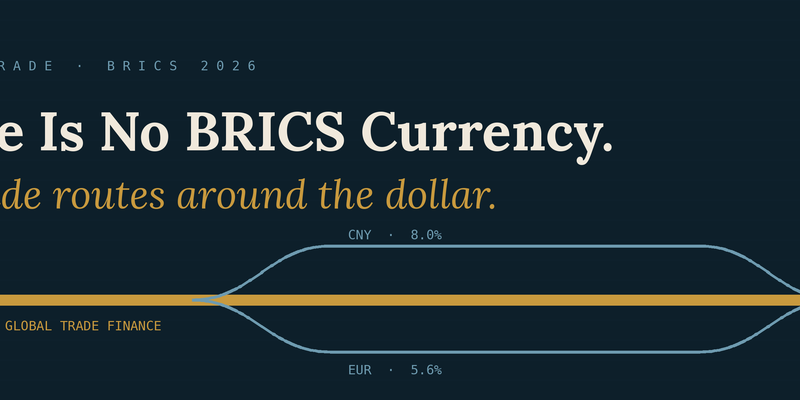
Brics currency what is actually happening
Every few months, a headline arrives announcing that BRICS is about to launch a currency and end the dollar’s reign. The headline is wrong. But the reason it’s wrong is worth more than the correction, because underneath the noise something real is being assembled – just not the thing anyone is shouting about.
The schoolyard version
Picture a very large school where kids trade snacks at lunch. Long ago, everyone settled on one kind of token. Not because it was special, but because everyone accepted it. Turn up with a different token and half the school shrugs.
That’s the dollar. A group of kids – India, China, Brazil, Russia, South Africa, and a growing cast of others – have noticed this and asked a reasonable question: why do we need the common token to trade with each other, when we’re standing right here?
Most reporting assumes the answer is a new shared token. It isn’t. What’s being built is closer to a fast swapping machine: rupees in one end, yuan out the other, no intermediary token required. Useful. Considerably smaller than the headlines.
And there is a second thing the schoolyard makes obvious, which most commentary skips entirely. Trading isn’t only about paying. It’s about borrowing – the shopkeeper who lets you take the snack now because she trusts the token will still be good on Friday. The swapping machine solves paying. It does nothing about borrowing. That distinction, as we’ll see, is where the whole argument actually lives.
What the numbers say
SWIFT’s July 2026 tracker put the US dollar at roughly 50.1% of global payments by value in June, the euro at 21.9%, and the renminbi at 3.1% – fifth, behind the yen.
Now the number that matters more. In trade finance specifically, the dollar accounted for 81.2% of value. The renminbi managed 8.0%; the euro, 5.6%.
Payment shares wobble month to month and make for good charts. Trade finance barely moves. Hold that gap in mind – it’s the load-bearing fact in this entire debate.
What was actually agreed this year
India took the BRICS chair on 1 January 2026. The first significant ministerial came on 14-15 May at Bharat Mandapam in New Delhi, and it produced the bloc’s most concrete financial step in years: a pilot framework linking members’ national payment networks, with India offering UPI as the reference implementation.
Read the chair’s statement rather than the coverage of it. The stated priority is local-currency settlement and a cross-border messaging layer. Russia’s earlier push for a BRICS Pay currency was deferred. Brazil had already shelved the currency idea during its 2025 presidency.
India’s own position, meanwhile, is blunter than any Western sceptic’s. Answering a parliamentary question on 13 March 2026, the Ministry of External Affairs stated there is no agreement within BRICS on trade among all members in their respective local currencies. Not “no currency yet.” No agreement on the precursor to the precursor.
The tell nobody quotes
If you want to know what de-dollarisation looks like in practice rather than in communiqués, look at mBridge – a wholesale central-bank digital currency platform run by China, Hong Kong, Thailand, the UAE and Saudi Arabia. The Bank for International Settlements coordinated it for four years, then withdrew in October 2024 and handed management to those five central banks. BIS chief Agustín Carstens was explicit that mBridge is not the BRICS Bridge, citing the institution’s policy against facilitating sanctioned parties.
The platform has since processed around RMB 387 billion – roughly $55 billion.
Here is the number that reframes everything: about 95% of that volume is in digital yuan.
So the celebrated multipolar alternative is, operationally, a renminbi settlement rail with four partners, three of whom happen to be in BRICS. That is a materially different proposition from a bloc currency, and New Delhi understands it perfectly well.
Why the currency can’t exist
Set the politics aside for a moment. A shared currency requires a convertible anchor, converged inflation and interest-rate cycles, and some appetite for mutual fiscal risk. China runs capital controls and a managed, not-fully-convertible renminbi. India runs structurally higher inflation and an independent rate cycle it will not surrender to a committee. There is no fiscal union, no lender of last resort, no deep bond market to denominate the thing in.
And then the question that ends the conversation: who anchors it? Whoever does captures the seigniorage and the policy leverage. The only plausible candidate is China — which is precisely why India has consistently resisted the proposal as divisive.
Add the coalition problem. Russia and Iran need sanctions insulation. The UAE, Saudi Arabia and Brazil need continued access to dollar markets. These are not variations on a shared interest. They are opposed interests wearing the same lanyard.
The part that gets missed: it’s a credit problem
What makes the dollar sticky in trade is not SWIFT messaging. Replacing messaging is an engineering task, and engineering tasks get solved.
What’s hard is credit. Letters of credit, receivables discounting, vessel and inventory financing — these need a deep, liquid, legally predictable short-term instrument market with a lender of last resort standing behind it. In practice: Treasury bills and the Federal Reserve.
Local-currency rails deliver settlement without delivering that credit layer. An exporter can be paid in rupees and still need dollar working capital on Monday. Until there is a large offshore renminbi or rupee bill market with reliable repo and no capital-control risk attached, that 81% figure isn’t going anywhere.
India already has the cautionary case in its own files. Russian exporters accumulated rupee balances they struggled to deploy, because India doesn’t offer the combination – persistent deficit plus open capital account – that makes holding rupees attractive. The surplus partner ends up sitting on a currency it can’t freely spend or invest. No amount of blockchain fixes that.
What India is actually playing for
The interesting move isn’t monetary at all. Offering UPI as the reference implementation for the BRICS payment pilot is digital-public-infrastructure export and standards influence dressed as financial diplomacy.
If the bloc’s rails end up running on Indian architecture rather than Chinese, New Delhi gets the thing it genuinely wants: relevance inside the alternative system without dependence on one where 95% of the volume is somebody else’s currency. That is a far shrewder objective than a shared banknote, and far more achievable.
What to watch, and what to ignore
The 18th BRICS Summit lands in New Delhi on 12–13 September 2026. Don’t watch for a currency announcement. Watch whether the UPI-linked pilot acquires named participants and a settlement bank. Watch whether the RBI’s proposal to link member CBDCs makes the formal agenda. And watch whether the summit produces a joint declaration at all – the May ministerial failed to, and India issued a unilateral chair’s statement instead. That last one tells you more about the bloc’s capacity for monetary coordination than any white paper will.
Beyond the summit, watch invoicing rather than settlement: whether a major commodity contract gets priced in a non-dollar unit and survives a volatility cycle; whether non-Chinese corporates start issuing offshore renminbi bonds at scale; whether any challenger’s trade-finance share breaks out of low single digits.
Slow, unglamorous, far more informative.
The honest summary
What’s being built reshapes how value moves between particular pairs of countries. It adds compliance cost and thins FX liquidity in the interim, because two rails are more expensive than one until one of them wins. And it slowly erodes the enforceability of unilateral financial sanctions, which is arguably the point.
It does not reprice world trade. Not this decade.
One closing note, since the confusion is monetised: there is no BRICS coin. If you encounter a price chart for one, or someone offering to sell you exposure, it’s a scam. There is nothing there to price.
Karnvir Mundrey is the Editor of TheFutureOfPR.com. Reach out at tfofpr@gmail.com or at +918296303806.
Subscribe to TheFutureOfPR.com to get great ideas on life, education, health & fitness, real estate, glamour, jewelry, movies, and podcasts! Share this article with people who you think might benefit. They will thank you for it!
Follow TheFutureOfPR.com on Facebook & Twitter.
Karnvir Mundrey is also the producer and host of 4 YouTube channels. Finest Fintalk brings you the latest in Finance, LitInMin for Books, The Health Tips Podcast for health and Atharva Marcom for leadership talks.










Comments