
 By
By 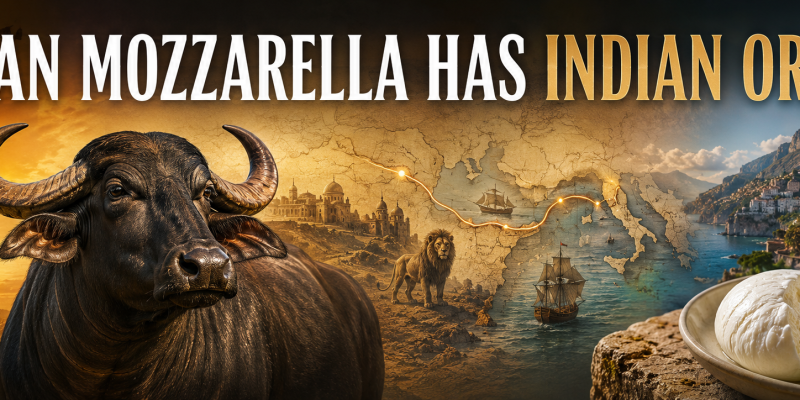
The cheese was created in Italy. But the buffalo that made it possible began its journey in the Indian subcontinent-and may have crossed continents with Jat herders, Arab armies and even lions.
Every time you lift a slice of pizza and watch mozzarella stretch towards your plate, you are looking at the end of a journey that may have begun thousands of years ago in the Indian subcontinent.
Italian mozzarella has Indian origins.
Not because Indians invented the cheese. Mozzarella was unquestionably developed and perfected in southern Italy.
But the original buffalo mozzarella was made from the milk of an animal domesticated in the northwestern Indian subcontinent. Medieval records suggest that thousands of these buffaloes were transported from Sindh across the Arab Empire, accompanied by Indian communities who knew how to raise them.
The story involves Indian buffaloes, Arab caliphs, Jat herders, Byzantine soldiers, Italian monks, wild lions and, centuries later, Sikh dairy workers.
It sounds almost too extraordinary to be true.
Yet a surprising amount of it is supported by history, linguistics and modern genetic research.
It begins with a road terrorised by lions
In the early eighth century, the Arab Caliphate controlled an enormous territory stretching from Sindh in the east to North Africa and the Mediterranean in the west.
Along its northern frontier, Arab armies were fighting the Byzantine Empire. One strategically important road connected Antioch, near the border of modern Turkey and Syria, with the frontier settlement of al-Massisa. Travelling along this road had become dangerous for a remarkable reason.
Lions.
Asiatic lions once lived across a vast region stretching from India through Iran and Mesopotamia to Syria and Turkey. They survived in parts of Syria until the nineteenth century. Today, their only wild population lives in and around Gujarat’s Gir forest. According to the ninth-century Arab historian al-Balādhurī, lions on the Antioch road were attacking travellers.
When the problem reached Caliph al-Walid I, who ruled between 705 and 715, he ordered an extraordinary solution. He sent 4,000 water buffaloes. The buffaloes, according to the account, produced the desired result and made the road safer.
This is not a modern internet legend. The figure appears in al-Balādhurī’s Kitāb Futūḥ al-Buldān, one of the most important medieval histories of the early Islamic empire. It is available in English as The Origins of the Islamic State.
Why would buffaloes frighten lions?
A water buffalo is not a harmless, oversized cow.
An adult buffalo can weigh several hundred kilograms and carries a formidable pair of horns. When a herd is threatened, the animals can gather defensively around their calves and weaker members. A lion attacking such a group risks being charged, trampled or gored.
Buffaloes were not invincible, of course. Lions could still attack isolated animals and calves. But thousands of buffaloes occupying the wetlands and grasslands around a frontier road would have dramatically changed the balance of power. The animals also offered something lions could not: enormous economic value.
Buffaloes could pull heavy loads, work in marshy fields and produce milk exceptionally rich in fat and protein. They were tractors, dairy plants and defensive walls combined in one creature.
The buffaloes came from Sindh
Al-Balādhurī provides an even more astonishing detail.
He writes that Muhammad bin Qasim, the general who conquered Sindh in 711–712, sent thousands of buffaloes from Sindh to his superior, al-Hajjaj. Of these, 4,000 were passed to Caliph al-Walid. Another 4,000 buffaloes kept near the Tigris and the marshes of Kaskar were subsequently sent to al-Massisa. This second group travelled with a community whom Arabic sources called the Zutt.
According to al-Balādhurī, the buffalo population around al-Massisa eventually reached approximately 8,000. The popular version imagines one enormous caravan marching directly from Sindh to Syria. The actual movement was probably more complicated. The animals appear to have travelled in stages through the administrative and agricultural network of the Arab Empire.
But the central fact remains remarkable: a major medieval source explicitly records thousands of buffaloes being transported from Sindh into West Asia and Syria. This was globalisation more than a thousand years before the term existed.
Empires did not move only soldiers, taxes and treasure. They also moved animals, crops, technologies, workers and entire communities.
Who were the Zutt?
The Zutt were not, as is sometimes claimed, the Arabic name for every Indian.
The word was an Arabicised form of Jat. It referred mainly to communities associated with Sindh, Makran and the lower Indus Valley. Some Zutt were pastoralists and buffalo herders. Others became agricultural workers, soldiers, traders, craftsmen and guards. They had been moving between the Indian subcontinent, Persia and Mesopotamia even before the Arab conquest of Sindh.
Arabic sources describe Zutt settlements in the marshlands of southern Iraq. Some raised buffaloes and cultivated wet terrain that other communities found difficult to use. Others joined military units or protected trade routes.
Al-Balādhurī records that Zutt communities were resettled near Antioch. A neighbourhood there was apparently known by their name. These movements were not always voluntary. People could be recruited, relocated, enslaved or displaced whenever control of a frontier changed hands.
The buffaloes could not have travelled alone. Someone had to understand how to breed them, control them, protect them and obtain milk from them. India was therefore exporting more than an animal.
It was exporting an entire system of knowledge.
The Indian animal that changed Italian food
Modern genetic research supports the Indian origins of the river buffalo.
Domesticated water buffaloes are divided broadly into two types:
- Swamp buffaloes, associated mainly with China and Southeast Asia
- River buffaloes, associated with the Indian subcontinent and dairy production
A major genetic study concluded that river buffaloes were first domesticated in the northwestern Indian subcontinent, probably before the mature phase of the Indus Valley Civilisation. From there, they spread towards Iran, Mesopotamia, Egypt and the Mediterranean. The research was published in Genome Biology and Evolution.
Buffaloes may have travelled from the Indus Valley to Mesopotamia thousands of years before Muhammad bin Qasim. Buffalo-like animals appear in both Indus Valley and ancient Mesopotamian imagery.
The eighth-century movement recorded by al-Balādhurī was therefore probably one dramatic episode in a much older story. The animal behind Italian mozzarella did not suddenly appear in Europe.
It crossed civilisations.
How did the Indian buffalo reach Italy?
The exact route remains disputed.
One of the strongest theories is that Arab rulers carried water buffaloes into Sicily during the ninth or tenth century. The Normans may then have transported them from Sicily into mainland southern Italy.
Other theories credit returning Crusaders, pilgrims or earlier Germanic rulers. Italy may also have received buffaloes through several different migrations. The official Mozzarella di Bufala Campana consortium considers the Arab-to-Sicily and Norman-to-mainland route one of the more credible explanations, although it acknowledges that the history is not completely settled. Its account traces the buffalo’s spread through medieval southern Italy.
There is no proof that the buffaloes sent to confront lions near Antioch were the direct ancestors of every buffalo in Italy. Nor is there reliable confirmation of the colourful claim that a ruler presented exactly 500 buffaloes to a king in northern Italy. History rarely leaves us such a convenient receipt.
What it does give us is a persuasive larger route:
Northwestern Indian subcontinent → Mesopotamia → Syria and the Mediterranean → Sicily → southern Italy
The swamps of Campania created mozzarella
Once buffaloes reached southern Italy, they found an ideal home.
The coastal plains of Campania were wet, muddy and frequently flooded. Ordinary cattle struggled in these conditions, but buffaloes flourished. Their broad hooves worked well on soft ground. They could survive in wetlands, clear waterways and consume vegetation that was unsuitable for more delicate animals. Then Italian cheese-makers discovered the buffalo’s real treasure.
Its milk.
Buffalo milk contains more fat, protein and milk solids than cow’s milk. It produces a cheese with a richer flavour and unmistakably creamy texture. By the twelfth century, monks at the monastery of San Lorenzo in Capua were reportedly offering pilgrims bread with a fresh cheese known as mozza. When smoked to preserve it for longer, it was called provatura.
The name came from the Italian verb mozzare, meaning “to cut off.” Cheese-makers stretched the warm curd and cut off individual portions by hand. The word “mozzarella” appeared in a cookbook written by Bartolomeo Scappi, chef to the papal court, in 1570.
Italy created the cheese-making technique.
But India provided the animal that made buffalo mozzarella possible.
So is mozzarella Indian or Italian?
It is both—but in different ways.
Mozzarella is culturally and technically Italian. It was developed by Italian cheese-makers, shaped by the environment of Campania and refined over centuries in southern Italy.
Its biological roots, however, lead back to the Indian subcontinent.
Consider the chilli.
Chilli peppers originated in the Americas and reached India only after European contact. Yet no one would deny that India transformed chilli into something uniquely Indian.
Similarly, tomatoes originated in the Americas, but Italy turned them into the foundation of some of the world’s most famous sauces.
Ingredients have biological origins. Dishes have cultural histories.
Italian mozzarella has Indian origins because the buffalo at the centre of its story descended from an animal first domesticated in the Indian subcontinent.
Its journey was Asian. Its transformation was Italian.
Did the Indian buffalo handlers become Europe’s Roma?
This is the most fascinating part of the story.
Europeans once incorrectly believed that the Roma came from Egypt. That mistaken belief gave rise to the increasingly avoided term “Gypsy.” Linguistic and genetic evidence now shows that the Roma originated in the Indian subcontinent, particularly its northwestern region.
Romani is an Indo-Aryan language. Words resembling the Hindi and Punjabi kān for ear and chhurī for knife survive in it. Its numbers, grammar and basic vocabulary preserve a clear Indian inheritance. But the Romani language also contains Persian, Armenian and Byzantine Greek words.
These linguistic layers act like footprints. They suggest that the ancestors of the Roma moved through Iran, Armenia and the Byzantine world before entering Europe.
Genomic studies estimate that the Roma left South Asia approximately 1,000 to 1,500 years ago. Research repeatedly identifies northwestern India as their most likely South Asian source. A major European genetics study found important Indian paternal and maternal lineages across different Roma populations.
This creates an intriguing possibility.
Indian-origin Zutt communities lived in Iraq and Syria. Some were resettled along the Arab–Byzantine frontier. Byzantine armies frequently captured and relocated people from Arab-controlled settlements. The ancestors of the Roma later emerged from the Byzantine world and spread across Europe.
Could some Zutt buffalo handlers have become ancestors of the Roma?
It is possible.
But no surviving document proves that these particular people became Europe’s Roma. Modern research establishes the Roma’s Indian origins, not the precise identity of every community involved in their migration.
The Zutt connection is a fascinating historical theory, not a settled fact.
What does the mysterious “Indian genetic marker” prove?
Genetic researchers have identified a Y-chromosome lineage known as H1a1a-M82 among many Roma men.
This lineage originated in the Indian subcontinent and is estimated to be around 22,000 years old. Romani versions of it show particularly close connections with populations from northwestern India. A study involving more than 10,000 global samples examined this lineage.
But the marker must be interpreted carefully. It is not exclusively a Roma gene or Jat gene. It occurs among several South Asian populations. Carrying it does not prove that someone descended from a particular group of medieval buffalo handlers.
A 22,000-year-old genetic lineage also does not mean the Roma left India 22,000 years ago. The paternal lineage is ancient; the migration happened much later. DNA can reveal distant relationships.
It cannot automatically fill every missing page of history.
Then the Sikhs returned to Italy’s dairies
The story contains one final, almost poetic twist.
During the late twentieth century, large numbers of Punjabis and Sikhs migrated to Italy. Many found employment in agriculture and dairy farming because they already understood animals, milk production and the discipline required by farm work.
In northern Italy, Sikh workers became essential to the production of Parmigiano-Reggiano and Grana Padano.
In the Pontine Plain south of Rome, Sikh workers began tending water buffaloes and working in dairies producing mozzarella di bufala.
Thousands of years after river buffaloes left the Indian subcontinent—and more than a millennium after Zutt communities travelled with buffaloes across West Asia—Indians were once again caring for these animals in Europe.
The historical symmetry is extraordinary.
It should not, however, be romanticised. Investigations have documented low wages, excessive working hours and serious exploitation among some Sikh agricultural workers. Their role in protecting Italy’s celebrated food traditions often remains invisible. Reporting from the Pontine Plain documents their involvement in buffalo farming and mozzarella production.
Italian mozzarella has Indian origins
India did not invent mozzarella.
Italy did.
But Italy created it from the milk of an animal whose domesticated roots lead back to the northwestern Indian subcontinent.
Medieval sources record thousands of buffaloes moving from Sindh across the Arab Empire. Indian-origin Zutt communities travelled with some of them, carrying the knowledge needed to raise these animals in distant lands.
The buffaloes spread through West Asia and the Mediterranean before reaching southern Italy. In the marshlands of Campania, Italian monks and cheese-makers transformed their rich milk into mozza—the ancestor of buffalo mozzarella.
The Roma connection remains tantalising but unproven. The modern Sikh connection is real.
The next time mozzarella stretches from your pizza, look at it differently.
It is not simply cheese. It is a living connection to the Indus Valley. A survivor of ancient trade routes.
An animal once deployed against lions. A product of Arab expansion and Italian imagination. And proof that the world’s greatest foods rarely belong to only one civilisation.
Italian mozzarella has Indian origins.
But its true birthplace was the long journey between cultures.
Karnvir Mundrey is the Editor of TheFutureOfPR.com. Reach out at tfofpr@gmail.com or at +918296303806.
Subscribe to TheFutureOfPR.com to get great ideas on life, education, health & fitness, real estate, glamour, jewelry, movies, and podcasts! Share this article with people who you think might benefit. They will thank you for it!
Follow TheFutureOfPR.com on Facebook & Twitter.
Karnvir Mundrey is also the producer and host of 4 YouTube channels. Finest Fintalk brings you the latest in Finance, LitInMin for Books, The Health Tips Podcast for health and Atharva Marcom for leadership talks.










Comments