
 By
By: Karnvir Mundrey
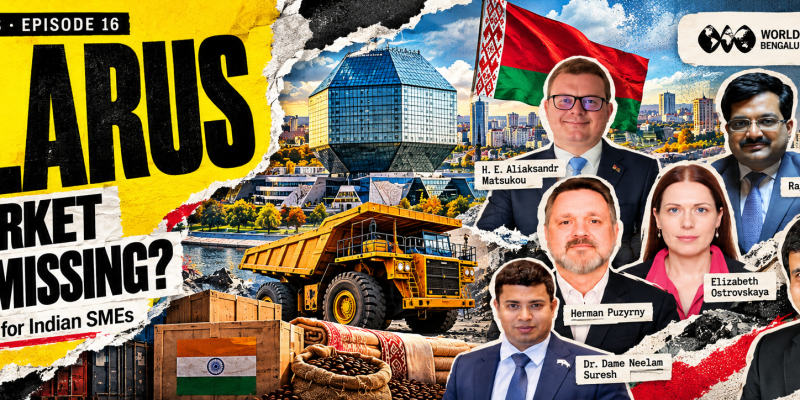
Discovery Series Episode 16 found the cheapest way for an Indian SME to test Belarus. Here’s how it works, what sells, and what to check before your first trade.
Forty thousand buyers and sellers from 84 countries are accredited on the Belarusian Universal Commodity Exchange (BUCE), and the exchange reports turnover of about $11 billion, according to its own presentation for Indian exporters. At our webinar on 14 October, Herman Pusirni of BUCE’s foreign relations team told the audience how many of those companies are Indian: 17.
That small number matters because the exchange may be the cheapest door into Belarus an Indian small business has. Accreditation is free, and you don’t need to set up a Belarusian company. Once you’re in, the same platform puts your goods in front of buyers in other countries, from Russia to the UAE.
The occasion was Episode 16 of the Discovery Series. In this monthly webinar, World Trade Center Bengaluru, Chennai and Kochi and the Bangalore Chamber of Industry and Commerce (BCIC) introduce Indian firms to one foreign market at a time. I moderated. Five people who work the India-Belarus corridor joined me, and between them they explained how to walk through that door, what to carry and what to check first.
Listen to the complete YouTube episode!
A marketplace for real goods, not paper
Many Indians hear “commodity exchange” and picture futures contracts and flickering price screens. BUCE is different. It’s an electronic marketplace for physical goods, from butter to plywood to steel rods, sold under contracts the exchange checks before each trade.
That design explains why panellists kept saying payments on the exchange are secure. BUCE verifies companies before accrediting them and offers escrow accounts free of charge. It says 99% of its transactions go through without problems, according to its presentation. Herman also stressed that an accredited Indian company can trade with third countries on the platform; the UAE is already among the exchange’s five biggest markets.
Indian business on it is small but growing. Trades involving Indian companies were worth $1.55 million in 2024 and $4.83 million in 2025, roughly three times as much, according to the exchange and BelTA, as reported by TV BRICS. Most of it was textile raw material: Belarus shipped cottonised flax fibre to India, and Indian firms sent back wool and polyester tops.

If you like what we do, don’t just scroll past! Support the publication! Scan the Image above to give!
The Consul’s case: a bridge, not an outpost
Consul General H.E Aliaksandr Matsukou, who helped assemble the panel, began by putting Belarus on the map for Indian listeners. It is not part of the European Union, he stressed; Indians often assume it is. Belarus belongs to the Eurasian Economic Union and the Commonwealth of Independent States, and forms a Union State with Russia. It also sits in the Shanghai Cooperation Organisation and is a partner country of BRICS.
His pitch was geography. Belarus borders both the EU and the Eurasian bloc, and he described it as an economic and political bridge between them. A small country, he argued, can punch above its weight on location, technology and a well-educated workforce.
He also reminded us how far back the ties go. Bengaluru and Minsk have been sister cities for about 40 years, he said, a link he traced to Rajiv Gandhi’s 1985 visit to Belarus. Indian films, yoga, chess and masala are all popular there.
His closing advice drew on more than 16 years as a diplomat: business follows people-to-people contact. Come for pleasure if not for business, he said, because “you won’t feel lost and forgotten.” He pointed to the India–Belarus Business Forum held in Mumbai in June and invited participants to the next one.
How to get in: four steps, three documents
Herman laid out the process, and BUCE’s India presentation fills in the paperwork.
- Choose a commodity section: agricultural products, timber, metals, or industrial and consumer goods.
- Gather three documents:
- your company’s register extract from the Ministry of Corporate Affairs (MCA);
- a copy of the signatory’s passport or ID;
- a notarised power of attorney on the exchange’s template.
- Get an electronic signature and complete accreditation.
- Take the free training course, then start trading.
Accreditation, software, basic training and escrow cost nothing. You pay an exchange fee only when a deal goes through, charged as a share of the transaction value that varies by section. The Embassy of India in Minsk thinks enough of the route that it circulated the exchange’s details to Indian chemical exporters through CHEMEXCIL in July 2026.
Dr Neelam Suresh Dhame, who imports Indian consumer brands into Belarus, registered on the exchange the week before the webinar. He described the smartest way to use it: don’t import first and hope, but list Indian goods on the exchange and act only when an order arrives. “Here you don’t need a ton of money to start something,” he said.
There’s a reason to register even if you only want to buy. Rajeev Poddar has done business in Belarus since 1997 and represents its Chamber of Commerce and Industry (BelCCI) in India. He pointed out that many Belarusian products can’t be bought directly from the producer; they have to go through the exchange.
What Belarus sells, and what it wants
BUCE publishes its own lists of what moves in each direction. Read them as a map of where an Indian product could fit.
| Belarus sells through the exchange | Belarus buys through the exchange |
|---|---|
| Butter, milk powder, cheese, meat | Grain, corn and cereals; oil meal |
| Flour, rapeseed oil, sugar, beet pulp, molasses | Feed and feed additives; veterinary drugs |
| Wet blue leather | Seeds, fertilisers, crop-protection products |
| Sawn timber, plywood, fibreboard, chipboard, cellulose, peat briquettes | Groceries and vegetables; meat products |
| Rebar and wire rod | Metals, cables and wiring, coal and coke, ferroalloys |
Source: BUCE presentation for Indian exporters, 2026.
Dairy is the clearest surplus. Belarus produces nearly three times the milk and dairy products it consumes, according to its agriculture ministry. Audience members asked whether that dairy could reach India or the UAE. Supply isn’t the constraint, but dairy imports into India need their own sanitary clearances, so check those first.
The bigger surprise sits on India’s side. Our audience asked again and again about tea, cardamom, cashews and raisins. Yet India’s recorded exports of coffee, tea and spices to Belarus came to less than $100,000 in all of 2024, according to UN trade data.
The wider food picture is thin too. APEDA, India’s agricultural export authority, tracks farm and processed-food exports. To Belarus, these were about ₹11.7 crore (roughly $1.4 million) in 2023–24, down from ₹71.8 crore in 2021–22.
Dr. Dame already imports Indian coffee, spices and cardamom for Belarusian supermarkets. He believes Belarus buys more than $2 billion of such goods a year, leaving India with a sliver. I couldn’t verify his import estimate, but his question stands: “Whose fault is that?”
Help may be coming. In February, Indian suppliers told BUCE they were ready to trade rice, nuts, tea, coffee and dried fruit on the exchange, BelTA reported.
Machinery shows a similar gap. Coal India has ordered 173 trucks from BelAZ, the Belarusian maker of giant mining dumpers, across contracts signed in 2019 and 2021. Dhame’s point was that BelAZ’s Indian business runs almost entirely through that one buyer, while India has many other mines.
The money question, revisited
In my pre-event piece, I argued that every Belarus deal must pass three gates: is it legal, can the money move, and who controls your access to the market? Payments worried readers most. The panel had news.
Dr. Dhame said his company now pays Indian suppliers every week and the money lands within hours. From Russia, he said, a transfer to India takes three or four days. That is one importer’s experience, not a guarantee. Still, it’s a sharp contrast with the 2022 potash payment that largely stalled after being routed through a Russian bank.
Mr. Poddar was more measured. Sanctions, including restrictions on SWIFT, make payments the area to watch most carefully, he warned, though settlement has become steadily easier.
Two developments back him up. The state-owned Belarusbank opened a representative office in Mumbai in July 2026. And since 2023, India has allowed Belarusian banks to hold rupee “vostro” accounts, which let trade settle in rupees.
Dr. Dame credits Belarusian discipline for the rest. In his experience, a buyer who agrees to pay in 60 days pays in 60 days.
The other two gates haven’t moved. In September 2026, an EU court upheld asset freezes on the truck makers MAZ and BelAZ, as I noted before the webinar. Screen your counterparty and its owners against US and EU sanctions lists before you sign. If a deal could cost you a European customer, walk away.
The exchange’s escrow protects your payment. It does nothing for your sanctions exposure.
If you want to build, not just trade
For firms ready to set up in Belarus, Ms. Elizabeth Ostrovskaya walked through the incentives. She is deputy head of investor services at the National Agency of Investment and Privatization (NAIP). Which incentive applies depends on what you make and where.
- Free economic zones, one in each of Belarus’s six regions, suit export-oriented manufacturing. Profits from goods you make and export are exempt from profit tax. Property tax is relieved, and so are customs duties and VAT on imported inputs (NAIP).
- Great Stone Industrial Park, near Minsk, targets electronics, telecoms, pharmaceuticals, R&D and e-commerce. Residents pay no profit tax for 10 years from their first profit, then half the standard rate, and no property or land tax (NAIP).
- The Hi-Tech Park is for IT companies only, but its regime applies anywhere in the country. Residents are exempt from corporate profit tax and most VAT (NAIP).
- Small towns and rural areas cover everywhere except 22 larger cities, including Minsk and the regional capitals. New businesses there pay no profit tax on their own products, and no property tax on their buildings, for seven years (NAIP).
- Investment agreements offer tailored benefits, but she said they suit projects above about $13 million.
Her most useful point was simpler. NAIP is a one-stop shop for foreign investors, and “all our services are free of charge,” she said. It will find partners, land and buildings, run market research, set up meetings with ministries and companies, and plan a seven-day visit.
She named pharmaceuticals as a sector where Belarus wants Indian investment. Poddar, separately, called pharma the Indian export Belarus needs most.
Think 185 million, ship to a landlocked country
Poddar has traded potash, textiles and BelAZ trucks with Belarus. His first advice was to stop thinking of it as a market of 9.2 million people. Belarus belongs to the Eurasian Economic Union with Russia, Kazakhstan, Armenia and Kyrgyzstan, which together had about 185 million people at the end of 2022.
Dr. Dame’s business shows what that means in practice. He brings Indian goods into Belarus and supplies Russia and other neighbours from there.
Mr. Poddar’s second point was logistics. Belarus is landlocked, so sea freight takes longer and costs more. Belarusian sellers also prefer to sell ex-works, at the factory gate, so line up a reliable freight forwarder before you quote a price.
His third was temperament. “You need a little bit of patience and a little bit of time,” he said. Like Indians, Belarusians do business through relationships, and those take visits to build.
To find buyers, start with BelCCI. Unlike India, with its many chambers, Belarus has one main chamber, with offices in all six regions and Minsk. Poddar offered to help participants directly.
Go and see
Every panellist ended in the same place: visit. Dr. Dame’s advice was to book a ticket and spend seven days in Belarus before deciding anything. Getting there has become easier.
- Belarus added India to its e-visa list on 14 September 2026.
- Under a Russia–Belarus agreement in force since January 2025, a valid Russian visa also lets you enter Belarus.
- Consul General H.E. Mr. Alexander Matsukov said holders of a multiple-entry Schengen visa can also enter without a Belarusian visa. Check current conditions before you fly.
- Belavia flies between Minsk and Delhi once a week, a route it launched in 2023. Belarus has proposed flights to Mumbai and Goa; neither has launched.
If you go, go with a purpose. Prodexpo, Belarus’s largest food trade fair, runs in Minsk from 17 to 20 November 2026, and Indian companies exhibited there last year. Dhame also recommends BelAgro, the agriculture show that draws buyers from across the former Soviet states.
One tip I shared on the day: if you take flowers to a meeting, give an odd number. Even numbers are for funerals!
What we still don’t know
Seventy-five minutes couldn’t cover everything. Detailed questions on tea standards, chemicals, textiles, defence and tourism were passed to the panellists after the session.
Several questions from my pre-event piece also remain open. They include how much India–Belarus trade still moves through third countries and how widely the rupee accounts are used. I’ll keep asking.
Back to 17
Seventeen Indian names among 40,000 isn’t a verdict on Belarus. It’s a measure of how few Indian firms have tried a door that costs almost nothing to open.
The panel’s advice adds up to a clear sequence:
- Screen your partner for sanctions.
- Register on the exchange and list what you make.
- Spend seven days in Minsk, ideally around a trade fair.
- Let the first small order tell you whether there should be a second.
For an Indian SME that wants to learn the Eurasian bloc, Belarus may be the cheapest place to start, and for now there’s very little Indian competition at the door.
Support The Future Of PR
TheFutureOfPR.com explores the stories behind business, reputation, leadership, investment and global trade-especially the ideas that conventional media often overlooks.
If you enjoy independent reporting, thoughtful analysis and stories from the ground, you can support my work. Your contribution helps fund the continued development of TheFutureOfPR.com.
Click here: buymeacoffee.com/tfofpr to appreciate this writing.
Thank you for helping independent ideas travel further.
Karnvir Mundrey is a narrative strategist and media entrepreneur who helps founders, institutions and international businesses turn complex ideas into influential public stories. He is the Founder of Atharva Lifesciences Consulting Pvt. Ltd. , Atharva Marcom and Founder Editor of TheFutureOfPR.com. He has also authored a book on Nutraceuticals (available on Amazon). Karnvir Mundrey is also the producer and host of 4 YouTube channels. Finest Fintalk brings you the latest in Finance, LitInMin for Books, The Health Tips Podcast for health and Atharva Marcom for leadership talks He is also recognized as India’s longest running podcast host, continuously running since 2006!
Reach out at tfofpr@gmail.com or at +918296303806.
Subscribe to TheFutureOfPR.com to get great ideas on life, education, health & fitness, real estate, glamour, jewelry, movies, and podcasts! Follow TheFutureOfPR.com on Facebook , Twitter and Linkedin!
Join the WhatsApp Group at: https://tinyurl.com/ynj8pyn9
Share this article with people who you think might benefit. They will thank you for it







Comments