
 By
By 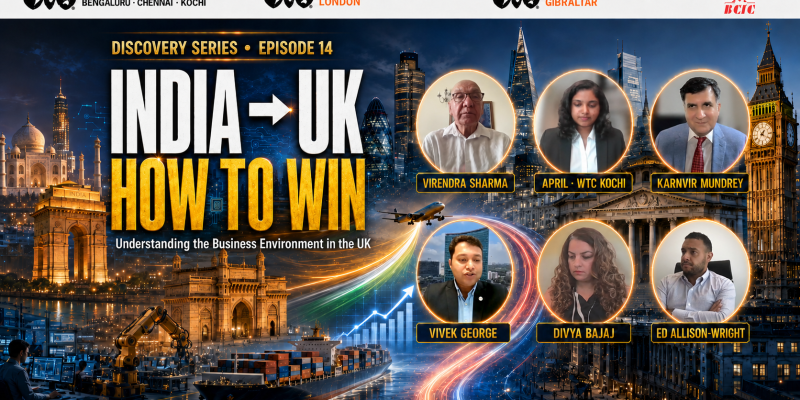
By: Karnvir Mundrey
The India–UK Free Trade Agreement has opened a historic commercial door for Indian exporters, startups and MSMEs. But succeeding in Britain will require more than lower tariffs.
This article draws on Episode 14 of the World Trade Center Discovery Series, moderated by Karnvir Mundrey, and has been supplemented with government data, business case studies and market-entry experiences.
The India–UK Free Trade Agreement came into force on 15 July 2026, creating one of the most important international business opportunities available to Indian companies.
UK–India trade was already worth approximately £48 billion in 2025. The British government estimates that the agreement could increase bilateral trade by £25.5 billion annually in the long term and add £4.8 billion a year to UK GDP.
For Indian exporters, the immediate advantage is substantial. Nearly 99 per cent of Indian goods can receive duty-free access to the UK, subject to product classification, rules of origin and documentation.
The greatest India–UK FTA business opportunities are expected in textiles, apparel, leather, footwear, gems and jewellery, pharmaceuticals, processed foods, engineering goods, machinery, auto components and agricultural products.
Technology and professional-services companies may also benefit from provisions covering services, digital trade and business mobility.
But lower tariffs do not automatically create customers.
The India–UK FTA makes entering Britain easier. It does not make succeeding there effortless.
The businesses that win will treat the agreement as the beginning of a carefully planned UK market-entry strategy – not as a substitute for one.
India–UK FTA benefits at a glance
The India–UK Free Trade Agreement provides Indian businesses with several potential advantages:
- It came into force on 15 July 2026.
- Nearly 99 per cent of qualifying Indian exports receive duty-free UK access.
- The agreement covers goods, services, investment and digital trade.
- It improves business mobility for certain professionals and service providers.
- It creates a more predictable framework for bilateral trade.
- It could increase bilateral trade by £25.5 billion annually in the long term.
- The accompanying Double Contributions Convention can allow eligible employees and employers to pay social-security contributions in only one country for up to five years.
The Government of India describes the agreement as providing unprecedented duty-free access for Indian exports, covering almost the entire value of goods currently exported to Britain.
However, tariff benefits are not automatic.
Indian exporters must ensure that their products satisfy the agreement’s rules of origin. They must also use the correct tariff classification and customs documentation.
A product shipped from India is not necessarily considered Indian for preferential-tariff purposes if too much of its value or production originated elsewhere.
Every exporter should therefore confirm the applicable tariff and origin test before quoting prices to British customers.
Which Indian industries will benefit most?
Textiles and apparel
Indian textile and clothing exporters can become more competitive against suppliers from other Asian countries. The opportunity extends from mass-market garments to sustainable textiles, technical fabrics and premium Indian craftsmanship.
Leather and footwear
Duty-free access can improve the competitiveness of manufacturers in major leather and footwear centres such as Kanpur, Agra, Chennai and Ambur.
British buyers will still expect consistent quality, ethical supply chains and documented environmental compliance.
Gems and jewellery
Indian jewellery businesses can use the agreement to approach Britain’s luxury, wedding and diaspora markets. Success will require trusted certification, transparent sourcing and designs adapted to British purchasing preferences.
Pharmaceuticals and healthcare
India’s pharmaceutical and healthcare companies may find opportunities in generics, contract manufacturing, research services and health technology.
However, the UK remains a highly regulated market. Tariff access cannot replace approvals, quality standards and appropriate clinical or technical evidence.
Engineering and auto components
Manufacturers of machinery, tools, industrial components and automotive parts can benefit from reduced tariff barriers. British buyers, however, will demand reliable specifications, certification, delivery schedules and after-sales support.
Food and agricultural products
Processed foods, spices, seafood, tea, coffee and speciality agricultural products may become more competitive. Exporters must still meet British food-safety, labelling, packaging and traceability requirements.
Technology and professional services
Indian companies in software, artificial intelligence, engineering, architecture, financial technology, marketing and business services can benefit from closer commercial integration and selected mobility provisions.
The real advantage for service companies may not be a tariff reduction. It may be greater confidence, easier relationship-building and an expanding India–UK business ecosystem.
The trade agreement is a door – not a magic carpet
Britain offers Indian companies more than access to British consumers.
The UK remains an influential centre for finance, technology, media, professional services, scientific research, education and international investment.
Establishing credibility in Britain can help an Indian business approach customers, partners and investors in Europe and North America.
India is already a major source of investment into Britain. It became the largest source market for foreign direct investment into London, overtaking the United States and China. London & Partners supported 77 Indian companies in establishing or expanding their London operations over a three-year period.
William Shakespeare supplied an appropriate metaphor more than four centuries ago:
“There is a tide in the affairs of men / Which, taken at the flood, leads on to fortune.”
The India–UK FTA is that tide. But opportunity must be recognised, prepared for and acted upon.
Indian companies must understand the difference between being legally permitted to sell in Britain and being commercially ready to sell there.
From a London bus conductor to the House of Commons
Virendra Sharma’s life offers a valuable lesson about entering Britain and earning its trust.
Sharma arrived in the UK from India in 1968. He began working as a bus conductor on London’s Route 207 before becoming involved in community service, local government and British public life.
He later represented Ealing Southall in the House of Commons from 2007 to 2024.
His journey demonstrates that newcomers can succeed without abandoning their identity – but they must participate in the society around them.
Sharma did not simply reside in Britain. He built relationships, served communities and developed credibility over many years.
Indian companies should adopt the same philosophy.
A business cannot build lasting influence through a registered address and occasional visits. It must listen to British customers, join industry associations, employ locally and contribute to the market it hopes to serve.
British customers must believe that the company will still be present when a problem arises two years later.
What Cobra Beer’s battered Citroën teaches entrepreneurs
One of Britain’s most memorable Indian entrepreneurial stories began with approximately £20,000 of student debt and a second-hand Citroën 2CV purchased for £295.
Karan Bilimoria had identified a gap in the British drinks market. Lager was often too fizzy to accompany Indian food, while traditional ale could be too bitter.
He created Cobra Beer to combine the refreshment of lager with the smoothness of ale.
In the company’s early days, Bilimoria delivered cases of Cobra from a battered Citroën called Albert. He travelled from one Indian restaurant to another, frequently arriving without an appointment but always carrying a specific customer proposition.
Cobra was not created merely because Bilimoria wanted to enter the British beer industry. It solved a recognisable problem.
Compare these two propositions:
Weak proposition:
We are a successful Indian technology company expanding into Britain.
Stronger proposition:
We help UK pharmaceutical manufacturers reduce quality-control delays without replacing their existing systems.
The first describes the seller. The second addresses the buyer.
Cobra subsequently encountered serious financial difficulties and underwent restructuring through a joint venture with Molson Coors.
Margaret Thatcher once told the British Chambers of Commerce:
“You often have to fight battles more than once to win them.”
Cobra demonstrates that a setback does not necessarily mean that the market opportunity was wrong. The financing, timing, ownership structure or distribution strategy may need to change.
Do not confuse speed with market readiness
Indian businesses are frequently admired for their adaptability, energy and ability to make decisions quickly.
Those qualities can become competitive advantages – but only when combined with disciplined preparation.
The UK is a sophisticated and heavily regulated market. Before entering, a company may need to examine:
- Company and tax structure
- UK GDPR and data protection
- Employment law
- Product certification
- Intellectual-property ownership
- Consumer-protection requirements
- Insurance and contractual liability
- Industry-specific licences
- Modern-slavery obligations
- Supply-chain transparency
- Customs documentation
- Rules of origin
An Indian startup profiled by TechUK treated legal and financial planning as part of its expansion strategy. The company considered intellectual-property ownership, shareholder agreements, taxation and investor incentives before scaling its British operation.
These preparations may not produce exciting photographs for social media. They can prevent expensive mistakes.
George Orwell captured the difficulty of confronting an inconvenient reality:
“To see what is in front of one’s nose needs a constant struggle.”
Founders can become so excited by the potential of the UK market that they underestimate regulation, competition, cash requirements and sales cycles.
Due diligence is the discipline of seeing what enthusiasm may be hiding.
When “interesting” does not necessarily mean interested
British business communication can appear friendly, restrained and indirect. It can also be difficult for international founders to interpret.
A discussion on Reddit’s AskUK community examined expressions such as “That’s interesting,” “I’ll bear it in mind” and “That’s quite ambitious.”
Some participants argued that such phrases may conceal scepticism. Others warned that British communication cannot be reduced to a comic phrasebook.
The practical lesson lies somewhere in between.
Do not judge a meeting only by the warmth of the conversation. Judge it by what happens afterward:
- Has another meeting been scheduled?
- Have other decision-makers been introduced?
- Has the prospect requested a proposal or pilot?
- Are the questions becoming more commercially specific?
- Has a budget or timetable been discussed?
- Has someone accepted responsibility for the next action?
A British prospect may be polite without being persuaded. Follow-through often communicates more than compliments.
A UK address is not a UK presence
Registering a British company can be relatively straightforward. Building a meaningful local presence is much harder.
A London address, British telephone number and UK-registered company may create an initial impression of legitimacy. They cannot replace relationships, local knowledge and responsiveness.
A credible UK presence means:
- Customers can reach someone during British working hours.
- Contracts and proposals use appropriate terminology.
- Marketing addresses the concerns of British buyers.
- Problems can be resolved locally.
- Salespeople understand UK procurement practices.
- The company can provide relevant British references.
It also means selecting the right location.
London is valuable for finance, investment, technology, media and professional services, but it is not the only option.
Manchester has strengths in technology, media and advanced manufacturing. Birmingham is connected to major industrial and professional-services networks. Cambridge is internationally recognised for science and innovation. Leeds and Edinburgh possess important financial-services ecosystems.
The location should follow the commercial opportunity – not prestige.
Borrow local credibility
Every company entering a new market begins with a credibility deficit.
British buyers may not recognise an Indian brand or understand its existing references. They may worry about data security, support, financial stability or the supplier’s long-term commitment to Britain.
Advertising alone rarely solves this problem.
Indian companies can borrow credibility through:
- A respected British adviser
- A recognised distributor
- A credible pilot customer
- A UK industry association
- An academic or research partnership
- A chamber of commerce
- An established professional-services firm
- A strategic investor or joint-venture partner
A relevant introduction from a trusted person may produce more progress than hundreds of unsolicited emails.
This is especially important in B2B markets. The customer is not only asking whether the product works. The customer is also asking:
Could choosing an unfamiliar overseas supplier damage my reputation?
Your UK market-entry strategy must reduce that perceived risk.
Use the Indian diaspora as a bridge – not a boundary
Britain’s Indian diaspora gives Indian companies an enormous strategic advantage.
Diaspora communities can provide early customers, introductions, feedback and cultural understanding. Indian restaurants gave Cobra Beer its first natural distribution network. Ethnic grocery stores have helped numerous Indian food brands establish an initial British presence.
Haldiram’s adopted a related strategy when it opened a large restaurant in Leicester Square. The location provided access to diaspora customers, international tourists and one of London’s busiest entertainment districts.
But diaspora success can create an illusion.
A product may perform strongly among customers who already understand its flavours, traditions or cultural significance while remaining largely unknown to the wider British market.
The diaspora should therefore be treated as a beachhead – not the final destination.
The strategic question is:
How can loyalty from the first audience become proof for the second?
Dishoom did not merely sell Indian food
Dishoom provides an excellent example of cultural translation.
Its founders did not present the business as another generic Indian restaurant. They created a distinctive experience inspired by the Irani cafés of Bombay.
The food, interiors, language, music and storytelling contributed to a coherent world.
Dishoom did not weaken its Indian identity to appeal to Britain. It made that identity understandable, intriguing and emotionally accessible.
The same principle applies in other industries.
An Indian technology company should not simply announce that it is successful in India. It must explain the problem it solves for a British organisation.
A fashion brand should not rely solely on the richness of Indian craftsmanship. It must demonstrate how that craftsmanship fits the preferences and lifestyles of UK consumers.
A food company should not merely promise authenticity. It should help unfamiliar customers understand when, why and how the product should be consumed.
Adaptation is not surrender. It is translation.
Win one British customer before chasing one hundred
Many companies attempt to create scale before establishing proof.
They launch expensive campaigns, employ large sales teams or attend multiple exhibitions before understanding why a British customer would buy from them.
A better strategy is to secure one carefully chosen pilot customer.
That customer can reveal:
- Which aspect of the proposition resonates
- Which objections arise repeatedly
- How long procurement actually takes
- What evidence the buyer requires
- Whether the pricing is credible
- Which product changes are essential
- What level of local support is expected
A successful pilot produces something more valuable than a launch announcement: a British reference.
Queen Elizabeth II observed in her 2019 Christmas broadcast:
“Giant leaps often start with small steps.”
The small step may be a trial, regional distributor or single customer. If it generates evidence, knowledge and credibility, it can support a much larger expansion.
Avoid the expensive trade-show trap
Trade exhibitions are frequently treated as shortcuts to international expansion.
One B2B marketer described spending approximately $18,000 on three exhibitions. The company returned with badge scans and business cards but generated almost no meaningful responses.
The problem was not necessarily the events. It was the absence of a strategy surrounding them.
Experienced marketers recommended beginning targeted outreach four or five weeks before an exhibition. Priority prospects should be researched, meetings arranged and follow-up material prepared before the team enters the venue.
A stand is not a strategy.
Trade shows work best when they accelerate relationships that have already started.
After an important event conversation, record a 30-second voice note covering:
- The person’s name
- The company
- The business problem
- The promised action
- One memorable personal detail
This makes personalised follow-up possible.
A generic message says:
It was great meeting you at our stand.
A meaningful message says:
You mentioned that your team is reviewing suppliers before its September budget meeting. I have attached the case study we discussed and highlighted the section on data residency.
Ten well-understood conversations are more valuable than 200 unidentified badge scans.
Tata demonstrates the long-term opportunity
Tata’s presence in Britain demonstrates the potential scale of the India–UK economic relationship.
Beginning with Tata Tea’s acquisition of Tetley in 2000, Tata companies made several major UK acquisitions, including Corus and Jaguar Land Rover.
These investments provided access to brands, employees, engineering capabilities, distribution and institutional knowledge.
More importantly, Tata became part of Britain’s commercial and industrial landscape.
Not every Indian company can make a Tata-sized investment. Every company can adopt the underlying philosophy: enter Britain with a long-term commitment.
The objective should not merely be to sell Indian products in the UK. It should be to create organisations that British customers, employees, partners and communities regard as part of their economy.
How to enter the UK market from India: A seven-step strategy
1. Choose a specific beachhead market
Select one customer group, one urgent problem and one geographical or sector focus. “The UK market” is too broad to be a practical target.
2. Confirm your FTA eligibility
Check your product’s tariff classification, origin requirements and required documentation. Do this before quoting a tariff advantage to customers.
3. Validate the customer proposition
Interview potential British customers before making a major investment. Test your language, price, proof requirements and buying process.
4. Prepare the legal and regulatory foundations
Resolve company structure, taxation, employment, intellectual property, data protection, certification and insurance requirements.
5. Establish local credibility
Build relationships with industry associations, advisers, distributors and potential reference customers. Seek trusted introductions.
6. Secure a pilot customer
Use a limited project to generate evidence, understand procurement and produce a credible British case study.
7. Learn before scaling
Record objections, measure sales cycles and adapt the operation before recruiting aggressively or committing significant capital.
India–UK FTA frequently asked questions
When did the India–UK FTA come into force?
The India–UK Free Trade Agreement came into force on 15 July 2026. It was signed on 24 July 2025 after negotiations that began in January 2022.
Are all Indian exports to the UK now duty-free?
Nearly 99 per cent of qualifying Indian exports can receive duty-free UK access. The treatment of an individual product depends on its tariff classification, origin and documentation.
Which Indian industries benefit most from the agreement?
Potential beneficiaries include textiles, apparel, leather, footwear, gems and jewellery, pharmaceuticals, engineering goods, auto components, machinery, processed foods and agricultural products.
Technology and professional-services businesses may also benefit from provisions covering services, digital trade and mobility.
How can an Indian company enter the UK market?
Begin by selecting a specific customer segment, confirming regulatory requirements and validating demand. The next objective should be securing a credible local partner or pilot customer.
Registering a British company should follow a commercial strategy – not replace one.
Does an Indian company need a UK office?
Not every exporter needs an office immediately. Some businesses can begin through distributors, representatives or strategic partners.
However, high-value B2B businesses generally benefit from local availability, customer support and British references.
Is London the best UK location for an Indian company?
London is valuable for finance, investment, technology, media and professional services. It may not suit every company.
Manchester, Birmingham, Cambridge, Leeds and Edinburgh offer strong sector-specific ecosystems and potentially lower operating costs.
Does the India–UK FTA guarantee lower prices?
No. Tariff savings are only one component of the final price. Freight, insurance, certification, distribution, VAT, compliance and currency movements can affect the landed cost.
Can Indian professionals work in Britain under the FTA?
The agreement contains provisions covering selected business visitors, contractual service suppliers and independent professionals. Eligibility depends on the profession, purpose, duration and applicable immigration route. The agreement does not create unrestricted freedom of movement.
The India–UK opportunity belongs to the prepared
The India–UK Free Trade Agreement has created a historic commercial opening. It reduces friction, improves market access and signals a strong political commitment to expanding trade.
But trade agreements create possibilities. Businesses create results.
The winners will not necessarily be the companies with the largest budgets or loudest launch announcements. They will be those that prepare carefully, listen closely and persist intelligently.
Virendra Sharma’s journey demonstrates the value of participation. Cobra Beer shows the importance of solving a specific customer problem. Dishoom reveals how Indian culture can be translated without being weakened. Tata illustrates the power of patient, long-term commitment.
Britain is not merely another export destination. It is a sophisticated, competitive and internationally connected market that rewards evidence, reliability and credibility.
The commercial door is open.
The question is no longer whether Indian businesses can enter Britain.
The question is whether they are prepared to win.
Karnvir Mundrey is the Editor of TheFutureOfPR.com and the moderator of the Discovery Series. Reach out at tfofpr@gmail.com or at +918296303806.
Subscribe to TheFutureOfPR.com to get great ideas on life, education, health & fitness, real estate, glamour, jewelry, movies, and podcasts! Share this article with people who you think might benefit. They will thank you for it!
Follow TheFutureOfPR.com on Facebook & Twitter.










Comments