 By
By 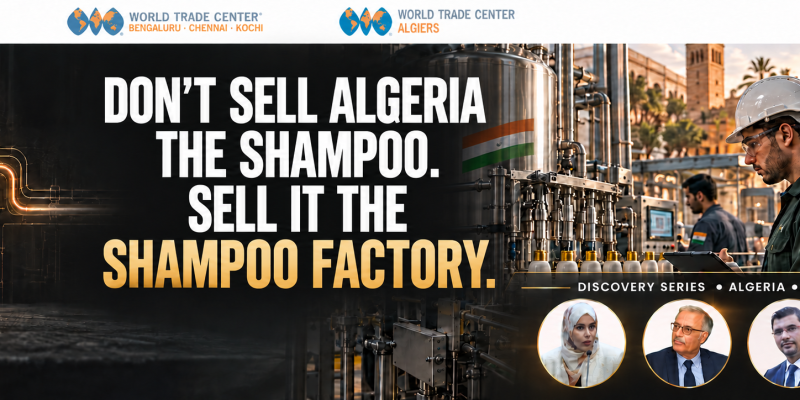
By: Karnvir Mundrey
Algeria wants to manufacture more of what it imports. India already knows how to build much of it. Somewhere between an Algerian factory and an Indian SME lies a surprisingly large opportunity. On 23 September, I’ll moderate Discovery Series Episode 15, “Understanding the Business Environment in Algeria,” with the Algerian Investment Promotion Agency, the Algerian Chamber of Commerce and Industry, and World Trade Center Algiers.
Registration details are at the end.
Picture a shampoo factory near Sétif, in eastern Algeria. Call its owner Amina.
Her mixing tanks are European. Her bottles come from an importer. Her capping machine was built thousands of kilometres away.
One morning, the capping machine stops. It needs a part, and the part will take six weeks to arrive. Until then, a line built to fill thousands of bottles a day fills none.
Now travel 7,000 kilometres east, to Rajkot. Call the entrepreneur there Ramesh.
Ramesh makes capping and filling machines at a fraction of European prices. He stocks his own spares, and his engineer will diagnose a fault over WhatsApp at midnight. But his international strategy amounts to a distributor in Dubai. He has never heard of Sétif.
Amina and Ramesh are imaginary. The opportunity connecting them is not.
Indian businesses keep asking what can India sell Algeria? The more useful question is different:
What does Algeria want to make that India already knows how to make?
The Numbers Say Something Is Missing
Bilateral trade stood at just USD 1.71 billion in 2024-25, against USD 2.92 billion in 2018-19. That is a fall of roughly 40 percent in six years.
What travels between the two countries is revealing. India sells Algeria rice, pharmaceuticals, PET resin, granite, and iron and steel. Algeria sells India petroleum products, LNG, phosphates, methanol and urea.
The raw materials of each economy already feed the other’s production systems. Indian PET resin becomes Algerian bottles, and Algerian phosphates become Indian fertiliser.
So perhaps the relationship shouldn’t be India makes, Algeria buys.
Perhaps it should become: India helps Algeria make.

If you like our writings, support us! Scan the image to show your appreciation!
Algeria Is Telling Us What It Wants
In May 2026, Algeria’s Ministry of Foreign Trade and the Algerian Investment Promotion Agency (AAPI) agreed to direct investment towards the sectors driving the country’s import bill. The stated goals were import substitution, stronger domestic production and higher local integration.
That is a clear signal. Algeria isn’t looking for another foreign supplier; it wants productive investment. The Indian company arriving with another container of finished goods matters less than the one arriving with the machine that lets an Algerian entrepreneur stop importing them.
A clock is also running. The IMF’s July 2026 assessment notes that high hydrocarbon prices are lifting revenues, but fiscal buffers have eroded. Algerian buyers have hard currency now, and partnerships formed in this window are the ones likely to endure.
India’s Hidden Industrial Superpower
We talk about India’s strengths in IT, pharmaceuticals and space. We rarely mention something less glamorous: machines.
Across Rajkot, Coimbatore, Pune, Ahmedabad, Ludhiana, Faridabad and Hyderabad, thousands of companies make pumps, valves, gearboxes, conveyors, blister-packers, bottle-making machines, food-processing lines, cold rooms, pharmaceutical equipment and irrigation systems. Most will never become household names. Together they represent one of India’s most distinctive capabilities: frugal industrialisation.
Europe sells sophistication and China sells scale. India can occupy the space in between.
A growing Algerian entrepreneur may not need a €20-million automated European plant. She may need a ₹2-crore Indian line that works reliably, can be repaired without flying an engineer across the Mediterranean, and can grow with her business. That is not inferior technology. It is right-sized technology.
India also brings experience. We spent decades on import substitution and learned what protection without competition produces. More recently, we became the world’s pharmacy while depending on imports for key starting materials, localising the last step of production and still importing the first. An Indian partner can share those lessons along with the equipment.
Don’t Sell Algeria Shampoo
Don’t just sell Algeria shampoo. Sell the mixing tanks, the filling machine, the capping machine, the bottle-making equipment, the ingredients and the packaging line. Train the Algerian technicians. Help an Algerian entrepreneur build an Algerian brand.
Then repeat the model. Don’t export tomato sauce; help Algeria process its own tomatoes. Don’t export packaged dates; supply the sorting, pitting and packing lines. Don’t just sell medicines; supply the APIs, excipients, clean rooms and pharmaceutical machinery.
One export opportunity becomes an industrial ecosystem.

Join the Webinar!
The Algeria Shopping List
Here are seven specific opportunities, each with a first move an Indian company could make.
1. Keep Algeria’s food factories running
Algeria’s largest private company, Cevital, runs one of the world’s largest sugar refineries, with capacity of 2 million tonnes a year. Plants like that constantly consume pumps, valves, gearboxes, bearings, seals and filling heads. An Indian SME can start with replacement parts and retrofits, move into maintenance contracts, and eventually supply complete lines.
First move: a French-language catalogue of replacement parts for common European processing equipment, with delivery times and a service guarantee.
2. Process Algeria’s dates in Algeria
Algeria is one of the world’s largest date producers. The opportunity is helping it extract more value from every date through sorting, washing, pitting, drying, paste, syrup, cold storage and retail packaging. India already makes much of this equipment.
First move: run a working pitting and packing line at an Algerian agri-food fair. Algerian buyers want to see a machine running before they commit.
3. Package what Algeria manufactures
Every industry Algeria localises creates another packaging customer. That means demand for PET preform and blow-moulding equipment, closures, filling and labelling lines, flexible packaging, corrugated boxes and coding. India already exports PET resin to Algeria. Why stop at the resin?
First move: identify twenty Algerian brands that import finished bottles or caps, and offer them a local-supply model.
4. Supply the pharmaceutical factory, not the pharmacy
Algeria already makes a substantial share of its medicines and is pushing into active ingredients. The opening for India lies in APIs, excipients, pharmaceutical machinery, clean rooms, water systems, lab consumables and packaging. Technology transfer and joint manufacturing could follow.
First move: get qualified as a second source for the highest-volume inputs Algerian manufacturers already buy, and take local legal advice early on joint-venture ownership rules.
5. Help build Algeria’s water infrastructure
Algeria is targeting 5.6 million cubic metres a day of desalinated water by 2030, and contracted three new 300,000 m³/day plants in January 2026. At Oran’s Cap-Blanc plant, all the builders were Algerian and 30 percent of the equipment was local. Importing the rest took 288 flights.
The Indian opportunity may not be winning a desalination project. It may be supplying pumps, valves, piping and pressure vessels, quickly and from local stock, to the Algerian contractor who already has one.
First move: get onto the approved-vendor lists of the Algerian contractors building the next plants.
6. Enter Algeria’s automotive supply chain
This is the most concrete opportunity on the list. Stellantis’ Fiat plant at Tafraoui, near Oran, grew from 17,000 vehicles in 2024 to 53,000 in 2025. It targets 90,000 in 2026 and aims for 135,000 a year by 2028, and the expansion is explicitly meant to deepen local integration and open doors to suppliers. It has already signed an Algerian company for stamped parts, and Stellantis has announced an Opel plant in Algeria, the brand’s first outside Europe.
For Indian auto-component SMEs, that means demand for stampings, wiring, rubber and plastic parts, filters and tooling. The catch: if local content is the goal, the long-term opportunity is making those parts in Algeria, usually with an Algerian partner.
First move: approach Stellantis’ Algerian supplier-development team with a joint-venture proposal and a local partner already identified.
7. Supply the Saharan farm economy
Qatar’s Baladna is building a USD 3.5 billion dairy project in Adrar, deep in the south. Projects on that scale need micro-irrigation, solar pumps, fodder machinery, veterinary products, feed additives and cold chain. India understands farming under difficult conditions better than almost anyone.
First move: target the recurring consumables such projects need every year, not just one-off equipment.
Two bigger bets for large companies are also worth a look: long-term phosphate offtake from Algeria’s new USD 7 billion phosphate project, and helium supply for India’s semiconductor and healthcare ambitions.
The Bigger Opportunity: Service
The Algerian factory owner doesn’t just need your machine. She needs it to work. That means installation, training, French documentation, spare parts, maintenance, remote diagnosis, and someone who answers when production stops.
Indian SMEs should stop selling machines and start selling:
Uptime.
Imagine five complementary Indian machinery makers sharing one Algerian service company, one spare-parts warehouse and several locally trained engineers. Suddenly a small manufacturer can offer something far more valuable than a cheaper machine: confidence. The technician trained on your machine becomes your most credible salesperson.
Start With the Factory, Not the Trade Delegation
Trade missions usually begin in India: find twenty exporters, book a hotel ballroom abroad, make speeches, run B2B meetings, fly home.
Reverse it. Start in Algeria. Visit a hundred factories and ask every owner:
- What do you import?
- What would you rather make locally?
- Which spare part takes too long to arrive?
- What would you manufacture tomorrow if you had the technology?
Then come back to India and find the companies that can solve those exact problems. Don’t begin with a catalogue of Indian exporters. Begin with the Algeria Shopping List.
An Opportunity, Not an Easy One
Doing business in Algeria isn’t simple. Entrepreneurs describe bureaucracy, banking hurdles and customs complexity. Payment risk is real: the Indian Embassy has recorded an Indian agro-food company chasing unpaid dues. Business runs largely in French, relationships are built in person, and quick sales are rare.
Check before you ship. Several rules reported in public sources could shape an Indian company’s plans. They include restrictions on importing used equipment, limits on what liaison offices can do, minimum shelf-life rules for imported food, ownership rules in some pharmaceutical activities, and import procedures that have changed repeatedly since 2025. Confirm each with Algerian counsel, a customs broker or AAPI before acting.
Find the maker, not the middleman. Algeria has produced remarkable industrial entrepreneurs. Issad Rebrab, its only Forbes-listed billionaire, built his fortune in food processing.
The lesson for an Indian SME is simple. Partner with the entrepreneur whose wealth depends on customers buying what the factory produces. Basavanna called it kayaka: honest, productive work. That partner’s incentives are closest to yours.
From ₹0 to ₹500 Crore
With almost ₹0, build intelligence: find Algerian requirements and Indian capabilities, and make introductions.
With ₹10 crore, build local presence for several complementary manufacturers: spare parts, technical staff, demonstration equipment.
With ₹100 crore, once demand is proven, consider local manufacturing in packaging, food processing, components or automotive parts.
With ₹500 crore, build an Indian industrial platform in Algeria offering factory space, warehousing, services and compliance to many SMEs.
The ₹500 crore should be the consequence of what you learned with ₹0, never the starting point.
For Ramesh, the first 90 days are simple. Pick one opportunity. Translate the catalogue into French and arrange export credit cover. Identify thirty buyers through the Chamber, WTC Algiers and the Indian Embassy. Then exhibit, demonstrate and offer a first order with service included. Three qualified buyers and one pilot order by day 90 is a good start.
Amina and Ramesh, 2028
Amina’s shampoo line in Sétif is running. Her capping machine came from Rajkot. When it jammed last month, an Algerian technician trained by an Indian company fixed it the same afternoon. Her bottles come from a converter down the road running Indian machinery, and her products carry an Algerian brand.
Ramesh no longer sells through Dubai. He shares a spare-parts warehouse in Algiers with two other Indian manufacturers and visits twice a year.
None of this required India to sell Algeria a single bottle of shampoo. It required something more valuable. India helped Algeria make it.
🇮🇳 Made With India. Made in Algeria. 🇩🇿
On 23 September
Discovery Series, Episode 15: Understanding the Business Environment in Algeria
Presented by World Trade Center Bengaluru, World Trade Center Algiers and BCIC
- Siham Djedar, Director, Algerian Investment Promotion Agency
- Chakib Kouidri, Managing Director, Algerian Chamber of Commerce and Industry
- Ahmed Tibaoui, General Manager & CEO, World Trade Center Algiers
Wednesday, 23 September 2026 · 3-4 PM IST · Zoom · No participation fee · [Register here]
https://us06web.zoom.us/webinar/register/WN_x-485ZyuTpqnZRTGZBPjsA
Support The Future Of PR
TheFutureOfPR.com explores the stories behind business, reputation, leadership, investment and global trade-especially the ideas that conventional media often overlooks.
Investing
If you enjoy independent reporting, thoughtful analysis and stories from the ground, you can support my work. Your contribution helps fund the continued development of TheFutureOfPR.com.
Click here: buymeacoffee.com/tfofpr to appreciate this writing.
Thank you for helping independent ideas travel further.
Karnvir Mundrey is a narrative strategist and media entrepreneur who helps founders, institutions and international businesses turn complex ideas into influential public stories. He is the Founder of Atharva Lifesciences Consulting Pvt. Ltd. , Atharva Marcom and Founder Editor of TheFutureOfPR.com. He has also authored a book on Nutraceuticals (available on Amazon). Karnvir Mundrey is also the producer and host of 4 YouTube channels. Finest Fintalk brings you the latest in Finance, LitInMin for Books, The Health Tips Podcast for health and Atharva Marcom for leadership talks He is also recognized as India’s longest running podcast host, continuously running since 2006!
Reach out at tfofpr@gmail.com or at +918296303806.
Subscribe to TheFutureOfPR.com to get great ideas on life, education, health & fitness, real estate, glamour, jewelry, movies, and podcasts! Follow TheFutureOfPR.com on Facebook , Twitter and Linkedin!
Share this article with people who you think might benefit. They will thank you for it!






Comments