 By
By 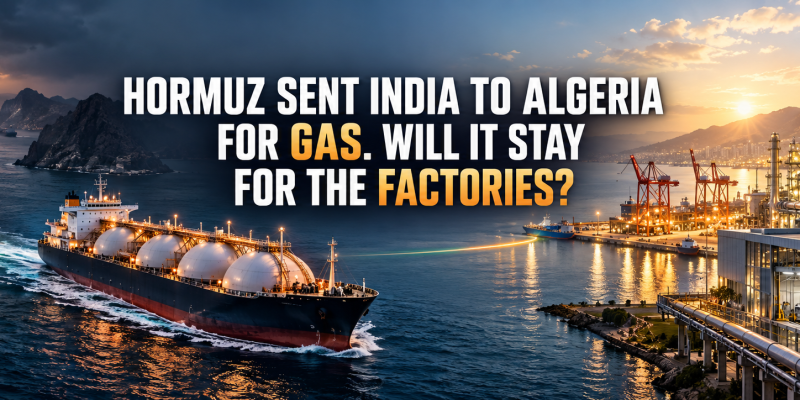
By: Karnvir Mundrey
In March, an Ambala restaurant went back to cooking on wood fires. By June, India was buying gas from Algeria. Why did it take a war, how can the connection last, and does it make financial sense for an Indian SME?
In March this year, an 89-year-old restaurant in Ambala cut half its menu and went back to cooking on wood-fired bhattis. It wasn’t alone. The war that began in late February had choked the Strait of Hormuz, the route for about 90% of India’s LPG imports, and the government put households first. Commercial kitchens had to wait.
By June, some of the relief was coming from an unlikely place. India resumed LPG imports from Algeria. In August, Indian Oil signed a 2027 deal with Sonatrach: one tanker of 45,000 to 55,000 tonnes a month, priced below Saudi Aramco’s benchmark.
It took a war for India to rediscover a country it has called a friend since diplomatic relations began in 1962. That raised the question I kept returning to as I prepared to moderate the World Trade Center Bengaluru Discovery Series episode on Algeria. If Algeria can help keep India’s kitchens running, why is the whole relationship worth only $1.7 billion a year?
On paper, the two economies fit together. India needs energy, fertilisers and markets. Algeria has gas, phosphates and urea, and wants medicines, farm machinery and partners who can help it manufacture at home. Delegations have been saying so for years, under banners, in front of flags, over handshakes that photograph well.
An Ayurvedic vaidya faced with a patient who looks healthy but isn’t thriving doesn’t reach for the prescription pad. He starts with nidana, the causes, and samprapti, how the illness took hold. Only then comes chikitsa, the treatment, and finally pathya and apathya, what to follow and what to avoid. So let’s take the pulse.

If you like our writings, Cmon, support us! Scan the image to show your appreciation!
Nidana: follow the money back
The headline number looks merely disappointing. Bilateral trade in 2024–25 was $1.71 billion: Indian exports of $947 million and imports of $760 million. In 2018–19 it was $2.92 billion. The detail is more revealing, because trade in both directions fell.
In 2018–19, India sold Algeria $1,299 million of goods and bought $1,622 million. Since then, Indian exports have fallen about 27%, and Algeria’s sales to India about 53%. Algeria’s side is mostly commodities, so it rises and falls with world prices. India’s side lost one thing above all: cars. In 2017, vehicles were the largest single item in the $984 million Algeria imported from India, at $246 million. By 2024 that was down to $37 million. Of Algeria’s $43.6 billion of imports in 2024, China supplied 26.8%, Turkey 6.58% and India roughly 2%.
Why did the cars vanish? Look at Algeria’s reserves. Its foreign-exchange reserves peaked at $193.6 billion in April 2014 and stood at $35.4 billion in March 2026. The IMF’s July 2026 mission found they fell sharply again in 2025, and that the gap between the official and parallel-market exchange rates stayed wide.
Every drop in reserves brings a new import control. Importers must now file six-monthly import forecasts, called PPIs. Without an approved forecast, the bank won’t process the import and customs won’t clear it. Since May, that bank processing must be finished before the supplier ships. Since January, any standalone service imported into Algeria needs prior ministry approval. The EU has the same complaints: in July 2025 it launched arbitration over import licensing that, for some products, works like a ban.
That explains why trade shrank. It doesn’t explain why Indian capital never went in to manufacture behind those walls, as others did. For that, we need to understand how the illness took hold.
Samprapti: how caution became absence
India is present in Algeria, mostly as a contractor or technology partner:
- Tractors: Sonalika has restarted tractor production, and Mahindra supports an Algerian assembly plant with technology.
- Pharma: Prime Pharmaceuticals and BDR Pharmaceuticals run joint ventures making medicines.
- Engineering and infrastructure: Engineers India, L&T, Dodsal, IRCON and Shapoorji Pallonji have all delivered projects there.
Indian firms win projects and transfer technology far more often than they commit permanent equity.
Picture the meeting. An Algerian official asks the Indian promoter when the factory will be built, how many Algerians it will employ and how many imports it will replace. The promoter replies that he’d like to export first, test demand, keep control, and be sure he can send profits home. Each leaves thinking the other isn’t serious. Neither is irrational; they are working from different logics.
Indian boardrooms also remember one story. In 2001 Ispat, then owned by the Mittal family, bought the El Hadjar steelworks. In 2016 ArcelorMittal handed its entire stake to the Algerian state for a symbolic dinar.
Algeria has changed its law since then. The 2022 investment law limits the rule requiring 51% Algerian ownership to strategic sectors: hydrocarbons, mining, defence, pharmaceuticals and importing goods for resale. But a right on paper is not the same as a right a bank will lend against:
- Profit repatriation is guaranteed only if the foreign investor funds at least 25% of the project.
- Services and royalties paid abroad are taxed at 30% at source, and India and Algeria only began talks on a tax treaty in 2023.
- International arbitration against the Algerian state is available only where a treaty is in force, and India has none.
- The Joint Commission, the main government-to-government forum for trade, last met in May 2015.
Incentives make a profitable project more profitable. Predictability decides whether it happens at all.
Some doors closed while India wasn’t looking. Algeria has the world’s third-largest phosphate reserves. India built phosphoric-acid joint ventures next to mines in Morocco, Jordan, Senegal and Tunisia, but never opened the fifth door. In August 2026, Sonatrach signed construction contracts for its own $7 billion phosphate project with Saipem and CHEC, alongside Chinese partners. In pharma, local production now covers more than 82% of Algeria’s needs, and importing medicines already made locally has been banned since 2008.
Indian capital went elsewhere: more than 70 Indian companies have invested over $5.5 billion in Egypt. The competitor that stayed was Turkey, with more than 1,600 companies and over $8 billion invested in Algeria. Cheap power helped: business electricity costs about $0.036 per kWh, less than a quarter of the world average.
Then there is a risk no incentive can offset. In 2022 Spain backed Morocco’s position on Western Sahara, and Algeria froze banking operations for trade with Spain. One Spanish machinery maker held 40% of an Algerian company and earned nothing for six months. Spanish exports to Algeria fell by more than 80%, while Algeria sold Spain over $6.5 billion of gas and oil in the same period. India withdrew its recognition of the Sahrawi Republic in 2000 and has stayed neutral since, a position worth protecting. Local partners carry their own risk: after Bouteflika fell in 2019, trials over the car-assembly industry jailed two former prime ministers and two industry ministers.
By early 2026, India and Algeria had become old friends who rarely spoke. Then the Strait of Hormuz closed.
The turn: what the war changed
The Ambala kitchen is where the story turns. Algerian LPG is now arriving in India, and trade will probably rise next year, but because of a war rather than anything Indian business did. By my rough estimate, the Indian Oil deal alone is worth several hundred million dollars a year.
Other doors have opened too. French wheat has been shut out of Algeria’s state tenders since October 2024, and India lifted its wheat export ban on 24 August 2026. Indian business has noticed: a 100-member Pharmexcil delegation representing 65 companies visited Algiers in January, and FIEO followed in February.
Two caveats temper the optimism. Algerian cargoes avoid Hormuz but still pass through the Red Sea, where the Houthis declared a blockade on Saudi shipping on 20 July. And Algeria’s own budget expects hydrocarbon exports to fall. Algeria can supplement Gulf supplies, not replace them.
So the patient is up and walking. The question is whether the recovery lasts once the emergency passes, and whether it is worth an Indian SME’s money.
Chikitsa: the treatment
Meera’s spreadsheet: why Algeria, and not Egypt, Dubai or Vietnam?
Take an illustrative case: a mid-sized farm-pump maker in Coimbatore, run by someone we’ll call Meera. Algeria is pushing irrigated farming in the south, so the demand is real. Before she books a flight, her CFO asks the obvious question: if we’re going to build abroad, why Algeria? So she lines up the alternatives.
| Country | Corporate tax | Tax on dividends to India | Business power (US$/kWh) | Tax treaty with India | Best use |
|---|---|---|---|---|---|
| Algeria | 19% on manufacturing, 3–10-year exemptions | 15% | 0.036 | No | Selling into a protected home market |
| Egypt | 22.5% | 10% | 0.041 | Yes | Regional manufacturing base |
| Morocco | 20% | 10% from 2026 | 0.118 | Yes | Selling into Europe |
| UAE | 9% above AED 375,000 | 0% | 0.110 | Yes, plus a 2024 investment treaty | Trading and services hub |
| Vietnam | 20%; 10% for up to 15 years in priority sectors | 0% | — | Yes | Export factory for Asia |
| India (baseline) | ~25% | — | 0.116 | — | — |
Sources for the table:
- Algeria: corporate tax of 19% for manufacturing; exemptions of 3-5 years under the sector regime and 5-10 under the other regimes; 15% on dividends. Royalties and service fees are taxed at 30%, against 20% in Egypt and 10% in Morocco.
- Egypt: corporate tax of 22.5% and 10% on dividends from unlisted companies.
- Morocco: 20% corporate tax, with the tax on dividends falling to 10% from 2026.
- Vietnam: 20% standard, or 10% for up to 15 years in priority sectors. Its 15-17% small-company rates don’t apply to firms related to larger groups.
- Business power: Algeria and Egypt are cheapest, at about $0.036 and $0.041. Morocco, the UAE and India all pay roughly three times that.
Then Meera asks what $100 of profit is worth once it reaches Coimbatore, counting only the host country’s taxes. Indian tax on the dividend, net of credit for foreign tax, comes on top, and she’ll model that with her CA:
- Algeria during the tax holiday: about $85
- Algeria after the holiday: about $69
- Egypt: about $70 (less tax if the treaty applies)
- Morocco: about $72
- Vietnam: about $80, or $90 in a priority sector
- UAE: about $91
- Staying in India: about $75
On paper, Algeria in its holiday years wins. But tax isn’t where the decision gets made. The real costs of Algeria don’t appear in tax tables:
- Currency. A plant selling locally earns dinars. The dinar weakened against the dollar in 2025 and more against the euro, and some estimates put the parallel-market rate more than 60% below the official one. A 10% slide in the dinar turns that $85 into about $76.
- Time to cash. Customs clearance can take weeks to months. The first transfer of profits home can be slow even though the legal right is established. For an SME paying Indian interest rates, every extra month costs money.
- Fixed costs. Funding at least 25% of the project, Arabic-language founding documents, work permits for Indian staff and French-language administration can absorb much of the tax saving on a small project.
There are real advantages on the other side:
- Power costs about 70% less than in India.
- Wages: the minimum net wage is about €140 a month.
- Cheap local debt: the central bank’s key rate is 2.75%, and Qatar’s Baladna financed 49% of its dairy project with Algerian bank loans.
- Protection: the import walls that keep Indian exports out also keep competitors out once you produce locally.
Meera’s conclusion, and mine for most Indian SMEs, is that each country suits a different kind of bet. Algeria is a bet on a protected home market, Egypt a regional base, the UAE a hub, Vietnam an export factory. Building a plant in Algeria makes sense if at least three of these are true:
- Energy is a significant share of your production costs.
- Your product is shielded by an import ban, high duty or the DAPS surcharge.
- You have a committed local buyer.
- You can reinvest profits locally for a few years.
- You can borrow in dinars and have someone who can run the business in French.
Meera’s pumps aren’t energy-intensive, and she has no committed buyer yet. So her spreadsheet says: export first, and let the numbers decide each next step.
Meera’s route in
Here is how that route works under today’s rules. This is not legal or financial advice, and Algeria revises its import rules every six months.
Year one: export, carefully. Meera sells through a verified Algerian distributor, whose buyers must include her pumps in their six-monthly import forecast before the window closes. She can ask for a deposit of up to 15%, and payment terms can run to 360 days. She doesn’t ship until the buyer’s bank has finished processing the import. She bundles installation with the pumps instead of selling it as a separate service. Her commissioning engineers travel on temporary work visas, because some regions, the oil province of Ouargla included, no longer accept business visas even for short jobs.
Year two: assemble, if the tests are met. Irrigation equipment isn’t a strategic sector, so Meera can own an assembly unit outright. She chooses a location in one of the regions that qualify for 5 to 10 years of corporate tax exemption, rather than 3 to 5 elsewhere. She funds at least 25% of the project herself, so she keeps the right to send profits home. She takes returns as dividends, taxed at 15% at source, rather than as fees or royalties, taxed at 30%.
Year three: scale. For state irrigation tenders, Meera takes a 49% stake in an Algerian-majority company, which qualifies for a price preference that has historically been 25%. For price-sensitive product lines, she weighs Egypt instead. Goods genuinely made there with at least 40% regional content enter Algeria duty-free under the Arab free-trade agreement.
Meera isn’t the only one with an opening, and the best openings fit the profile her spreadsheet describes:
- Steel pipes. Jindal SAW’s proposed pipe complex is energy-intensive by nature.
- Auto parts. Fiat’s plant near Oran is a committed buyer that needs local suppliers. It builds the Grande Panda on the same Stellantis platform as the Citroën C3, which is also assembled in India, and it is at 20% local content against a 30% target.
- Buses. The 2026 Finance Law exempts new buses, complete or in kits, from duties and taxes.
- Dairy equipment. Qatar’s Baladna has signed over $500 million of supply contracts with Algerian and international firms for its dairy project.
A story that proves governments can make it work
In December 2001, officials in Oman initialled the agreements for OMIFCO, a $969 million urea plant. It was owned 50% by Oman Oil and 25% each by India’s KRIBHCO and IFFCO. India agreed to buy its urea for 15 years, and Oman guaranteed its gas supply for 20. At its IPO in 2026 OMIFCO was valued at about $2.6 billion, and India will keep buying about a million tonnes a year until 2031. Algeria already does deals of this kind: in August it agreed with Oman’s Suhail Bahwan group to add a third ammonia-urea production line near Oran.
That is the model for an energy-for-industry bargain:
- India commits to buy Algerian LNG, urea and phosphates for five to ten years, at market-linked prices.
- Algeria commits to give approved Indian manufacturers five years of regulatory stability, land, guaranteed access to imported inputs, and a clear route for sending profits home.
- Indian firms commit to measurable targets for local jobs, training and suppliers.
Around that bargain, both governments need to build the missing infrastructure:
- Rules: a published three-year list of restricted products, with 90 days’ notice of changes.
- Profit transfers: designated banks that decide on sending dividends home within 30 to 45 days.
- Partnerships: a standard joint-venture template covering board seats, intellectual property and exit.
- Treaties: a tax treaty and an investment protection pact.
- Finance and insurance: Exim Bank credit, ECGC export insurance and World Bank (MIGA) political-risk cover.
- Pharma: a regulatory fast track, including recognition of the Indian Pharmacopoeia, which India’s ambassador has already requested.
- Logistics and support: consolidated fortnightly freight from Mundra and JNPT, a verified register of Algerian partners run from an India Commercial Centre in Algiers, and e-visas for investors.
Pathya: the schedule
A vaidya’s prescription comes with a schedule. So should this one.
| Period | Essential actions |
|---|---|
| First 100 days | Set up a joint delivery unit; screen 25 projects; designate banks; publish standard joint-venture and letter-of-credit documents; scope an OMIFCO-style fertiliser venture; begin treaty talks |
| Within 12 months | Hold the 10th Joint Commission with an energy-for-industry agenda; open project finance; launch customs and pharma fast tracks; start consolidated freight |
| Within three years | Ten operating manufacturing joint ventures; customs clearance under 48 hours; profit transfers under 45 days; trade heading towards $3 billion |
LPG purchases could lift the headline number on their own, so the scorecard should track non-hydrocarbon trade and operating factories instead.
Apathya: what the patient must avoid
Stop counting a delegation as a deal, or an MoU as an investment. Stop calling Algeria a “gateway to Africa” before the routes are proven: after Algeria shot down a Malian drone in April 2025, Mali and its neighbours withdrew their ambassadors, and ties with Mali were restored only in July 2026. Stop demanding full localisation in year one. Stop believing a tax holiday can offset currency risk; Meera’s spreadsheet shows it can’t. Indian firms should stop shipping before the buyer’s bank has processed the import, stop sending engineers on business visas, and stop taking partners with political baggage.
Go back to the Ambala kitchen, and to all those handshake photographs before it. For decades, the friendship between India and Algeria was real but idle. The emergency has put it to work. Whether it becomes lasting business depends on what both sides build next.
That was the argument I started with. Don’t sell Algeria the shampoo. Sell it the shampoo factory, one that runs on Algerian gas, and buy its fertiliser in return. Hormuz sent India to Algeria for gas. Whether India stays for the factories is now up to both countries.
India and Algeria have shaken hands long enough. It is time to start building.
Support The Future Of PR
TheFutureOfPR.com explores the stories behind business, reputation, leadership, investment and global trade-especially the ideas that conventional media often overlooks.
If you enjoy independent reporting, thoughtful analysis and stories from the ground, you can support my work. Your contribution helps fund the continued development of TheFutureOfPR.com.
Click here: buymeacoffee.com/tfofpr to appreciate this writing.
Thank you for helping independent ideas travel further.
Karnvir Mundrey is a narrative strategist and media entrepreneur who helps founders, institutions and international businesses turn complex ideas into influential public stories. He is the Founder of Atharva Lifesciences Consulting Pvt. Ltd. , Atharva Marcom and Founder Editor of TheFutureOfPR.com. He has also authored a book on Nutraceuticals (available on Amazon). Karnvir Mundrey is also the producer and host of 4 YouTube channels. Finest Fintalk brings you the latest in Finance, LitInMin for Books, The Health Tips Podcast for health and Atharva Marcom for leadership talks He is also recognized as India’s longest running podcast host, continuously running since 2006!
PublicRelations
Reach out at tfofpr@gmail.com or at +918296303806.
Subscribe to TheFutureOfPR.com to get great ideas on life, education, health & fitness, real estate, glamour, jewelry, movies, and podcasts! Follow TheFutureOfPR.com on Facebook , Twitter and Linkedin!
Share this article with people who you think might benefit. They will thank you for it!






Comments