
 By
By 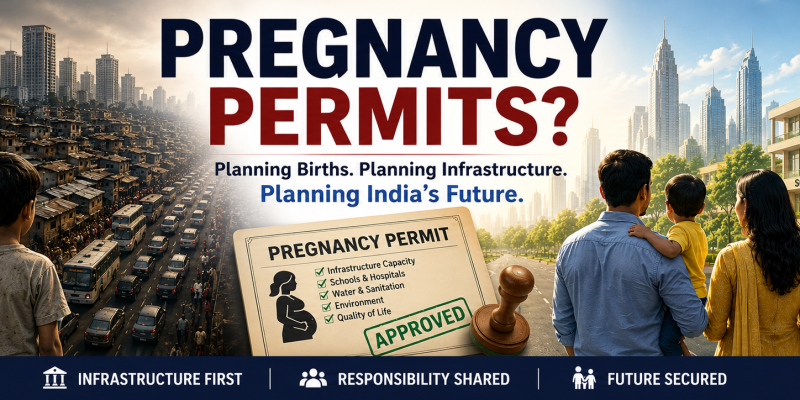
By: Karnvir Mundrey
The numbers behind a provocative proposal for connecting childbirth, urban capacity and the state’s responsibility towards every child
India does not merely need more classrooms, hospitals, roads and water pipelines.
It needs them before the people who will use them arrive.
Every child is born into a family-but also into a city, a state and a public system. From the first vaccination to the final pension, that person will require hospitals, schools, teachers, electricity, water, sanitation, transport, housing, policing, employment and public space.
Parents create a life. Society must create the conditions in which that life can be lived with dignity. That raises an uncomfortable question:
Should the decision to have a child remain entirely private when a substantial part of the responsibility for supporting that child becomes public?
Before dismissing pregnancy permits as dystopian, consider the numbers.
India’s Cities Are Approaching Their Limits
India already had approximately 522 million urban residents in 2025. By 2036, its cities are expected to house about 600 million people-roughly 40% of the country’s population. Those cities could generate nearly 70% of India’s GDP, but they will also require dramatically more water, transport, housing, electricity, healthcare and sanitation.
The World Bank estimates that India will need to invest approximately $840 billion in urban infrastructure by 2036, averaging about $55 billion every year.
Yet India’s annual urban-infrastructure investment was only around $16 billion in 2018. Capital expenditure between 2011 and 2018 averaged about 0.6% of GDP-only half the estimated requirement. Just 5% of urban-infrastructure financing came from private sources.
The World Bank calculates an average urban-infrastructure requirement of approximately $108 per urban resident every year.
At that rate, every additional one million urban residents create, on average, approximately $108 million in annual capital requirements for transport, water, drainage, roads, sewage, street lighting and other urban services.
That figure excludes several major costs, including housing and slum rehabilitation. A child, therefore, is not only an emotional and biological decision.
A child is also an infrastructure commitment.
Every Birth Eventually Requires a School Seat
India already operates one of the largest education systems in the world.
According to the Ministry of Education’s UDISE+ report for 2023–24, India’s school system serves nearly 24.8 crore students through approximately 14.72 lakh schools and more than 98 lakh teachers.
Even a 1% increase in the number of students would mean approximately:
- 24.8 lakh additional schoolchildren
- thousands of additional classrooms;
- tens of thousands of additional teachers;
- more school buses, toilets, kitchens and playgrounds;
- millions of additional textbooks, uniforms and midday meals.
And education does not end with school. Children eventually require colleges, vocational institutions, universities, laboratories and employment opportunities. Yet India generally begins constructing this infrastructure only after the demand has become a crisis.
A new neighbourhood appears. Thousands of families move in. Children are born. Traffic increases. Schools become overcrowded. Water tankers arrive. Hospitals become congested. Only then does the government begin discussing a flyover, school, sewage-treatment plant or additional hospital.
Population comes first. Planning comes twenty years late.
India Has People, but Not Enough Planners
The irony is that India is attempting to manage one of the world’s largest urban transitions with a remarkably small planning establishment.
A NITI Aayog report found that India had 7,933 urban settlements according to the 2011 Census. It estimated that more than 12,000 posts for town planners were required in state planning departments, while fewer than 4,000 sanctioned positions existed.
In other words, India did not have even one sanctioned town planner for every urban centre. The same report cited an estimate of only about 0.23 accredited planners per 100,000 people in India, compared with approximately 38 in the United Kingdom.
We are adding buildings, vehicles and people faster than we are adding the professionals required to plan for them. This is not urbanisation.
It is improvisation on a national scale.
Water Is Already Sending Us a Warning
NITI Aayog previously estimated that around 600 million Indians faced high-to-extreme water stress.
Its report on urban-planning capacity also warned that 30 Indian cities, including Bengaluru, Mumbai, Jaipur, Pune, Kolkata, Indore, Amritsar and Visakhapatnam, were likely to face acute water shortages in the coming decades. More people do not automatically produce more water.
A city can expand its buildings vertically and its boundaries horizontally, but it cannot manufacture unlimited groundwater. Every additional household requires water for drinking, cooking, bathing, sanitation, cleaning and food production. It also generates sewage that must be collected and treated.
When population exceeds infrastructure, the rich buy tankers, filters and private borewells. The poor wait beside public taps.
That is not merely inconvenience. It is the unequal distribution of scarcity.
Overcrowding Has a Human Cost
According to Census 2011 data cited by NITI Aayog, approximately 17.3% of India’s urban population was living in slums. Around 70% of the country’s slum population was concentrated in just six states.
That statistic is more than a housing number.
It represents children growing up in areas that may have inadequate sanitation, overcrowded schools, unsafe streets, poor ventilation and limited access to playgrounds or healthcare.
Similarly, air pollution cannot be separated from the way India builds and populates its cities. A major peer-reviewed study estimated that air pollution contributed to approximately 1.67 million deaths in India in 2019, accounting for around 17.8% of all deaths that year.
Not all pollution is caused by population growth. Industry, energy policy, vehicle technology, construction and agricultural practices all matter. But when millions of additional people are concentrated in cities without adequate public transport, waste management, green space or urban planning, environmental pressure inevitably grows.
The real question is not how many people India can physically accommodate. Human beings can be packed almost anywhere.
The question is:
How many people can an area support while still providing a reasonable, healthy and dignified life?
What Would a Pregnancy-Permit System Look Like?
Under a pregnancy-permit system, couples planning to have a child would register their intention with a designated public authority.
The first permit could be free.
But its timing would be linked to the infrastructure capacity of the area where the child is expected to grow up.
The authority would examine measurable indicators such as:
- school seats per child;
- teachers per student;
- hospital beds and doctors per resident;
- water availability;
- sewage-treatment capacity;
- housing affordability;
- public-transport capacity;
- air quality;
- employment opportunities;
- parks and public spaces.
Where sufficient capacity exists, the permit would be issued immediately. Where a city or district has crossed defined limits, applicants could be placed on a waiting list – similar to the allocation of other scarce resources.
The principle is uncomfortable but straightforward:
A government should not continue approving unlimited demand in an area where it already knows that basic supply is inadequate.
You Can Have a Child-But Perhaps Not Anywhere
A pregnancy permit should not become a simple national licence to reproduce. It could instead be linked to geography.
A family wishing to have a child in an overcrowded metropolitan area might have to wait. Alternatively, it could relocate to an emerging town where the government has created adequate capacity.
But relocation cannot mean telling families to move into a desert, mountain or remote district and survive on patriotic enthusiasm.
The state would first have to build:
- quality schools and hospitals;
- universities and vocational centres;
- dependable electricity and digital connectivity;
- cultural and recreational facilities;
- public transport;
- industries and employment;
- safe and affordable housing.
India’s problem is not that it lacks land. Its problem is that jobs, education, healthcare, influence and entertainment are concentrated in a limited number of places.
Pregnancy permits could therefore become part of a much larger policy for developing 50 or 100 new centres of opportunity, reducing the pressure on Delhi, Mumbai, Bengaluru and other overloaded metros.
Should a Second Child Cost More?
A second child creates additional private and public responsibilities.
In severely congested areas, parents seeking a second-child permit could be required to make a higher contribution towards the infrastructure that will support that child.
However, arbitrary figures such as ₹2 crore or ₹3 crore would be difficult to defend without credible lifecycle costing.
The amount should instead be calculated transparently using factors such as:
- local infrastructure deficits;
- the family’s income and assets;
- expected education and healthcare subsidies;
- water and transport pressure;
- the cost of adding civic capacity.
The contribution should be progressive. A wealthy household should pay more than a middle-income household.
The purpose must be to recognise responsibility.
Should Child-Free Citizens Receive a Dividend?
Governments frequently provide benefits to parents through tax deductions, subsidised education, healthcare schemes and child-welfare programmes.
But citizens who voluntarily remain child-free receive little recognition for reducing future demand on these systems.
A “child-free dividend” could provide an enhanced pension, tax credit or retirement contribution after the age of 55 or 60.
This should not be based on the claim that children are purely a financial burden. Children eventually become workers, taxpayers, entrepreneurs and caregivers.
But the state could recognise that citizens who do not have children have made less use of child-related public expenditure.
The benefit need not be an unrealistic payment of several crores. It could take the form of:
- a higher pension contribution;
- additional health insurance;
- a retirement tax credit;
- priority access to assisted-living facilities.
That would create a genuine policy choice rather than assuming that every adult must become a parent.
Encourage Parenthood Among Financially Secure Families
India should be willing to acknowledge an uncomfortable economic reality: families with greater financial stability are generally better positioned to invest heavily in a child’s nutrition, healthcare, education, exposure, extracurricular development and long-term opportunities.
Wealth does not automatically produce good parents, and poverty does not prevent exceptional parenting. But resources matter. A child raised in a financially secure household is less likely to depend entirely on already overstretched public schools, hospitals, housing subsidies and welfare systems. Such families can also invest more in higher education, skills, entrepreneurship and global exposure.
For a country seeking to build a healthier, better-educated and more productive population, the state should therefore consider encouraging financially capable couples to have children.
The most appropriate instrument would be tax rebates rather than cash grants.
A grant requires the government to collect money and distribute it directly, often creating administrative costs, leakages and the possibility that parenthood is treated as a route to immediate financial assistance. A tax rebate works differently: it allows families already earning and contributing to the economy to retain more of their own income and invest it directly in raising their children.
For example, financially established parents could receive:
- an additional income-tax deduction for each child;
- rebates linked to verified spending on education, healthcare and insurance;
- tax-free investment accounts for a child’s higher education;
- reduced taxation for parents who independently fund schooling and medical care;
- additional incentives for raising children in newly developed cities or regions that need skilled populations.
The incentive should reward sustained investment in the child, not merely childbirth. Benefits could therefore be connected to vaccination, school attendance, health insurance, nutrition and educational savings.
This approach would be preferable to unrestricted grants offered simply for having more children. Direct cash incentives can unintentionally encourage births among households that may already be struggling to provide adequate time, housing, education or healthcare. They can also increase future dependence on public expenditure without guaranteeing better outcomes for the child.
The objective is not to declare that rich people are genetically or morally superior. It is to recognise that financially secure families possess greater capacity to raise healthy, educated and economically productive citizens without placing the entire cost on the state.
India should not pursue population growth for its own sake. It should encourage responsible parenthood backed by the resources required to give every new child a strong start.
The goal should be fewer incentives for unsupported reproduction and greater incentives for families that can demonstrably invest in the next generation.
The Risks Cannot Be Ignored
A pregnancy-permit regime would create serious dangers.
Who would issue the permit?
Would approvals be sold through corruption?
Would women be harassed or monitored?
Would poorer families, migrants or minorities be treated unfairly?
What would happen in the case of an unplanned pregnancy?
Would the child be denied services because the parents lacked permission?
Any system involving forced abortion, sterilisation, contraception, criminal punishment or denial of basic services would be morally indefensible.
No child should ever suffer because a parent violated an administrative rule.
Pregnancy permits can therefore be discussed only as a policy thought experiment-and only alongside absolute protection for bodily autonomy, privacy, equality and the welfare of every child.
Perhaps the Permit Should Be for the Government
There is another way to interpret the proposal.
Perhaps citizens should not need permission to have children. Perhaps governments should need permission to approve more housing and population growth without demonstrating that adequate infrastructure exists.
Before approving another 5,000-apartment project, the authority should prove that the locality has sufficient water, sewage capacity, schools, hospitals, roads and public transport. Before allowing a city to add another million residents, the state should publish a plan showing how those residents will live.
That may be the more practical version of the pregnancy-permit idea:
Not a licence controlling a woman’s body, but a capacity certificate controlling irresponsible urban expansion.
Population Is Not Just a Number
Every new child represents hope, imagination and possibility.
But that child will also need a hospital bed, a classroom desk, clean water, breathable air, a safe street and a meaningful livelihood. India must stop treating those requirements as problems to be solved later.
Reproduction may begin as a personal choice. Its consequences are shared by schools, hospitals, taxpayers, cities and future generations.
The pregnancy-permit proposal may sound extreme. But so is building cities where millions of children must compete for resources that governments knew were inadequate before those children were born.
The goal is not to prevent life.
The goal is to ensure that when a life begins, India has already made room for it.
Karnvir Mundrey is the Editor of TheFutureOfPR.com. Reach out at tfofpr@gmail.com or at +918296303806.
Subscribe to TheFutureOfPR.com to get great ideas on life, education, health & fitness, real estate, glamour, jewelry, movies, and podcasts! Share this article with people who you think might benefit. They will thank you for it!
Follow TheFutureOfPR.com on Facebook & Twitter.








Comments