
 By
By 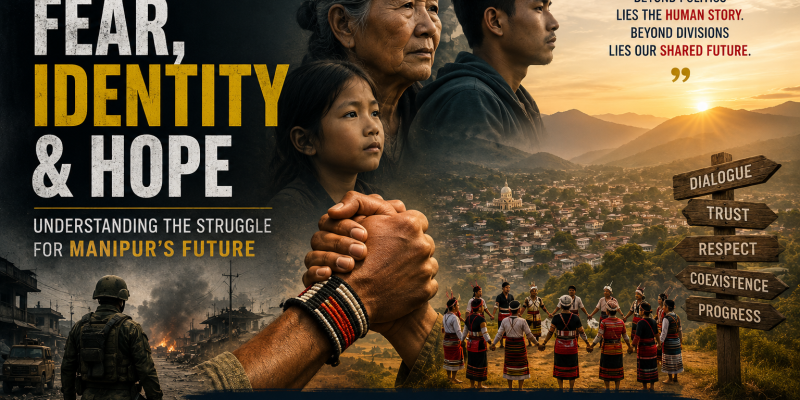
By Karnvir Mundrey
When conflicts erupt, the headlines usually focus on politics, violence, security operations, and government responses. Television debates become exercises in assigning blame, politicians issue statements, and social media transforms complex realities into simplistic narratives. Yet beneath every conflict lies a far deeper story, one that rarely makes the front page. It is the story of ordinary people trying to make sense of an uncertain future while carrying the weight of fear, loss, and frustration.
I recently listened to a long and emotionally charged conversation involving people discussing the situation in Manipur and the wider Northeast. What stayed with me was not the political arguments themselves but the emotions that flowed through every sentence. The discussion revealed a profound sense of anxiety about identity, concerns over demographic changes, anger towards institutions, fears about security, and an overwhelming feeling that the future of their communities is becoming increasingly uncertain.
Whether every claim made in the discussion is accurate is ultimately less important than what the conversation reveals about the state of mind of people living in a region that has experienced decades of instability. The language may sometimes be emotional, the conclusions may sometimes be contested, but the fears themselves are real. Understanding those fears is essential if one wishes to understand the human dimension of the conflict.
When People Begin to Fear Becoming Strangers in Their Own Homeland
One of the strongest themes running throughout the discussion is the fear of being overwhelmed by forces beyond one’s control. The speakers repeatedly express concerns about population changes, political representation, migration, and the possibility that communities which once felt secure may eventually lose influence over their own future.
These concerns are not unique to Manipur. Throughout history, communities across the world have worried about preserving their identity, culture, language, and way of life. Whenever people begin to feel that the foundations of their community are shifting, they naturally start asking difficult questions. Who belongs here? Who decides the future? Who controls political power? Who speaks for the community? Who will inherit the land and institutions that previous generations built?
Such questions are powerful because they are not merely political. They touch something deeply personal. They touch identity itself.
The danger is that once identity becomes the central lens through which every issue is viewed, compromise becomes increasingly difficult. Every disagreement starts to feel existential. Every political decision feels like a battle for survival. Every demographic change is viewed through the prism of threat rather than opportunity.
The Economic Tragedy Hidden Behind Every Conflict
While politicians and commentators often focus on ideology, ordinary people tend to worry about something much more practical. They worry about their livelihoods.
As I listened to the discussion, what struck me repeatedly was the frustration over lost opportunities. The speakers talked about young people spending their time worrying about security instead of building careers. They spoke about communities investing resources into protection rather than progress. They described a society where energy that could have gone into entrepreneurship, education, innovation, and wealth creation is instead consumed by uncertainty and conflict.
This may be the greatest hidden cost of any prolonged crisis.
Every year spent managing conflict is a year not spent building prosperity. Businesses become hesitant to invest. Tourism disappears. Infrastructure projects slow down. Skilled professionals leave in search of stability elsewhere. Young people begin to believe that success can only be found outside their homeland.
The result is a vicious cycle in which economic weakness creates greater frustration, and greater frustration creates more instability.
The saddest part is that the people who suffer most are often those who had no role in creating the conflict in the first place.
The Growing Crisis of Trust
Perhaps the most troubling aspect of the conversation was the apparent loss of trust in institutions. The participants repeatedly questioned whether governments, security agencies, political leaders, and administrative systems truly understood or represented their concerns. There was a recurring sense that decisions were being made far away from the realities faced by ordinary citizens on the ground.
Trust is one of the most valuable assets any society possesses. Roads can be rebuilt. Buildings can be reconstructed. Economies can recover. Trust, however, is far harder to restore once it has been damaged.
When citizens lose confidence in institutions, they naturally begin to look elsewhere for protection and representation. Community identities become stronger. Informal networks become more influential. People increasingly place their faith in groups that they believe understand their concerns.
While this response is understandable, it often creates even deeper divisions. Societies become fragmented into competing narratives, each convinced that the other side is receiving preferential treatment.
The challenge for any democracy is ensuring that all communities feel heard, respected, and protected under the same institutional framework.
The Battle Over History
Another striking feature of the discussion was the importance of historical memory. The participants repeatedly referred to events from the past, discussing migration, settlement patterns, political representation, and historical grievances. Their interpretation of history shapes how they understand the present and how they imagine the future.
History has always been more than a record of events. It is a source of identity. It explains who we believe we are and why we believe we belong.
This is why competing versions of history become so powerful during periods of conflict. Different communities often remember different aspects of the same story. Each group carries memories of suffering, sacrifice, and loss. Those memories become part of their collective identity.
The challenge is that communities frequently remember their own pain more vividly than the pain of others.
Yet meaningful reconciliation becomes possible only when people acknowledge that suffering rarely belongs exclusively to one side.
The Human Cost of Living With Fear
Perhaps the most heartbreaking aspect of the conversation was the constant presence of fear. Beneath the political opinions and historical arguments lay a simple human concern: the desire to feel safe.
People want to know that their homes will still be standing tomorrow. They want their children to grow up without fear. They want to invest in businesses without worrying that instability will destroy everything they have worked for. They want to build a future rather than constantly prepare for the possibility of conflict.
These are not unreasonable expectations. They are among the most basic aspirations any human being can have.
The tragedy of prolonged conflict is that it normalizes insecurity. Entire generations can grow up believing that instability is simply a permanent feature of life. Over time, the extraordinary begins to feel ordinary.
That may be the greatest loss of all.
What Manipur Needs Most
Listening to the discussion left me with a clear conclusion. Manipur does not need more fear, more suspicion, or more anger. It already has enough of all three.
What it desperately needs is trust.
It needs trust between communities that increasingly see each other through the lens of competition and conflict. It needs trust that institutions will act fairly and transparently. It needs trust that legitimate grievances can be addressed without violence. It needs trust that economic opportunities will be shared. Most importantly, it needs trust that future generations can inherit something better than the divisions of the past.
Building that trust will not be easy. Decades of conflict leave deep scars. Memories cannot simply be erased. Historical grievances do not disappear because leaders ask people to move on.
Yet history repeatedly demonstrates that societies only move forward when they decide that coexistence is more valuable than perpetual confrontation.
Looking Beyond Politics
For people observing events from afar, it is easy to reduce Manipur to a political issue. For those living through it, however, the reality is much more personal.
The conflict is about whether children can grow up with hope instead of fear. It is about whether families can build homes without worrying that everything they own could be lost. It is about whether young people can focus on careers and education instead of security concerns. It is about whether communities can preserve their identity without feeling threatened by their neighbours.
These are not political ambitions.
They are deeply human aspirations that transcend ideology, ethnicity, religion, and geography.
The Future Is Still Being Written
The conversation reflects a region struggling with uncertainty, identity, and competing narratives about the future. Yet it also reveals something encouraging. People still care passionately about what happens next. They still care enough to debate, argue, and engage. Beneath the frustration lies a belief that the future can still be shaped.
That matters because the opposite of conflict is not victory. The opposite of conflict is trust.
Trust is difficult to build and remarkably easy to destroy, but it remains the only foundation upon which lasting peace, prosperity, and development can stand. Until that trust begins to grow, every political solution will remain fragile. When that trust finally takes root, however, even the deepest divisions can begin to heal.
Manipur’s future, like its past, will ultimately be written by people. The question is whether those people choose to build bridges or walls. History suggests that societies prosper when they choose the former, and suffer when they choose the latter.
The stakes could not be higher.
Karnvir Mundrey is the Editor of TheFutureofPR.com







Comments