
 By
By 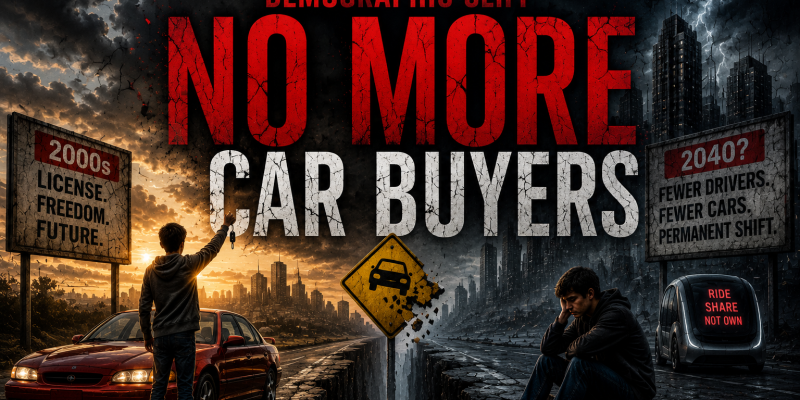
For almost a century, the American auto industry could depend on one simple emotional truth: every teenager wanted to drive.
A 16-year-old did not just want a license because it was practical. A license meant freedom, adulthood, status and escape. It meant the ability to leave home, meet friends, take a date out, get a part-time job, go to college, move to the suburbs and eventually buy a bigger car for a growing family.
That emotional cycle became the commercial engine of Detroit.
Every generation entered the same pipeline. They learned to drive, bought a used car, upgraded to a new one, got married, had children, bought an SUV, replaced it every few years, and kept the industry moving.
But analysts are now warning that this cycle may be breaking in a way the industry has never faced before.
In 2026, the U.S. auto industry is expected to sell around 1.5 million fewer vehicles than it did during its record years roughly a decade ago, and some analysts believe this is not a temporary slowdown but the beginning of a structural decline that could bring annual U.S. car sales down to about 13.7 million units by 2040.
The most frightening part is that the threat is not coming from one dramatic event.
It is coming slowly, quietly and mathematically.
Population growth in the U.S. has slowed and now depends heavily on immigration. If immigration tightens, the pool of future car buyers becomes smaller. At the same time, nearly half of 16-year-olds are not even getting driver’s licenses, which would have been almost unthinkable in an earlier American generation.
By the time many young people reach their mid-20s, they may want a car, but the economics are often brutal. New vehicles have become too expensive, insurance is costly, interest rates are painful, and the idea of buying a new car has moved out of reach for many younger and less wealthy consumers.
Then there is another problem that almost sounds like good news until you see what it does to sales.
Cars are lasting longer.
In 2025, the average vehicle on the road was a record 12.8 years old, which means people are holding on to their cars for longer instead of replacing them. In 2000, about 6% of cars were deregistered in a year, meaning they were scrapped, exported or taken off the road and eventually replaced. By early 2026, that figure had fallen to about 5%, and analysts believe it could fall further by 2040.
For consumers, a longer-lasting car is a blessing. For automakers, it is a warning. If fewer cars die, fewer new cars need to be born.
Technology is adding another twist. Modern vehicles are safer, smarter and packed with systems that did not exist 15 years ago, from collision avoidance to advanced driver assistance, but all that technology also makes cars more expensive. The industry has built better cars, but in doing so it may have priced out the very young buyers it needs for the future.
And then comes the biggest unknown: autonomous vehicles. If self-driving technology eventually becomes mainstream, the number of cars needed per person could fall. Robotaxis, shared fleets and autonomous mobility could mean that one vehicle serves many people instead of every household needing multiple cars in the driveway.
For an industry built on ownership, that is not just innovation. It is an existential question. The car was once the ultimate symbol of independence, but for the next generation, independence may mean not owning one at all.
This is why the coming crisis in the auto industry is not only about electric vehicles, batteries, software or China. It is about demographics.
Fewer young people entering the market, fewer teenagers getting licenses, fewer consumers able to afford new vehicles, fewer cars being scrapped, and possibly fewer vehicles needed per driver. The U.S. auto market will remain enormous, but the old assumption that every generation will automatically grow into car ownership is beginning to look fragile.
And if Chinese automakers eventually enter the U.S. market seriously, the competition could become even more brutal because more brands will be fighting for a market that may no longer be growing.
For 100 years, the industry assumed the next generation would grow up, get a license and buy a car.
The shocking question now is this:
What happens when the next generation grows up and decides that the dream of the open road is too expensive, unnecessary or already available through an app?
Statistics from the Internet. Karnvir Mundrey is the Editor of TheFutureOfPR.com. Reach out at tfofpr@gmail.com or at +918296303806.








Comments