
 By
By 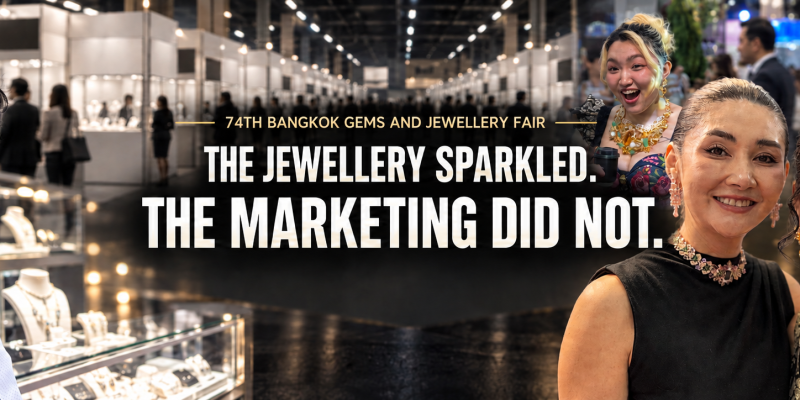
By: Karnvir Mundrey
At Bangkok Gems 2026, I found an industry rich in rarity, craftsmanship and family legacy, still communicating like a closed wholesale market.
The guard took my passport, photographed it, and handed it back without a smile.
No passport, no entry. Not even Thai citizens get in on a national ID card. “Any Tom, Dick and Harry cannot walk in,” an exhibitor told me later, and he meant it as reassurance. Behind those doors sat enough precious stone to fund a small country.

A place guarded this carefully, I thought, must be spectacular inside.
I had not come to Bangkok to buy a diamond. I was flying home to Bengaluru from a trade delegation to Vietnam, the routing gave me a stopover, and a quick search showed that the 74th Bangkok Gems & Jewelry Fair was running from 8 to 12 September at the Queen Sirikit National Convention Center.
Curiosity is considerably cheaper than a diamond, so I went.

The fair is enormous. It draws more than 1,300 exhibitors. The previous edition recorded THB 4.75 billion in trade and more than 40,000 visitors from 118 countries, and this year the organisers spread it across the entire convention centre. Gold, diamonds, rubies, pearls, silver, synthetic stones, machinery and packaging each occupy their own zones. It is less an exhibition than a temporary city, built around the human desire to make the earth sparkle.
I entered that city with one considerable disadvantage: I knew almost nothing about the gems and jewellery business.

That turned out to be an advantage.
An insider sees carat, cut, clarity, provenance and certification. An outsider sees hundreds of counters covered in small, glittering objects. I spend my working life in communications, and I walked in expecting theatre. Jewellery is the most emotional product human beings buy. It marks weddings, births, inheritances and apologies. Every culture that ever valued a stone gave it a myth before it gave it a price.
Instead, I found silence.
Row after row of glass cases under the same flat white light. A name board. A fascia. A stack of business cards. Perhaps a brochure. The loudest piece of marketing in the building was the free tote bag.

I have walked medical device exhibitions where companies selling syringes had more posters, more demonstrations and more case studies than anything I saw that afternoon. Put a syringe maker and a diamond house through the same communications audit, and the syringes would win.
The jewellery sparkled. The marketing did not.
This was not a problem with the products. The products were remarkable. It was a failure to translate specialist value into public meaning. And if every stall looks alike, price becomes the only story left.
So I carried one deliberately naïve question from stall to stall like a visitor’s badge:

How do I know your stone is better than the one at the next counter?
Every exhibitor had an answer, and every answer was better than their booth. By the end of the day, those answers had also dismantled the theory I walked in with.
The country nobody explained
My first conversation was with a trader from Myanmar.
I asked him what his country was best known for. The answer was brief. The stock he bought there was good. Business was slow. The price depended on the size.
What he did not say, because any professional buyer would already know it, is that Myanmar has given the world some of its most celebrated rubies. Many of them form in marble, which holds relatively little iron. That lets the chromium-driven red burn unusually intensely, and some of these stones fluoresce even in ordinary sunlight, as if lit from inside.
That is not inventory. That is a story about mountains, pressure, chemistry, light and national identity.
Unless the buyer already knows it, though, the stone remains a red object in a glass case.

The boy whose brother was in Tanzania
He could not have been more than a few years into the business. He handed me his family’s card and ran his finger down the three names printed on it: his father, his brother, and then, “The smallest one is me.”
His brother, he said, was in Tanzania that very week.
The family sells tanzanite, and as he talked, the stone turned into a story. It comes from essentially one place on Earth, the Merelani Hills in the shadow of Kilimanjaro, and the whole world buys from that single deposit. The rough travels to Jaipur, where the family cuts it. Its colour shifts with the angle of the cut and the light it is seen in. It sparkles like diamond and stands in for sapphire at a fraction of the price.
He put two stones side by side. A top-colour 7 mm round at about USD 125 per carat. A paler one at around USD 70.

To my untrained eye, they were both attractive blue stones. To him, the difference was obvious and commercially decisive. That gap, between what a seller knows and what a buyer understands, is exactly where marketing should work. It is where value is either created or lost.
I asked whether it was hard to run a mine-side operation in Africa from India.
“It’s risky,” he admitted. Then he smiled. “But we love this now. It has become our daily routine.”
Listen to what was packed into that five-minute conversation. Single-source scarcity. A family working across two continents. Indian craftsmanship turning African rough into finished gems. A luxury priced within reach. That is a complete brand story, and it arrived unrehearsed.
This particular stone already knows what a story can do. When it was found in 1967, its mineral name was blue zoisite, and the trade worried that it sounded too much like “suicide” at a shop counter. Tiffany & Co. renamed it after its only homeland and launched it with a promise that it could be found in just two places in the world: Tanzania, and Tiffany. It was a modern myth, built from exactly what this young man was telling me for free.

His booth said none of it. Stones. Prices. Nothing else.
I put it to him plainly. People in this industry put their effort into the stone, I said, not into the marketing.
He did not defend it. “We should,” he said, and then, more quietly: “I myself should.”
He showed me their one experiment. This season, they had printed a QR code on the brochure that opens their WhatsApp, LinkedIn and Instagram. They had planned a magazine too, but ran out of time.
“Next time,” he said. “In the February show.”
I would hear some version of that sentence all afternoon. The intent was there. The story was there. The time never was.

Tears sold by the gram
A few aisles on, I picked up a warm, honey-coloured piece from a tray.
“What is this stone?”
“Amber. From Poland.”
Baltic amber, he explained, from the coasts of Poland and Russia. When I mentioned the little amber shops near the bridges of Prague, he waved them away. Buy it in Poland, he told me firmly. That is where it is made properly. Prague is where the tourists pay extra.
After that, the conversation broke into fragments. “Not heated.” A price of USD 5.50, by the gram, as far as I could tell. “Twelve grams.” I held up one piece and asked what it was for. We circled the question, ran out of shared words, and gave up.

Strictly speaking, amber is not a mineral at all. It is an organic gem: resin from ancient forests, hardened and fossilised over tens of millions of years. Some pieces hold insects trapped long before there were humans to find them.
And once humans did find it, they could not stop telling stories about it.
The Romans said amber was grief. In Ovid’s Metamorphoses, the sisters of Phaethon weep so long for their fallen brother that they turn into poplar trees, and their tears harden into amber on the riverbank. On the Baltic shore, Lithuanians tell of Jūratė, a sea goddess who lived in an amber palace beneath the waves. She fell in love with a mortal fisherman. The thunder god Perkūnas shattered her palace in rage, and its pieces still wash up on the beach after every storm.
Two civilisations looked at this resin and saw heartbreak.
At the fair, it was sold the way you sell rice. By weight. No card, no placard, not one sentence in English that told a passing buyer what they held in their hand.
The jewellery industry does not suffer from a shortage of stories. It suffers from a failure to unpack them.

The man who almost quit
The best conversation of the day began with me being slightly rude.
He was a diamond professional based in Hong Kong, fourteen years with a Belgian-owned firm. I told him that to my untrained eye, his stall looked exactly like the one opposite.
He did not take offence. He took it as a brief.
“To an unknown eye, everything looks the same,” he agreed. “Sparkly.” Then he started taking the sameness apart.

He pointed to his fancy yellow diamonds. In the ordinary white range, he explained, a yellow tint is a flaw and pulls the grade down. In a fancy yellow, the colour is the attraction. Pinks, blues and reds are rarer still. For fancy colours, the logic runs in reverse: the stronger and purer the colour, the greater the value.
The certificates differ too, he said. He considers GIA more standardised than HRD, so two stones that look identical can carry different values.
I began to see a problem hiding inside his answer. Certification is essential, because a diamond’s most valuable attributes are invisible to an untrained eye. A report can say whether a stone is natural or lab-grown, treated or untreated, and where it sits on the scale. But a certificate is proof, not positioning. It can verify what a stone is. It cannot explain why this company deserves trust, why its cutters are exceptional, or why the piece belongs in someone’s life.
When every stall leads with near-identical trays and the same technical vocabulary, the certificate quietly starts doing the job positioning should do. And when the laboratory becomes the most recognisable name in the transaction, the seller has surrendered too much of the brand. Good public relations does not replace independent verification. It places that verification inside a larger story of origin, expertise, responsibility and meaning.

Then, almost casually, he gave me something I have never seen printed in any trade publication: a map of how the world buys.
In Hong Kong, buyers will take a smaller stone as long as it is the very best. Here in Thailand, and in Vietnam and Cambodia, they want the bigger stone, and grade matters less. Thai buyers stick to yellow, he said, because a small blue can cost as much as a fifty-carat white, and most would rather wear the big white. Australians shop to a spending limit. In America and India, everything sells. “Ambani will wear the top,” he said, “and there will be somebody for every budget.”
This was one man’s field experience, not a market survey. But the lesson matters. Luxury is not one universal language. One customer buys purity. Another buys size, another rarity, another the reassurance of a certificate, another the design a celebrity wore. Their media habits and cultural references differ too. The same story cannot speak equally well to all of them.
So how does he find customers?

“You knock doors, honestly. Cold calling. You go and show your sample.” He shrugged. “There is no secret.”
And how does anyone get into this industry in the first place? There is no campus route and no CV, he said. “There is a lot of trust process. Only if they trust you, they will give you a job.” His own way in was an uncle who knew the owner.
Then he told me something he did not have to. In his early years, he wanted to quit. The doors did not open. Nothing sold. “But once you see a little bit of success, you think you can do it. It is a waiting game.”
I left his stall with the whole operating system of this industry in my notebook. It runs on trust. And trust, for centuries, has travelled by introduction, not by poster.
“Sir, you know more about marketing than us”
India has a claim on diamonds that no other country can make. For roughly two thousand years, until finds in Brazil in the eighteenth century, the subcontinent was the world’s only known source. The Sanskrit word for diamond, vajra, is also the name of Indra’s thunderbolt, the weapon nothing could break. Today, India processes more than 90 per cent of the world’s polished diamonds by volume.
So it felt fitting that the diamond aisles were run largely by Indian family firms, most of them Gujarati and Marwari. These are the networks that built Surat’s cutting industry and the Indian presence in Antwerp, and they are among the most successful trading communities anywhere.
That success was not an accident. It rests on a model these communities understood better than anyone: family, reputation, patience, personal introductions and long memory. It moves tiny objects of enormous value across borders because one person knows another person who knows the family behind the counter.
A Gujarati trader selling machine-cut calibrated stones explained his edge patiently. Every stone is cut to the same specification, uniform in size and weight. That costs more than hand-milled goods, where each stone varies a little.

I told him I still could not see how a buyer tells one stall from the next.
“You don’t have that line, that’s why you don’t understand,” he said. “Like when I buy clothes. If I only look, it all looks the same. If I touch it, if I have the knowledge, then I know.”
It was a perfect answer. It was also, without his meaning it to be, the entire problem. The industry sells to people who already have the knowledge. Everyone else just sees glass.
When I pressed him on branding, the door closed politely. “We don’t do retail marketing here.” This is B2B, he said. The buyer across the counter judges the goods, not the display. If I wanted to see branding, “visit the Hong Kong show.”
Then, with disarming honesty: “Sir, you know more about marketing than us.”
I believed him. Then I walked to the next stall, and the story turned.
The twist
I asked the same tired question at the next booth. Do you build a brand?
“Yes,” the exhibitor said, without hesitating. “We have a brand.”
It is called Smiling Rocks, and they supply American retailers under that label. I looked it up that evening. It presents itself as a premium lab-grown diamond brand based in New York. A share of its sales goes to charity and it carries a sustainability certification. Its website features celebrities and influencers wearing its jewellery and a podcast on the industry and sustainability. Standing at the booth, the exhibitor had described exactly that playbook: lending pieces to recognisable people to wear at events.
By any standard, that is modern, values-led consumer marketing.
In Bangkok, the same people sat behind a plain glass case.

That was the moment my thesis cracked. I had walked in with a tidy theory: these are traditional family business houses that have not yet caught up with modern marketing.
It was wrong, and on reflection, a little lazy. These houses are perfectly capable of marketing; some of them do it very well on another continent. The truth is more interesting. The model that made them so successful was private, product-led, network-driven and wholesale. It never required them to explain themselves in public. In a closed market, buyers already spoke the language, knew the families and recognised the reputations. The stone and the handshake did the selling.
For a hundred years, that was a sound bet. The trouble with a relationship economy is that the trust inside it is invisible to everyone outside it.
That is now a problem. To explain why, I need to borrow a story roughly two thousand years older than this fair.
The jewel that needed a public hearing
The Bhagavata and Vishnu Puranas tell the tale of the Syamantaka.
The sun god Surya gives a nobleman named Satrajit a radiant jewel that produces gold every day. Satrajit’s brother wears it on a hunt, is killed by a lion, and the jewel vanishes into the forest.
Dwarka does what trading towns have always done when an asset goes missing. It gossips. Krishna had once admired the jewel, so the whispers settle on him.
Watch what Krishna does next. He is an avatar of Vishnu, and his word ought to be enough. He does not rely on it. He goes into the forest to establish provenance. He finds the dead lion. He follows the tracks into a cave. He fights the bear-king Jambavan, by most tellings for close to a month, and wins the stone back. Then he calls Satrajit to the royal assembly, returns the jewel in front of everyone, and tells the whole story in public.

The lesson outlived the Puranas. Around Ganesh Chaturthi, a popular belief holds that anyone who sees the moon that night will face a false accusation, just as Krishna did, and that hearing the Syamantaka story is the cure.
It is the finest piece of reputation management in Indian literature. Even a god understood that when doubt enters a market, trust has to be earned again, in public, with evidence and a story.
The halls of Bangkok still behave as if the word is enough. The exhibitors themselves told me why it no longer is.
The cracks in the old model
Trust keeps customers. It does not find new ones. Near the end of the day, I met a young Bangkok co-founder who had grown up around a family trade in blue stones. The business began small, with custom orders. The co-founder had recently finished a degree in gemology, and wants deep expertise rather than simply the ability to sell. The hardest problem, I was told, is not product or price. It is new customers. The regulars still come back. Strangers, with regional conflict and a softer economy, do not. The best channel is “direct contact.”
Relationship networks are superb at keeping people and poor at meeting them, and every business eventually runs out of people who already know its name. Today, jewellery companies are chasing international retailers, younger buyers and digital audiences who may never meet the founder. Personal trust still matters, but it has to be converted into scalable trust. That is the job of modern public relations. A founder’s history, a traceable supply chain and an honest explanation of treatments can begin the relationship before anyone knocks on a door.
The diamond is now competing with the iPhone. Older generations bought jewellery for life. It moved from parent to child and sometimes stayed in a family for a century. Younger buyers are used to replacement. A phone that costs a small fortune is exchanged every few years. Experiences compete with possessions. Locking money into an object that lives in a safe is no longer automatically persuasive.
The Gujarati trader described the shift precisely. The young buy jewellery for fashion, not for occasions, and not expensive diamonds. With gold where it is, they buy lab-grown stones, small rings for ₹5,000 to ₹10,000 and bracelets for ₹15,000 to ₹20,000. “Everything is online.”
fff
The pressure shows up in the numbers. In 2025–26, India’s exports of cut and polished diamonds fell 8.5 per cent to about USD 12.16 billion, following a year that had already been the weakest in two decades. The industry blamed tariffs, inventory corrections and soft demand, and its own export council described the year as a “structural reset.”

When the end buyer discovers jewellery on a phone, the retailer needs stories to sell, and the supplier who hands over that story wins the shelf. Silence at the wholesale counter travels all the way down the chain. An industry going through a structural reset cannot afford interchangeable brands.
The trade knows stories move money. It just outsources them. The same trader pointed out that when a celebrity wears a stone, demand follows. Emeralds, he said, had their moment after a famous Indian wedding. The most successful line in the history of this business, De Beers’ “A Diamond Is Forever,” written in 1947, was a myth composed on purpose. The industry understands the power of narrative perfectly well. It just waits for a film star or an advertising agency to supply it.
Lab-grown has turned the story into the product. A Thai founder who had built her diamond company over 33 years told me business had slowed with the economy, and especially with the rise of CVD lab-grown stones. The Hong Kong salesman was uncertain about the investment future of ordinary white natural diamonds, but confident about rare natural fancy colours. On lab-grown he was blunt: “You buy once. If you go to sell it again, it’s zero.”
That is a trader’s view, not financial advice. Jewellery is an illiquid, specialist purchase, and no seller can promise a resale price. But the market is moving in the direction he described. India’s polished lab-grown diamond exports fell by more than half in dollar terms last year even as volumes rose, a sign of prices still falling. The industry’s own referee has formalised the separation too. From 1 October 2025, GIA stopped describing lab-grown diamonds with the grading language it built for natural stones. It now classes them simply as “Premium” or “Standard,” reasoning that the overwhelming majority fall into a very narrow band of colour and clarity.
When technology can reproduce the appearance at a fraction of the price, a natural stone’s only real defence is everything the eye cannot see: origin, rarity, provenance, meaning. Repeating the word “natural” will not be enough. The Hong Kong salesman made that case brilliantly, to one visitor, in one conversation, because I happened to ask.
Discretion has hardened into silence. When I explained my work to the 33-year founder, she said gently that she was not very familiar with talking to media. She suggested I come back in the afternoon if I wanted to discuss publicity, and she declined a photograph. That was her right, and in a business of high-value goods, caution makes sense.
Nobody should want this industry to turn into a circus of LED screens and empty superlatives. Luxury has always depended on restraint. But discretion and invisibility are not the same thing. Being discreet about where your stones are kept is one thing. Being silent about why they are worth buying is another.
Imagine the same booth next February
When the gods and demons churned the cosmic ocean in the Samudra Manthan, one of the treasures that rose from the depths was the Kaustubha, the most brilliant jewel in creation. Vishnu did not lock it in a vault. He wore it on his chest, at the level of the heart, where every eye would meet it. The greatest gem in Indian cosmology is defined as much by where it is displayed as by what it is.
So picture the tanzanite booth at the February show.
A visitor stops. Before anyone speaks, a panel at eye level tells her what the young man told me in minute three: one hill below Kilimanjaro, one family across two continents, cut in Jaipur.
A small screen loops three shots filmed on a phone: the mine, the cutting wheel, and the glass case she is standing in front of. It is a documentary that takes forty seconds to watch.
Two stones sit side by side, one at USD 125 a carat and one at USD 70, with a card explaining exactly why. It covers colour, saturation, and the direction of the cut. Another card explains, in plain language, what the grading report establishes, what it does not, and what treatment changes. She now trusts the booth before she has seen a single sample.
On the counter sits a free two-page brief: How Asia Buys Coloured Stones, drawing on the kind of market knowledge the Hong Kong salesman carries in his head. It explains honestly how natural and lab-grown stones differ, without insulting the buyer who prefers either. She takes it back to her store, and she remembers where it came from.
She scans the QR code. This time, it leads somewhere worth going. A link is not a message. A QR code can take someone to a story, but it cannot make up for the absence of one. A week after the show, a short, useful note reaches her inbox. It is not a sales pitch.
And a week before the fair even opened, a trade journalist already had the family’s story. They wrote it, and the visitor read it on her flight in.
None of this requires glitz. It is not decoration applied after the real work. It is the translation layer between specialist value and public understanding. It begins with a handful of questions every exhibitor should be able to answer before the doors open:
- Where did this stone come from, and what was its journey?
- Who sorted, cut, designed and set it?
- What does the certificate establish, and what does it not?
- Has the material been treated?
- Why do two similar-looking stones carry very different prices?
- What is the honest difference between natural and lab-grown?
- What does this business stand for beyond moving inventory?
- Why should a buyer remember this company after seeing two hundred other counters?
Every exhibitor I met could answer most of these out loud. Almost none had written the answers down where a stranger could find them.
India polished the world’s diamonds. Now it must polish their stories.
There is an old Indian word for what these exhibitors do: ratnapariksha, the examination of gems. It was once a written discipline. Kautilya’s Arthashastra sets out how gems entering the treasury should be assessed, and later works such as Buddhabhatta’s Ratnapariksha and the gem chapters of the Garuda Purana recorded the knowledge of stones.
What is striking is how those texts begin. They do not open with a grading table. They open with a story.
The demon Bala, so the telling goes, gave his own body for a sacrifice of the gods, and wherever the pieces fell, gems were born. His bones became diamonds, his teeth pearls, his blood rubies. His bile, carried across the sky by the serpent king Vasuki and dropped on distant hills, became emeralds.
The ancient gemologists knew something the modern trade floor has forgotten. Before you teach someone how to judge a stone, you give them a reason to care where it came from.
I entered Bangkok Gems as an outsider, which let me ask the basic questions insiders may no longer hear. Why does this ruby matter? Why is one blue stone worth nearly twice another? Why should I trust this certificate? Why should a 25-year-old want an heirloom?
Every time I asked, someone had an answer. That may be the most frustrating part. This industry is not short of substance. Behind almost every counter were geology, migration, family, science, risk and ambition. The products were not alike. Only the presentations were.
I think about that guard at the door, photographing my passport. The fair has worked out, down to the last detail, how to keep the wrong people out. What it has not yet worked out is how to let the stories out.
This industry has spent centuries learning how to cut a stone so that it releases the light trapped inside. It now needs to do the same with its knowledge.
Value without explanation becomes price. Trust without visibility remains a private network. A stone can outlast a billion years; a brand cannot outlast invisibility.
India has polished the world’s diamonds for generations. The only question left is who will polish their stories: the family houses that actually know them, or the laboratories, which are already telling theirs.
Karnvir Mundrey is the Editor, and the Founder of Atharva Marcom and TheFutureOfPR.com. Reach out at tfofpr@gmail.com or at +918296303806.
Subscribe to TheFutureOfPR.com to get great ideas on life, education, health & fitness, real estate, glamour, jewelry, movies, and podcasts! Share this article with people who you think might benefit. They will thank you for it!
Follow TheFutureOfPR.com on Facebook & Twitter.
Karnvir Mundrey is also the producer and host of 4 YouTube channels. Finest Fintalk brings you the latest in Finance, LitInMin for Books, The Health Tips Podcast for health and Atharva Marcom for leadership talks








Comments