
 By
By 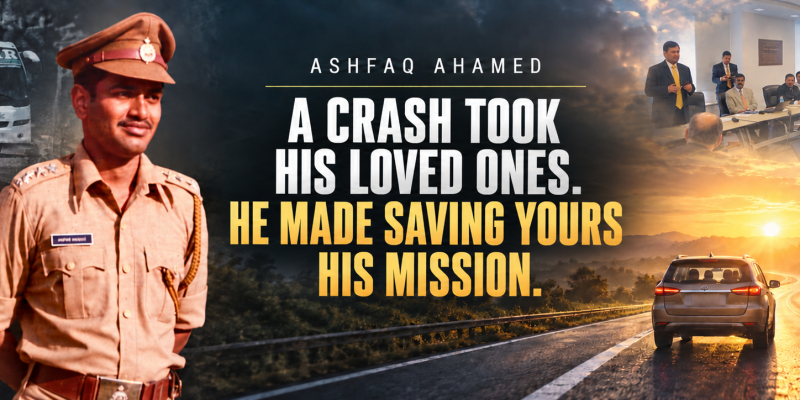
By: Karnvir Mundrey
Some lives are not built in grand moments. They are built slowly. Ashfaq Ahamed’s life is one such story.
His story does not begin in a grand office, on a public stage, or in a moment of recognition. It begins in 1958, in old Bangalore, in Yeshwanthpur, in a home filled with children, noise, discipline, scarcity, laughter and dreams.
He was the fifth among ten siblings.

Eight brothers. Two sisters. One father who worked hard. One mother who somehow held the house together. And in the middle of that crowded, demanding, beautiful world was a young boy who would one day spend nearly four decades inside the transport department – and then continue working for road safety long after retirement.
But to understand Ashfaq Ahamed, one must first understand the home he came from.
It was not a home of excess. It was a home of effort. His father, a civilian employee associated with the Air Force, had one quiet but powerful ambition: every child must be educated. In a family of ten children, that was not a small dream. That was a daily battle.
Fees had to be paid. Uniforms had to be stitched. Meals had to be prepared. Children had to be woken up, sent to school, brought back, made to study, disciplined, loved and protected.
His mother carried a load that is almost impossible to imagine today. Ten children, each separated by just a couple of years, all needing food, care, school, attention and guidance. There were no apps, no domestic conveniences, no modern systems of support. Just a mother’s endurance and a father’s determination.
And yet, every child studied. The result is that every sibling has one or two children living in the Us today.
That, perhaps, was the first lesson of Ashfaq Ahmed’s life: greatness is not always inherited through wealth. Sometimes it is inherited through sacrifice.
Ashfaq studied at Kendriya Vidyalaya, Hebbal,Bngalore, then known as Central School, inside the Air Force headquarters training command campus. The school fee was just one rupee. But what he received there was worth far more than money. The education was strong. The discipline was strict. The friendships were lasting. The foundation was so sound that, decades later, he still credits that school for giving him the confidence and English that helped him stand tall in his career.
There is one small memory that stayed with him forever.
His school uniform required a white shirt with two pockets. One day, by mistake, the tailor stitched his shirt with only one pocket. The school sent him back. His parents got another pocket stitched, but the cloth did not match. The school did not care whether it matched or not. The rule was simple: two pockets meant two pockets.
It sounds like a small incident. But small incidents often build large lives. That unmatched pocket became a symbol of a time when discipline mattered, rules mattered, and even a one-rupee school could shape children with seriousness and pride.
His childhood was also full of the sweetness of old Bangalore. He remembers walking from Yeshwanthpur to school, passing through the Indian Institute of Science campus when there were no restrictions. He remembers mango trees, guavas, rose apples, stolen fruit during breaks, friends who shared laughter, lunches that were sometimes just snacks bought with a few coins, and the joy of kali dosa, bakery biscuits and long walks home.
This was old Bangalore. A Bangalore of walking children, five-paisa bus fares, small bakeries, kali dosa, round “Om” biscuits, and friendships formed without phones, apps or social media.
There was little money, but there was life. There was discipline, but there was laughter.
There were ten children in one home, but also enough love to make a childhood unforgettable.
Then life changed early.
Ashfaq had initially followed a technical path. After Class 10, he chose a mechanical engineering diploma instead of a longer engineering degree, partly because his family was thinking practically. His elder brothers had already studied engineering and were planning to start an industry.
Then his father suddenly passed away due to cancer in 1977. The family’s plans shifted. Life demanded responsibility. When a father dies in a large family, something changes forever. Dreams become more practical. Choices become heavier. Youth becomes shorter. Responsibility arrives before one is fully ready for it.
Ashfaq moved forward. In 1978, he applied for the post of Motor Vehicle Inspector. He did not come from a family of government officers. He simply tried his luck. On November20, 1978, he joined government service.
What followed was not merely a job.

It became a 40-year journey through Karnataka’s transport system – Mangalore, Hassan, Madikeri, Bangalore, Tumkur, Bijapur, Belgaum, Gulbarga Kolar, , and back again to Bangalore. It was a career of enforcement, licensing, registration, accident investigation, court appearances, public interaction, and constant learning.
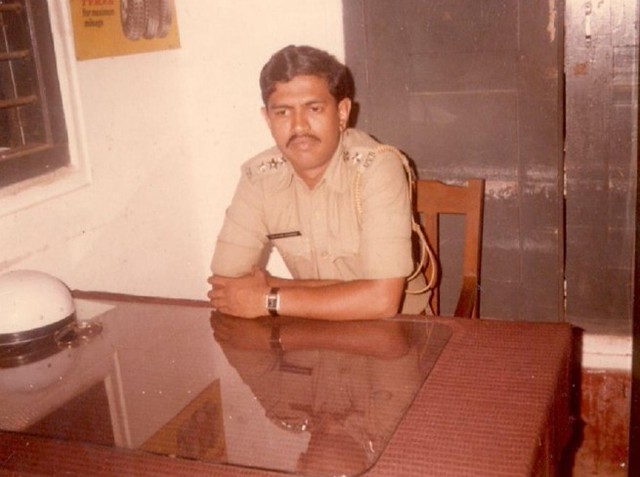
In the early years, he remembers the uniform feeling almost funny on him. But over time, that uniform became responsibility. It became public trust. It became the visible sign of a life spent enforcing rules that were not always popular, but were often necessary.
The offices were not glamorous. In Mangalore, where he was posted during his probation years, the office building was so poor that during heavy rains the young officers would sit holding umbrellas to protect themselves from rain coming in from behind.
But instead of bitterness, he remembers those days with fondness. They were young. They worked hard. They learned the system. They faced the public. They faced lawyers. They faced pressure. And they kept going.
That is the invisible side of government service – the side the public rarely sees. Behind every uniform is also a human being learning to survive with poor facilities, pressure from above, anger from the public, and the responsibility of enforcing laws that are often unpopular.
One of the striking aspects of Ashfaq’s career was his comfort with challenge. He enjoyed enforcement work because it required courage and clarity.
In his early enforcement days, he would stop buses carrying passengers beyond the permitted capacity. He would count the excess passengers, record the case, take the driver’s and conductor’s signatures, issue notices and later appear in court.
The courtroom was its own battlefield. Advocates would cross-examine him sharply. They would suggest he had booked false cases to meet monthly targets. They would ask how he knew there were ten extra passengers. They would challenge whether he had touched each person’s head and counted them physically.
Ashfaq would not bend.
He had counted. He had recorded. He had checked the licence details. He had noted the time and place. If a senior officer or colleague was with him, he took their signature as witness. He understood something very early: in public service, truth must be supported by documentation. A weak officer may panic in court. A prepared officer stands calmly.
Many of those cases ended in conviction with fines because he had done the work properly. He was not easily shaken. That firmness came from preparation. He knew that if the facts were right, he had nothing to fear.
It is a lesson many young officers can learn from: confidence does not come from arrogance; it comes from doing your work properly.

That was one side of his work – enforcement. Another side was accident investigation.
He remembers a horrifying case involving a lorry carrying a massive rock. The vehicle went down 200 to 300 feet and broke into pieces. The steering system, brake system, engine, suspension, wheels – everything was scattered and damaged. Normally, after an accident, officers would test whether the brakes, steering and mechanical systems were roadworthy. But in this case, the vehicle was so completely destroyed that no mechanical opinion could honestly be given.
So Ashfaq did what an honest officer must do. He did not invent certainty. He recorded the damages and wrote that no opinion could be furnished because the vehicle was not mechanically fit for testing.
That is another lesson from his life: honesty is not only about saying what you know. It is also about admitting what you cannot know.
One of Ashfaq’s most telling incidents involved a drunk driver at a border check post. In those days, officers did not have modern breathalysers and equipment. But they could make out when someone was drunk. One night, a man was stopped. Ashfaq realised he was intoxicated.
He had a choice. He could have formally booked a case, prepared a memo, taken him to a hospital for medical examination and followed the full process. But at that hour and location, facilities were limited. So he made a practical decision.
He detained the vehicle and made the driver wait for several hours until the alcohol level reduced and he was fit to go. The purpose was not to punish for the sake of punishment. The purpose was to ensure he did not kill himself or someone else on the road.
There is a deep humanity in that moment. A rigid officer might only see a violation. A careless officer might let him go. Ashfaq saw the danger – and chose prevention. That is what road safety really means: stopping a tragedy before it becomes a statistic.
But the deepest turn in Ashfaq Ahmed’s life came not from a promotion or posting.
It came from tragedy.
In 1982, while he was attending a road safety conference in Jaipur, his sister, brother-in-law and their children were travelling between Abu Dhabi and Dubai. They met with a terrible accident. Out of five people in the car, four died on the spot. One child survived with severe injuries and remained in a coma for months.
Some tragedies break people. Some tragedies give them a mission.

For Ashfaq, that accident intensified an already existing interest in road safety. It made the subject personal. Road safety was no longer a government file, a department activity, or an annual awareness program. It was life and death. It was family. It was grief. It was memory.
From that point onward, he immersed himself deeper into accident investigation, safety systems, vehicle fitness, enforcement, training and awareness. He was the only person to be selected from India for a sponsored training program at Hasselt University in Belgium. He visited Germany, Austria and other countries. He saw Mercedes-Benz and BMW. Later, he took a group of 16 officers from India to the United States for a three-week training program in Scientific crash investigation & Re-construction. They returned as certified crash investigators. He attended road safety conferences in Australia – Sydney, Perth – and also travelled to China.
This was not the path of a typical retired government servant. This was the path of a man who kept asking: how can we save more lives?

One of the most devastating investigations of his career involved a night bus travelling between Bangalore and Hyderabad on 30/10/2013 at Palem, Mahaboobnagar District, Andhra Pradesh. The bus caught fire in the early hours of the morning. Out of 44 passengers, 42 were burnt alive.
Ashfaq was part of the committee that investigated the accident. Imagine standing before the remains of such a bus. Imagine seeing the seats where people had been sleeping. Imagine knowing that within 10 to 15 minutes, an ordinary journey became a death trap.
He inspected the bus. He saw that the engine block had melted because the heat was so intense. He checked the warning system. The alert message was in English. When he interviewed the driver, he found that the driver did not understand English enough to recognise what the warning meant.
Then came another painful issue. The bus was a long multi-axle vehicle, but it had only one door in front. Ideally, such a long bus should have had another entry and exit. But an extra door would have meant losing passenger seats. In the end, seats were valued over escape.
That is not just an engineering failure. It is a moral failure. When a design saves three seats but traps forty people, the question is not technical. The question is human.
What is the value of a passenger’s life?
Ashfaq raised uncomfortable questions. He questioned why the bus was Volvo manufactured that way. He questioned why safety was compromised. But he also saw how institutions often avoid accepting painful truths.
That is the loneliness of an honest officer. Sometimes you see the truth clearly. But the system looks away.
He also inspected other bus fire cases. In one case near Davangere, people survived, but many suffered fractures after jumping out. The bus had hit a culvert. He noticed unauthorised extra fuel tanks added for long-distance travel. When the impact happened, the diesel tank burst and the bus caught fire.
These were not random accidents. They were the result of unsafe modifications, commercial shortcuts and poor respect for safety.
Again and again, Ashfaq’s work revealed the same lesson: accidents are not always accidents. Many are consequences. Consequences of speed. Consequences of greed.
Consequences of poor design. Consequences of weak enforcement. Consequences of ignored warnings. Consequences of citizens and operators believing that rules are obstacles rather than protection.
Behind every accident statistic, there is a design decision. A cost decision. A language decision. An enforcement failure. A human failure.
Ashfaq understood this deeply.

That is why he refuses to see road safety as one department’s responsibility. For him, it is multi-sectoral. Transport, police, medicine, engineering, vehicle manufacturers, road designers, schools, colleges, parents and road users – everyone has a role.
He speaks of India’s road safety challenge with realism. Roads have improved. Vehicles have improved. ABS, ADAS, penalties, helmet rules, seat belt campaigns, black spot identification and digital systems have all come in. But deaths remain high. India still loses a frightening number of people every year on the roads.(1,70,000 Annually)
He points to one major Indian reality: two-wheelers. No other country has India’s scale of two-wheeler dependence. When 75 to 80 percent of the vehicle population is two-wheelers, the risk profile of the nation changes completely. Helmets are not accessories. They are survival devices. Pillion riders are not exceptions. They are equally vulnerable.
He also has strong views on driving licences. He believes the licensing process has improved with automated tracks, CCTV recording and computerised testing. But he worries about people who fail tests and then try to influence, bribe or find shortcuts instead of learning properly.
His words to people seeking driving licences are powerful: If you can drive, you will pass. If you cannot drive, you should not force yourself to pass. Nobody is going to save your life on the road. You are in charge of it.
That single idea could save thousands of lives. It is more than traffic advice. It is life advice. Do not fake readiness. Do not buy competence. Do not use influence to enter a space where your ignorance can kill you or someone else.

After retirement, Ashfaq did not withdraw into private life. He continued his mission through the All India Federation of Motor Vehicles Department Technical Executive Officers Association. Having been associated with it for about 25 years, he rose from member to public relations officer, vice president and eventually president – a role he has held for around 15 years. He and the federation played key role in drafting the Motor Vehicle amendment Bill 2019.
Under this platform, he has helped conduct road safety programs across India, training programs for inspectors, awareness programs in schools and colleges, and “road safety ambassador” initiatives. The federation also recognises officers doing meaningful work through Road Safety Excellence Awards and Transport Enforcement Excellence Awards.
He even helped build bonds among officers through the Transport Premier League, a cricket tournament involving teams from various states. For him, road safety is not only about laws and penalties. It is also about community, morale, friendship and professional pride. Systems are not improved only by rules. They are improved by networks of committed people.

But Ashfaq is not blind to the difficulties officers face. He speaks with pain about transport officers killed during enforcement. One officer, Rajendra Singh, was hit by an underage e-rickshaw driver and later died. Another, Naresh Parwal, was allegedly run over by a trailer after issuing a fine. A district transport officer in Telangana was killed while dealing with an overloaded coal vehicle.

These are not just “department incidents.” They are reminders that enforcement officers also stand on the front line of public safety. Sometimes they are the people standing between law and chaos. Sometimes they are the people who stop an overloaded vehicle before it kills someone. Sometimes they are the people who face anger, violence and death because they are trying to make roads safer.
Yet Ashfaq’s message is not anti-public. Quite the opposite. He believes officers must be people-friendly. They must know the law. They must stay updated. They must guide citizens properly. They must not make people run around unnecessarily. If something is legally possible, do it. If it is not possible, say no clearly. That is the dignity of public service.
To the public, his advice is equally clear: do not take shortcuts. Do not depend blindly on agents. Do not fall for false promises of tax reduction, special numbers, shortcuts or fake websites. The system is becoming increasingly digital and transparent, and citizens should use official channels, emails and grievance mechanisms instead of wrong routes.
In his words, the best way is not to go the wrong way. That sentence carries the wisdom of an entire life. It applies to roads. It applies to government work. It applies to public dealing. It applies to life.
In many ways, Ashfaq Ahamed’s life is a story of old India meeting new India.
He came from a world of one-rupee school fees and five-paisa bus rides. He served in offices where young officers sat with umbrellas during the rain. He investigated accidents before mobile phones, digital records and modern equipment. He then witnessed the rise of Vahan, Sarathi, online payments, faceless services, automated driving tracks and digital transparency.

Through all these changes, one thing remained constant: his belief that public service is service. Not power. Not status. Not harassment. Just service.
Ashfaq Ahamed’s journey reminds us that a meaningful life is not always about fame. Sometimes it is about doing one’s duty so consistently that duty becomes legacy.
He did not start out wanting to become a road safety crusader. He became one because life showed him the cost of unsafe roads. He saw families destroyed. He saw buses burnt. He saw children orphaned. He saw officers die in the line of duty. And instead of looking away, he kept working.
That is what makes his story inspiring.
He is not a celebrity. He is not a politician. He is not a man chasing applause. He is a man who spent nearly four decades inside the machinery of government and still came out believing that systems can improve, officers can serve better, citizens can act wiser, and lives can be saved.
In a country where road deaths are often reduced to numbers, Ashfaq Ahamed reminds us that every number has a name. Every accident has a family. Every rule has a reason. And every responsible citizen, every honest officer, every trained driver, every helmet worn, every seat belt fastened, every unsafe vehicle taken off the road – is part of a larger national duty.

His life leaves us with a simple but powerful lesson: Do your work sincerely. Keep learning. Stand by the truth. Serve people. And when tragedy enters your life, turn your pain into purpose.
Some people leave behind wealth. Some people leave behind titles. Some people leave behind buildings. Ashfaq Ahmed leaves behind something far more valuable – a warning, a lesson and a hope.
The warning: roads can kill when we become careless. The lesson: systems improve only when honest people keep pushing. The hope: one sincere life can still save many unknown lives.
He began as a boy from Yeshwanthpur. He became a public servant. Then he became a voice for road safety. And perhaps that is the most touching truth about him: Ashfaq Ahamed did not spend his life chasing recognition. He spent it trying to make sure strangers reached home alive.
That is the legacy of Ashfaq Ahamed.
Ashfaq Ahmed retired as RTO Yeshwantpur. He is currently President of the All India Federation of Motor Vehicles Department Technical Executive Officers Association and a committed advocate for safer Indian roads. Following the loss of loved ones in a crash, he turned personal grief into a mission to protect others. With a background in Karnataka’s transport administration, his work spans RTO technical matters, transport practices, and nationwide road safety awareness. Today, he champions initiatives including Vision 2030-Zero, bringing attention to the urgent need to prevent road deaths. His story combines professional responsibility with deeply personal purpose: helping ensure more people return safely to their families daily.
Karnvir Mundrey is the Editor, and the Founder of Atharva Marcom and TheFutureOfPR.com. Reach out at tfofpr@gmail.com or at +918296303806.
Subscribe to TheFutureOfPR.com to get great ideas on life, education, health & fitness, real estate, glamour, jewelry, movies, and podcasts! Share this article with people who you think might benefit. They will thank you for it!
Follow TheFutureOfPR.com on Facebook & Twitter.
Karnvir Mundrey is also the producer and host of 4 YouTube channels. Finest Fintalk brings you the latest in Finance, LitInMin for Books, The Health Tips Podcast for health and Atharva Marcom for leadership talks









Comments