
 By
By 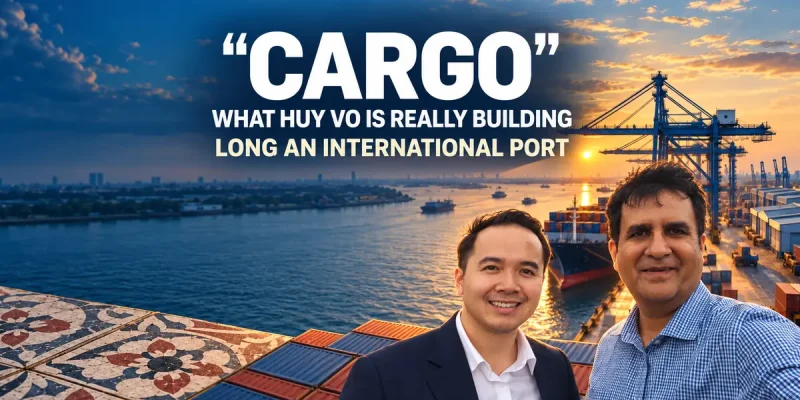
By: Karnvir Mundrey
Long An International Port has seven berths, twenty-four cranes and a million square metres of yard. What it doesn’t have is ships. A morning with Võ Quốc Huy – third generation of the family that built it – on the hardest inheritance in Vietnamese business.
The sky had turned the colour of wet cement.
We were standing at the edge of the quay, the delegation strung out along the berths, and Huy Vo was watching the weather the way a farmer watches it.
“Hopefully it doesn’t rain,” he said. “Because when it rains, we have to stop operation.” I asked why. It seemed a fair question from someone whose business is words rather than cargo. “Because it’s dangerous. With the rain comes the wind. First, it could damage the goods. Second, it’s for safety.” Then, almost as an afterthought: “If it doesn’t sell today, it’s a wasted day. If it rains, it’s a wasted day.”
Eleven words. They contain the entire distance between the business his family built and the business he now runs.
In manufacturing, inventory waits. In logistics, time expires.

One word, no varnish
A little later I asked him the question I put to everyone who runs a large asset. What is the hardest part of the job?
“Cargo,” he said. One word. No corporate finish. No attempt to convert an operating problem into a slogan. Look around and the answer seems absurd. Seven berths. Six ship-to-shore cranes, eighteen rubber-tyred gantries. A million square metres of warehouse and yard, some of it bonded. Roads, a container stack, and behind it all a horizon of industrial land. Roughly twelve thousand billion đồng of concrete and steel, finished and waiting.
But a port is not successful because it has cranes. It succeeds when ships call on a schedule, when exporters trust that schedule, when boxes move in both directions, and when thousands of separate commercial decisions start converging on the same patch of river.
Long An International Port has finished the visible work. Huy is now doing the invisible work – and that is the actual story here. His grandfather inherited nothing. His father inherited a brand. Huy has inherited a completed asset that does not yet do what it was built to do, and the thing he has to manufacture cannot be poured or welded.
He has to manufacture demand.

It began with a tile
Not with ships. With a tile.
On 25 June 1969, in Phú Định village in District 6 of what was then Saigon, Huy’s grandfather Võ Thành Lân registered a trademark called Đồng Tâm and began making cement floor tiles by hand. Six years before reunification. The country he was building a consumer brand in did not yet exist in its present shape.
From there: ceramic and granite, paint, concrete, roofing, sanitary ware, plastic doors. Factories in Long An, Quảng Nam, Hải Dương. Exports to twenty-nine countries. In 2003, a 302-hectare industrial park at Thuận Đạo.
The second generation is where the story becomes properly Vietnamese. Võ Quốc Thắng, born December 1967, took a business degree at the Université du Québec à Montréal, restarted the family brickworks with his siblings in 1986, incorporated the company in 1993, and later sat as a National Assembly deputy.
Across Vietnam, though, he is simply Bầu Thắng. Boss Thắng. Because of football.
This is not a footnote. In 2001 Đồng Tâm took over the Long An provincial team and turned it into the first genuinely professionalised club in the country. Under the Portuguese coach Henrique Calisto, who stayed eight years, Đồng Tâm Long An won the V-League in 2005 and 2006, finished runner-up three times, and collected the Cup and Super Cup along the way. In 2011 Thắng was elected chairman of VPF – the company that runs the professional league itself. Then he chaired Kienlongbank, listed it in 2017, and gave up the bank chair in 2018 when a change in the law forced him to choose between the bank and Đồng Tâm.
He chose Đồng Tâm.
Read that sequence again and a family method appears. Enter an unglamorous sector. Professionalize it faster than the incumbents. Hand it on.
Tiles. Football. Banking. Now ports. At the port, Huy pointed at a photograph on the wall.
“That’s my grandpa,” he said.
Handmade tiles to seventy-thousand-tonne ships in three lifetimes. It is a magnificent inheritance. It is also a trap, and the trap is this: family businesses talk about legacy as if succession were itself the achievement. But inheriting an asset and making it productive are different jobs. Shipping lines are indifferent to surnames. Cargo owners care about cost, transit time, and whether the vessel actually turns up.
What impressed me about Huy was that he clearly knows the difference.

Land and trees
The port began as somebody else’s abandoned file.
The scheme dates to 2002, when the old Long An provincial authorities approved an infrastructure plan for around 1,500 hectares at Tân Tập. Nothing happened for a decade. In 2012 Dong Tam took over the port and industrial area.
Huy supplied the part the corporate history leaves out. It had been a provincial joint venture, and the Vietnamese partner walked. Dong Tam was already invested in Long An, already knew construction materials, already ran an industrial park. The province asked them to carry it alone.
Building started in 2015 in conditions that would have deterred most investors – no access road, electricity and water for the site brought in by boat.
“So it was like, just land and trees,” Huy said.
The first berth opened in early 2017. Today there are seven, running continuously for 1,670 metres, taking vessels up to 70,000 DWT and container ships up to 4,000 TEU. The next phase goes to nine berths and 2,368 metres – the longest unbroken quay in Vietnam – with a dedicated LPG berth, floating anchorages and a cruise terminal, designed for ships of 100,000 DWT.
That last number belongs to the future, not to today.
And the cargo has come, steadily: 350,000 tonnes in 2018. Over 1.4 million in 2020. 2.2 million in 2023. More than four million in 2024. Seventeen million tonnes cumulatively.
So the port is not empty. It is under-full, which is a different and more interesting problem.

Where the land meets the water
Long An sits on the Soài Rạp channel, at the junction of several economies at once – Ho Chi Minh City, the Mekong Delta, the southeastern industrial belt, and increasingly Cambodia.
It keeps the Long An name, but Long An province no longer exists. Vietnam’s 2025 administrative reorganization folded it into an enlarged Tây Ninh. The port now carries the name of a place that has been erased from the map, which is either an accident of branding or an unusually good metaphor, depending on your mood.
That meeting of land and water has a mythic place here.
In the origin story of Lạc Long Quân, dragon lord of the sea, and Âu Cơ, the mountain fairy, a hundred children hatch from a hundred eggs. When the two part, fifty follow their mother into the highlands and fifty go down to the water with their father. Vietnamese still call themselves con Rồng cháu Tiên – children of the dragon, grandchildren of the fairy. The split is the point of the story. The country has always understood itself as having a mountain half and a sea half, and as owing something to both.
Đồng Tâm spent five decades in the earth half of that inheritance. Clay, kiln, cement, tile. The third generation has taken the family down to the water.
There is a second myth worth knowing, and it explains the rain. Sơn Tinh and Thủy Tinh, Mountain Lord and Water Lord, fought over a king’s daughter. The mountain won. The water never accepted it. Every year Thủy Tinh raises the rivers and hurls storms at the highlands; every year he loses; every year he comes back. It is Vietnam’s explanation for the monsoon – not weather, but a grudge.
At a modern port the contest is settled with forecasts and shutdown rules rather than magic. The older truth survives: water is simultaneously Vietnam’s highway and its hazard.

The one sentence that is actually different
Every port pitch sounds identical until you find the differentiated sentence. At Long An it is this: the land behind the port belongs to the port.
“What’s different about us is that here’s the port, and the land behind the port, the industrial part, belongs to us as well.”
The berths are one component of a 1,935-hectare Dong Tam master project – seaport, industrial park, services, urban. That integration is the business model, not any individual crane.
A normal industrial park makes cargo and then hunts for a workable port. A normal port waits for cargo made somewhere else. Đồng Tâm put production, storage, services and sea access inside one estate. Factory near warehouse. Warehouse near yard. Yard near ship.
From tiles they learnt manufacturing. From industrial parks they learnt how clusters form. The port is the attempt to wire both to the world.
The second half of the argument is aimed at Cát Lái, the incumbent container gateway in Ho Chi Minh City. Cargo going that way meets congestion, truck curfews, an infrastructure charge for entering the city’s port area, and a queue nobody can forecast. Long An may be marginally longer in kilometres, Huy conceded without prompting, but it is shorter in variance. No city to cross. No restricted hours. No infrastructure fee. No wait at the gate.
Shippers do not buy distance. They buy certainty.

Forty per cent
Which brings us back to the one-word answer.
Huy told a room full of foreign business people that his port runs at roughly forty per cent of capacity.
He then told them there is no established feeder link to Singapore or Port Klang; that Malaysia would need transshipment; that there is no service to Australia; that they hold no licence for liquid cargo; that there is no petrochemical warehousing; and that the container service so far is domestic only.
Any of it could have stayed on a slide. None of it did. When a Brazilian delegate asked about liquid bulk, the answer was: we don’t have the licence, berths eight and nine are in the approvals pipeline, and if you bring us a specific demand, we will make the case to the government to build it.
That is not weakness dressed as strength. That is a man telling potential customers precisely what he needs from them in order to justify the next tranche of capital expenditure.
It is the difference between selling a port and recruiting one into existence.
The heir who took the operating job
The room, I think, assumed it was being hosted by a career executive. It was not.
Võ Quốc Huy was born in 1991. He became chairman of Long An Port JSC in November 2021, at thirty. He did his undergraduate degree at Northeastern in Boston and an MBA in Michigan. He did not walk from a foreign campus into a ceremonial chair, either: assistant to the chairman, internal control, the group’s trading arm, business operations, vice-chairman of the port company.
His elder brother, Võ Quốc Lợi, born 1988, took the conventional route – London Business School, then deputy general director at Kienlongbank. Banking for the first son. Steel and water for the second.
Huy came to the port from selling tiles, and he was frank that the switch was harder than changing offices. “It’s not like manufacturing and putting it on the shelves for customers. Here we provide a service, not a concrete product.” But here is the part nobody mentioned, and the part I only found afterwards.
The port deliberately imported senior expatriate operators. In July 2022 it hired Peter Hendrik Slootweg as CEO – Dutch, formerly chief commercial officer at Busan New Container Port, before that global sales general manager at Maersk Line. In February 2023 it added an Australian COO with twenty years across China, Nigeria, Oman, Peru, Sri Lanka and Saudi Arabia.
By 2026, Huy is listed as Chairman and Chief Executive Officer.
Somewhere in between, the Maersk veteran left and the founder’s grandson took the operating chair himself. An heir who could have sat above hired professionals has instead put his own name on the daily performance of the family’s single largest asset, in his mid-thirties, at forty per cent utilisation.
That is either confidence or exposure. Probably both.
One truck, going home empty
Picture a truck leaving a factory in Tây Ninh with a full container.
It reaches a port. It unloads. Then it drives all the way back with nothing in it, because nobody has told the driver that a shipment is waiting eleven kilometres away, and because the empty box he needs is sitting in a depot on the wrong side of the province.
Multiply that by a few thousand firms, and you have southern Vietnam’s logistics economy.
This is the problem Huy took to the stage at the September conference on connecting Tây Ninh’s import-export supply chains – an event convened by the provincial People’s Committee with the Ministry of Industry and Trade, drawing around 650 delegates including 178 foreign companies from 27 countries. Nearly forty of them came out to the port afterwards. I was one of them.
His proposal is a single continuous corridor:
Cambodia and ASEAN → Tây Ninh’s border gates → logistics centres and industrial parks → Long An International Port → international markets.
The province is unusually well placed for it. More than 369 kilometres of Cambodian border. Four international border gates. Fifty-one industrial parks and sixty industrial clusters. Logistics demand spread across roughly four thousand businesses. Conference reporting put Tây Ninh’s 2025 import-export turnover at about $31.4 billion, of which $17.8 billion was exports.
Enormous volume. Almost no coordination.
So Huy wants the province, the parks, exporters, warehouses, hauliers and the port to build a shared map – cargo by location and commodity- so that scattered loads can be consolidated into regular two-way runs by road and barge. Alongside it, a shared digital layer, so that businesses, depots, customs, logistics centres and the port can all see the same cargo at the same time.
The port would stop being the place the journey ends. It would help organise the journey.
The same logic drives his call for an early legal framework covering Vietnam–Cambodia transit cargo. Get the rules and the volume right and goods flow from Cambodia through Tây Ninh to the sea, with imports travelling back along the same road. Balanced flows are what stop trucks going home empty.
The port’s own account of the proposal put the commercial reality in a single sentence, and it is the best line anyone connected with this project has produced:
“It is not enough to attract shipping lines to Long An International Port. More importantly, we need sufficient cargo volumes to keep them here.”
Ships follow cargo. Cargo follows reliability. Reliability follows coordination.
Built ahead of its network
Forty per cent utilisation sits oddly beside $31.4 billion of provincial trade – until you realise the contradiction is the opportunity.
The region is not short of goods. The goods are dispersed, contracted to established routes, or already flowing through Cát Lái and Cái Mép–Thị Vải. Long An was built ahead of the network required to fill it.
That is a genuine risk, and worth naming plainly. Cranes consume capital years before shipping behaviour changes. Incumbent routes have gravity: forwarders know them, lines schedule around them, exporters will not experiment unless frequency is dependable. The stated target of one million TEU and ten million tonnes by 2030, set against four million tonnes and no international container service, is a steep climb.
What makes Huy’s work interesting is that he is attacking the problem at the right altitude. He is not waiting for a shipping line to solve it for him. He is trying to assemble the cargo, the government support, the customs arrangements, the industrial-park buy-in, the data and the two-way economics that make a route survive its first year.
The inherited asset is the port. The task of the third generation is to create its network effect.
Diesel
Long An is also building the invisible infrastructure – terminal operating systems giving live visibility of cargo and paperwork, SAP S/4HANA, an e-port platform, warehouse management, solar across the warehouse roofs, electric cargo-handling equipment.
In July 2026 it became the first Vietnamese port to win Frost & Sullivan’s Asia-Pacific Smart Green Port Company of the Year, announced while its team was at ASEAN Ports & Logistics in Kuala Lumpur. A year earlier it was the first Vietnamese company to take the International Bulk Journal’s People Development Award. And it has been chosen as host port for ASEAN Ports & Logistics 2027, in Ho Chi Minh City next March.
Then somebody asked about electric trucks.
The trucks, Huy said, are diesel. Electric heavy vehicles are still a developing field in Vietnam. Charging infrastructure is not there. Efficiency is not there. The industry has not invested. They are exploring it. They have not done it.
That answer made the green claim more credible, not less. Serious transformation starts by separating what has been achieved from what is still hard.
The empty column
Here is a list.
Port of Portland. Port of Gothenburg, the largest in Scandinavia. Port of Kobe. Oakland. Long Beach. The Bohai Bay cluster and SPG in China. OPASCOR in the Philippines.
The Portland memorandum was signed in September 2025 at the previous edition of the Tây Ninh forum, and the Oregon side treated it as a policy win – a state legislative trade caucus reported it back to a House committee alongside a reported two-billion-dollar Vietnamese commitment to buy American agricultural products. The Kobe agreement came out of a Tây Ninh provincial delegation to Japan led by the Party Secretary.
This is not an operation that struggles to make friends abroad.
So I asked Huy about India. We are pouring billions into Mundra and JNPA. Both countries are rewiring supply chains around the same tariff turbulence. Was there scope for a port-to-port partnership?
His answer was as short as the one about cargo.
They had never had a meaningful opportunity to work with an Indian port – or with Indian industry at all. They were open to it. They were happy to explore it.
American, Nordic, Japanese, Chinese, Filipino counterparties. Indian counterparties: none.
That is not a capability gap. It is an attention gap, and attention gaps close the instant somebody shows up. Long An sits beside one of Vietnam’s most productive regions, with Delta access and a potential land-sea corridor into Cambodia, handling precisely the cargo classes where Indian trade with Vietnam is thickest – agricultural produce, food, construction materials, machinery, project equipment, containers.
But Huy’s own argument is a warning against ceremonial partnership. A memorandum and a photograph will not create an India–Vietnam service. It has to be built on identified commodities, identified buyers, consolidated volume and dependable two-way flow.
So the useful question is not whether an Indian port can sign an agreement with Long An.
It is: what cargo can both sides organise well enough to justify a continuing route?
The template already exists. Kobe came from a provincial government delegation with the port as commercial anchor. Any serious Indian engagement would need the same shape.
Somebody should make that trip.

The coffee
The visit ended the way the best ones do, with something not on the agenda.
“We don’t have any presents,” Huy said. “We cannot send you containers to take home. So we have a small gift. Coffee from Vietnam.”
The brand is Ông Bầu – Vietnamese slang for a sports-club patron. Three men founded it in 2019, and each of them owned a football club: Tran Hai of NutiFood, Đoàn Nguyên Đức of Hoàng Anh Gia Lai, and Võ Quốc Thắng of Đồng Tâm.
“And then Mr. Thắng, chairman of Dong Tam Group,” Huy said, “who is also my father.”
Then, without emphasis: “I’m the third generation in the business.”
What stayed with me
Ports invite grand language. Gateways. Hubs. Engines of growth. Standing among the cranes it is easy to believe scale alone guarantees anything.
The most convincing thing about Huy Vo was the opposite of grandeur. It was his willingness to name the unglamorous constraints out loud, to a room of strangers, several of them potential customers: irregular cargo, empty return legs, container imbalance, rain delays, missing routes, missing licences, diesel trucks, and the difficulty of persuading businesses that already have a perfectly good alternative.
He also understands that the port cannot win alone. It needs the province, customs, the border gates, the factories, the parks, the warehouses, the truckers, the barge operators, the exporters, the lines and the buyers to behave as one system.
Which closes the family circle rather neatly. Đồng Tâm means something close to of one heart – people bringing their effort and purpose together. A port may be the ultimate test of that idea. Nobody manufactures a trade corridor alone.
In 1969 his grandfather made cement tiles by hand. His father built factories, a brand, an industrial park and a football club. Huy’s generation is trying to connect all of it to ships, data and markets across borders.
Ten years ago this was land and trees. The cranes are already there. The next inheritance he is building is not made of concrete. It is a network.
And the rain, incidentally, held off. The tour went ahead.
Nobody lost a day.
Karnvir Mundrey visited Long An International Port with an international business delegation following the 2026 Tây Ninh supply chain conference. Quoted remarks are from the author’s conversation with Võ Quốc Huy and the delegation Q&A. Corporate history, ownership, port specifications, throughput figures, provincial trade data, award details and the May 2026 commune progress report have been verified against Vietnamese and international public sources.
Karnvir Mundrey is the Editor, and the Founder of Atharva Marcom and TheFutureOfPR.com. Reach out at tfofpr@gmail.com or at +918296303806.
Subscribe to TheFutureOfPR.com to get great ideas on life, education, health & fitness, real estate, glamour, jewelry, movies, and podcasts! Share this article with people who you think might benefit. They will thank you for it!
Follow TheFutureOfPR.com on Facebook & Twitter.
Karnvir Mundrey is also the producer and host of 4 YouTube channels. Finest Fintalk brings you the latest in Finance, LitInMin for Books, The Health Tips Podcast for health and Atharva Marcom for leadership talks








Comments