 By
By 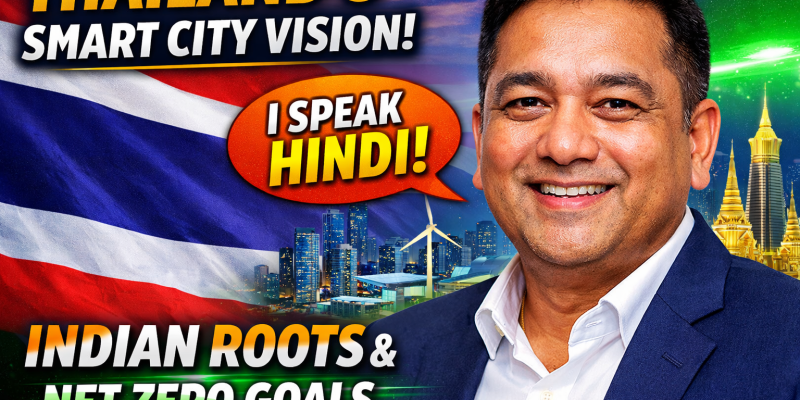
In an increasingly interconnected world, the story of cities is often also the story of people—of migration, culture, history, and the unexpected ways civilizations influence each other.
During a recent international technology and urban development event, I had the opportunity to speak with a fascinating leader from Thailand: Winai Sony, Advisor to the Mayor of Chiang Rai Municipality. Guiding his municipality toward becoming a Net Zero Smart City. What began as a conversation about urban innovation quickly evolved into a much deeper story-one that bridges India and Thailand across generations.
At first, we discussed the future of cities.
Many municipalities across the world are now rethinking how urban environments should function in the 21st century. This Thai city is actively working on transforming itself through modern infrastructure, underground electric systems, high-speed connectivity, and environmentally sustainable planning. The goal is not just modernization, but a green, intelligent urban ecosystem designed for long-term sustainability.
The city has already achieved international recognition as a UNESCO Lifelong Learning City, highlighting its commitment to education, knowledge-sharing, and civic development. Now, the leadership is looking toward the next frontier: building a city that combines technology, sustainability, and human-centered planning.
But what made this conversation truly special came in a moment of surprise.
During the interview, the advisor suddenly said something unexpected:
“I can even speak Hindi.”
That sentence opened the door to a remarkable personal story.
His grandparents were originally from India. Like many members of the Indian diaspora who moved across Southeast Asia during the mid-20th century, they built their lives and businesses in Thailand. Today he represents the third generation of an Indian-origin family in the country, continuing a legacy that connects two great civilizations.
He himself spent part of his childhood studying in Dehradun, Mussoorie, and Shimla—cities nestled in the Himalayan foothills that have educated generations of international students. Those early experiences left him with lasting memories of India, along with a continued connection to relatives who still live there.
This personal history also reflects the deep cultural ties between India and Thailand.
Thai civilization has long been influenced by Indian traditions, languages, and philosophy. Many Thai words trace their origins to Sanskrit, while elements of Indian culture-from religious ideas to culinary traditions—continue to resonate throughout Thai society. Even today, the Indian community plays an important role in Thailand’s business and social landscape.
What made this conversation powerful was the realization that the future of cities is not only about technology.
Smart sensors, digital infrastructure, and sustainable design may shape the physical framework of tomorrow’s urban spaces. But the spirit of a city is still defined by people-their stories, their heritage, and the cultural bridges they build.
This interview is a reminder that behind every “smart city” initiative are individuals whose lives connect continents, histories, and ideas.
In this conversation, we explore:
- Thailand’s ambitions to develop net-zero smart cities
- How urban infrastructure is evolving toward green and digital ecosystems
- The role of international knowledge-sharing in shaping future cities
- The Indian diaspora in Thailand
- And the enduring cultural connections between India and Southeast Asia
You can watch the full conversation here: https://youtu.be/v-Ix4E9OL4c
As cities around the world move toward sustainability and technological transformation, stories like this remind us of something important: the future is global, but it is also deeply personal.






Comments