
 By
By 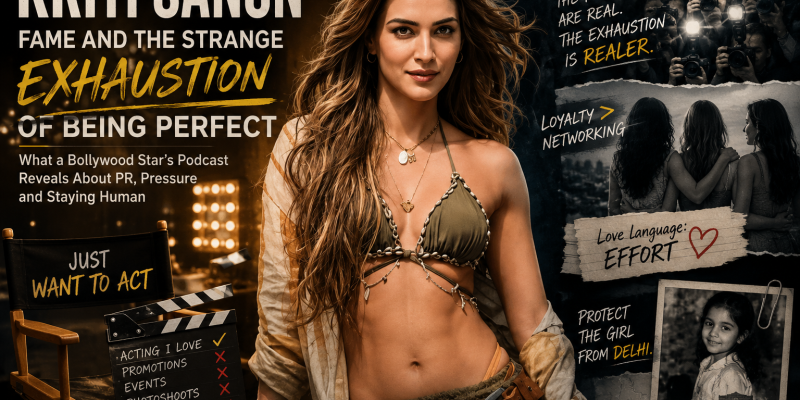
Her interviews are a breath of fresh air.
Behind every red carpet smile, there is often a tired human being wondering why she has to do another photoshoot. Behind every perfectly styled appearance, there is sometimes someone who would rather be in jeans and a T-shirt. Behind every promotional campaign, there is often an actor thinking: “I just want to act.”
That may be the most honest sentence in the modern entertainment business.
The Girl from Delhi Inside the Star
Kriti Sanon’s story is attractive because it is not packaged as a fairy tale.
She was not born into the film industry. She came from Delhi, studied engineering, entered modelling, did advertisements, moved into films, learned on set, made mistakes, improved, waited, worked and eventually built a career on her own terms.
That outsider-to-star journey has become a familiar Bollywood narrative, but what makes Kriti interesting is not just that she made it. It is that she seems deeply aware of what the journey could have done to her.
The film industry can change people quickly. It tells you how to dress, how to smile, how to pose, how to answer questions, how to network, how to be seen, how to not be seen, how to speak, how to remain silent, how to appear available and yet untouchable.
In other words, it can turn a person into a product. Kriti’s central struggle seems to be that she does not want to become only a product. She speaks about preserving the “girl from Delhi” inside her. That line matters. In celebrity PR, the most valuable asset is not beauty, talent or even visibility. It is recognisable humanity.
The public may admire glamour, but they connect with realness. This is why some stars become brands and some become people.
Brands can be promoted. People are remembered.
The Curse of the Type A Celebrity
One of the most revealing parts her interviews is Kriti’s relationship with perfectionism. She describes herself as someone who wants to give her best, someone who notices flaws, someone who can see what is not working before seeing what is working. That is the classic Type A blessing and curse.
It helps you rise. Then it refuses to let you rest.
This is common among high achievers, but in the entertainment industry it becomes even more dangerous because every part of your life is open to evaluation. Your acting is reviewed. Your face is reviewed. Your clothes are reviewed. Your weight is reviewed. Your relationships are speculated upon. Your Instagram post is judged. Your silence is interpreted. Your smile is decoded.
In most professions, people are evaluated for their work. In cinema, actors are evaluated for their existence. So when a perfectionist enters the entertainment industry, she is not just trying to perform well. She is trying to live correctly in public.
That is exhausting.
It also explains why Kriti’s honesty about being critical of herself feels relatable. We often imagine stars as people floating above ordinary anxieties. But perhaps fame does not remove insecurity. It simply gives insecurity better lighting.
The PR Frills Nobody Talks About
One of the funniest and most painful parts of the conversation is Kriti’s description of the “frills” of being an actor.
Acting is the core. Everything else is the circus.
Hair. Makeup. Styling. Award shows. Portal awards. Brand events. Photo approvals. Airport looks. Paparazzi moments. Promotional tours. Reality shows. Repeated interviews. The same questions. The same answers. The same laugh. The same “It was amazing working with him.” The same “The energy on set was fantastic.”
At one point, Kriti recalls being so tired during promotions that she broke down in her vanity van. It was not because she hated her profession. It was because the parts around her profession had become too much.
That distinction is important. Many people do not hate their work. They hate the performance around their work. The actor may love acting but hate pretending to enjoy every promotional obligation. The entrepreneur may love building but hate attending every networking dinner. The writer may love writing but hate selling themselves online. The doctor may love healing but hate paperwork. The teacher may love teaching but hate institutional politics.
Every profession has its “frills.” In cinema, the frills are simply more glamorous, more photographed and more expensive.
But they can still be soul-draining.
The Great Award Function Inflation
There was a time when award functions felt rare. Now, as Kriti points out, it sometimes seems as if every portal has an award show.
This is not just a joke. It is a comment on the modern PR economy. Awards have become content. Red carpets have become content. Outfits have become content. Reels have become content. Reactions have become content. Even attendance has become content.
The event is no longer only an event. It is a media machine. The celebrity is not merely attending. She is feeding an ecosystem. Stylists need images. Designers need tags. Publications need galleries. Influencers need commentary. Paparazzi need clips. Fans need updates. Brands need visibility. Algorithms need movement.
And the actor? The actor may just want to go home.
This is the strange paradox of fame today. The celebrity must constantly appear visible enough to remain relevant, but not so visible that she becomes overexposed. She must be authentic, but not messy. Glamorous, but relatable. Successful, but humble. Private, but accessible. Emotional, but composed.
It is a full-time performance layered on top of a full-time profession.
Why Loyalty Is Kriti’s Real Networking Strategy
One of the strongest ideas in the conversation is the comparison between money compounding and relationships compounding.
Everyone talks about financial compounding. Save early, invest consistently, and over time your money grows. But relationships compound too. Trust grows. History grows. Understanding grows. Comfort grows. Shared memory grows.
Kriti says she values constants. She does not like changing the people around her too often. In an industry where teams often shift with status, trends and convenience, this is significant. Modern networking is often shallow. People collect contacts the way children collect stickers. A hundred handshakes. A thousand LinkedIn connections. Ten thousand followers. Endless small talk.
But real influence is rarely built that way. It is built through people who have seen you tired, scared, confused, successful, insecure, happy and broken – and stayed. In PR terms, this is powerful. The strongest personal brands are not built only by visibility. They are built by continuity.
People trust what remains consistent.
Female Friendships and the Need to Be Understood
The conversation also enters the territory of friendship, especially female friendship.Kriti’s view is simple but important: female friendships often involve a deeper attempt to understand what is happening inside the other person.
The discussion contrasts this with male friendships, which are often built around shared interests, humour, insults, sports, cars, technology and the occasional deep conversation that appears suddenly like a comet.
This part of the conversation works because it is funny and true. Many male friendships can survive for twenty years on cricket, sarcasm and one emotional disclosure every Olympic cycle. Female friendships often seem to operate with a different emotional vocabulary. There is more checking in, more decoding, more noticing, more holding of emotional context.
For a celebrity, this matters even more.
Fame creates many acquaintances but few safe spaces. Everyone knows the public version of you. Few people know the tired version, the silly version, the irritated version, the version that does not want to smile for a camera.
That is why old friendships become precious. They knew you before the lighting changed.
The Mental Health Cost of the City and the Industry
Kriti also speaks about mental health in a way that feels refreshingly normal. Not dramatic. Not branded. Not turned into a motivational poster.
Just real. It is up and down. Some days are good. Some days are not. Everyone has phases.
Her conversations also touch on Mumbai – its speed, ambition, air, pressure, career opportunities and restlessness. Mumbai is wonderful for ambition, but not always gentle on the nervous system.
That is a very accurate description of many modern career cities. They give you opportunity and take away calm. They give you access and take away silence. They give you growth and take away sleep. They give you networks and take away stillness.
For young people in media, entertainment, startups, finance and public life, this is an important warning. A city can be good for your career and bad for your peace at the same time. That does not mean one should run away. It means one must learn when to step back.
The Actor Who Just Wants to Act
Perhaps the most human theme in the conversation is Kriti’s desire to return to the core of her work.
She enjoys acting. She wants to be on set. She misses performance. She wants the right role. But she does not want to work only because of FOMO. She does not want to sign something merely because she is restless.
This is maturity. In the early stages of a career, everything feels urgent. Every opportunity feels like it must be taken. Every event matters. Every appearance matters. Every invitation matters. Every missed chance feels like career suicide.
But after a point, the question changes. It is no longer: “How do I get more?” It becomes: “What is worth my energy?” That is the transition from ambition to discernment. For celebrities, founders, creators and professionals, this is a crucial evolution. Success gives you choices, but wisdom tells you which choices to refuse.
Love Language: Effort
Kriti also talks about love in her interviews. Her love language is effort. Not grand declarations. Not drama. Not excessive performance. Just effort. Remembering small things. Being present. Not making someone ask for attention. Making love feel available because it wants to be there, not because it has been demanded.
This may sound like a relationship point, but it is also a communication lesson. The best brands do this too. They do not make the audience beg for sincerity. They show up consistently. They remember what matters. They make people feel seen.
Good PR is also a form of effort. Bad PR says: “Look at me.” Good PR says: “I see you.”
The Modern Celebrity Has to Be a Human Brand
Kriti shows where celebrity communication is heading. Audiences are tired of over-managed perfection. They know when a smile is rehearsed. They know when an answer is safe. They know when a publicist has entered the room invisibly and polished every word until nothing human remains.
The future of celebrity PR is not more control. It is more intelligent honesty. Of course, not everything has to be shared. Privacy matters. Boundaries matter. Public figures do not owe the world every detail of their lives.
But when they do speak, they must sound like people.
Kriti Sanon’s appeal lies in the fact that she does not sound like a press release. She sounds like someone who has worked hard, been hurt, stayed kind, become tired, questioned the frills, valued loyalty, loved deeply, and still wants to protect something original within herself.
That is rare. And that is exactly why it works.
The Real Lesson
The biggest lesson from hearing Kriti is not about Bollywood. It is about survival. How do you grow without becoming fake? How do you become successful without becoming unavailable? How do you stay ambitious without becoming joyless? How do you build a public image without losing a private self? How do you handle pressure without allowing it to harden you?
Kriti’s answer seems to be this: stay curious, stay loyal, stay kind, keep learning, ask questions, protect your constants, and do not let the machinery of fame eat the person who wanted the dream in the first place.
That is not just good life advice. It is good PR advice. Because in the end, the strongest personal brand is not the one that looks perfect.
It is the one that still feels human.









Comments