
 By
By 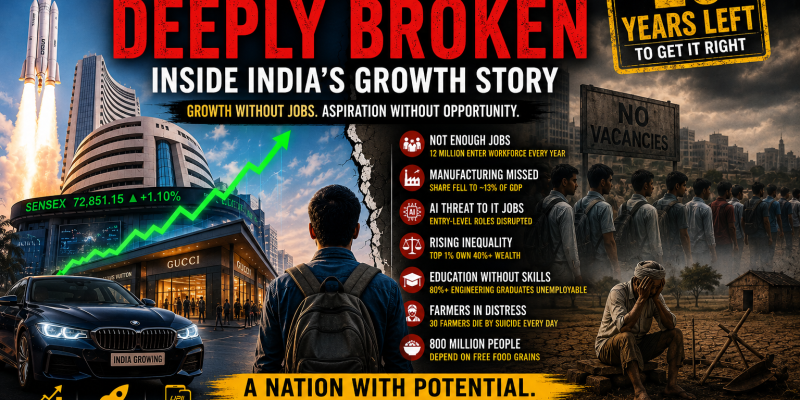
India is having a strange economic moment. On the surface, everything looks magnificent.
The stock market is rising. GDP growth is strong. Global leaders speak of India as the next great engine of the world economy. The country has landed on the moon, built world-class digital infrastructure, produced global technology talent, and positioned itself as a democratic counterweight to China.
The India story sounds powerful. But beneath the celebration, something is beginning to crack. The uncomfortable truth is this: India may be growing, but it is not creating enough meaningful work for its people.
Every year, millions of young Indians enter the workforce with ambition, degrees, smartphones and hope. But the economy does not have enough jobs waiting for them. The result is a generation caught between aspiration and frustration.
This is not merely an economic issue. It is a social issue. A political issue. A psychological issue. And perhaps, over the next two decades, it could become one of India’s biggest national challenges.
Growth Without Enough Jobs
India’s GDP numbers are impressive. But GDP can grow without employment growing at the same pace. That is the heart of India’s problem.
A country can create value for shareholders, investors and large companies without creating enough stable employment for its citizens. Capital-intensive industries, automated factories, IT services, finance, digital platforms and large conglomerates can all expand the economy without absorbing millions of workers.
This is often called jobless growth. For a country as young and populous as India, jobless growth is dangerous. India does not need only unicorns, billionaires and stock market wealth. It needs jobs at scale. It needs work for young graduates, semi-skilled workers, rural migrants, women, technicians, factory workers and first-generation professionals.
Without that, growth becomes top-heavy. The rich become richer. The middle class becomes anxious. The poor remain dependent. And the young begin to lose faith.
The Factory That Was Never Built
The countries that lifted hundreds of millions of people out of poverty followed a familiar path.
They industrialised. China did it. South Korea did it. Vietnam is doing it. The formula was clear: move people from low-productivity farm work into factories, build manufacturing scale, create exports, increase wages, and build a middle class. India was supposed to follow the same path.
The promise of Make in India was powerful. India would become the next manufacturing hub. Global companies would shift production from China. Millions of Indians would find work in factories. The country would move from services-led growth to broad-based industrial strength. But that transformation has not happened at the scale required.
India’s manufacturing share of GDP has not moved towards the ambitious target once imagined. In fact, the deeper criticism is that India missed the manufacturing wave in precisely those sectors that create mass employment – textiles, footwear, leather, electronics assembly, consumer goods and light manufacturing.
Instead of becoming the next factory of the world, India remained trapped between two extremes. At the top are giant conglomerates. At the bottom are millions of tiny businesses. What is missing is the middle: large numbers of mid-sized manufacturing companies employing thousands of workers each.
That missing middle is one of India’s biggest economic tragedies.
Why India Struggled to Industrialise
The reasons are not mysterious.
Land acquisition is difficult. Power supply remains uneven. Logistics costs are high. Ports, roads and clearances are often inefficient. Labour regulations have historically discouraged companies from growing beyond certain thresholds. Compliance burdens are heavy. Litigation is slow.
For many entrepreneurs, staying small is safer than scaling up. That is disastrous for employment.
A country cannot become a manufacturing powerhouse if its entrepreneurs are afraid to hire. It cannot build a middle class if factories do not scale. It cannot compete with Vietnam, Bangladesh or Mexico if supply chains remain expensive and unpredictable.
The tragedy is that India has the people. It has the ambition. It has the domestic market. It has entrepreneurs. But the system often punishes scale instead of rewarding it.
The IT Ladder Is Under Threat
For three decades, India had one great economic success story: IT services.
Companies such as TCS, Infosys, Wipro and others helped build a new Indian middle class. They took English-speaking graduates and plugged them into global technology and back-office systems. They created campuses, careers, salaries, confidence and social mobility.
For millions of families, IT was the ladder.
But now that ladder is under pressure. Artificial intelligence is beginning to attack the entry-level roles that once absorbed young graduates. Coding support, customer service, testing, documentation, basic analytics, back-office work and routine software tasks are all becoming vulnerable.
This does not mean Indian IT will disappear. It will not. But it does mean that the old model — hire large numbers of young graduates, train them, and deploy them on global projects — may not work the same way again.
For India, this is serious. The country failed to build enough factory jobs. Now the services ladder that helped the urban middle class is also being disrupted. That leaves a frightening question: If factories did not absorb the masses, and AI reduces the need for entry-level service workers, where will India’s young people go?
The K-Shaped Economy
Modern India increasingly resembles the letter K. One arm shoots upward. Luxury cars sell. Premium homes sell. Expensive weddings become global spectacles. Stock markets rise. Billionaires multiply. Airport lounges are full. High-end restaurants are packed. Private schools, private hospitals, gated communities and luxury brands thrive.
The other arm falls downward.
Rural wages remain weak. Small farmers struggle. Entry-level consumption slows. Informal workers remain insecure. Young graduates chase government exams for years. Families cut spending even on basic items.
This is the real India contradiction.
A country can have record luxury car sales and still have millions depending on food support. It can have billionaires building global empires and young graduates applying for peon jobs. It can have world-class digital payments and broken public education. It can launch rockets and still fail to provide dignified work to its youth.
This is not a simple rich-versus-poor story. It is a story of uneven opportunity.
The Psychological Impact of Inequality
There is another dimension India has not fully understood. Earlier, poverty was local. People compared themselves with those around them. A poor person in a village saw other poor people. Aspiration existed, but exposure was limited.
Now inequality is visible every minute.
Thanks to cheap data and smartphones, every Indian can see the lives of the rich in real time. Instagram, YouTube and short video platforms have made luxury visible to everyone. Weddings, foreign holidays, designer homes, malls, cars and celebrity lifestyles are streamed directly into the hands of people who may never experience them.
This creates aspiration.
But when aspiration is not matched by opportunity, it creates resentment.
That is where the danger lies.
A young country can tolerate inequality if it believes tomorrow will be better. But if millions of young people begin to believe the ladder is broken, the mood of the country can change.
The Demographic Dividend Can Become a Disaster
For years, India has celebrated its demographic dividend. A young population is supposed to be an advantage. Compared to ageing societies such as Japan, China and many European countries, India has youth on its side.
But youth alone is not a dividend. It becomes a dividend only when young people are educated, healthy, skilled and employed. Otherwise, it becomes a demographic burden. India has a limited window. Over the next two decades, it must create jobs at extraordinary scale. It must repair education. It must improve healthcare. It must build manufacturing. It must reform compliance. It must support small and mid-sized companies. It must prepare workers for an AI-driven economy.
If it does not, the same young population that was supposed to power India’s rise could become a source of instability. A demographic dividend is not automatic. It has to be built.
The Education Crisis
India’s education system is producing degrees faster than it is producing capability. This is one of the most painful parts of the story. Across the country, families spend life savings on engineering colleges, management institutes, coaching centres and private education. Parents sell land, gold and security to give their children a chance.
But many students graduate without employable skills. They have certificates, not competence. They know how to pass exams, not how to solve problems. They know how to memorise, not how to think. The result is the rise of the educated poor — young people too qualified for manual work, but not skilled enough for the jobs they were promised.
This creates a deep emotional crisis. The degree was supposed to be a golden ticket. For many, it has become a costly illusion.
Agriculture Cannot Carry Half the Country
Another structural problem is agriculture.
India still has a large share of its workforce dependent on farming, even though agriculture contributes a much smaller share of GDP. This means too many people are fighting over too little income.
Landholdings have fragmented across generations. Many farms are too small to be profitable. Mechanisation becomes difficult. Debt becomes common. Middlemen control prices. Climate risk adds another layer of uncertainty.
The farmer is celebrated in speeches, but crushed in reality. No modern economy can become prosperous if nearly half its people remain trapped in low-productivity agriculture. The solution is not to romanticise farming.
The solution is to create non-farm jobs at scale. That means manufacturing, food processing, logistics, construction, services, rural enterprises and small-town industrialisation. India needs an employment bridge from the village to the modern economy.
Right now, that bridge is too weak.
The Compliance Burden
India often celebrates entrepreneurship. But many entrepreneurs know the truth. Building a business in India can be exhausting. Compliance, paperwork, inspections, legal uncertainty, tax complexity, permissions, delays and fear of penalties make it hard for businesses to grow. The burden is especially heavy for small and mid-sized companies.
Large conglomerates can afford teams of lawyers, consultants and compliance officers. Small businesses cannot. This creates a system where the very companies that could generate employment are often discouraged from scaling.
If India wants jobs, it must make it easier for honest businesses to grow. Not just startups that raise venture capital. Not just giant conglomerates. India needs thousands of mid-sized companies that can employ 500, 1,000, 5,000 and 10,000 people. That is where mass employment will come from.
India Is Not Collapsing
It is important to be clear. India is not collapsing. That would be too simplistic and too dramatic.
India remains one of the most important countries in the world. It has extraordinary talent, deep entrepreneurship, a young population, digital public infrastructure, a large domestic market, global geopolitical relevance and civilisational resilience.
India has survived far worse. But resilience is not a strategy. Potential is not a plan. And optimism is not employment.
The danger is not that India has no future. The danger is that India mistakes potential for achievement.
The Real Question
The India story is real. But it is incomplete. India can become a major global power. But it cannot do so on GDP headlines alone. It cannot do so by celebrating billionaires while ignoring jobless graduates. It cannot do so by building apps without building factories. It cannot do so by producing degrees without producing skills. It cannot do so by depending on welfare while failing to create work.
The real test of India’s rise will not be the number of billionaires it creates. It will be the number of ordinary people it moves into dignified, productive, secure work.
That is the foundation of a true superpower. India has perhaps 20 years to get this right. To build the factories. To fix the schools. To reform compliance. To prepare for AI. To support entrepreneurs. To move people out of disguised unemployment. To create real ladders of mobility.
The question is not whether India has potential. Of course it does. The question is whether potential alone has ever been enough.
History’s answer is brutal.
It has not.
Statistics from the Internet. Karnvir Mundrey is the Editor of TheFutureOfPR.com. Reach out at tfofpr@gmail.com or at +918296303806.







Comments