
 By
By 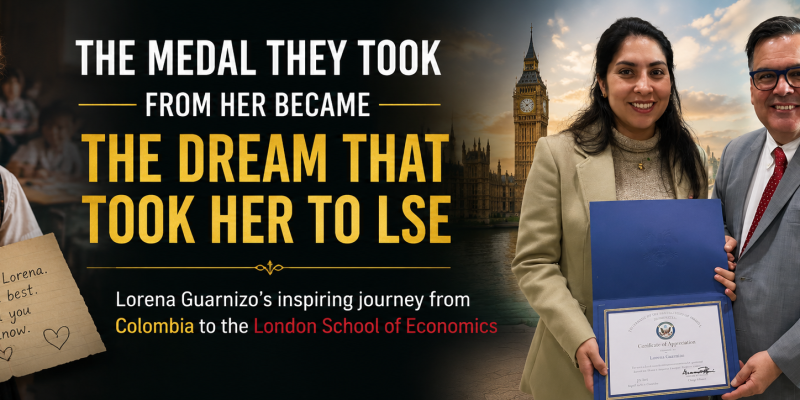
By: Karnvir Mundrey
How a school teacher’s daughter from Colombia discovered that the greatest opportunities in life often begin with moments that seem deeply unfair.
There are moments in life that appear insignificant while they are happening, only to reveal years later that they quietly changed everything. For Lorena, that moment did not happen in London, Washington or Bogotá. It happened in a small classroom in the Colombian city of Ibagué when she was just ten years old.
The school year had come to an end, and her teacher announced that Lorena had been chosen as the best student in the class. She loved learning, not because she wanted to win prizes, but because curiosity came naturally to her.

Her teacher recognised that dedication and placed the school’s medal for academic excellence around her neck.
For the daughter of two schoolteachers, there could hardly have been a greater honour. Education was the foundation of family life, and the medal represented everything her parents believed in. The celebration lasted only a few moments.
The owner of the school entered the classroom, looked at the medal, and quietly removed it from around Lorena’s neck. Her own niece was in the same class, and she believed the award belonged elsewhere. No explanation was offered. No apology followed.
Lorena remembers standing silently as her classmates watched. At ten years old, she did not understand favouritism or power. She only knew that something deeply unfair had happened. She spent the rest of the day trying not to cry, but by the time she reached home, the tears she had held back could no longer be contained.
Fortunately, another teacher understood that something far more precious than a medal had just been taken away.
She found Lorena sitting alone and gently said: “Don’t worry, Lorena. You are the best. That is all you need to know.”
Those words stayed with her. Looking back today, Lorena believes that conversation shaped her life far more than the medal ever could. Awards are given by other people. Confidence is built within ourselves, often because someone believes in us before we learn to believe in ourselves.

A Childhood Built on Education, Not Privilege
Lorena grew up in Ibagué, surrounded not by privilege but by possibility.
Her parents were both teachers who believed that education was life’s greatest investment. Their income was modest, yet their home was rich in books, conversation and encouragement.
They taught their children that learning was not simply a path to employment but a way of understanding the world.
Her father often worked away from home, leaving her mother to raise Lorena and her younger brother while working more than one job. Yet when Lorena speaks about her childhood, she rarely talks about sacrifice.

She remembers happiness. She remembers afternoons spent playing with her brother. And she remembers a mother whose love appeared every morning in the simple ritual of preparing a lunchbox before leaving for work.
Lorena rarely ate that lunch. Instead, she quietly gave most of it to one of her closest friends because she knew her friend enjoyed it. Decades later, she still laughs that her mother never discovered where the carefully prepared lunches disappeared.
Looking back, that small act revealed something that would define much of her life. Helping other people never felt like a duty. It simply felt natural.
The Curious Girl Who Wanted to Do Everything
Curiosity seemed to shape every part of Lorena’s childhood.

She entered singing competitions, performed in school plays, joined debates and volunteered for almost every activity available.
Her mother often wondered why she insisted on participating in everything, especially when every event required another costume or another rehearsal.

Without realising it, those experiences were building the confidence that would one day allow Lorena to stand before government ministers, diplomats and international audiences with remarkable composure.
As she grew older, her ambitions changed. She briefly dreamed of becoming a doctor before discovering that what fascinated her most was not science but people. Languages, cultures and international relations captured her imagination, eventually leading her to study International Affairs at university.
“I always wanted to study something international,” she recalls. “I don’t know why.”
Sometimes the most important decisions in life begin as instincts that only make sense years later.
The Unpaid Internship That Opened a Door
After graduating at just twenty years of age, Lorena accepted an unpaid internship with Colombia’s Tax and Customs Directorate in Bogotá. The decision surprised many people.
It meant leaving home, moving to Colombia’s most expensive city and working without a salary or any guarantee that the opportunity would become a permanent job. Her mother never hesitated. She had always believed education was the safest investment anyone could make, and she was prepared to support her daughter while that investment matured.
It proved to be one of the best decisions they ever made.

Lorena approached the internship with the same determination that had defined her student years. She arrived prepared, volunteered for challenging assignments and spent as much time understanding why systems existed as she did learning how they worked.
Her supervisors quickly recognised that she was motivated by curiosity rather than simply ambition. Within months, the internship became a permanent appointment. Soon afterwards, Colombia began implementing its landmark Free Trade Agreement with the United States, creating one of the most technically demanding projects of Lorena’s career.
Before the agreement could operate, the country needed an entirely new digital customs platform capable of managing agricultural tariff-rate quotas. The project was highly complex, politically sensitive and essential to one of Colombia’s most important international agreements. While many hesitated, Lorena volunteered.

For two years she worked alongside customs officials, software engineers, agricultural specialists and government ministries to build a system that remains part of Colombia’s customs infrastructure today.
Her fluency in English allowed her to work closely with American delegations, explaining technical concepts and helping bridge cultures as well as governments. More than a decade later, the platform continues serving Colombia. Her name does not appear on it.
She prefers it that way.
The greatest satisfaction comes from knowing that something she helped build continues improving people’s lives long after the headlines have disappeared.
The Dream of LSE
Her success led to Colombia’s Ministry of Trade, where conversations with colleagues introduced her to the London School of Economics. Until then, she had imagined studying in the United States. But the more she learned about LSE’s Master’s in Public Management and Governance, the more she realised it offered something she truly wanted.
Not simply another qualification. Another way of thinking.

Being accepted represented far more than admission to one of the world’s leading universities. It confirmed that a young woman from a middle-class family in Ibagué belonged among some of the brightest minds in the world.
But acceptance was only the first mountain.
For students from developing countries, studying abroad is often not just an academic challenge. It is a financial one. Dreams may be global, but bank accounts remain local. When Lorena applied to LSE, she also applied for two scholarships. She needed both of them to be able to live in London during her master’s programme.
She received one scholarship from Colfuturo, a Colombian organisation that supports students pursuing postgraduate education abroad. But the second scholarship did not come through. She reached the final stage and missed it.

The disappointment was crushing.
For a few painful days, Lorena thought she would have to postpone her studies. After years of dreaming, preparing, applying and hoping, London suddenly seemed to be slipping away. Then the phone rang. She was told that she had received a full tuition scholarship from LSE.
At first, she could hardly believe it.
What she later discovered made the moment even more meaningful. Colfuturo, the organisation that had already granted her support, had nominated her to LSE for a full tuition scholarship without her knowing. She was selected from among forty Colombian candidates.

That phone call changed everything.
It meant she could go to London. It meant the dream did not have to wait. It meant the daughter of two schoolteachers from Ibagué could walk into LSE not as a visitor, but as a student. Lorena still remembers that day as one of the happiest of her life.

It also explains why she continues to volunteer with the university whenever she can. “I believe I can return something of what I received from the university,” she says. For Lorena, LSE was not only an institution that educated her. It was an institution that opened a door when the door seemed to be closing.

What London Taught Her
London changed Lorena in ways that no degree ever could.
Living alongside students from every continent taught her that intelligence is not confined to any country, religion or culture.
Classroom discussions challenged assumptions she had carried all her life, while conversations over coffee often proved as educational as formal lectures.
She returned home convinced that the greatest lesson she had learned was not about economics or governance, but about perspective.
The world became much larger once she realised that every society had something worth teaching and every person carried experiences worth understanding.
Returning Home to Create Impact
Returning to Colombia, Lorena focused on ensuring that innovation reached ordinary people.
She helped thousands of small businesses embrace digital technology, travelled to remote regions including Putumayo on the edge of the Amazon, advised multinational companies investing in Colombia and eventually returned to another lifelong passion: teaching. In many ways, life had brought her back to where it all began.

The little girl who once arranged dolls into rows and pretended to teach a classroom had become the lecturer she had imagined all those years before.
When I asked Lorena what advice she would give her younger self, she did not speak about career strategies or professional success. She spoke about experiencing the world sooner, meeting people from different cultures and learning to listen before judging. It was a reminder that education is measured not only by degrees but also by the number of perspectives we are willing to embrace.
The Real Lesson Behind Lorena’s Journey
As our conversation ended, I found myself thinking once again about that little girl standing silently in a classroom after her medal had been taken away. Had the medal remained around her neck, she might never have remembered that day.
Instead, she remembers it more vividly than any award she has received since. Not because someone took the medal away. But because one teacher chose to replace disappointment with belief.
Years later, another act of belief would change her life again. A Colombian organisation nominated her. A university selected her. A phone call sent her to London. And a long-held dream became real.
Perhaps that is the real lesson behind Lorena’s remarkable journey.
Careers are built through talent, hard work and opportunity, but they are often sustained by something much simpler: one person, one teacher, one institution or one unexpected phone call that tells you the world has not closed its doors yet. Sometimes changing a life does not require wealth, influence or power. Sometimes it begins with three simple sentences.
“Don’t worry. You are the best. That is all you need to know.”
Karnvir Mundrey is the Editor of TheFutureOfPR.com. Reach out at tfofpr@gmail.com or at +918296303806.









Comments