
 By
By 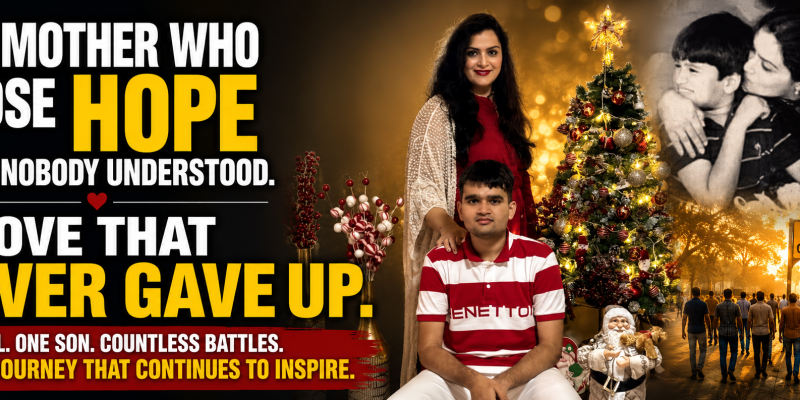
By: Shweta Dogra
When my son Ayan was a little over two years old, one of his teachers called me aside after school and gently told me that she had noticed a few things that concerned her. She said he did not always make eye contact, he did not communicate with the other children in the same way they communicated with one another, and he often seemed to be in a world of his own. I listened carefully, but I did not think too much about it because, like most mothers, I believed my child was simply developing at his own pace. Every child is different, and at that age I felt it was far too early to worry about labels or diagnoses.

Over the next few months, however, those small observations slowly became bigger questions. One assessment led to another, and one doctor’s appointment led to another. Eventually I heard a word that I knew very little about at the time: autism. Looking back, I often say that the diagnosis itself was not the hardest part because, in that moment, I did not fully understand what autism meant. The hardest part was everything that followed, because as I began reading, meeting therapists, talking to specialists, and speaking to other parents, I slowly realised that the future I had imagined for my son might not look the way I had always expected it to.
I think every parent secretly writes a story for their child long before the child grows up. We imagine school days, friendships, careers, marriages, grandchildren, and all the moments that society tells us are part of a successful life. When Ayan was diagnosed, it felt as though somebody had suddenly taken that story out of my hands and torn away the ending. I was not grieving my son because he was still the same beautiful child I had always loved. What I was grieving was certainty. I was grieving the future I thought I understood.

The months that followed were some of the darkest of my life. I went through denial because I desperately wanted somebody to tell me that there had been a mistake. I went through sadness because I felt alone and frightened. I eventually went into depression and needed therapy myself because I realised that before I could help my son, I had to learn how to help myself. There were days when the emotional weight became so heavy that I struggled to think clearly, and there were moments when I felt completely overwhelmed by questions that nobody seemed able to answer.
At that time, autism was not something most people understood. Many people confused it with intellectual disability. Others treated it as though it were a disease that could simply be cured. Some people would offer advice even though they knew very little about it. What hurt the most was not that people were unkind. What hurt was that they simply did not understand. It is a very lonely feeling when you are carrying the biggest worry of your life and nobody around you can truly see it.
As the years passed, our family life changed in ways I never expected. Holidays became difficult because unfamiliar places could be overwhelming for Ayan. Family gatherings often required planning and preparation that other people never had to think about. Weddings, parties, and social events stopped being simple outings and became situations that demanded careful consideration. Gradually our world became smaller, and for many years it felt as though our lives revolved around helping our son navigate a world that often seemed confusing and overwhelming for him.

Yet it was during those same years that Ayan began teaching me lessons that would completely change the way I looked at autism. The world often focused on what he could not do, but I slowly learned to focus on what he could do. One day, his swimming coach challenged him to complete one hundred laps in the pool. I remember watching him with disbelief as he kept going without stopping, lap after lap, showing a level of determination and endurance that many adults would struggle to match. That day I realised that while autism might create certain challenges, it could also come with strengths that many people never take the time to notice.
Over the years, Ayan continued to surprise me. Whether it was swimming, cycling, basketball, skating, or simply the way he approached daily routines with honesty and discipline, he constantly challenged my assumptions. I began to understand that autistic children are often far more capable than society gives them credit for. They may communicate differently, they may experience the world differently, but that does not mean they have less to offer. In many ways, they see things that the rest of us miss.

One question, however, remained in my heart for many years. It is a question that almost every parent of a special-needs child asks sooner or later: what will happen after I am gone? No matter how much progress your child makes, there is always a part of you that worries about the future. I knew I could save money for Ayan and I could leave behind financial security, but I wanted something much more important than that. I wanted him to have confidence. I wanted him to have purpose. I wanted him to experience the dignity that comes from contributing to society rather than depending entirely on others.
That thought eventually became the seed from which the Anmol Foundation grew.
Anmol Foundation was not created because I felt sorry for autistic young adults. In fact, it was created because I had seen how much they were capable of doing when somebody believed in them. Over the years, I had watched Ayan surprise me again and again. I had watched him develop skills, discipline, honesty, and determination that many people never expected from him. I had met dozens of other autistic young adults with similar strengths. What I realised was that the problem was not their lack of ability. The problem was the lack of opportunities available to them.

I decided to create a place where these young adults could learn, work, earn, and grow together. Instead of treating them as people who needed to be looked after, I wanted to treat them as people who could contribute. At the Anmol Foundation, we support a unique mix of young adults, including both autistic individuals and those with intellectual disabilities
We started by bringing a group of autistic young adults into our workplace and giving them structured training. During those first few months, I spent time understanding what each individual enjoyed and where their natural strengths lay. Some were comfortable interacting with customers. Some had an incredible eye for display and design. Others excelled at repetitive tasks that required patience, focus, and consistency.

What happened next was one of the most rewarding experiences of my life.
Slowly, they stopped seeing the workplace as a training centre and started seeing it as their second home. They arrived every morning with enthusiasm. They shared lunch together. They celebrated birthdays together. They helped one another. Friendships began to form naturally. For many of them, it was the first time they had experienced a workplace where they felt completely accepted.

One of the most touching moments comes at the end of every month when salaries are distributed. Many of these young adults do not immediately think about what they want for themselves. Instead, they come to me and ask whether they can buy something for their parents. Some want to buy a mobile phone. Some want to buy a handbag. Some simply want to take their parents out and spend money they have earned with their own effort.
Those moments never fail to move me.
As a mother, I know what it feels like to worry that your child may never become independent. Then one day you watch that same child proudly talk about buying a gift for you with money they have earned themselves. There are very few moments in life more beautiful than that.
The foundation has also taught me something important about autism. Society often focuses on what autistic individuals struggle with, but very few people take the time to notice what they are exceptionally good at. One Christmas season, I gave some of our interns plain decorative wreaths and a collection of materials and simply asked them to create something. The designs they came up with were unlike anything I had seen before. Their colour combinations were bold, creative, and unique. Those wreaths became some of our best-selling products that season. Similar things happened with wedding decorations and handicrafts, where their creativity often produced ideas that surprised even experienced designers.

Every day at Anmol Foundation reminds me that inclusion is not charity. Inclusion is recognising talent where others fail to see it. These young adults are not here because anyone feels sorry for them. They are here because they contribute. They work. They create. They solve problems. They add value.
When people ask me what Anmol Foundation means to me, I often say that it is much more than an organisation. It is the answer to a question that kept me awake for years. It is proof that autistic young adults can live meaningful, productive lives when given the right support and opportunities. It is also proof that a mother’s greatest fear can sometimes become her greatest purpose.
Today, when people ask me whether I still worry about Ayan’s future, I tell them the truth. Yes, I worry, because mothers never stop worrying. The difference is that I no longer allow fear to control my life. I have seen too many examples of courage, determination, creativity, and resilience to believe that autism defines what a person can achieve. What I understand now is that my son did not need to become somebody else in order to succeed. Instead, the world needed to learn how to see the value that was already there.
When I look at Ayan today, I do not see a diagnosis. I see a young man who taught me patience when I wanted certainty, hope when I felt fear, and acceptance when I was struggling to understand. Most importantly, he taught me that a beautiful life does not always follow the path we originally imagined. Sometimes the most meaningful journeys are the ones we never planned to take, and sometimes the children we worry about the most end up becoming our greatest teachers.
Shweta Dogra is a mother with an autistic child. She has created Anmol Foundation to train and help autistic children be more independent and self reliant. Reach out to her on +919611344193









Comments