
 By
By 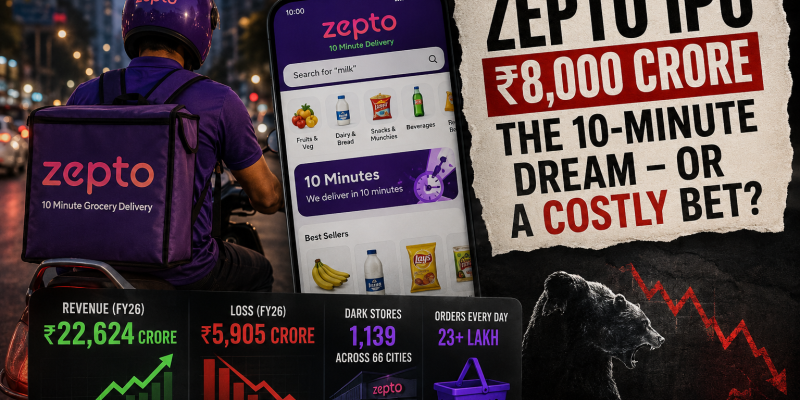
Revenue has surged to ₹22,624 crore. Customers are growing at breakneck speed. Advertising income is exploding. Yet Zepto still lost nearly ₹6,000 crore last year. As the quick-commerce giant prepares for one of India’s most anticipated IPOs, investors face a simple but crucial question: is this the future of retail or an expensive gamble dressed up as a growth story?
From College Startup to Quick-Commerce Giant
A few years ago, the idea would have sounded absurd. Why would anyone pay extra to have groceries delivered in ten minutes when there was already a neighbourhood store around the corner?
Yet consumer behaviour has changed dramatically. Between worsening traffic, increasingly busy lifestyles, and a growing preference for convenience, millions of Indians have embraced the idea that everyday essentials should arrive almost instantly.
Few companies have benefited more from that shift than Zepto.
Founded by two young entrepreneurs who believed speed itself could become a business model, Zepto has grown from a startup curiosity into one of India’s largest quick-commerce platforms. The company now operates 1,139 dark stores across 66 cities, serves nearly 4.8 crore annual transacting users, and processes more than 23 lakh orders every single day.
The growth has been staggering. Revenue from operations has climbed from ₹4,454 crore in FY24 to ₹22,624 crore in FY26. By almost any measure, that is an extraordinary achievement.
Unfortunately for investors, there is another number that is just as important.
Zepto lost ₹5,905 crore during FY26.
That single figure transforms the IPO from a straightforward growth story into one of the most controversial investment opportunities currently available in the Indian market.
Why the Zepto IPO Is Different From Most IPOs
Most IPOs are relatively easy to analyse.
Investors examine profits, estimate future earnings growth, apply a valuation multiple, and arrive at a reasonable estimate of what the company might be worth.
Zepto does not fit into that framework.
The company has already achieved enormous scale, but profitability remains somewhere in the future. Investors are therefore being asked to value a company based largely on what it might become rather than what it currently is.
That makes this IPO fundamentally different from traditional investments.
When investors buy shares of a profitable bank, consumer goods company, or IT services firm, they are purchasing proven earnings. When investors buy Zepto, they are purchasing the possibility of future earnings.
That distinction matters.
The Bull Case: Why Investors Are Excited About Zepto
Supporters of Zepto argue that focusing exclusively on the losses misses the bigger picture.
They point out that nearly every important operating metric is moving in the right direction. Revenue growth remains exceptional. Customer adoption continues to accelerate. Cost efficiencies are improving. Advertising income is growing rapidly. Most importantly, losses per order are steadily declining.
To bullish investors, this is exactly what a successful scaling business should look like.
Improving Unit Economics
One of the strongest arguments in Zepto’s favour is the improvement in unit economics.
Every dark store has fixed costs including rent, salaries, technology systems, and logistics infrastructure. When those stores process only a few hundred orders, profitability becomes difficult. However, as order volumes increase, those same costs are spread across a much larger number of transactions.
The result is that each order becomes more profitable than the previous one.
Zepto’s adjusted EBITDA loss per order has fallen significantly over the last year, while gross margins have expanded and operating efficiency has improved. Although profitability remains distant, the direction of travel is encouraging.
Scale Could Become Zepto’s Biggest Advantage
Supporters also believe Zepto is building something that will be difficult to replicate.
The company has spent years creating a dense network of dark stores, supply chains, delivery systems, and technology platforms. If it can continue increasing order density within those networks, scale could eventually become a powerful competitive advantage.
This is the central argument of the bullish investment thesis.
The company may be losing money today, but it is creating an infrastructure network that could become extremely valuable tomorrow.
The Hidden Profit Engine: Advertising Revenue
Perhaps the most interesting part of the Zepto story has little to do with groceries.
Instead, it involves advertising.
When customers open the app, they see featured products, sponsored listings, promotional campaigns, and targeted offers. Brands pay Zepto significant amounts of money for this visibility.
The numbers are remarkable.
Advertising revenue has increased from just ₹49 crore in FY24 to more than ₹1,600 crore in FY26.
That matters because advertising is far more profitable than grocery delivery.
Selling a packet of biscuits requires warehousing, inventory management, logistics, and delivery infrastructure. Selling advertising space on an app requires very little incremental cost once the platform has attracted millions of users.
This is the same playbook that helped transform Amazon into an advertising powerhouse, and many investors believe Zepto could eventually follow a similar path.
Risk #1: Profitability Remains Theoretical
For all the excitement surrounding the business, investors must remember one important fact.
Profitability does not currently exist.
Despite generating more than ₹22,000 crore in annual revenue, the company still lost almost ₹6,000 crore in FY26. While management can point to improving metrics and falling losses per order, there is no guarantee regarding when sustainable profitability will actually emerge.
The danger is that profitability remains perpetually six to twelve quarters away.
Investors have heard similar promises from high-growth technology companies before.
Sometimes those promises materialise.
Sometimes they never do.
Risk #2: Competition Could Destroy Margins
Competition is arguably the biggest threat facing Zepto.
Unlike luxury brands or specialised software businesses, quick-commerce platforms have very few barriers preventing customers from switching providers. Consumers can move between apps in seconds. Merchants can sell on multiple platforms simultaneously. Delivery partners can work wherever incentives are highest.
Zepto is competing against Blinkit, Instamart, Amazon, Flipkart, and BigBasket. Each competitor possesses substantial financial resources and is chasing the same urban customer base.
This creates a dangerous dynamic.
The moment one company cuts prices or increases incentives, every other company is forced to respond.
As a result, improving economics can quickly deteriorate.
Risk #3: The Dark Store Model Is Extremely Capital Intensive
Many investors compare technology companies to software businesses that can grow rapidly without substantial physical infrastructure.
Zepto is different.
Every new city requires warehouses. Every warehouse requires inventory. Every inventory location requires lease agreements, employees, logistics systems, and operational management.
Growth therefore consumes capital.
The company already carries significant lease liabilities linked to its dark-store network, and a meaningful portion of IPO proceeds will be used to support expansion and infrastructure requirements.
The question investors must ask is simple.
If the company is already operating at such a massive scale, why does it still require so much external capital?
Risk #4: Cash Burn Remains A Major Concern
Accounting losses are one thing.
Cash burn is another.
Zepto has burned thousands of crores in free cash flow while building its network. As long as investors remain willing to fund growth, that may not be a problem. However, capital markets can change quickly.
If market sentiment weakens or funding becomes harder to access, companies dependent on external capital often face challenges much sooner than expected.
The history of technology investing is filled with businesses that looked unstoppable until access to capital suddenly became more difficult.
Risk #5: Quick Commerce May Never Become Highly Profitable
This is perhaps the most overlooked risk of all.
Investors often assume that because customers love a service, the business behind it must eventually become highly profitable.
History suggests otherwise.
Airlines transport billions of passengers every year yet have often struggled to generate attractive returns. Food delivery platforms spent years chasing profitability. Telecom companies serve millions of customers while operating under constant pricing pressure.
There is a possibility that quick commerce becomes a massive industry without ever becoming an exceptionally profitable one.
If that happens, the valuations being discussed today may prove difficult to justify.
Risk #6: Regulatory Risks Are Growing
Governments around the world are paying increasing attention to gig-economy businesses.
Issues involving worker welfare, delivery partner benefits, urban logistics, data privacy, and competition regulations continue to attract scrutiny.
Any future regulations requiring higher employee benefits, increased compliance standards, or restrictions on operating models could raise costs significantly across the sector.
These risks are difficult to predict but impossible to ignore.
Risk #7: Advertising Growth May Slow Down
A growing part of the investment case depends on advertising revenue.
That creates another risk.
Advertising budgets tend to fluctuate with economic conditions. During periods of economic uncertainty, companies often reduce marketing spending. If advertising growth slows, one of Zepto’s most promising profit drivers may not develop as quickly as investors expect.
The market is increasingly valuing Zepto as more than a delivery company.
If advertising disappoints, investor expectations may need to be adjusted.
Risk #8: Valuation Could Be The Biggest Risk Of All
Even a great company can become a poor investment if purchased at the wrong price.
This may ultimately be the most important consideration for investors.
Because Zepto has negative earnings and negative free cash flow, there are few traditional valuation anchors available. Investors are effectively valuing a future version of the company that does not yet exist.
That future version assumes stronger margins, lower losses, higher advertising income, rational competition, and eventually sustainable profitability.
The problem is that all of those outcomes still need to happen.
Why Existing Investors Are Selling
Another detail worth noting is that several existing shareholders are partially selling their holdings through the Offer For Sale component of the IPO.
There may be perfectly valid reasons for doing so, including portfolio diversification and liquidity needs. Nevertheless, public investors should ask themselves whether the valuation being offered leaves enough room for future returns.
After all, if some of the earliest investors are taking money off the table, new investors should ensure they are being adequately compensated for the risks they are assuming.
Should You Invest In The Zepto IPO?
The answer depends largely on the type of investor you are.
Conservative investors who prioritise profits, dividends, cash flow, and predictable earnings will probably find better opportunities elsewhere. The risks associated with competition, profitability, and valuation are simply too high.
Growth-oriented investors may see things differently.
Few companies in India can match Zepto’s revenue growth, customer adoption, market opportunity, and strategic position within one of the country’s fastest-growing consumer categories.
If management executes successfully and the industry matures as expected, the upside could be significant.
However, investors must recognise that the bullish case depends on several assumptions becoming reality.
Final Verdict: Buy, Avoid, or Watch?
Zepto is undoubtedly one of the most impressive startup stories India has produced in recent years.
The company has changed consumer behaviour, built a nationwide logistics network, attracted millions of customers, and established itself as a major force in quick commerce. Those achievements deserve recognition.
However, investing is ultimately about future returns rather than past accomplishments.
At its core, the Zepto IPO is a bet that scale will eventually solve the profitability problem. If management succeeds, investors may look back at today’s losses as the cost of building a dominant retail platform. If management fails, the company may become another reminder that rapid growth and shareholder value are not always the same thing.
Zepto represents a fascinating but high-risk investment. The business is clearly strong. The market opportunity is enormous. The execution has been impressive. Yet profitability remains unproven, competition remains fierce, and valuation remains uncertain.
For aggressive investors with a long-term horizon, Zepto may deserve a place on the watchlist and potentially a small allocation if the valuation is attractive. For conservative investors, the risks still outweigh the rewards.
The company may well become one of India’s defining retail businesses over the next decade.
The question is whether today’s IPO price already assumes that future success.
Karnvir Mundrey is the Editor of TheFutureOfPR.com. He is also the producer and moderator of India’s leading finance YouTube channel: Finest Fintalk. Subscribe Now!








Comments