
 By
By 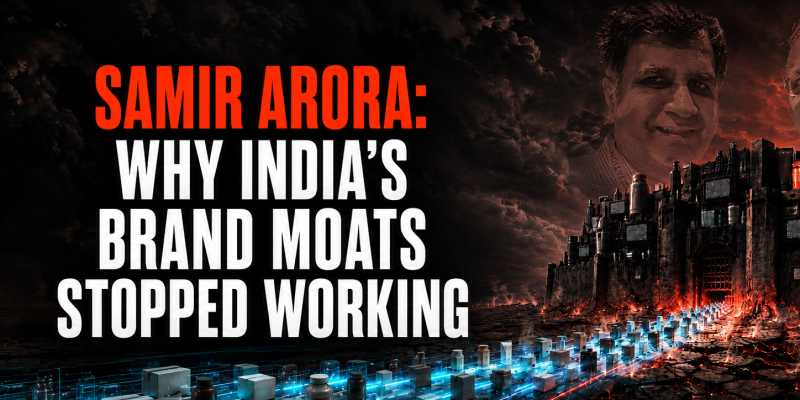
By: Karnvir Mundrey
Samir Arora (Founder and Fund Manager at Helios Capital Asset Management India Pvt. Ltd) on why India’s biggest brands stopped compounding – and why the collapse is a marketing story, not a demand story
Samir Arora spent an hour in Chennai explaining why India’s strongest companies are losing ground, and the answer had almost nothing to do with weaker demand. The brand moats that protected incumbents for thirty years – distribution reach, advertising scale, inherited consumer trust – were marketing assets. All three broke inside a decade. For anyone who builds brands for a living, that makes his session less a market call than an obituary for a business model.
Key takeaways
- India’s consumer incumbents are not losing customers. They are losing the next rupee of growth – challenger brands under 2% share took 39% of incremental category growth in 2024.
- The three classic moats – six million outlets, ₹500 crore television budgets, thirty-year formulations – were all communications infrastructure, not product advantages.
- The counterparty changed: brands once negotiated with fragmented kiranas, now with platforms holding real-time velocity and substitution data.
- Arora’s method is elimination, not selection – remove recognisable losers rather than attempt to identify permanent winners.
- His horizon is two to three years, not twenty. Phases, not permanence.
Samir Arora opened his Chennai session with an airport. He’d landed in Bengaluru, been told to take a shuttle bus to reach his driver, and asked on X why this is normal. Thousands of people discovered they’d been quietly annoyed for years.
It’s the whole thesis in miniature. A large institution builds an elaborate system. Everyone inside stops noticing it’s inconvenient, because noticing isn’t anyone’s job. Then someone outside asks why.
India’s incumbents aren’t failing because their products stopped working. They’re struggling because the system that protected them got cheap enough for everyone else.
Three moats, one cause of death
For thirty years, a large Indian consumer company had three advantages, each stated to the market as a near-threat.
Distribution. We reach six million outlets. You cannot.
Advertising scale. We can spend ₹500 crore on national television. Try launching without us.
Product credibility. This formulation comes from a global research operation and has worked for decades.
All three weakened for one reason: the cost of reaching a customer collapsed.
A challenger doesn’t need six million stores to be discovered. It starts on a marketplace, advertises to a defined audience for a fraction of a TV budget, and secures a quick-commerce listing if demand appears. It doesn’t need every household – just enough people who want onion shampoo or protein coffee.
Scale isn’t dead. Worldpanel’s 2026 rankings still put Parle first for in-home consumption and Britannia first out of home, and established brands remain far more likely to expand reach than small ones – 83% against 56%. Most challengers disappear.
What changed is narrower and more damaging. Incumbency no longer guarantees capture of the next rupee. Bain found brands under 2% market share took 39% of incremental category growth in 2024, up sharply from the year before.
Under two percent. Individually beneath notice. That’s the mechanism – each is too small to reach a competitive review slide, and collectively they take most of what grows.
Ravana, in the Ramayana, had this problem. Asking for invulnerability, he listed every being capable of threatening him and omitted humans because humans were beneath consideration. Not forgetfulness – contempt.
Most incumbents are armoured against the wrong list.
Arora added a fourth break that gets less attention. The counterparty changed. Brands once negotiated with fragmented kiranas holding no data. They now negotiate with platforms that see search, substitution, velocity and repeat purchase in real time. The brand owner is no longer the best-informed party in the room.
His conclusion: consumption in India can grow while large consumer companies don’t. Those are separate claims now.
The uncomfortable part for this industry is that the moat was never the product. It was national media buying, shelf access, trade relationships, and the inherited trust of a name your mother recognised. Most of the moat was marketing – and marketing’s scale advantage has been competed down by cheaper distribution.
The live test: quick commerce vs D-Mart
Arora’s Eternal position makes the argument a wager. His case is better than “India likes convenience”: these companies spent a decade private beating twenty or thirty rivals, and arrived at listing already tested.
He ignores consolidated losses entirely, asking instead which stores are mature, which are one to three years old, and whether the young cohort is masking the economics of the old one. He was candid that quick commerce changed everything – bought at ₹52 as food delivery, he’d probably have sold by now otherwise.
The numbers cut both ways. Blinkit’s June 2026 adjusted EBITDA margin was 0.6% against a 5–6% target, while net order value rose 86% across 2,443 stores. Rapid adoption, unsettled economics.
His D-Mart critique is clever and oversold. When a retailer owns its property, saved rent surfaces inside operating profit and gets a retail multiple rather than a property yield – you pay perhaps 100x for something worth 15x. It generalises usefully: buy your stores, buy your offices. But it explains part of a multiple, not a business.
The better reading: a distribution moat once assumed singular has fractured into missions – monthly value, urgent replenishment, discovery. Different formats may win different trips.
Worth noting against his conviction: the theme is under 4% of his fund.
What Asana’s $12,000 migration means
Asana needed to remove Enzyme, an outdated testing framework blocking its frontend modernisation. Conventional estimate: $6 million, five years. Using Codex with four agents in parallel and an engineer reviewing every change, it finished in two weeks for about $12,000.
The engineer matters. Nothing was handed to a machine and forgotten. Cheap code and good software aren’t the same thing.
But a capable engineer can now finish work that previously required a large team. For an industry whose economics depend on how many people are assigned for how long, that’s a change in the unit of sale. The customer can now test the assumption cheaply.
Which is why below its five-year average multiple isn’t enough. If a business is being repriced by technology that didn’t exist for most of those five years, the average describes the old world. And 10% below the mean means 10% of upside. That’s the whole game.
Cheapness is not a thesis. Arora wants a credible route to 12–15%. He held zero IT for fifteen months, then bought when one management team guided to 20–30% rather than one. His filter isn’t anti-IT. It’s anti-stagnation.
A real exit, and a rotation inside it
Foreign ownership fell from roughly 20% a decade ago to about 15%. But the number of Indian stocks with over 1% FPI ownership rose from 900 to 1,300, and the largest holdings’ share of the FPI book fell from 41% in 2022 to 21% in 2026.
So some foreigners are rotating out of index heavyweights into capital goods, telecom and new-age companies. But rotation shouldn’t deny the exit: ownership sits at a 17-year low, over $50 billion left between October 2024 and June 2026, and India’s MSCI EM weight fell from 21% to below 12%.
There is a real exit. There is also a rotation inside it.
That matters because index ownership conceals a changing economy. Banking and staples stay heavy weights long after growth moves elsewhere. Private equity widens the gap by keeping winners private through their early growth and optimising the exit price.
You can still grow with India. Owning yesterday’s index leaders is no longer the same thing.
Elimination, not selection
Arora’s target was investing’s most durable slogan: buy great companies and hold forever.
The problem isn’t the sentence. It’s the timestamp. Calling Kotak great today is easy. In 2004 it was a broker, and nobody had established a broker could become a great bank. The qualities we now find obvious were revealed by the path.
Same with concentration. We hear from the manager whose five stocks worked. Nobody publishes the process notes of the archer who missed. Concentration converts variance into stories, and survivorship converts those stories into a method.
His alternative is arithmetic. In a fifty-stock portfolio, roughly fifteen do very well and fifteen very badly. You don’t need to identify the winners. You need to cut fifteen likely losers to ten. Do that and you outperform without claiming to know anything.
So he removes what’s recognisably dangerous: extreme valuation, weak governance, brutal industry structure, state dependence, implausible growth. You can’t define good – ask what good governance is and you’ll get a list of absences. You can define bad.
Errors of omission don’t trouble him. Decline a winner and the opportunity set doesn’t shrink; roughly half a 500-stock universe beats the index anyway.
“Eliminate, and then pray.”
The elimination is yours. The compounding never was.
The horizon follows. He underwrites two or three years, not twenty, because survival is itself a filter. Bharti is the example: bought at the 2002 listing, sold when new entrants wrecked the industry structure, back in 2019 when the phase changed.
He applies it to himself, which is rarer. On HDFC Bank – held on cheapness and twenty-five years of history – he won’t add unless it first rises on its own. Valuation is one line. There are ten other lines.
The Schneider tell
On manufacturing, his best evidence wasn’t a government target. It was a cheque.
Schneider took 65% of L&T’s Electrical & Automation business in a deal completed in 2020, with Temasek holding the rest. In July 2025 it bought Temasek out for €5.5 billion cash and said it would expand Indian capacity two-and-a-half to three times.
It could have pursued an Indian listing. It paid heavily for control instead.
Almost everything you’re told about Indian manufacturing comes from someone with an interest in your believing it. A €5.5 billion cheque is a thing a company did with its own balance sheet while the easier option pointed elsewhere. Apple points the same way – roughly 18% of global iPhones now made in India, with Tata and Foxconn adding capacity.
His question about what shrinks was rhetorical and good: if a country has energy, startups and vibrancy, how are its largest companies selling soap?
The rice that stays on the board
Asked whether he’d take a consistent 20% ROE or a weak 6-7% with a path to 20%, he took the second.
A business can earn spectacular returns on a small base and have nowhere to reinvest. So it distributes the cash, and you’ve paid a premium multiple for a statistic that can’t compound inside the business.
At Ambalappuzha, Krishna asks for one grain on the first chess square, doubling after. The king is bankrupt by the fortieth – not because the request was greedy, but because nothing ever left the board.
Doubling isn’t the miracle. Staying is. A company that returns everything has removed the rice after every square. You’re on square one, forty times.
What this means for marketers
Reach is no longer defensible. If your strongest slide is outlet count or media spend, you’re describing something a competitor can rent by the week.
Retail media is an information problem, not a procurement one. When your counterparty knows your consumer better than you do, treating it as trade negotiation loses terms you didn’t know were negotiable.
Heritage depreciates silently. Trust keeps the existing buyer. It doesn’t win the new one.
Your competitive review is watching the wrong companies. If nothing under 2% share appears in your tracking, you’re monitoring the segment that isn’t taking your growth.
One question organises it: which of the things you’re defending were ever going to last?
The six-million-outlet network. The ₹500 crore television budget. The thirty-year formulation. The five-year migration. The assumption that yesterday’s leaders capture tomorrow’s growth. None were imaginary. They were temporary arrangements that intelligent, well-resourced, entirely sincere institutions mistook for permanent ones.
Don’t confuse loyalty with discipline. Don’t confuse cheapness with a thesis. Don’t confuse a moat with immortality.
The moat was real. The mistake was believing it belonged to the company forever.
FAQ
Why aren’t India’s FMCG companies growing despite rising consumption?
Consumption growth and incumbent growth have decoupled. Challengers under 2% share took 39% of incremental category growth in 2024. Big brands hold penetration but no longer capture the increment.
What is a brand moat, and why are they collapsing?
A structural advantage that makes a brand hard to displace – in Indian FMCG, distribution reach, national ad scale and decades of product credibility. All three eroded as the cost of reaching a customer fell.
What is Samir Arora’s investment philosophy?
Elimination over selection. Remove companies with recognizable problems rather than trying to identify permanent winners, and hold a diversified portfolio for two to three years rather than twenty.
Reporting note
Based on a fireside chat in Chennai, cross-checked against company disclosures and published reporting. Where recollection conflicted with the record, the published figure is used.
Karnvir Mundrey is the Editor of TheFutureOfPR.com. Reach out at tfofpr@gmail.com or at +918296303806.
Subscribe to TheFutureOfPR.com to get great ideas on life, education, health & fitness, real estate, glamour, jewelry, movies, and podcasts! Share this article with people who you think might benefit. They will thank you for it!
Follow TheFutureOfPR.com on Facebook & Twitter.
Karnvir Mundrey is also the producer and host of 4 YouTube channels. Finest Fintalk brings you the latest in Finance, LitInMin for Books, The Health Tips Podcast for health and Atharva Marcom for leadership talks.










Comments