
 By
By 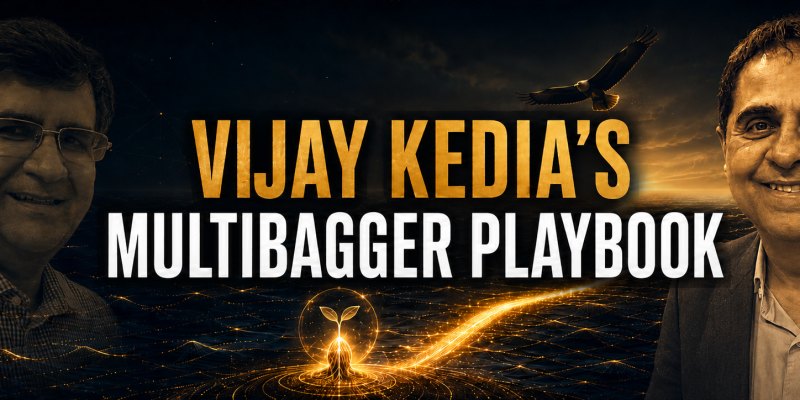
By: Karnvir Mundrey
There is a detail in Vijay Kedia’s biography that everyone repeats and almost nobody sits with.
Sometime in the late 1980s, in a rented Kolkata room he shared with six other people, his wife scraped together loose coins to buy milk for their infant son. The sum involved was fourteen rupees. He didn’t have it.
Hold that number against this one: as of the June 2026 quarter, his publicly disclosed holdings across roughly 22–23 listed companies were tracked at approximately ₹1,340 crore.
Between those two numbers sit forty years, two total wipeouts, one Class 10 exam failed out of grief, a father who died when he was fourteen, a mother who followed within three years, four siblings who became his responsibility before he could legally vote, and a family that – by most accounts – had stopped speaking to him by the time he boarded a second-class train to Bombay.
That is the man who walked into a room full of chartered accountants and fund managers this month, was told he was a good singer, and refused the compliment.
Asked to settle whether he was the better singer or the better investor, he didn’t pause: “Both are mediocre.” God gave him decent lyrics, he explained, not a voice. And the investing was a work in progress.
This from a man with more than ten original songs about the stock market on YouTube, three TEDx talks and a lecture history that runs through the IIMs, ISB and London Business School. He is not shy. The self-deprecation is something else – a habit of calibration, the same reflex that made him say “I may be wrong” roughly a dozen times over the next ninety minutes.
Then he gave the room its opening line.
“When we are right, we earn. When we are wrong, we learn.”
Fridge-magnet stuff, until you set it against the number he volunteered twenty minutes later.
His hit rate, by his own admission, is five out of ten.
Half his stocks do nothing. Everything he has built sits on top of an admitted coin flip. That is not a confession. It is the design specification – and once you see it, the rest of the evening reorganises itself around it.
The line nobody in the room had drawn
Kedia’s central distinction is one most Indian investors have never made explicitly.
Making money is not creating wealth.
Making money is beating the fixed deposit. Your FD gives 6-7% before tax; you make 12-13%. He is careful not to sneer – he calls it “of course very good.”
Creating wealth is a different activity with different physics. It requires that your portfolio changes as the economy changes. And it requires that nothing in your life can ever force you to sell.
What happens when Indians confuse the two is measured annually by the regulator. SEBI’s latest study found 87.7% of individual F&O traders lost money in FY26, with aggregate losses of ₹91,685 crore. The year before: 91% and ₹1.06 lakh crore. The three years before that: 93% and ₹1.8 lakh crore.
Three studies. One answer. Nine in ten.
And the detail that should genuinely unsettle you – among traders who lost money two years running and carried on anyway, roughly 90% lost again the following year. That is not a learning curve. That is a treadmill with a payment gateway attached.
Why a coin flip is enough
Do the arithmetic, because it is the most clarifying five minutes available to any investor.
Ten positions of ₹1 lakh each. Ten years. Apply Kedia’s own distribution: five do nothing, three do reasonably well, two turn into what he calls cheetahs.
Five at 0.8x gives you ₹4 lakh. Three at 3x gives you ₹9 lakh. Two at 30x gives you ₹60 lakh.
Total: ₹73 lakh. Roughly 22% a year, with a strike rate that would get you fired from most jobs.
Now change one thing. Same research, same picks – but you sell the two cheetahs at 3x, because a 200% gain feels like a gift and holding on starts to feel greedy.
Total: ₹19 lakh. About 6.6% a year.
You have matched a fixed deposit while carrying small-cap risk for a decade.
This is not a toy model. Hendrik Bessembinder studied more than 64,000 global stocks from 1990 to 2020 and found that 55.2% of US and 57.4% of non-US stocks underperformed one-month Treasury bills – not the index, cash. The top 2.4% of firms accounted for all $75.7 trillion of net global wealth creation. In his earlier US work going back to 1926, the median stock’s lifetime return was negative and its median listed life about seven years.
So Kedia’s 50% is not embarrassing. It is enormously better than the base rate. And his refusal to sell a winner early stops being temperament and becomes arithmetic. If a tiny minority of companies produce everything, selling one of them at 3x isn’t prudence. It’s the most destructive act available to a long-term investor.
There is an older formulation of this, and Kedia stumbled into it without naming it. Talking about how the Tata acquisition rescued his Tejas position – something he could not possibly have foreseen – he said luck plays an enormous role, so one should simply do good karma and stop claiming credit.
कर्मण्येवाधिकारस्ते मा फलेषु कदाचन।
You have a claim on the action alone, never on its fruits. – Bhagavad Gita 2.47
The verse is routinely misread in India as permission not to care about outcomes. It says nothing of the sort. It describes the structure of a probabilistic game. You control the screening, the sizing, the decision not to sell. You do not control which two of ten become cheetahs. Kedia did not cause Tata Sons to buy Tejas. He caused himself to be holding 4.4% of it when they did.
His TED talk, as it happens, is titled Success Is a Series of Accidents.
The promoter’s cage
Here is the idea you rarely hear from a professional fund manager, because they have cages of their own.
A promoter cannot sell his own company.
Picture the founder of a mid-sized components business waking up genuinely convinced that the next five years are flat. Margins compressing, technology shifting, the whole sector de-rating. What can he do? Nothing. He is welded to the asset. His name is on the building.
You can be out before lunch.
Kedia calls investing a “blessed business” for exactly this reason – not because it is easy, but because of this asymmetry. The catch is that the option is only worth something if you know when to exercise it, which is why he insists the real job is understanding the economy before the company.
And then he disowned his younger self. “Buy and forget” was his mantra for years. He now calls it dangerous. Britannia, Hindustan Unilever, ITC – recession-proof, cash-generating, never needing capital – have each gone through decade-long stretches of doing essentially nothing. Ten years is not a rounding error in a human life. It is a third of your compounding window.
He didn’t cite the hard evidence, so here it is.
Ninety-three companies have been part of the BSE Sensex since 1985. Sixty-three have left. Of the original thirty at the 1986 launch, only three have never once exited – Reliance, HUL and ITC. Ballarpur Industries, once the eleventh most valuable company in India, is gone. Premier Automobiles and Hindustan Motors, whose cars every Indian family aspired to own, are gone. In 1991, manufacturing made up 96% of the index’s market capitalisation. There was not a single bank or IT company in it.
There is a story in the Brahmavaivarta Purana that fits this better than any chart. Indra, fresh from defeating Vritra, is building himself a palace of appropriate magnificence. Vishnu arrives disguised as a boy, notices a column of ants crossing the floor, and laughs. Asked why, he explains: every one of those ants was, in a previous cycle, an Indra. Each had won his war. Each had built his palace. Each had believed the position permanent.
Our word for a large, established company is bluechip – a phrase that quietly promises permanence. The Purana and the BSE agree that there is no permanent tier. Only a current one, and a rate of replacement.
From SMILE to the general ward
Everyone knows the acronym. Small in size – within its sector, not a penny stock. Medium in experience – fifteen to twenty years of management history, people who have already failed once and paid for it. Large in aspiration. Extra-large market potential.
That last one he sums up in six words that are worth more than the rest of the framework: a fish in the ocean, not a crocodile in a pond. A crocodile in a pond is the dominant player in a market that cannot grow. It screens beautifully on every metric you own and goes nowhere for a decade.
But the news from Chennai is that he has moved on to something sharper. Three stages:
A beautiful past. The company has already set a record once. When an athlete stumbles and falls out of form, the crowd forgets. He doesn’t. If they did it once, it’s in the DNA.
Currently out of form. Abandoned, unfashionable, institutional ownership falling.
An inflection point. And here is the discipline that separates this from ordinary bottom-fishing:
“I am not buying an ICU. The moment it comes out of ICU and goes into a general ward, there I start thinking about this company.”
He does not buy the fall. Stumbling is not a signal – stumbling gets you onto the watchlist. He waits for observable evidence of recovery, and only then takes a position that matters.
This inverts what most retail contrarians do. They buy on the way down, average down, and exhaust both capital and conviction before the turn. Kedia deliberately surrenders the bottom tick in exchange for confirmation. He has written elsewhere that only God and a liar know the exact top and bottom, and that he is content to pay 10% or 20% above the low. Almost every retail investor in India is hunting the low. He has decided in advance to pay a fifth more as a fee for information – the information being that the business has actually stopped deteriorating.
Tejas Networks: the story he told, and the ending he didn’t
This was the evening’s set piece, and he told it well.
From 2014-15 he watched Indian telecom collapse from sixteen or seventeen service providers to what he called “two and a half.” Nobody had capex money. India skipped 3G almost entirely and sat on 2G. Then Jio arrived, tariffs recovered, and the survivors started generating cash. At the same time: Huawei effectively barred on security grounds, Ericsson and Nokia the only alternatives, Make in India pushing procurement domestic, and exactly one credible Indian equipment maker.
He is emphatic that the cheap price was never the thesis. “I connected each and every dot.”
Six dots, and they were a causal chain rather than a list. He bought during the COVID collapse and scaled to over 4% of the company. In July 2021, Tata Sons’ Panatone Finvest took control at ₹258 a share. He says plainly he had no idea it was coming. By June 2024 the stock touched ₹1,495.
Most tellings stop there, and the lesson is useless: find the next Tejas.
Keep watching.
He trimmed all the way up – 4.4%, then 1.87%, then 1.02%, then off the disclosed shareholder list entirely by mid-2025.
Then Tejas came apart. FY26 revenue: ₹1,103 crore, against ₹8,923 crore in FY25. Not a decline – an evaporation. A loss of ₹909 crore. Net debt of ₹3,531 crore. The cause was a ₹1,526 crore BSNL order, advance-approved in May 2025, whose final purchase order sat unsigned for roughly eight months while the company held inventory it had already bought.
Now re-read the thesis. Every dot he connected in 2020 was correct. Telecom recovered. Capex came. Huawei stayed out. Make in India preferred him. Tejas was the only domestic OEM.
And the company was nearly destroyed by a variable that was not on his list: single-customer concentration.
The framework found the opportunity. The switching discipline banked it. And the filter he was missing is the one you should add – who is the largest customer, what percentage of revenue, and what happens to working capital if they go quiet for two quarters.
IndiGo: right about the business, wrong about the stock
Asked for a bold decision that failed, he offered this one without hesitation.
Around 2022, near ₹1,800, he bought InterGlobe Aviation. The logic was first-principles, and he described it as his general method for finding a theme: without this, the country cannot run. Sixty per cent market share, every competitor losing money, and a government that could restrict and advise but – unlike with petrol and diesel – could not dictate fares.
Then he changed his mind. Conflict in West Asia grounded routes, fuel spiked, demand cracked. And he arrived at an insight that travels well beyond aviation:
In a business with this cost structure, three months of losses take twelve months to recover, because the losses are denominated in thousands of crores.
He exited.
Read both scoreboards, because they disagree.
The business validated him. IndiGo swung from a ₹7,258 crore profit in FY25 to a ₹2,394 crore loss in FY26, on revenue that grew. Growing revenue, deepening losses – exactly the fragility he described.
The stock humiliated him. It traded around ₹5,000 by mid-2026. Roughly a 2.8x he walked away from.
This is the honest version, and it teaches more than a clean one. Being right about the business is not the same as being right about the stock. His process worked precisely as designed. It cost him a great deal of money. He tells the story anyway.
Which brings up the half of investing nobody prepares for. On the thirteenth day at Kurukshetra, Abhimanyu enters the chakravyuha knowing how to break in and not how to get out – Subhadra fell asleep before Arjuna finished explaining. He fights brilliantly and dies inside a formation he penetrated perfectly.
Every Indian investor knows that story. Almost none have applied it to a demat account. We have entire industries built to help people enter positions. Ask an investor why he bought something and you’ll get fifteen minutes. Ask what would make him sell and you’ll usually get silence.
Write the exit conditions at the time of purchase, in the same document, before you know how the story ends.
The No Gravity Zone
If you take one thing from the evening, take this.
Asked how someone with a job can invest peacefully, he didn’t talk about allocation or position sizing. He said:
“I don’t want to be dependent on the income of the stock market to run my family.”
He calls it the No Gravity Zone. Not a percentage, not a rule – a structural condition. He owns real estate. He owns three small wellness retreats. He buys property the way he buys stocks, opportunistically, when something trades below what it’s worth. There is no target ratio. There is one purpose: generate income outside the market so that no life event ever forces a sale inside it.
Then the payoff line: “That is why I can keep the shares for sixteen years. That is the only reason.”
Understand what he is actually claiming. His celebrated patience – the thing everyone attributes to temperament, discipline, Marwari conditioning – is not primarily a psychological achievement. It is a cash-flow architecture.
He can hold for sixteen years because nothing can make him sell in year four. Not a wedding. Not a hospital. Not a school fee that lands the same month as a bad quarter. He has removed the mechanism by which long-term investors get converted into short-term ones.
Every Indian knows the Samudra Manthan, and every retelling rushes to the amrita. Two details get skipped, and both are the point. The first thing the churning produced was not nectar but halahala, a poison that nearly ended creation. The good things came much later. And before any of it, Mount Mandara began sinking into the seabed and the entire operation stopped — not for lack of effort or a weak rope, but because there was nothing stable underneath. Vishnu became Kurma, the tortoise, and sat beneath the mountain as its base.
The No Gravity Zone is Kurma. It produces no alpha and appears on no returns statement. Its only job is to keep the axis from sinking while the churning runs for sixteen years.
Most Indian portfolios don’t fail because the churner lost faith. They fail because the mountain sank in year four, when a wedding came due.
So the question is not how do I become more patient? Patience is downstream. The question is: what would have to be true about my income for patience to be structurally available to me? Map your next five years of large obligations. Mark every one that would currently be funded by selling equity. Each one you move off that book adds years to your holding period.
RISE, and the sentence that should sit above it
His current sectoral frame is RISE – Renewables, Infrastructure, Security, Emerging technology – offered with a ten-to-fifteen year horizon and an immediate caveat that policy or geopolitics could change his mind tomorrow.
The tailwinds are real. India crossed 300 GW of non-fossil capacity in July 2026. Defence exports hit a record ₹38,424 crore in FY26, up 63%. Nobody disputes the direction.
But he volunteered the cautionary case himself, and it was the sharpest thing in the section: Suzlon was early to Indian wind, and being early to a correct theme destroyed capital anyway. Being first to identify a sector, as he put it, wins you an award. Every star has to align for it to win you money.
A tailwind is not a stock. Solar capacity can soar while a manufacturer is ruined by leverage and price competition. Defence orders can rise while receivables and valuation ruin the shareholder. Use RISE to generate a research universe, never to skip the research.
Then came the moment worth the whole evening. On cybersecurity he was unusually firm: “Currently we don’t have any cyber security company in India which can become so investable.” Three or four are listed, they’re expensive, and – his warning, not mine – do not buy something because the words appear in its description.
Except Vijay Kedia owns a cybersecurity company. About 11% of TAC Infosec, with his son holding more.
The resolution is the lesson. He didn’t buy it in the market. He came in through an angel round in 2016. The company listed on the SME platform in April 2024 at ₹106 and was above ₹1,100 by December.
Read his statement again in that light and it stops being a contradiction. He is not saying the theme is uninvestable. He is saying you cannot buy it on a screen. By the time a theme is screenable and covered, the entry that mattered happened years earlier, somewhere you weren’t. His edge in cyber wasn’t analysis. It was access, and eight years of patience holding something illiquid with no exit in view.
That is uncomfortable, and it is true: the version of a theme available to public-market retail investors is usually the late, expensive one.
The company has to want a Test match too
He uses cricket because, as he admitted with some self-awareness, he is a storyteller who needs images people can stand inside. Stay on the pitch. Test match, not T20. Marathon, not sprint. Familiar enough.
But one extension was not familiar, and it was the best line of the night:
The company must also be willing to play a Test match with you.
If your horizon is a decade and management’s horizon is the next quarterly print, no amount of patience on your side fixes the mismatch. You are batting for a draw while your partner tries to hit every ball out of the ground.
“You should love me, I should also love you.”
This is screenable, not sentimental. Read three years of concall transcripts. Is capex framed in years or in guidance beats? Is capital allocation explained, or defended? Horizon alignment is a due-diligence item, and almost nobody treats it as one.
Why you cannot simply copy him
The obvious response to an evening like this is: fine, just tell me what he owns.
The record answers that. When Kedia bought 3.4 lakh shares of Ramco Systems at ₹87.82 in June 2020, the stock was locked in upper circuit for five straight sessions and rose 91% in five trading days. The company had to file a clarification saying nothing had happened. Talbros rose 32% in two days. Websol hit the upper circuit twice.
Add the structure: disclosures are quarterly and lagged; only stakes above 1% are named; you learn about an exit only once it’s complete. His Tejas holding vanished from the list in mid-2025 – by the time that was visible, the stock had already fallen most of the way.
You are not buying his entry price. You are buying his entry price plus a crowd.
There is a verse Indians quote constantly about career and almost never where it is most mechanically true:
श्रेयान्स्वधर्मो विगुणः परधर्मात्स्वनुष्ठितात्।
Better one’s own dharma, imperfectly performed, than another’s performed well. – Gita 3.35
His sva-dharma includes forty years of pattern recognition, private-market access, position sizes at prices you’ll never see, and a temperament forged by two total wipeouts before he turned forty. None of that transfers with the stock name. You can copy the holding. You cannot copy the holding capacity.
What he actually gave the room
Strip out the metaphors and the evening produced six things you can use tomorrow.
Build the No Gravity Zone before you build the portfolio – everything else depends on it. Understand the economy before the company. Buy at the inflection, not the fall; general ward, never ICU. Connect at least five causally linked dots, and remember that a cheap price is not one of them. Test for customer concentration and horizon alignment. And protect the outliers above all else, because two positions in ten carry the entire result.
Then the caveat that matters most.
Kedia told a room full of people that his hit rate is 50%. That his best holding took seventeen years. That the Tata acquisition which made Tejas was not remotely his doing. That he was wrong about IndiGo. That he may be wrong about RISE.
The frameworks are worth having. The honesty about their failure rate is worth more.
Nothing here is investment advice. Several companies are named specifically as illustrations of theses that broke. Do your own work, or pay a registered adviser to do it with you.
Reporting note
Based on a fireside chat in Chennai, cross-checked against company disclosures and published reporting. Where recollection conflicted with the record, the published figure is used.
Karnvir Mundrey is the Editor of TheFutureOfPR.com. Reach out at tfofpr@gmail.com or at +918296303806.
Subscribe to TheFutureOfPR.com to get great ideas on life, education, health & fitness, real estate, glamour, jewelry, movies, and podcasts! Share this article with people who you think might benefit. They will thank you for it!
Follow TheFutureOfPR.com on Facebook & Twitter.
Karnvir Mundrey is also the producer and host of 4 YouTube channels. Finest Fintalk brings you the latest in Finance, LitInMin for Books, The Health Tips Podcast for health and Atharva Marcom for leadership talks.









Comments