
 By
By 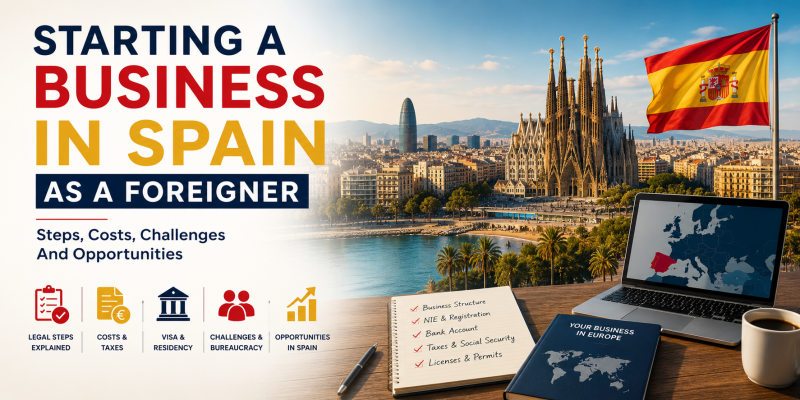
Spain has an attractive promise for entrepreneurs. It offers access to the European Union, a strong lifestyle advantage, good weather, global cities such as Madrid and Barcelona, a growing startup ecosystem and a natural appeal for founders who want to combine business with a better quality of life. For many foreigners, especially from outside the EU, Spain is no longer only a holiday destination. It is becoming a possible base for startups, consultants, digital businesses, relocation companies, food ventures, language academies and professional services firms.

But the dream needs to be understood clearly. Starting a business in Spain is possible, but it is not always simple. The process involves legal identification, residence status, company structure, banking, notary procedures, tax registration, social security and often professional help from lawyers or gestores. The country offers opportunity, but it also has bureaucracy. The smart founder should enter with both enthusiasm and preparation.
Can A Foreigner Start A Business In Spain?
Yes, a foreigner can start a business in Spain, but the first question is whether the person has the right to live and work in the country. The basic company formation steps may be similar for Spaniards, EU citizens and non-EU citizens, but the immigration requirements are different. EU citizens usually have a more straightforward path, while non-EU citizens may need a suitable work or residence route before they can actively run a business in Spain. The source material explains this distinction clearly: everyone can start a company, but non-European citizens must deal with the extra issue of legal residence or work authorisation.
For non-EU founders, common routes may include an entrepreneur visa, self-employed work authorisation or other residence categories depending on the nature of the business and the founder’s circumstances. The entrepreneur route is usually more relevant when the business idea is innovative, scalable or brings something new to the Spanish market. However, immigration rules are detailed and can change, so any founder should speak to a Spanish immigration lawyer before making financial commitments.
Choosing The Right Business Structure
One of the first practical decisions is the type of business entity. Spain offers different options, and the right choice depends on the size of the business, risk level, investment needs and whether the founder is operating alone or with partners.
A sole trader, or autónomo, is often the simplest route for freelancers and small solo businesses. It can work well for consultants, digital professionals, teachers, designers or service providers who do not need a company structure at the beginning. The disadvantage is personal liability, which means business debts can affect the individual directly.
The Sociedad Limitada, or SL, is one of the most common structures for small and medium-sized businesses in Spain because it offers limited liability and is suitable for companies that want to grow. Many older guides still refer to a €3,000 capital requirement, and the uploaded material also describes the SL as Spain’s popular limited liability option with €3,000 in capital. However, the current Spanish Companies Act now states that the minimum capital for an SL cannot be lower than €1. Until the capital reaches €3,000, special rules apply, including allocating at least 20% of profit to legal reserve and potential shareholder responsibility for the difference between subscribed capital and €3,000 in certain liquidation situations.
This means founders should not treat the €1 rule as a reason to undercapitalise the business. In practice, a company still needs enough working capital to pay for formation costs, accounting, legal advice, banking, software, salaries, rent, marketing and early operations.
For larger businesses, a Sociedad Anónima, or SA, may be more suitable, especially for companies that plan to raise significant capital or operate at scale. Spanish law currently states that the minimum capital for an SA cannot be lower than €60,000. A branch office may be appropriate when a foreign company already exists abroad and wants to operate in Spain without creating a completely separate Spanish company.
The Main Steps To Set Up A Company In Spain
The process can vary depending on the structure and the founder’s immigration status, but a typical path includes several important steps.
The first step is getting a NIE, the foreigner identification number used for legal, tax and administrative processes in Spain. Without this number, it becomes difficult to open a bank account, sign documents or be properly identified by the tax system. The transcript identifies the NIE as the first practical requirement for a foreigner because it allows the person to open a bank account and be tax identified.
The second step is reserving the company name. This normally involves checking name availability with the Registro Mercantil and obtaining a certificate confirming that the chosen name can be used. The source material recommends preparing three possible company names and submitting them for approval, with the accepted name becoming the official legal name used on invoices and company documents.
The third step is opening a bank account and arranging share capital or equivalent contributions. Depending on the company structure and capital level chosen, the founder may need a bank certificate or evidence of capital contribution for the notary process. Older processes often centred around the €3,000 deposit for an SL, although, as noted above, the current legal minimum for an SL has changed.
The fourth step is defining shareholders, directors and ownership percentages. This is not a formality. It is one of the most important parts of the process because mistakes in the shareholder agreement can create serious problems later. Founders should decide who owns what, how decisions are made, what happens if someone leaves, how shares can be transferred and how disputes will be resolved. The uploaded material rightly warns that this is a crucial stage and recommends relying on a business lawyer.
The fifth step is signing the public deed before a notary. At this stage, the shareholders, administrators, company address and business activity are formally recorded. A practical suggestion from the source material is to define the company activity broadly enough to avoid unnecessary changes later if the business expands or pivots.
After the notary stage, the company must be registered with the relevant authorities, including the tax agency. The uploaded material refers to obtaining the company tax identification code and registering with the Spanish tax agency, followed by registration with social security where required. In modern terminology, people may still casually say CIF, but the official tax identification system uses NIF for both individuals and legal entities.
The Reality: Spain Is Attractive, But Bureaucratic
Spain is not an impossible country for business, but it can be bureaucratic. One of the uploaded transcripts refers to Spain as not being particularly easy when judged against international ease-of-doing-business comparisons, especially in areas such as starting a business, construction permits and getting electricity.
The challenge is not only national bureaucracy. Spain also has multiple layers of administration, including municipal, autonomous community and national systems. This means the experience of doing business can vary depending on the city or region. The source material notes that some regions, such as Madrid, may be easier for business than others, while bureaucracy and local procedures can create friction for small businesses.
For a large company, bureaucracy can be managed with lawyers, accountants and consultants. For a small founder, it can become tiring because the founder may also be the salesperson, operator, accountant, marketer and administrator. This is why many entrepreneurs in Spain use a gestor, a local administrative professional who helps with paperwork, compliance and filings. The transcript describes gestores as people who can handle the bureaucratic process while the entrepreneur waits, though the process may still take time.
The Bigger Challenge Is Not Opening The Company. It Is Managing It.
One of the most important insights from the material is that opening a company may be manageable, but running it well is harder. A founder in Spain must think about taxation, salaries, invoices, compliance, bank processes, social security and ongoing accounting. In one of the interviews, the speaker says the bureaucracy is more complex, things take time, and good preparation can prevent future problems.
This is especially relevant for foreign founders who are used to faster or more digital systems in countries such as the UK, Singapore, Estonia or the UAE. Spain may offer a better lifestyle, but that does not mean its administrative systems will move at startup speed. Founders should build delays into their plans and avoid assuming that a document, bank process or permit will be completed immediately.
Why Spain Still Makes Sense
Despite the bureaucracy, Spain remains attractive. The country offers a strong quality of life, an active social culture, good public infrastructure in major cities, a growing startup environment and access to the EU market. In the uploaded interview, the speaker describes Spain as a good opportunity for startups and business builders who want to live in a good environment.
Barcelona, in particular, is discussed as a startup-friendly city with common workspaces, networking possibilities and an emerging ecosystem for international founders. The interview also mentions a textile AI company looking to grow in Barcelona because of access to industry and startup resources.
Spain’s lifestyle advantage is also real. The material highlights good infrastructure, affordability compared with cities like Paris or London, social life and a better work-life balance. For founders who can earn internationally, run digital businesses or build specialised services, this combination can be powerful.
What Foreign Founders Should Do Before Starting
The first thing a foreign founder should do is clarify immigration status. Without the right residence or work permission, the business plan may get stuck before it begins.
The second is to decide whether to begin as an autónomo, an SL or a branch structure. A freelancer with low risk may not need an SL immediately, while a founder with partners, employees or investor plans may benefit from a limited liability company.
The third is to hire the right local help. A good lawyer, gestor and accountant can save time, reduce errors and prevent future tax or compliance problems. This is not an area where founders should cut corners, especially if they do not speak Spanish fluently.
The fourth is to study the market deeply. Spain may be attractive, but competition can be intense in areas such as language schools, restaurants, tourism, relocation, real estate and digital services. One of the transcripts warns that even apparently simple sectors can become crowded, so market research is essential before entering.
The fifth is to prepare for slower processes. Spain rewards patience, relationships and local understanding. A founder who expects everything to move instantly may become frustrated, while one who prepares properly can still build a strong business.
Final Word
Starting a business in Spain as a foreigner is not a fantasy, but it is also not a casual lifestyle experiment. It requires legal preparation, patience, capital, paperwork, market research and local support. The opportunity is real, especially for founders who can combine international skills with Spanish market needs, but the bureaucracy is also real.
Spain’s appeal lies in the balance it offers. It may not be the easiest country in Europe for paperwork, but it offers something many entrepreneurs value deeply: a serious market, a strong lifestyle, access to Europe and the possibility of building a business without sacrificing quality of life.
For the right founder, Spain can work beautifully. But the founder must arrive with open eyes, not just a dream of sunshine.
Karnvir Mundrey is the Editor of TheFutureOfPR.com. Reach out at tfofpr@gmail.com or at +918296303806. Join the conversation on July 7th, 2026. Click on this link to register. See other episodes of the Discovery Series here.









Comments