
 By
By 
By: Karnvir Mundrey
At IFCCI’s 49th AGM in Mumbai, a question pinned to a wall turned into an argument about authority – and a challenge to count jobs, not MoUs.
The card on the wall
The card was small, white and handwritten. It was pinned to a backdrop at the St. Regis Mumbai, in a grid of mostly blank squares, under a question in large white letters: What does innovation mean to you?
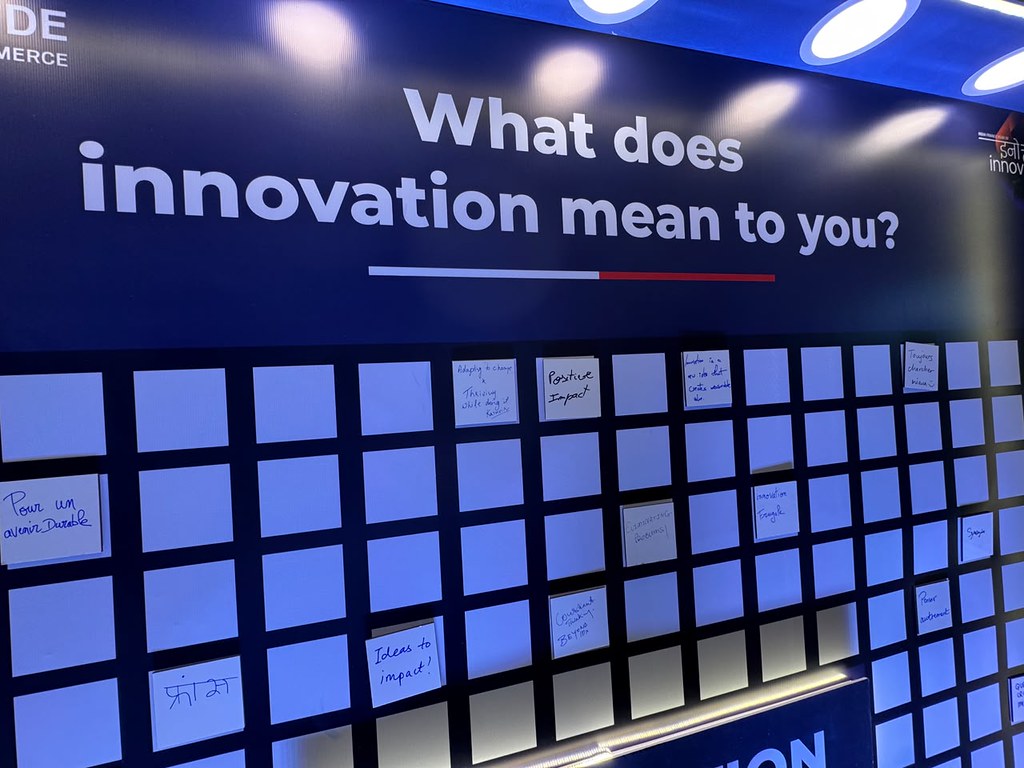
The innovation wall, filling up before the first session. Someone had written: Innovation is a new idea that creates measurable value.
The cards around it were more poetic, and multilingual. “Pour un avenir durable.” “Toujours chercher mieux.” “Innovation frugale.” “Penser autrement.” “Ideas to impact!” One simply said फ्रांस – France, in Devanagari. But it was the plain one in English that I kept coming back to. By the end of the night, it read like the evening’s verdict.
I had flown in from Bengaluru for the 49th Annual General Meeting of the Indo-French Chamber of Commerce and Industry (IFCCI) on Tuesday, 29 September 2026. More than 400 people filled the room for a theme that sounded familiar: “Driving Innovation for Global Impact”. France’s Minister of Higher Education, Research and Space and its Ambassador to India would close the night.
In between came two panels with leaders from TotalEnergies, Dassault Systèmes, Saint-Gobain, BNP Paribas, JM Financial, Capgemini, Renault, AXA and Sanofi.
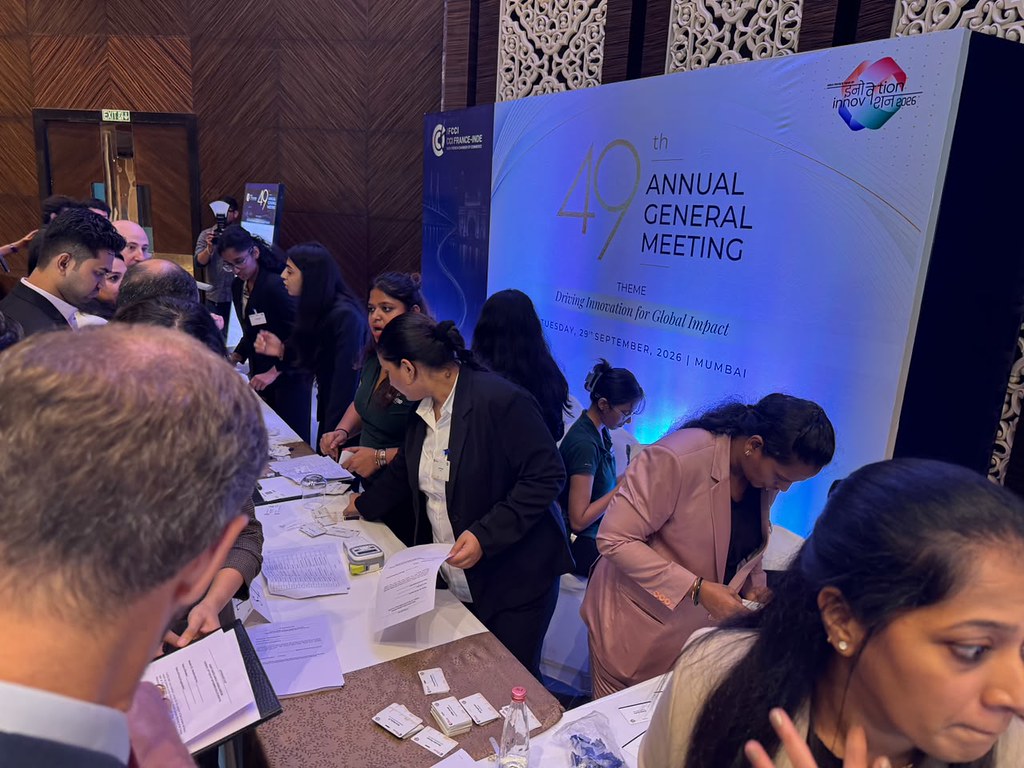
Registration at IFCCI’s 49th AGM, St. Regis Mumbai
Nobody in that room disagreed about the word innovation. The real argument was hidden in the other word on the card: measurable. Measured by whom, in what currency, and who gets to own the result?
Over three hours, the answer took shape. The India–France relationship is graduating from cost to ownership, and the scoreboard has to change with it. The man who said so most bluntly had been asked only to set the context. The one who showed it most clearly runs a car company.

If you like what we do, don’t just scroll past! Support the publication!
The man who was only supposed to set the context
The evening began with a joke about a car. Two Renault Dusters stood on display, and IFCCI Treasurer Sanjay Singh of BNP Paribas India joked that if the speakers impressed the Renault team, it might just leave a car behind. The only challenge, he added, would be getting one down from the ninth floor.

Then Ravin Mirchandani, IFCCI Vice-President, took the stage and spent ten minutes describing a world coming apart.
He opened by poking fun at himself. He had been around the chamber so long, he said, that he was no longer sure whether he was invited each year or was simply part of the furniture. The upside of longevity was licence to be “deliciously provocative”.
The storm
His framing was that 2026 feels like 1997, 2008 and 2020 arriving at once. In his telling, the year opened with the US capture of Venezuela’s President Maduro, and then the Iran conflict turned the Gulf into a pressure point. He cited crude near $107 a barrel, US Treasury yields above 5% and Europe forecasting about 3% inflation. China’s squeeze on critical minerals and IP, he said, had left Indian energy-transmission projects short of materials, people and technology.
The result was “expensive energy, expensive money, and increasingly unpredictable supply chains”. A wonderful combination, he said, deadpan – provided you have no shareholders, customers or employees to worry about.
He kept going. Greenland had just agreed to a much larger American military presence, which he called extraordinary between NATO allies. Canada, under Mark Carney, was looking across the Atlantic for stability. India was cautiously reopening cooperation with China while facing proposed US tariffs on buyers of Russian energy – caught between affordable fuel for 1.4 billion people and a major export market.
“Apparently, globalisation is a wonderful thing,” he observed, “until somebody else benefits from it.”
Even the Trump–Xi summit, he noted, had produced mostly ceremony and a two-month extension of the trade truce. And then there was AI, whose own builders now warn about it while governments refuse to slow down.

At the event.
The compass
Then he turned from diagnosis to direction. For the next 24 months, he predicted three shifts:
- Resilience becomes as important as efficiency. The cheapest supply chain is no longer the most sensible one, and even “alternative” chains are fragile if they still rely on China for base materials.
- Technological and energy sovereignty move to the centre. Geopolitical risk becomes a routine boardroom conversation, not an annual slide.
- AI reshapes the economics of almost every industry. Innovation stops being about competitive advantage and becomes about survival.
The match
This, he argued, is where India and France fit. France brings research, aerospace, energy, defence and advanced engineering. India brings engineering talent, digital capability, entrepreneurship and scale.
“The French have a remarkable ability to engineer something to perfection. Indians have a remarkable ability to engineer something that works at a fraction of that cost.”
At the IFCCI AGM
It lands because both halves are true. His point was that the relationship must now run both ways: France helping India climb the technology value chain, India helping France on cost. Selling French products in India and Indian services in France is no longer enough.

Then he laid down the challenge that runs through this piece:
“Let’s measure our success not in MoUs – we’re really good at signing those – not in conferences, but in how many actual businesses, technologies, products and jobs we create together.”
He signed off with “Jai Hind, and Vive la France.” Everything that followed would be measured against that line.
Five ways to read the same storm
If Mirchandani had described the storm, the first panel was asked how to sail through it. Manoj Gidwani, Senior Vice-President at Nexdigm, moderated “Global Shifts, Global Opportunities: The Power of Innovation”. His opening question echoed the card on the wall: how do you convert innovation into measurable business impact?
He asked each panellist to name the one global shift that matters most. Almost nobody could pick just one.
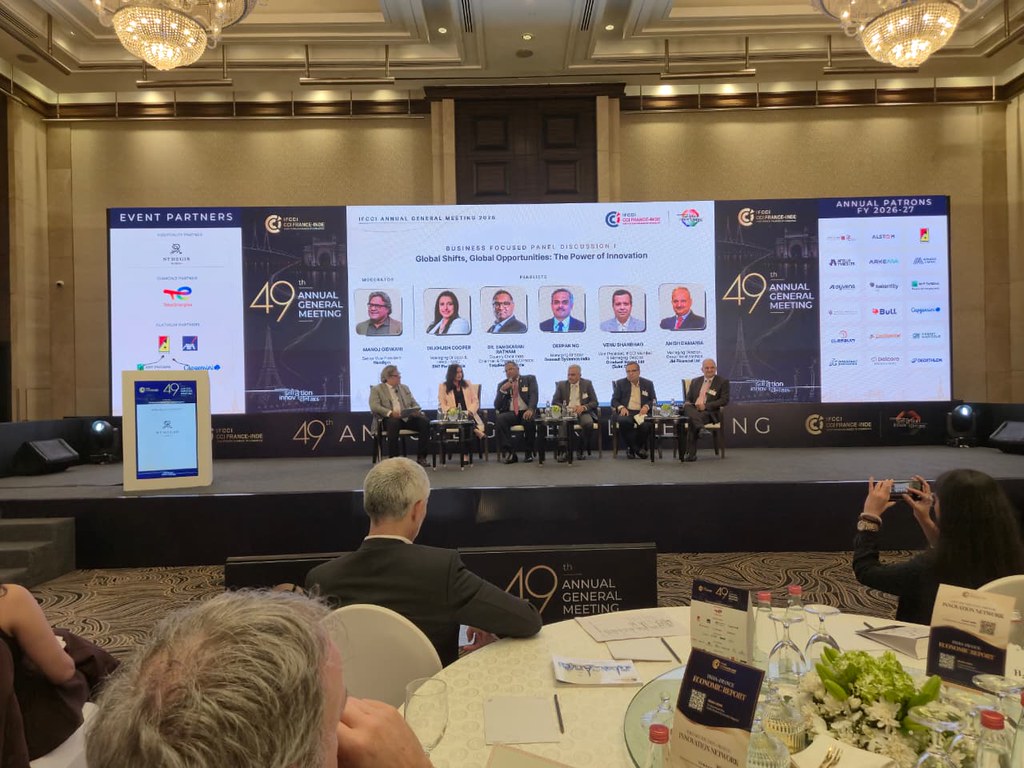
The energy chief who promised a boring answer
Dr. Sangkaran Ratnam, TotalEnergies’ Country Chair for India, began with history. The company was born about a century ago, after the First World War, because France needed to secure its own energy. Security, he said, is in its DNA. Present in more than 130 countries, TotalEnergies is, he said, the largest supplier of crude oil to India.
India imports about half its gas, he noted, and much of it feeds strategic uses such as fertiliser. So the mindset has to move “from the cheapest molecule to the most risk-free molecule”.
Asked about innovation, he warned he would give “a pretty boring answer”. It wasn’t. A single offshore well costs $30–50 million, and a deepwater well over $100 million, so marginal gains are worth fortunes. He said the company had spent about $50 million installing more than 15,000 sensors across its operations, and now uses AI to catch failures before they happen.
Asked how the energy transition can empower young people, he described campus platforms where students debate the energy future with industry experts. The idea, he said, is for youth to be engaged rather than dictated to – many walk in with a fixed view and leave with a changed one.

The engineer who wants AI out of pilot purgatory
Deepak NG, Managing Director of Dassault Systèmes India and an IFCCI Vice-President, sees India building new factories, roads and labs with the latest technology – a late-mover advantage. His company’s motto for it: “Invest in India, for India and for the world.”
His worry is that too many companies are stuck running AI pilots that never scale. He offered four tests:
- Linked use cases. Separate pilots in HR, finance, engineering and marketing will not add up.
- Integration. AI sits on top of the applications a company already runs.
- Value from day one. Measure outcomes, not activity.
- Cost. Compute is expensive; plan for it.
It reminded me of Drona’s archery test in the Mahabharata. Every pupil saw the tree, the branch and the bird; only Arjuna saw nothing but the bird’s eye. Deepak’s four tests are the corporate version of that discipline: define the target precisely enough to know when you have hit it.
His answer is the “virtual twin of the organisation”: product, processes and data on one platform, with an AI companion for each role. He made the point with a carmaker. Ask a public chatbot how to build a car and you will get an answer, “but does it have the knowledge? No. Knowledge is always with the industry.”
He also made the case for jugaad grown up. Indian improvisation is maturing into real innovation, he argued, but physical products still face a quality question that software does not. Fix quality and close the gap between industry and academia, he said, and India could one day be looked up to the way China is today. Dassault Systèmes alone counts close to 25,000 customers in India.
The manufacturer who refuses to pay a green premium
Venu Shanbhag of Saint-Gobain’s Grindwell Norton, also an IFCCI Vice-President, rejected the idea that sustainability must cost more. Improve yield, he said, and you save energy, cut cost and reduce rejections at once.
He said Saint-Gobain now makes low-embodied-carbon glass and gypsum board in India. He also described one of its plants, in Visakhapatnam, as net-zero carbon. It plans to invest another €1 billion in Indian manufacturing over five years. About 2,000 of its engineers in Chennai, Bengaluru and Mumbai build digital and AI solutions that are then scaled across the group’s plants worldwide.
His message to French companies was blunt: stop treating India as a low-cost base and start treating it as the place where solutions for the future are built.
The investor with the uncomfortable numbers
Anish Damania of JM Financial brought the evening’s sharpest data. About 1,000 French establishments operate in India, and 38 of the 40 CAC 40 companies are present here. Yet very few are listed on Indian exchanges.
Indian companies spend only about 0.9% of sales on R&D, up from roughly 0.4% years ago. Domestic fund managers are ranked every quarter, which makes long bets hard to back. In the US, by contrast, investors fund R&D because the ecosystem has repeatedly rewarded it. Still, the market here has started rewarding innovators. He pointed to HAL and Bharat Dynamics, which spend around 9% of sales on R&D and have re-rated from about 10 to about 45 times earnings. Companies that do not innovate, he warned, end up like IT services firms – returning cash through buybacks.
Then he said the quiet part out loud. True co-creation, with design authority in India, is something he had not yet seen happen. The idea, too often, still sits with the parent in Paris.
The banker who sells insurance against the storm
Dilkhush Cooper of BNP Paribas India saw AI moving India from execution to development. The tailwinds were the India–EU FTA and India’s role as the “plus one” in diversification strategies. On a recent roadshow in Europe, Cooper said, the clients the bank met all named India as the place where they wanted to do more.
On risk, the advice was simple: in permanent volatility, hedging is not optional. The rupee depreciates every year, but not in a straight line, and a sudden 10–15% move can wreck a balance sheet carrying foreign-currency debt. “You do not stop paying your insurance premium because you didn’t claim on it last year.” Cooper cited the cocoa price spike that caught unhedged chocolate makers. Cooper also described BNP Paribas’s investment in Kantox, which automates currency hedging within a company’s own policy.
Gidwani’s wrap was fair: disruption creates opportunity, but capturing it needs technology, industry, energy and capital working together. Damania’s remark, though, was left hanging. If India builds so much for French groups, why does so little of it belong to India? The second panel took that question personally.

India has proven it can do the work. Now it wants the pen.
The second panel was, in effect, a negotiation – conducted politely and in public – between India and the headquarters it serves. Titled “GCCs as Innovation Engines: Drivers for Global Impact”, it was about global capability centres (GCCs). Its moderator, Hardeep Sachdeva, Senior Partner at AZB & Partners, set the stakes. India now hosts about 2,100 GCCs generating roughly $90 billion in revenue, said Sanjay Chalke, CEO of Capgemini India. Nobody questions the scale any more. The question is who holds the pen.
The Ramayana has a scene for this moment. At the edge of the ocean, Hanuman has to be reminded by Jambavan of a strength he already possesses; only then does he make the leap. Much of this panel sounded like Jambavan’s speech – addressed partly to headquarters, and partly to India itself.
Renault’s confession
Stéphane Deblaise, CEO of Renault Group India, told the story most honestly. For its first ten years here, Renault used India as a cost base. Work packages went to India and came back to Paris for assembly – where the problems surfaced, late.
After COVID, the group handed India real delegation: not just execution, but creative solutions and speed. Renault now develops a car in India in under two years, which he said is faster than China. Delegation, in other words, was the innovation.
His cultural observation was the most candid of the night. In France, he said, a bad manager is not a big problem, because the team carries on doing what it wants. In India, a bad manager is a serious problem, because the team follows. In Korea, he had found, every step must be spelled out. In India, “you give the direction and people will find the issues and the solutions”.
The ladder to ownership
Chalke gave the journey a shape. GCC maturity, he said, climbs three rungs:
- Scale – India has reached it.
- Capability – which is really credibility, earned one mandate at a time.
- Ownership – which brings influence over platforms, data, decisions and IP.
To reach the top rung, GCCs must move from task automation to autonomous operations. They need deep domain talent and their own employer brand, instead of borrowing headquarters’ name. They also need governance designed in from the start – including a kill switch – so headquarters has the confidence to let go. The final proof, he said, is IP patented in India and taken global. He pointed to Capgemini’s work for Stellantis, where systems are designed in India end to end.
Vivek Jaykrishnan, Vice-President at ALTEN India, called the evening a “half-circle moment”: he had started his career in Mumbai in 1995. By his estimate, only a third of India’s GCCs own outcomes today; two-thirds are still midway. Coming from aerospace, automotive and pharma, he delivered what was, for me, the line of the night: “innovation needs to be certified, not claimed”. AI cannot yet carry that certification. So clients want engineers fluent in AI who still think in systems engineering and compliance.

Networking can be fun!
From noise to signal
Deepak Arora, Country Lead and Managing Director of Sanofi India, admitted he dislikes the word GCC; it recalls an era of standardising and centralising. Sanofi’s India hub has grown from about 1,600 to over 4,000 people in four to five years. It now works on early R&D in immunology and oncology, using AI for computational toxicology and patient stratification. The aim is to predict phase-two success before committing phase-three money, and to compress the 18–20 months between preclinical work and phase one.
He called it the move from AI as “vocabulary noise” to AI as “signal impact”. His frustration will be familiar to anyone who has worked in a captive centre: GCCs are still handed KPIs to score rather than accountability to deliver. His proof that capability beats headcount was a team of about 400 that handles manufacturing and supply resilience for Sanofi’s global market.
He was candid about the distance still to cover. India hosts clinical trials because of its patient diversity and scale, but originating new molecules here is still some way off. Getting there, he argued, needs public–private partnership and some form of protection for intellectual property and data.
The most human story came from Prashanthi Thorat, Executive Vice-President at AXA Global Business Services (AXA GBS), which has more than 10,000 people in India. As AI reshapes jobs, AXA is not letting domain knowledge walk out of the door. Internal academies are turning claims adjudicators into business analysts and testers. About 96% of staff have taken skill assessments, and roughly 3,900 have completed them across 11 professional families.
The GCC, she said, is no longer an afterthought; it has a seat at the table. What it still lacks is autonomy – and she admitted that sometimes the India team waits when it should be asking.

With President of the Indo-French Chamber of Commerce and Industry (IFCCI) Jean Touboul, who also serves as the Chief Executive Officer of Pernod Ricard India.
What they asked of Delhi
When Sachdeva asked what government should fix, each gave a different answer:
- Vivek Jaykrishnan (ALTEN India): build on the 2026 transfer-pricing safe harbour by trusting GCC self-governance, and develop dense talent clusters, not just tier-4 and tier-5 towns.
- Prashanthi Thorat (AXA GBS): a clear national strategy for GCCs.
- Sanjay Chalke (Capgemini India): invest in whole ecosystems, not just talent pipelines, to compete with China.
- Stéphane Deblaise (Renault Group India): fix the infrastructure around campuses where 10,000 to 20,000 people arrive and leave together; bad commutes push work-from-home and erode team spirit.
- Deepak Arora (Sanofi India): give GCCs Make in India-style incentives, because “we are making talent, building capacity, capability”.
Listening to them, I realised the chamber hosting the evening had been making the same journey.
A chamber that took its own advice
IFCCI could have been a case study on that stage. Earlier in the evening, Treasurer Sanjay Singh had presented the audited accounts with a banker’s dry wit. He joked that he had been asked to quote everything in crore, the better to confuse anyone who doesn’t think in crore. For a non-profit, he reminded the room, black or green on the balance sheet beats red.
He also set out the year’s backdrop. In February, the relationship was elevated to a Special Global Strategic Partnership, building on the Horizon 2047 roadmap. In June, the two countries adopted an India–France Innovation Roadmap 2030, focused on technology, AI, innovation and economic security.
President Jean Touboul and Director General Payal S. Kanwar then told the story of the year, and it followed the same arc the panels had described. In April, IFCCI opened a chapter in Paris, its seventh city – a corridor that now runs both ways. The chamber operates the India–France Innovation Network that Prime Minister Modi and President Macron launched in Mumbai on 17 February; Capgemini built it. And the chamber has grown so busy that Kanwar joked she sometimes learns about her own events from members.

Midway through her presentation, Minister Philippe Baptiste walked in. She paused for a round of applause, and carried on.
By the numbers
| Measure | Figure (FY 2025–26 / 2026) |
|---|---|
| Total income | ₹28.41 crore |
| Surplus after tax | ₹3.52 crore |
| Membership and subscriptions | About 17% of total income |
| Largest revenue line | Business support services |
| Members | About 860, French and Indian |
| Presence | 7 cities, including Paris (opened April 2026) |
| Business events | 150+ in the year |
| Sector committees | 17 |
| CSR | 116 projects in 8 states, 150,000+ lives reached |
| Network rank | 7th by turnover among 125 French chambers abroad |
| Team | About 40 people |
The rest of the year read like a to-do list for the relationship:
- Evidence. The India–France Economic Report 2026, about eight months of work with Team France.
- Visibility. A special Economic Times publication on India, France and innovation, in 16 cities and over 800,000 copies.
- New doors. An MoU with the Comité Colbert on French luxury, and investment conclaves in Guwahati and Madhya Pradesh, with Kolkata next on 4 December 2026.
- People. Chrysalis, a new programme coaching 15 senior women leaders, and the four-year-old France India Foundation for young leaders.
- Advocacy. A desk decoding what the EU–India FTA will mean for members.

With Payal Kanwar, Director General, Indo-French Chamber of Commerce and Industry
The Governing Council has 25 elected members, with roughly a third rotating each year on three-year terms. Six were elected or re-elected this year.
But the news that mattered was Touboul’s. IFCCI turns 50 in 2027, and the plan is not a single gala but a year-long programme across India and France – a celebration, he promised, that leaves a lasting social impact behind.
Touboul also told the room that the chamber had doubled its office space in Delhi, been recognised as a Great Place to Work for the third year running, and drawn more than 400 people to this AGM – close to a record. The EU–India FTA, he said, could arrive in the next few months, or perhaps a couple of years, and the chamber intends to be ready for it.

The IFCCI team, leadership and guests on stage at the close of the AGM.
Fifty years is a long time to keep a corridor open. The next speaker had spent the past year trying to widen it.
A promise kept, and a minister’s own India story

Ambassador Thierry Mathou, Ambassador of France to India
The Ambassador’s receipt
Ambassador Thierry Mathou began by noting that an ambassador is not supposed to say much when his minister is in the room, so he would be brief. Then he produced a receipt. A year ago, at this same AGM, he had told this room about the India–France Year of Innovation and promised it would open in Mumbai with both leaders present. On 17 February, it did.
His goal from the start, he said, was to break the silos between business and research. The first answer was the India–France Innovation Network, which IFCCI now runs and which spans AI, clean tech, biotech, space, digital transformation and healthcare. The next is an accelerator programme the Embassy is now preparing. French companies would support both French and Indian start-ups, working with leading institutions such as the IITs, notably IIT Bombay. It would draw on French companies’ CSR commitments, channelled through IFCCI. Joint incubation cohorts and research and fellowship exchanges are part of the design.

With Ambassador Thierry Mathou.
The point, in other words, is for the Year of Innovation to outlast its own calendar. He praised the chamber’s India–France Economic Report 2026 as an essential reference for businesses and investors. He also suggested opening IFCCI’s 50th year with a big event at the French Residency.
The Samudra Manthan is a fair picture of what such an accelerator attempts. Churning the ocean took both sides pulling on one rope around one mountain, and the first thing it produced was poison, which someone had to swallow before the nectar appeared. Joint innovation works the same way. It needs a shared mechanism, and someone willing to own the risks — on safety, data and money — that surface first.
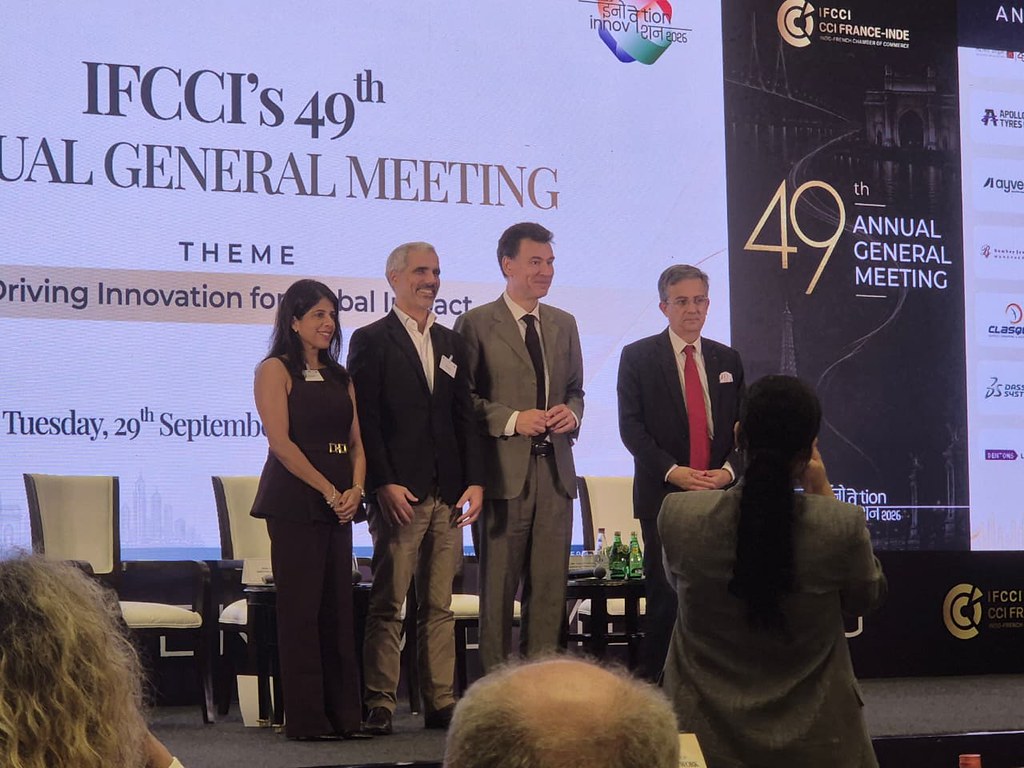
(L–R) IFCCI Director General Payal S. Kanwar, President Jean Touboul, Minister Philippe Baptiste and Ambassador Thierry Mathou.
The minister who keeps coming back
Philippe Baptiste told the room he first came to India 30 to 35 years ago, as a student who wanted to understand it. “Not that I understood anything,” he added. He came back as a researcher, then as a start-up founder, then as CTO of Total, then as head of CNES, the French space agency. Now he was back as France’s Minister of Higher Education, Research and Space.
His career reads like the arc this relationship is trying to make: from curiosity, to capability, to authority.

H.E. Mr. Minister Philippe Baptiste delivering the keynote address.
His argument mirrored the panels. India has an extraordinary pool of talent and a remarkable capacity to deploy technology. France has deep fundamental research, engineering schools and strategic technologies. “Our aim is not to choose between our strengths but to combine them.”
Three threads stood out:
- AI without fear. He praised India’s AI Impact Summit, which followed the Paris summit, and said he had spent the morning with Capgemini teams. Used wisely, he said, AI can improve disease diagnosis, optimise energy grids, strengthen food security and personalise learning; used irresponsibly, it can deepen inequality, threaten privacy and weaken trust. “Let’s not fear too much.”
- Space as a model. Earth-observation missions with ISRO, from SARAL-AltiKa to the upcoming TRISHNA, run from basic science in universities to technology in companies.
- Students. Indian student mobility to France is growing, “but not fast enough”. France wants to attract 30,000 Indian students, many programmes are taught in English, and graduates are encouraged to take the experience home. He wants more French students studying in India too.

With Minister Baptiste at the IFCCI AGM.
He had spent the previous days with his Indian counterparts and at universities and research institutions, and said he could imagine no better way to conclude the visit than at this AGM.
His most useful line for business was that innovation is not owned by labs or universities; it lives in industry too. The hard part is connecting the two – “to link ideas with markets” – and chambers like IFCCI, he said, are where that can happen.
He closed by placing the year in its arc: the Horizon 2047 roadmap adopted in 2023, and the 2026 elevation to a Special Global Strategic Partnership. Then he quoted Arundhati Roy: the great stories are the ones you have heard and want to hear again. He hoped India–France cooperation would be one that future generations tell again and again.
It was a novelist’s line in a minister’s speech. It is also a fair job description for everyone who was in that room.

What I am taking back to Bengaluru
Telling those stories is my trade; for two decades I have helped Indian ideas find an audience. So the evening landed for me less as a list of announcements than as a single argument.
In the Gita, Krishna tells Arjuna that his adhikar – his right – lies in the action alone, never in its fruits. It is wise counsel for a restless mind. It is poor design for a capability centre. Almost every Indian voice on that stage was asking for the reverse: authority over outcomes, not just over delivery.
Here is what I think it will take to earn it.
- Capability is assumed; evidence is the currency. Nobody doubted Indian talent. The doubts were about quality, certification and trust. Jaykrishnan’s “certified, not claimed” is the best brief I have heard for any Indian MSME hoping to supply a French group. Your test reports, process documentation and certifications are your marketing.
- Ownership has to be communicated, not just earned. Chalke’s point that GCCs need their own brand is a communications mandate. If the India team cannot tell its own story – to Paris, to talent, to government – the pen stays in Paris.
- Change the scoreboard. An MoU is a press release; a job is a story. Damania’s numbers say the same thing from the market side: 38 of the CAC 40 operate in India, yet few list here. A listing, an R&D centre with a global mandate, a product designed in India and sold in Europe – that is the evidence Mirchandani asked for. IFCCI already publishes an India-France Economic Report; the next edition could lead with jobs created rather than agreements signed.
- Research needs translators. Minister Baptiste wants to “link ideas with markets”. In my experience, Indian scientists and engineers love their labs but rarely know how to explain their work to a policymaker or a buyer. The new accelerator will need communicators as much as it needs capital.
Which brings me back to the card on the wall. Innovation is a new idea that creates measurable value. I would add one line beneath it: value that is never explained is rarely measured.

With Priyank Prakash, Deputy Head, Advocacy and Content, and delegates.
Epilogue: the foyer and the blank squares
The real AGM, as always, happened in the foyer. Longitude 77 and The Source by Sula poured, and the St. Regis chefs worked live stations for a crowded hall.
In a couple of hours I met a European Union diplomat, France’s deputy consul in Mumbai, and the newly arrived director of an Alliance Française. A real-estate leader said yes, in principle, to addressing our LSE Alumni Association chapter in Bengaluru. An engineer told me how he and about 100 other authors had written a book on the rocks and soils of India. A consulting firm wanted to talk about tax, compliance and family-office succession. I also had a few moments with Minister Baptiste, Ambassador Mathou, President Jean Touboul and Director General Payal S. Kanwar.
One theme kept surfacing over dinner, and it was not talent. It was regulation, especially import licensing. One senior French executive walked me through it in detail: separate licences, each capped by quantity, value and time. That is a story for another day, and I intend to tell it.
The goodie bag, for the record, was a small essay on craft: Makaibari tea, Mozimo chocolate, Truefitt & Hill, Sadhev’s Ayurvedic gel and a box simply titled “Honoring the Craft”.

The Goodies!
Dates to watch
- 4 December 2026 – IFCCI’s investment conclave in Kolkata, focused on eastern India.
- Coming soon – the Embassy’s accelerator programme for French and Indian start-ups, built with the IITs and French companies’ CSR.
- 2027 – IFCCI’s 50th anniversary, planned as a year-long programme across India and France.
Looking back at my photo of the innovation wall, what strikes me now is how many squares are still blank. That seems right for a chamber about to begin its next fifty years.
If you run an Indian company that wants to work with French groups, or a French company building in India, register on the India–France Innovation Network (indofrenchinnovation.org) and claim a square. Then ask yourself the question Ravin Mirchandani left us with: a year from now, how many jobs will you be able to point to?
Since that evening, I keep returning to Renault’s engineers. Given the whole problem instead of a piece of it, they found the issues sooner and moved faster.
The strength is already visible. The opportunity is to give it room to act – and then to count what it builds.
Support The Future Of PR
TheFutureOfPR.com explores the stories behind business, reputation, leadership, investment and global trade-especially the ideas that conventional media often overlooks.
If you enjoy independent reporting, thoughtful analysis and stories from the ground, you can support my work. Your contribution helps fund the continued development of TheFutureOfPR.com.
Click here: buymeacoffee.com/tfofpr to appreciate this writing.
Thank you for helping independent ideas travel further.
Karnvir Mundrey is a narrative strategist and media entrepreneur who helps founders, institutions and international businesses turn complex ideas into influential public stories. He is the Founder of Atharva Lifesciences Consulting Pvt. Ltd. , Atharva Marcom and Founder Editor of TheFutureOfPR.com. He has also authored a book on Nutraceuticals (available on Amazon). Karnvir Mundrey is also the producer and host of 4 YouTube channels. Finest Fintalk brings you the latest in Finance, LitInMin for Books, The Health Tips Podcast for health and Atharva Marcom for leadership talks He is also recognized as India’s longest running podcast host, continuously running since 2006!
Reach out at tfofpr@gmail.com or at +918296303806.
Subscribe to TheFutureOfPR.com to get great ideas on life, education, health & fitness, real estate, glamour, jewelry, movies, and podcasts! Follow TheFutureOfPR.com on Facebook , Twitter and Linkedin!
Join the WhatsApp Group at: https://tinyurl.com/ynj8pyn9
Share this article with people who you think might benefit. They will thank you for it







Comments