
 By
By 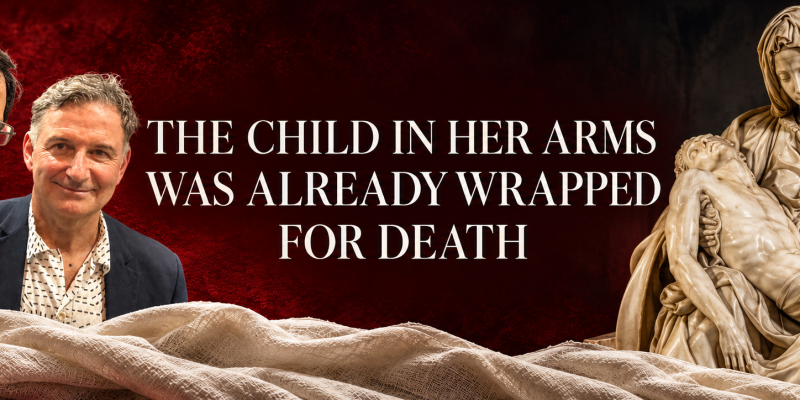
By: Karnvir Mundrey
At NGMA Bengaluru, Andrea Anastasio showed how one simple pose, a mother holding a child, was used to protect a city, teach a faith and comfort people in grief. Indian stories of divine mothers and children helped me understand why this image still matters.
On the screen, a mother held a baby wrapped in white. I saw warmth and safety. Then Andrea Anastasio asked us to look at the cloth again. In a Renaissance painting of Mary and Jesus, that white cloth could also be a hint of the shroud her son would one day be buried in. The child was alive in her arms, but the painting already knew how his story would end.
That moment changed how I saw everything else in the lecture. It made me wonder what else I had missed in this familiar image. Was it always about love? Who was it meant to comfort? And who got to decide what the mother stood for?

I attended “The Invention of the Sacred Mother: From Mater Matuta to the Renaissance Madonna” at the National Gallery of Modern Art (NGMA), Bengaluru, on 26 September 2026. It was the closing talk of One Mother, Many Mother Tongues. Anastasio, director of the Italian Cultural Institute in New Delhi, curated the exhibition with art historian Naman P. Ahuja.
The show began at the Humayun’s Tomb Museum in Delhi, which ran it from 23 June to 8 August 2026. It moved to Bengaluru with 26 artworks. At its centre was Sandro Botticelli’s Madonna and Child, painted around 1490, which Italy had never before brought to India. Around it stood Indian mothers: two statues of Hariti, a Skandamata from a remote temple near Udaipur, and a fierce Chamunda.
The most useful way to follow the talk is to ask one simple question of every image: what was this made to do?

One pose, several jobs
Job one: protect. Start with Mater Matuta, an ancient Italian goddess whose name means “mother of the dawn.” In 1845, farmers near the town of Capua dug up an altar and some stone statues by accident. Later digs, in the 1870s and 1880s, found more than 150 statues, each showing a seated woman holding one or more babies. Some hold as many as twelve, Anastasio said.
Here is the surprising part. Only one statue, holding a pomegranate and a dove instead of babies, is thought to be the goddess herself. The rest were offerings left by ordinary people, praying for the health of a mother and her children. So the “mothers of Capua” are not goddesses. They are prayers carved in stone.

Andrea Anastasio, Director, Italian Cultural Center, New Delhi
Mater Matuta protected more than babies. She guarded the whole city, and soldiers may have prayed to her before battle. Her lap carried a city’s hopes.
Indian readers know this kind of mother well. Bengaluru’s own neighbourhood goddesses, like Annamma and the Marammas, began as village guardians and are now seen as protective mothers of the city. Across South India, Amman goddesses are asked to protect whole communities, including from illness. Research on Mariamman’s protective role.
Some of the mothers in the room complicated the idea of protection. In Buddhist tradition, Hariti started out as a demon who stole and ate children. The Buddha hid one of her own children so she would feel the pain she had caused other parents. She changed, and became the protector of children. Her power to keep children safe came from learning what harm feels like. And the fierce Chamunda made it impossible to think of a sacred mother as only soft and gentle. The Met on Hariti’s transformation; the British Museum on Chamunda.
Job two: teach. Now put Mater Matuta beside an early Christian icon of Mary and Jesus. The pose is almost the same. But in many icons, Mary’s hand points at her son, as if to say: “This is the way.” She is not guarding anyone. She is presenting a religious message to the viewer. The outline is familiar, but the purpose has changed.

Where people saw an image mattered too. A small icon was for private prayer at home. A giant mosaic high up in a Roman church, like the one in Santa Maria in Domnica, spoke to a whole crowd. Anastasio compared these huge images to advertising: they made an idea memorable to people who would never read a religious book.
The Domnica mosaic even has a sponsor in it. Pope Paschal I, who paid for it, had himself shown kneeling at Mary’s feet, with a square halo to show he was still alive. His initials sit above Mary’s head, and a long inscription below praises him. It is a bit like a company putting its logo on an advertisement.

Indian readers understand why the setting matters. A god in a family’s home shrine, seen through darshan, plays a part in daily life that a photo of the same statue in a museum catalogue cannot. The Metropolitan Museum of Art on darshan and household images.
The medium also decides who gets to live with an image. In the 1880s, new printing technology made cheap colour prints of Hindu gods possible, and sacred pictures reached many more Indian homes. A mosaic spoke to one congregation in one building. A print could travel into thousands of homes. The Met on devotional prints.

Andrea Anastasio, Director, Italian Cultural Center, New Delhi
NGMA took the same idea seriously. Its guided walks through the exhibition were offered in Kannada, Hindi, Marathi and Malayalam, and the wall labels were translated into Hindi and Kannada. The exhibition’s title, Many Mother Tongues, became a practical invitation. NGMA’s multilingual gallery walks.
Job three: comfort. A loving painting of Mary and her baby could do yet another job. Anastasio suggested that a mother who had lost a child could pray before such an image and find the strength to carry on. What we study today for its style and date may once have helped someone survive a day of grief.
India still does this. At the church of Velankanni in Tamil Nadu, people offer small metal models of body parts to Mary, hoping to be healed, just as the people of Capua left their stone offerings 2,000 years ago.
The lesson: look beneath the surface. The Capua statues show why context matters. Anastasio told us they had once been plastered and painted. When they were first found, their rough appearance disappointed the finders, who buried them again. They saw the surface and missed the meaning.
How an image travels without staying the same
The mother and child also crossed borders. Anastasio showed Egyptian statues of the goddess Isis breastfeeding her son Horus: a mother feeding and protecting a holy but helpless child.

I thought of Yashoda nursing baby Krishna, which Indian sculptors also captured. An early twelfth-century Chola bronze shows her feeding the divine child she is raising. Seeing the two side by side made the closeness of Isis and Horus easier to feel. The Met’s Yashoda bronze.
Isis became so popular in Rome that the government tried to stamp her out. Roman leaders tore down her altars in 58, 53 and 48 BCE, and ordinary people rebuilt them. In one famous story, workmen refused to pull down her temple, so an official took off his robe and broke down the doors with an axe himself. When people will not destroy an image, it is holding a relationship that power cannot break.
Still, one of Anastasio’s slides warned against an easy conclusion. It is too simple to say Mary “comes from” Isis. What travelled was a picture language: a mother holding a holy child, a lap that means more than a place to sit, and breastfeeding as a sign of love and protection. Later people recognised these shapes but gave them new meanings.

India was part of that ancient traffic. Indian ships sailed to Berenike, a port on Egypt’s Red Sea coast, carrying pepper, gems, cloth and ivory. In 2022, archaeologists at Berenike’s temple of Isis found a marble statue of the Buddha, about 71 cm tall, with a sun-ray halo and a lotus. They also found a Sanskrit inscription from around 249 CE, in which a man named Vasula made an offering for the happiness of all beings. The University of Warsaw on the find.
The trade reached Bengaluru too. In 1891, 163 Roman silver coins were found at Yeshwantpur. In 1965, workers building the HAL airport runway found 256 more. Most of the airport coins show a woman sitting on a chair. The image of a seated woman reached our city about 2,000 years ago, in a trader’s purse.
Mary herself later came to India and changed again. Christian missionaries from Goa brought European paintings and prints to the Mughal emperor Akbar, and his artists quickly adapted them. Many at the court were Muslim and honoured Mary as the mother of a prophet. His son Jahangir decorated his palace in Lahore with pictures of her. A museum in Mumbai even has a Mughal painting of Mary wearing a tilak on her forehead.
At Velankanni, Mary wears a golden Indian sari, and baby Jesus is wrapped in the same cloth. Her yearly festival draws Hindus and Muslims as well as Christians.
For someone who works with stories and images, this matters. A lasting image can stay recognisable while each new audience makes something new of it. Its survival tells us as much about changing human needs as about art.

If this article is making you smile, and learn something new – support us with a donation. Scan the QR code above! We need your support!
The smallest gestures carry the biggest changes
A picture does not need a new subject to tell a new story. Sometimes a tilted head is enough.
The story of Yashoda and Krishna is a good Indian way into the lecture’s big puzzle. Yashoda scolds little Krishna for eating mud and tells him to open his mouth. In the Bhagavata Purana, she sees the whole universe inside it. Then she pulls him onto her lap and loves him as her child. The cosmic vision does not cancel the everyday moment. It makes her love more amazing, because the child she can hold is bigger than anything she can understand. Bhagavata Purana, Book 10, Chapter 8.

Anastasio showed Duccio’s Rucellai Madonna, painted around 1285. It is huge: four and a half metres tall, the biggest painted wooden panel we know from that century. A group of Florentines who sang hymns to Mary ordered it. Duccio’s contract said he would be paid 150 gold florins, but nothing if the painting was not beautiful enough. For centuries, people wrongly believed a Florentine painter, Cimabue, had made it.
Mary still sits on a grand throne against a gold background. But she bends her face toward the child, and his gestures make their relationship feel closer. Compare that with an icon where her hand points away from herself, toward Jesus. Both show Mary and Jesus, but they ask us to look for different things. There is also a little space behind Duccio’s throne, which Anastasio called a huge step. Once there is room behind her, later painters could place her in real fields and hills, in everyday life.
Later still, the figures gain real weight. In Masaccio‘s painting of 1426, the baby sucks his fingers while reaching for grapes his mother holds. It is a tiny, ordinary action. Next to older images where the baby looks like a small adult, it is startling: Jesus behaves like somebody’s baby. Any parent would recognise it. But even here there is a hidden message. The grapes point to the wine of Christian communion, and so to Christ’s blood. A picture of the Crucifixion once sat directly above this panel.
Artists could hide feelings beneath calm scenes. In a Raphael painting, two children play in a peaceful landscape. Anastasio pointed to red poppies behind them and a cross they handle almost like a toy. The children live in a happy present. A viewer who knows their story can see the suffering ahead.
Through all these changes, one small detail survived: stars on Mary’s cloak. Mater Matuta was a mother of the dawn, and so a mother of the sky. Even today, Catholic prayers call Mary the “Morning Star.” Indian readers have their own dawn goddess, Ushas, praised in the Rig Veda. Look again at the poster, and you will find that star on Botticelli’s Mary too.
These details are easy to miss if we treat the paintings as decoration. They are carefully built invitations to see more than one meaning at once. Which brings me back to that white cloth.
The image knows what comes next
In the works by Mantegna and Bellini that Anastasio showed, a baby wrapped in white could also suggest a body wrapped for burial. A marble ledge might look like the edge of a tomb. Mary could hold Jesus close while the picture hinted that she would have to give him up. One slide put it simply: the birth can contain the death, and a hug can contain the Pietà.
In one Mantegna painting, now in a Milan museum, the baby sleeps with his mouth open, wrapped in thin white cloth. The museum itself says the cloth points to his burial shroud, and that Mary’s sad face hints at the same future. The painting has a life story too. In 1861, its owner sold it to pay off a gambling debt. Experts later removed heavy old repainting to show what Mantegna really made.

Indian readers may recognise the same joy shadowed by danger in the story of Devaki. The night Krishna is born is also the night she and Vasudeva must send him away to save him from Kamsa. The stories end very differently. But the image of a parent holding a newborn while already fearing what the world will do to him made Anastasio’s point feel real to me. Bhagavata Purana, Book 10, Chapter 3.
Anastasio did not need to show Christ’s death for us to feel it coming. The white cloth belonged to babyhood and to the grave at the same time. I had seen mother and child living in one tender moment. He showed us an artist making the future visible inside that moment.

In Michelangelo’s Pietà, Mary sits with her son across her lap once more. Now he is a grown man, and he is dead. A French cardinal ordered the statue in 1498 for his own tomb, asking for the most beautiful marble statue in Rome. Michelangelo was only 23.
Anastasio pointed to Mary’s open left hand, a gesture of acceptance, and her surprisingly young face. When critics said she looked too young, Michelangelo told his biographer that her purity had kept her youthful. The legend also says it is the only work he ever signed. He carved his name on it after overhearing visitors credit another sculptor.
The Bhagavad Gita holds the same acceptance in one famous line (2.27): whoever is born will surely die, so do not grieve over what cannot be avoided.
Think back to Mater Matuta, her lap full of children and a city’s hopes. The Pietà is not the natural end point of that ancient image, and the two belong to very different beliefs. But seeing them together showed me how much a simple pose can hold, and how completely its meaning depends on the people who make it and use it.
Who gets to define a mother?
Then Anastasio made one more turn. His final slide showed three women artists, Judy Chicago, Cindy Sherman and Vanessa Beecroft, who used the old picture language of motherhood to question it.

Chicago’s In the Beginning (1982) is a coloured-pencil drawing about 30 feet long that retells the Bible’s creation story from a woman’s point of view. She has said she found remarkably few images of birth in Western art. Her related Birth Project brought together more than 150 needleworkers to fill that gap. Chicago on In the Beginning and the Birth Project; her account of the project’s origins.
Sherman’s Untitled #223 (1989) looks like an old painting of Mary, but it is a staged photo of the artist herself. She made the series while living in Rome, yet never visited its churches or museums. She worked from pictures in books instead, which is a perfect example of an image travelling as a copy of a copy.
Beecroft’s White Madonna with Twins (2006) came from her visits to an orphanage in South Sudan, where she breastfed two sick twin babies. She posed like a Renaissance Mary and later tried, and failed, to adopt them. Many critics accused her of using the children to make herself famous. One photo from the series now belongs to the Uffizi, one of the world’s great art museums.
Many of the sacred mothers we admired that evening were ordered, imagined and made by men, often monks. These newer works ask what happens when women take the tradition into their own hands. When does celebrating the mother hide the woman? Must her body always carry someone else’s idea of devotion, sacrifice or care?
Anastasio ended with a Sanskrit phrase. This, he said, could be the bija mantra, the seed, for a future show of Indian women artists who question these old images of motherhood. Artists like Nalini Malani, who has questioned the idea of “Mother India”, and Bengaluru’s Pushpamala N., who restages famous images of Indian women, suggest that such a show is ready to happen.
Closer to home, I thought of Abanindranath Tagore’s Bharat Mata. His four-armed figure holds a book, sheaves of rice, a rosary and a white cloth, showing what the motherland could provide. Here the cloth stands for clothing and care for a nation, a very different message from the shroud that opened Anastasio’s talk. The painting in the Victoria Memorial Hall collection.
The Taittiriya Upanishad tells students leaving school matru devo bhava, “treat your mother as a god.” It is a beautiful instruction. But Bharat Mata sharpens the question Anastasio left us with. When a woman becomes a goddess, or the symbol of a whole nation, how easily do we lose sight of women as real people?
That question gave the lecture its sharpest modern edge. An image of a mother holding a child can protect, teach and comfort. It can also box in the person it claims to honour. Images do real work in the world, and whoever shapes them helps shape what the rest of us see.
The exhibition was also a lesson in how countries build friendships through culture. It brought together eight Indian public museums, three private collectors and three Italian museums, through paperwork Anastasio called exhausting. Italy’s Consul General in Bengaluru, Giandomenico Milano, pointed out that around 100 Italian companies work in the city. Italy’s ambassador has called the show a preview of an Italy–India Year of Culture and Tourism planned for 2027.

Andrea Anastasio, Director, Italian Cultural Center, New Delhi
Two white cloths
I left NGMA with two white cloths in my mind. One wrapped a child and hinted at a shroud. The other, in Bharat Mata’s hand, promised care to a nation. They belong to different stories, but neither cloth speaks by itself. Someone chooses the object, the pose and the message.
Now, when I look at a mother-and-child image, I want to ask what it is asking me to believe, and whose voice I might hear if I looked past the frame.
Support The Future Of PR
TheFutureOfPR.com explores the stories behind business, reputation, leadership, investment and global trade-especially the ideas that conventional media often overlooks.
If you enjoy independent reporting, thoughtful analysis and stories from the ground, you can support my work. Your contribution helps fund the continued development of TheFutureOfPR.com.
Click here: buymeacoffee.com/tfofpr to appreciate this writing.
Thank you for helping independent ideas travel further.
Karnvir Mundrey is a narrative strategist and media entrepreneur who helps founders, institutions and international businesses turn complex ideas into influential public stories. He is the Founder of Atharva Lifesciences Consulting Pvt. Ltd. , Atharva Marcom and Founder Editor of TheFutureOfPR.com. He has also authored a book on Nutraceuticals (available on Amazon). Karnvir Mundrey is also the producer and host of 4 YouTube channels. Finest Fintalk brings you the latest in Finance, LitInMin for Books, The Health Tips Podcast for health and Atharva Marcom for leadership talks He is also recognized as India’s longest running podcast host, continuously running since 2006!
Reach out at tfofpr@gmail.com or at +918296303806.
Subscribe to TheFutureOfPR.com to get great ideas on life, education, health & fitness, real estate, glamour, jewelry, movies, and podcasts! Follow TheFutureOfPR.com on Facebook , Twitter and Linkedin!
Join the WhatsApp Group at: https://tinyurl.com/ynj8pyn9
Share this article with people who you think might benefit. They will thank you for it










Comments