
 By
By 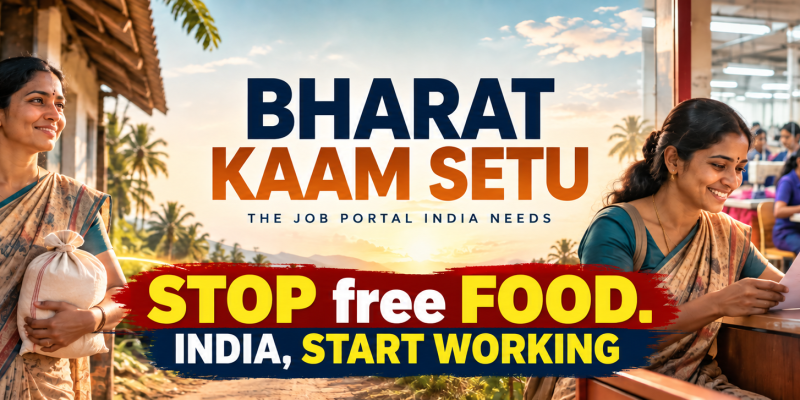
By: Karnvir Mundrey
India can deliver 20 kg of free rice to a family every month. It cannot tell a worker where the nearest real job is. A portal with a desk in every post office could change that.
On ration day, Lakshmi, 34, presses her thumb on the scanner at her village fair-price shop in Kolar. She collects 20 kg of rice for herself, her two children and her mother-in-law. Lakshmi is a composite, not a real person, but everything around her is real. The system knows her card number, her entitlement and what she took last month. An enormous public machine made sure the bag arrived.
Then she walks out, carrying questions no counter answers. She can stitch. Which employer nearby needs a tailor? What will the job pay after bus fare? Is the vacancy real? Will the wage actually arrive? If she needs a new skill, where is a course she can trust?
India has built a remarkably reliable delivery system for grain. Up to 81.35 crore people receive it free, under a scheme extended to December 2028. It has built nothing comparable for work.

If you like our writings, Cmon, support us! Scan the image to show your appreciation!
This essay argues for that missing system: Bharat Kaam Setu, a national job portal with a staffed desk in every post office and bank branch, linked to the ration card. It would:
- match workers to real, verified jobs;
- pay them through the system;
- let workers and employers rate each other;
- send people to training when no job fits;
- give the government, for the first time, a live picture of India’s labour market.
Why the ration counter alone wears down work
In February 2025, Justice B.R. Gavai told a Supreme Court hearing that his family’s farm in Maharashtra couldn’t find labourers because everyone was getting free rations at home. Prashant Bhushan replied that hardly anyone didn’t want to work, if work was available. Both were partly right.
A worker offered ₹12,000 a month in another town doesn’t compare that job with nothing. She subtracts rent, transport, meals and an agent’s fee. She adds the risk of not being paid. Then she compares what’s left with staying home, where there is free grain and family support. If the gap is small, turning the job down is rational.
Research discussed by the World Bank found that when ration entitlements expanded, people worked 3.29% less while wages rose 8.59%. In other words, people stopped taking the worst jobs. That is healthy, but only if a better offer follows. When it doesn’t, waiting hardens into withdrawal, and skills and confidence decay. The 2025 labour survey found that a quarter of Indians aged 15 to 29 were not in employment, education or training.
India’s skilling system doesn’t fill the gap:
- Only 4.9% of young Indians have formal vocational training (Economic Survey 2025-26).
- Among informal workers, 55% named not knowing about suitable courses as one of the main reasons they never trained (NITI Aayog).
- Of 56 lakh people certified in the first three phases of the flagship skilling scheme, PMKVY, only 41% were reported as placed (CAG, via PRS).
The ration system keeps people fed while they wait. It does nothing to make the next job findable, trustworthy or worth taking. That is the portal’s job.
India has a job website. It doesn’t have a job exchange.
The pieces already exist:
- National Career Service. It has registered 5.17 crore jobseekers and 38.64 lakh employers, carries about ten lakh active vacancies on average, and connects with e-Shram, the Udyam small-business register and the Skill India Digital Hub.
- e-Shram. The government’s register of informal workers lists 31.89 crore people and now works in 22 languages.
- India Post. It runs 1,64,999 post offices, 1,49,385 of them rural, backed by some 2.4 lakh rural postal workers.
But registrations are not matches. A running total of jobseekers doesn’t show whether a worker in Kolar found a genuine local vacancy, understood its terms, got hired and got paid. Today’s portals stop where the hard part begins: trust, reach, payment and follow-up. Bharat Kaam Setu is built to own that last mile.
How Bharat Kaam Setu works
1. One portable work profile. Every worker gets a profile linked to her e-Shram number. It records:
- skills and experience;
- the days and hours she is available;
- how far she can travel;
- the lowest wage she’ll accept (never below the legal minimum);
- the languages she speaks;
- any health or caring constraints.
Workers without certificates take a short practical test at the desk instead. Every completed job adds a verified line to the profile, so over time it becomes a skills passport any employer can trust.
2. Four ways in. Not everyone downloads apps. Workers can use the app, SMS, a voice line in their own language, or the staffed desk at the post office. Rural postal workers, who already bring banking to the doorstep, can register people at home. An offer counts as received only when the system confirms the worker got it and understood it.
3. Verified employers, honest offers. Every employer, whether a household, farm, shop, contractor or factory, verifies its identity and address, using its Udyam or GST registration where it has one. Every offer is a standard digital contract stating:
- the work, place and hours;
- the wage and payment date;
- how long the job lasts;
- safety conditions.
No worker ever pays a recruitment fee. An employer who changes the wage or location after a worker accepts is flagged.
4. Matching that respects distance. Instead of flooding workers with irrelevant alerts, the portal shows a handful of offers ranked by skill, distance, pay and availability. Each offer shows an estimated take-home figure after travel costs. That is the sum a worker currently has to work out alone.
5. Wages paid through the system. For short jobs, the employer deposits the wages in advance. The portal releases them to the worker’s bank or post office account when the work is done, with a quick process for disputes. Every payment creates a verified income record, which is proof she can show a lender.
6. Ratings both ways. After each verified job, the worker rates the employer: paid on time? hours honoured? site safe? The employer rates the worker: turned up? did the job well? Scores show each of these separately, along with the number of jobs, rather than a bare star average. Employers who withhold wages are suspended.
7. Training when no job fits. If the portal can’t find a match, it shows rated courses and apprenticeships within reach. These come with stipends to replace lost wages and help with transport. Training providers are paid in stages, with the largest share released only if trainees are still employed six and twelve months later. For small firms, the portal handles apprenticeship paperwork in one step. Today, only about 32,000 of roughly six crore registered small businesses use the national apprenticeship scheme (NITI Aayog).
8. A live picture of the labour market. Every posting, offer, acceptance and wage becomes data. Each district gets a public dashboard showing:
- which jobs go unfilled, and what they pay;
- which skills are missing;
- where workers are waiting with no offers.
The government would finally know where to build a training centre, a bus route or an industrial cluster.
9. Open to private platforms, like UPI. The state doesn’t have to do all the matching itself. Kaam Setu should be built as public infrastructure with open connections, the way India built UPI. Private job platforms and staffing firms can then list and match jobs on it, under the same rules on verification, fees and payment.
10. Desks paid for results. The post office or bank branch earns a fee for each verified registration and each completed job. It is never paid for removing anyone’s benefits.
Lakshmi on the portal
On Monday, Lakshmi visits the desk at her post office. The operator builds her profile, and a ten-minute test confirms she can run an industrial sewing machine with brief training. She sets her travel limit at 12 km.
On Wednesday, a voice call in Kannada reads out an offer. A garment unit nine kilometres away needs machine operators, with two weeks of paid training and a company bus. The screen at the desk shows her estimated take-home pay after costs. She accepts by pressing 1.
Her first month’s wages arrive in her post office account on the promised date. She rates the employer on pay and safety, and the supervisor rates her attendance and skill. Her profile now carries a verified line: machine operator, garment unit, three months. When the unit’s season ends, the portal already knows what she can do, and it sends her the next offer.
Her children’s rations never change.
The farmer’s side
Across the district, a farmer needs six workers for a four-day harvest. He calls the voice line, describes the job, sets the wage and deposits it. Within hours, the portal sends the job to verified workers within a few kilometres who have said they’re available.
Justice Gavai’s family would have found its labourers. A system that helps both workers and employers has two groups of supporters behind it, not one.
Linking the portal to welfare
The portal is worth building on its own. Linked to the ration card, it also lets welfare do something it has never done: tell apart the people who need help from the people ready to climb.
Permanent, unconditional support should go to three groups, and only three:
- Children without adequate adult support, with food, shelter, health care and schooling that follow the child.
- People aged 65 and above. Until 2007, India’s own national old-age pension began at 65.
- People medically unable to work, as certified by an authorised doctor or medical board, with a right to a second opinion. About 1.33 crore Unique Disability ID cards have already been issued.
Every other adult aged 18 to 64 registers on Kaam Setu, and free grain becomes a bridge rather than a destination:
- No suitable offer in ninety days: support continues, and the state owes the person a pathway. That could be training, an apprenticeship, or rural public works, which since July 2026 have been guaranteed for 125 days a year to rural households willing to do manual labour.
- What counts as a suitable offer: a verified employer; at least the legal minimum wage; work that matches the person’s ability; within their travel limit or with transport provided; safe; and respectful of disability, pregnancy and caring duties.
- Three refusals of suitable offers in twelve months: an independent officer holds a hearing, with notice and a right of appeal. Only then is that adult’s own free share paused, and they can still buy grain at the subsidised price. The pause ends when they accept work or training. No child’s ration is ever touched.
- A job found: support tapers only once earnings are stable, and returns quickly if the job ends.
Britain offers a warning. Its National Audit Office found that benefit penalties did push people into work, but often only briefly, at lower pay, and sometimes off benefits into nothing at all. That is why the portal’s records, not a clerk’s discretion, must show that every offer was real.
Protecting workers and their data
A portal holding data on crores of workers needs strong protections:
- Data. Sharing is by consent under India’s data protection law, worker data is never sold, and workers control which employers see their profile.
- Bias. Caste, religion and gender are hidden from employers before a match, and audits flag employers whose choices follow those lines.
- Ratings. Turning down an offer never lowers a worker’s rating, and disputed ratings are frozen until reviewed.
- Benefits. No benefit is ever cut because of a rating or an algorithm alone.
How to build it
Start with the National Career Service and e-Shram, which already exist. Then add the missing layers:
- the staffed desk;
- verified employers and standard contracts;
- wages deposited in advance;
- two-way ratings;
- the district dashboard.
Pilot the portal in a handful of districts, and Kolar would be a good first choice. Publish the results every month: registrations, offers, acceptances, wages paid on time, training starts, and workers still employed after six and twelve months.
The Economic Survey estimates India needs about 78.5 lakh new non-farm jobs a year until 2030. The portal should be judged against that number. Launch it nationally with the next census, when ration coverage has to be recalculated anyway.
Back at the counter
Next ration day, Lakshmi collects her 20 kg as always. The difference is what happens afterwards. Her phone buzzes with an offer she can trust, from an employer the system has checked, at a wage it will make sure she receives.
No Indian should sleep hungry tonight. Fewer Indians should need free food tomorrow. India has shown it can put a ration counter within reach of every family.
With Bharat Kaam Setu, it can put a work counter beside it.
Support The Future Of PR
TheFutureOfPR.com explores the stories behind business, reputation, leadership, investment and global trade-especially the ideas that conventional media often overlooks.
If you enjoy independent reporting, thoughtful analysis and stories from the ground, you can support my work. Your contribution helps fund the continued development of TheFutureOfPR.com.
Click here: buymeacoffee.com/tfofpr to appreciate this writing.
Thank you for helping independent ideas travel further.
Karnvir Mundrey is a narrative strategist and media entrepreneur who helps founders, institutions and international businesses turn complex ideas into influential public stories. He is the Founder of Atharva Lifesciences Consulting Pvt. Ltd. , Atharva Marcom and Founder Editor of TheFutureOfPR.com. He has also authored a book on Nutraceuticals (available on Amazon). Karnvir Mundrey is also the producer and host of 4 YouTube channels. Finest Fintalk brings you the latest in Finance, LitInMin for Books, The Health Tips Podcast for health and Atharva Marcom for leadership talks He is also recognized as India’s longest running podcast host, continuously running since 2006!
Reach out at tfofpr@gmail.com or at +918296303806.
Subscribe to TheFutureOfPR.com to get great ideas on life, education, health & fitness, real estate, glamour, jewelry, movies, and podcasts! Follow TheFutureOfPR.com on Facebook , Twitter and Linkedin!
Share this article with people who you think might benefit. They will thank you for it!









Comments