 By
By 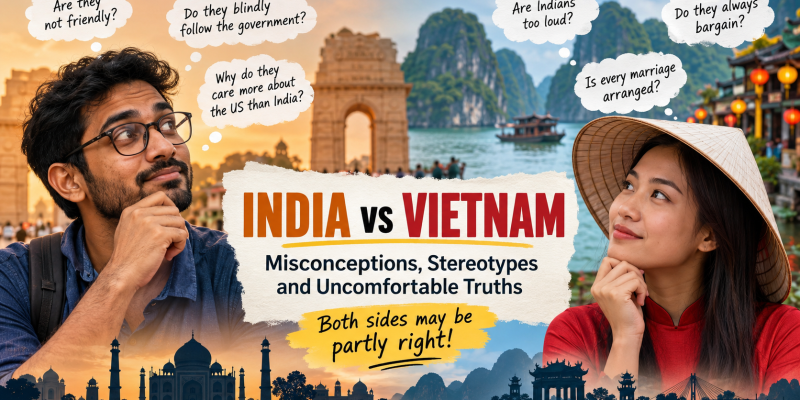
By: Karnvir Mundrey
Misconceptions, stereotypes, and an uncomfortable amount of truth.
Some of our assumptions about Vietnam are wrong. The more interesting question is: how wrong?
Every country develops shorthand explanations for other countries. Americans are individualistic. Japanese are disciplined. Germans are organised. Indians are argumentative. The shorthand is never quite right, but it is never quite arbitrary either.
Indians who travel to Vietnam are now developing their own shorthand. They are reserved. They obey their government. The North and South do not really like each other. They are not as organised as their economic success suggests. They care far more about America than they do about India.
Are these misconceptions?
Perhaps. But the more interesting possibility is that some stereotypes survive precisely because they contain fragments of truth. The danger arrives one step later — when the fragment becomes the whole picture.
The timing matters, because this is happening at scale for the first time. In 2019, roughly 102,000 Indians visited Vietnam. In the first eight months of 2026, the figure crossed 612,000. Relations were upgraded to an Enhanced Comprehensive Strategic Partnership when General Secretary Tô Lâm visited New Delhi in May 2026 – the first such visit by a Vietnamese Party chief since 2013 – with a two-way trade target of $25 billion by 2030.
The diplomacy has run ahead of the understanding. What fills that gap is stereotype.

Misconception No. 1: Vietnamese people are cold – perhaps even rude
You walk into a shop. Nobody gives you the expansive smile you expected. You ask a question and receive a short answer. There is little small talk. The interaction ends.
An Indian walks away thinking: that person was rude. Is it a misconception?
Yes. But perhaps not entirely.
Vietnamese people genuinely can appear more restrained in public interaction than Indians. We talk. A lot. We explain, negotiate, ask questions. We ask where you come from, what you do, whether you are married and how many children you have – sometimes before establishing your surname. A commercial interaction becomes a social one within ninety seconds.
Indian English is also padded with deference. Sir. Madam. Kindly. Please do the needful. No problem, sir. The warmth is carried in the words.
Vietnamese communication is economical. A question gets an answer, not an answer wrapped in three cushions. Vietnamese is tonal with a compact grammatical structure, and when it is translated on the fly into English by someone who learned English as a third priority, it arrives clipped: You want what? Sit there. Finish?
Nothing hostile is intended and nothing hostile is being said. The politeness markers live somewhere English cannot follow – in a pronoun system that encodes age and relationship with a precision we simply do not have.
And the warmth, when it arrives, is behavioral rather than verbal. Food pushed towards you. Your glass refilled before you noticed it was empty. Someone walking you three streets to a place they could have pointed to.
Perhaps Indians give warmth upfront and decide what they think of you later. Vietnamese may do the reverse. The mistake is not noticing that Vietnamese people are more reserved.
The mistake is assuming that reserve means rejection.

Misconception No. 2: North and South Vietnam don’t really like each other
Is it a misconception?
Yes. But perhaps not entirely.
Vietnam’s history makes it impossible to dismiss casually. The country was partitioned in 1954. A terrible war followed. Families and communities were separated. Reunification came only in 1975, followed by re-education camps and a refugee exodus from the South.
Fifty years sounds like a long time until you realize how many people alive today were born before reunification.
History does not disappear because the border does. And the two cities really do feel different. Hanoi is political, governmental, institutional. Ho Chi Minh City is commercial, entrepreneurial, outward-looking. Accents differ. Food differs. Business culture differs. Vietnamese people have their own stereotypes about Northerners and Southerners, and they trade them freely.
There is also a fiscal grievance, and it is not folklore – it is argued openly in Vietnam’s own institutions. Ho Chi Minh City’s assigned state budget revenue target for 2026 is around VNĐ805 trillion, roughly 31.8% of the projected national total. For 2022–2025, the city was permitted to retain 21% of what it collected – the lowest retention ratio among the eighteen localities that are net contributors to the national budget. From 2016 to 2020 it was 18%. City officials have petitioned repeatedly to raise it to 23-25%, and repeatedly not got it. A decade ago the city’s own chairman publicly called it the lowest such ratio in the world.
So when a Saigonese businessman tells you the money goes north and does not come back, he is not repeating a prejudice. He is describing an allocation formula his own city government has been formally contesting for years.
But “North and South don’t like each other” turns something complex into something childish. A budget argument is not an ethnic hostility. India should understand this better than most countries. Ask Mumbai what it thinks about Delhi. Ask Bengaluru about the Centre. Ask Chennai about North India. Ask Punjabis, Bengalis, Gujaratis and Malayalis about one another.
We complain bitterly about each other and remain part of the same national story. Regional difference is not national fracture. For business, though, the distinction matters enormously.
There isn’t just one Vietnam.
Hanoi isn’t Ho Chi Minh City. Ho Chi Minh City isn’t Da Nang. The industrial provinces operate differently again. So perhaps an Indian businessman should not ask “Should I enter Vietnam?”
He should ask: “Which Vietnam should I enter?”

Misconception No. 3: Vietnamese blindly follow their government
This may be the most interesting misconception of all, because it is the one where our own frame of reference does the most damage.
An Indian arrives and sees a Communist Party-led system. No BJP versus Congress. No competing national parties fighting to form a government in the way we understand it. No nightly television debates resembling political wrestling.
The conclusion comes easily: the government decides, people obey. Is that a misconception?
Yes. But perhaps not entirely.
Vietnam clearly has more concentrated political authority than India. The Party occupies the central leadership role. Political competition is narrower. The space for organised opposition to the ruling system is far more restricted than in India. These differences are real and should not be sanitised.
But neither should we leap from that to the conclusion that Vietnamese citizens play no part in governance. There is a National Assembly and there are local representative structures. There are People’s Councils. There are consultation mechanisms, petitions, community participation and feedback. Vietnamese governance also incorporates what is usually translated as grassroots democracy – the principle that in specified areas citizens should know about, discuss, participate in and supervise matters affecting their communities.
Participation exists. It simply does not look like Indian participation. And that distinction is genuinely fascinating.
India expresses democracy through visible disagreement. We protest. We argue. We litigate. We hold rallies. The opposition attacks the government. States fight the Centre. Governments lose elections.
Indian democracy is extraordinarily noisy. Vietnam’s system is quieter. Consultation and disagreement can occur through institutional, administrative, local and Party channels that an outsider never sees. And then something interesting happens. Once a decision is taken, the emphasis shifts hard from argument to execution.
To an Indian, that looks like obedience. Perhaps sometimes it is. But sometimes we may simply be arriving too late in the process to see the discussion that came before it.
This produces an uncomfortable comparison. India has far greater overt political competition. Vietnam appears to have far greater political coordination. Both carry benefits. Both carry costs. India’s system gives citizens the extraordinary power to challenge governments publicly and eventually remove them – and also produces paralysis, populism, endless litigation and policy reversal. Vietnam’s produces continuity, speed and coordinated national priorities – and concentrated authority makes internal accountability and institutional checks correspondingly more important.
So “Is Vietnam democratic?” may not even be the most interesting question. A better one: where does participation actually happen, who participates, how much influence do they have, and where are the limits?
And it raises a harder question for us. Do we sometimes confuse noise with participation? A country in which everybody is shouting is not necessarily one in which everybody is being heard.
And a country in which people aren’t shouting is not necessarily one in which nobody has been consulted.

Misconception No. 4: Vietnamese aren’t particularly organised
Some Indian businessmen come away frustrated. Emails are brief. Communication is informal. Documentation doesn’t arrive in the expected form. Processes aren’t explained. Follow-ups require follow-ups.
The verdict arrives quickly: they’re not very organised. Is that a misconception?
Yes. But perhaps not entirely.
Vietnam is developing extraordinarily fast, and capability is uneven. A sophisticated factory can coexist with informal communication. A world-class export company can still have processes that frustrate an Indian buyer. Rapidly developing economies contain contradictions.
India should know that better than anybody.
Then look at the larger picture. Vietnam has inserted itself into some of the world’s most demanding supply chains – electronics, machinery, furniture, footwear, textiles, food products, and increasingly complex industrial goods. Samsung assembles a very large share of its global smartphone output there. Global corporations depend on Vietnamese production.
That does not happen accidentally.
Factories must work. Ports must work. Industrial parks must function. Workers must be trained. Specifications must be met. Containers must move. Customs must clear. Electricity must arrive.
A country cannot become a major global manufacturing platform while being fundamentally disorganised. So perhaps something more interesting is happening. Vietnam can be highly organised at the system level while appearing surprisingly informal at the interpersonal level.
India frequently produces the reverse. We can build an immaculate forty-slide deck explaining a process while the road outside the conference venue has been dug up for six months.
There is one version of this misreading that costs Indian managers real money. Vietnamese staff often wait to be assigned work rather than volunteering additional help, and foreign managers read this as low commitment. It usually reflects hierarchical distance from the leader rather than indifference – and the work gets done as expected. Diagnosing it as poor motivation produces exactly the wrong management response.
Organisation has many forms. The international businessman’s job is not to ask why the Vietnamese system doesn’t look like his.
It is to understand why their system works the way it does.

Misconception No. 5: Vietnam cares much more about America than India
Is this a misconception?
It depends entirely on which claim you are making.
Strategically, it is simply wrong. Vietnamese foreign policy is ngoại giao cây tre – bamboo diplomacy: firm roots, flexible branches, deliberate non-alignment. The Comprehensive Strategic Partnership, Vietnam’s highest bilateral tier, is not an exclusive club. As of early 2026 Vietnam holds it with around fifteen partners, including China, Russia, India, Japan, South Korea, Australia, France, the UK and the European Union. The United States reached that tier in 2023 – which is to say, it arrived at the rank India had already held since 2016. The whole architecture exists to prevent dependence on any single power.
And India is not a footnote in it. The May 2026 upgrade brought a 2+2 strategic diplomacy and defence dialogue, Vietnamese accession to India’s Indo-Pacific Oceans Initiative, and thirteen cooperation agreements spanning digital technology, cybersecurity, pharmaceuticals and rare earths – plus, in the small-print category that actually moves trade, market access for Indian grapes and Vietnamese durians.
Commercially, however, this one may not be a misconception at all.
Speak to Vietnamese exporters and America comes up quickly, because the United States is the largest destination for Vietnamese goods. So do China, Korea, Japan and Europe. India sits further down the list.
This irritates Indian businessmen. We have 1.4 billion people. A huge emerging middle class. Why aren’t Vietnamese companies rushing towards us?
Perhaps because size alone does not make a market attractive. India is complicated. Regulation is complicated. Distribution is fragmented. Price sensitivity is intense. Consumers differ enormously across regions. Import requirements are demanding. Indian buyers negotiate hard.
A Vietnamese company that already knows how to sell into America may quite rationally decide that another container to an existing American customer is easier than spending two years learning India.
So perhaps the misconception isn’t “Vietnam doesn’t prioritise India enough.”
That may actually be true.
The misconception is “Vietnam should prioritise India merely because India is large.”
Why? India has to earn commercial attention. Vietnamese companies need distributors, buyers, partners, regulatory guidance, market intelligence, packaging adaptation, communications, capital and trust.
Indian businessmen cannot sit in Bengaluru, Mumbai or Delhi complaining that Vietnam is looking towards America.
We have to give Vietnam a reason to look towards India.

Misconception No. 6: Vietnamese people are extraordinarily disciplined
This stereotype is usually intended as praise, which is exactly why it deserves examination.
Public spaces appear orderly. People seem industrious. There is a strong culture of work. Large national objectives translate into action. Infrastructure gets built. Industrial zones emerge. Decisions turn into execution faster than we are used to.
So Indians conclude: Vietnamese people are simply more disciplined.
Is that a misconception? Perhaps. But again, not entirely. There may well be real cultural differences in attitudes towards collective behaviour, work and authority. Vietnam’s history has also demanded extraordinary levels of collective mobilisation.
But we should be careful about converting a hundred million people into productivity machines. Spend enough time anywhere and the mythology breaks down. Traffic rules are flexible. Motorcycles develop their own interpretation of public space. Businesses improvise. Rules get negotiated. People find shortcuts.
Vietnamese are human beings, not robots. Perhaps what Indians read as national character is partly something else.
Systems make people disciplined. When institutions, infrastructure, enforcement and social expectation consistently reward orderly behaviour, people adapt. When systems reward improvisation, people become superb improvisers. Which raises the most uncomfortable question in this entire piece.
Maybe India’s problem isn’t that Indians lack civic discipline. Maybe we have spent decades building systems in which improvisation is the rational response.

Misconception No. 7: Vietnam is a meat country
This is the assumption that shapes Indian travel plans more than any other.
Ask an Indian family what worries them about Vietnam and vegetarian food arrives before anything else. The image is fixed: phở with beef, grilled pork over noodles, bánh mì stuffed with pâté. Vegetarian travellers pack theplas, book Indian restaurants in advance, and resign themselves to a week of plain rice.
Is it a misconception?
Yes. But perhaps not entirely – and here the surviving fragment is more important than most travel writing admits.
Mainstream Vietnamese cooking is meat- and seafood-forward. More to the point, fish sauce, shrimp paste, oyster sauce and meat broth are quietly at work in dishes that look entirely plant-based. Asking for không thịt – no meat – will not save you. It can still leave fish, seafood, fish sauce and a meat-based broth in the bowl.
An Indian vegetarian who tries to negotiate a regular dish down into something acceptable will have a difficult and faintly humiliating trip.
But the conclusion drawn from that – that a vegetarian will struggle in Vietnam – is wrong, and wrong in a way that should embarrass us particularly.
Vietnam has one of the oldest continuously practised vegetarian food cultures in the world. It is called chay, it is Buddhist, and it is indigenous rather than an imported wellness trend. On the first and fifteenth of every lunar month, millions of Vietnamese eat only plant-based food. Around any significant pagoda you will find cơm chay and quán chay – dedicated vegetarian eateries serving the local Buddhist community, some run by the same family for three generations. Type quán chay into a map application in Hanoi or Ho Chi Minh City and the number of results will surprise you.
The cuisine is not a compromise. Phở chay builds its broth from charred onion and ginger, shiitake and king oyster mushrooms, daikon and carrot, with the same spice profile as the beef version. Bún bò Huế chay swaps fermented shrimp paste for fermented soybean paste and keeps the heat intact. There are vegetarian versions of bún chả where the smoke comes off caramelised tofu instead of charcoal-grilled pork.
Ho Chi Minh City now runs two layers at once – centuries-old temple chay alongside a fast-growing scene of modern plant-based cafés. Hanoi, Da Nang and Hoi An have followed.
Now the part that should genuinely land for an Indian reader. Vietnamese vegetarianism is a religious observance kept on a calendar by people who otherwise eat meat. That is not Western veganism as permanent lifestyle identity.
It is much closer to something we already do. Fasting days. Tuesdays. Shravan. Navratri. The household that eats one way on ordinary days and another way on temple days. We failed to recognise a system we ourselves practise, because we assumed vegetarianism had to be an identity rather than a discipline.
And there is a longer joke buried in it. The vegetarian tradition Indians worry about not finding in Vietnam travelled there along the same corridor as Buddhism – which is to say, from us.
The practical advice is simple. Do not customise a meat dish. Go to a dedicated quán chay, where the kitchen is already strict for religious reasons, and where you will eat considerably better than at the Indian restaurant you were planning to book.

Then I asked Vietnamese people what they think about us
That was considerably less comfortable.
Indians are loud. Indians bargain too much. Indian tourists travel in large groups. Some behave badly. Indian businessmen are difficult negotiators. And apparently almost every Indian has an arranged marriage.
Are these misconceptions?
Yes. But perhaps not entirely.
We are loud – certainly compared with many East and Southeast Asian cultures. We do bargain aggressively. Some Indian tourist groups do behave badly. Some Indian travellers are demanding. Pretending otherwise is national defensiveness, not analysis.
The complaints are also specific, which makes them harder to wave away. A widely circulated account from a solo traveller in Phú Quốc catalogued a single day: queue-cutting at a theme park, a family attempting to bypass a buggy queue, a man repeatedly pressing forward in a Ferris wheel line, queue-jumping at the airport, unsupervised children in a crowded terminal, and a family filming selfies in a cable car with a stranger stuck in the frame. The writer went out of their way to disclaim generalising.
One of the Indians in the comments agreed with every word.
There is now a growing body of Indian self-criticism on exactly this point – that too many of us travel carrying entitlement instead of civic sense, and that behaviour romanticised at home as jugaad reads abroad as treating every rule as a system to outsmart.
Much of it also traces to a simpler fact: the Indians most Vietnamese people encounter are tourists. People at their least considerate, in a group, on a schedule, negotiating in a currency they cannot feel. Haggling is the specific flashpoint. In India, bargaining is a social ritual with warmth built into it. In Vietnam it exists in a much narrower band, and pushing past it reads as insult rather than as play.
But the Vietnamese then make exactly the mistake we make about them. They observe something real and extrapolate too far.
A hotel employee encounters three large Indian tour groups and develops a theory about 1.4 billion people. That is roughly equivalent to an Indian meeting fifty Vietnamese tourists and deciding he understands Vietnam.
There is no single Indian personality. A Bengaluru technology entrepreneur, a Gujarati trader, a Punjabi wedding party, a Bengali academic, a Tamil industrialist and a student from Assam share a passport while inhabiting remarkably different worlds.
India isn’t merely diverse. It is almost a collection of civilisations negotiating life under one political roof.
And yes, the arranged-marriage stereotype contains some truth
The Vietnamese people I met seemed fascinated by it. Do Indian parents really choose whom their children marry? Well. Sometimes.
Family-assisted matchmaking remains enormously important in India. Pretending otherwise would be ridiculous.
But it is worth knowing where the Vietnamese picture actually comes from, because the source is unusually traceable. Cô dâu 8 tuổi – “The 8-Year-Old Bride,” the Vietnamese broadcast of the Hindi serial Balika Vadhu – ran on TodayTV from November 2014 to February 2017 and became a national phenomenon. It ran to nearly 2,000 episodes. It was popular enough that a second season was picked up and aired in Vietnam in June 2022.
The show is set in rural Rajasthan. Its subject is child marriage. It is a serious drama about a social evil and it was controversial in India for exactly that reason.
But for an enormous number of Vietnamese viewers it was the most sustained exposure to Indian domestic life they have ever had. Years of it, night after night. Marriage arranged by elders, a bride with no say, an extended household governing every decision.
If your only sustained window into a country were a thousand-hour melodrama about its worst social practice, set in one of its most conservative rural districts, your model of that country would be badly calibrated.
Ours would be too.
Meanwhile the binary between “arranged marriage” and “love marriage” has stopped describing what actually happens. Modern India has traditional arrangements, love marriages, dating apps, matrimonial websites, family introductions, friends introducing friends, couples dating secretly before convincing their parents, inter-caste marriages, inter-religious marriages, and a vast grey zone in between.
A modern Indian arranged marriage frequently works like this. The parents make an introduction. WhatsApp happens. Instagram is investigated. LinkedIn is checked. Coffee happens. Another coffee happens.
Both families conduct due diligence. Horoscopes may appear. And eventually two adults decide whether they want to marry. Is that arranged? Is it love? Is it both?
Perhaps the Vietnamese stereotype isn’t wrong. It is simply several decades out of date.
The part that is no longer academic
There is a reason to write this now rather than in five years.
In March 2026, footage circulated widely of Indian tourists in Hội An saying they had been refused entry at several restaurants because of their nationality, including a signboard reading “No smoking, No Indian.” A similar sign was photographed in Đà Nẵng. The Indian reaction split immediately between those calling it plain racism and those arguing our own conduct had produced it.
The most useful voice in that argument came from an Indian who had lived in Vietnam for two years and returned to find the temperature changed. There was a time, he wrote, when Vietnamese people were curious about and fond of Indian culture – Balika Vadhu was a hit, people had watched 3 Idiots, Nehru and Hồ Chí Minh were connected by real respect, and Indians had protested against the American war.
Today the sentiment feels different.
Both things are now true at once. Vietnamese tourism authorities describe India as a strategic priority market for 2026-2030. And a rising number of individual Vietnamese are forming their view of Indians in an arrivals hall.
That is what happens when a relationship scales faster than the understanding beneath it. The diplomacy is ahead of the sentiment. And the sentiment is being written by whoever gets off the plane.

Perhaps stereotypes aren’t lies
This was my biggest takeaway.
We treat stereotypes as invented falsehoods. But the most persistent ones usually begin with observation. Vietnamese may indeed be less outwardly expressive than Indians. North and South Vietnam really do have different histories and a live fiscal argument.
Vietnam really does have much less overt political competition than India. Vietnamese businesses really may prioritise America over India. Vietnam may genuinely exhibit greater collective discipline. Indians really can be loud.
Indian families really are unusually involved in marriage. The stereotype becomes dangerous one sentence later. Vietnamese are reserved, therefore they are unfriendly. Vietnam has one-party rule, therefore citizens have no voice. North and South are different, therefore they dislike each other. Vietnamese companies prioritise America, therefore they don’t care about India. Indians speak loudly, therefore Indians are badly behaved. Indian families arrange introductions, therefore young Indians cannot choose their partners.
The observation may contain truth. The conclusion may not.

India and Vietnam are entering the difficult stage of friendship
For decades, India and Vietnam could call each other traditional friends without ordinary Indians and Vietnamese knowing very much about one another.
That was easy. Diplomatic friendship is abstract. Human familiarity is messy.
It is worth remembering how old the connection underneath actually is. Long before either country had tour buses or trade targets, the Cham kingdoms of central Vietnam built Hindu temple complexes to Shiva, carved Sanskrit into their stone, and worshipped at lingams that are today Vietnamese national treasures. The sanctuary at Mỹ Sơn, near Đà Nẵng, is a UNESCO World Heritage Site, and Indian conservation teams have worked on its restoration. The towers of Po Nagar still stand above Nha Trang. Buddhism travelled the same corridor in the opposite direction.
Two civilisations with two thousand years of documented contact are now forming their opinions of each other from hotel-lobby volume levels and a Rajasthani television serial.
Because now the two societies are actually meeting. Indian tourists are arriving. Business delegations are arriving. Indian companies are sourcing. Vietnamese companies are exploring India. Flights are connecting the countries. Trade exhibitions are putting businessmen across tables from one another.
And the clichés of diplomatic communiqués are colliding with the realities of breakfast buffets, taxis, factories, restaurants and negotiation rooms.
There will be friction. Indians will think Vietnamese people are unfriendly. Vietnamese will think Indians are too loud. An Indian buyer will think a supplier is disorganised. A Vietnamese exporter will think the Indian buyer bargains endlessly and never closes. Someone will mistake silence for agreement.
Someone else will mistake disagreement for disrespect. Good. Because perhaps that is when a real relationship begins. Countries do not understand one another because their governments repeatedly describe the relationship as historic.
They understand one another when their people spend enough time together to discover which stereotypes are wrong – and which ones contain just enough truth to teach us something. That may be the real opportunity here. Not simply more trade. Not simply more flights. Not simply more agreements.
But something much harder: learning to see the other country as it actually is, rather than as we expect it to be. And perhaps the best rule for an Indian arriving in Vietnam is this: Trust your observations. Be suspicious of your conclusions.
Because the stereotype may contain a little truth. The wisdom lies in knowing where that truth ends.
Karnvir Mundrey is the Editor, and the Founder of Atharva Marcom and TheFutureOfPR.com. Reach out at tfofpr@gmail.com or at +918296303806.
Subscribe to TheFutureOfPR.com to get great ideas on life, education, health & fitness, real estate, glamour, jewelry, movies, and podcasts! Share this article with people who you think might benefit. They will thank you for it!
Follow TheFutureOfPR.com on Facebook & Twitter.
Karnvir Mundrey is also the producer and host of 4 YouTube channels. Finest Fintalk brings you the latest in Finance, LitInMin for Books, The Health Tips Podcast for health and Atharva Marcom for leadership talks









Comments