
 By
By 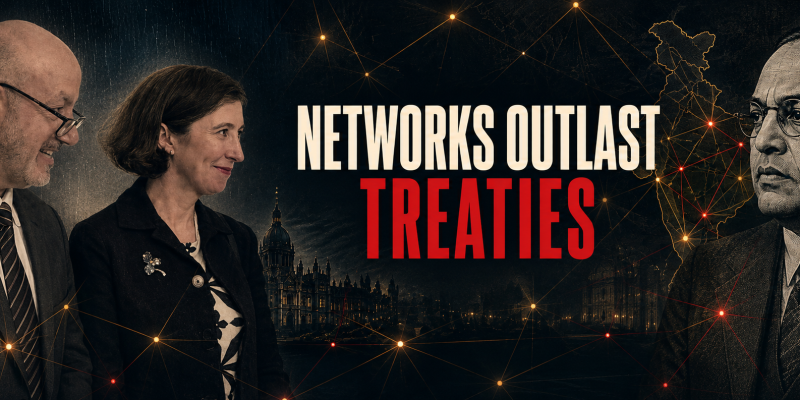
By: Karnvir Mundrey
Inside the British High Commissioner’s residence, LSE’s Indian network was described in the language of infrastructure – not sentiment. Look at what that infrastructure has produced, and the framing stops sounding like flattery.
There is a particular kind of evening that diplomacy does well. Rain hammering the garden. A room full of people who half-know each other from other rooms. Drinks in hand, badges optional, everyone slightly damp.
That was HE Dame Lindy Cameroon, the current British High Commissioner to India at the High Commissioner’s residence, hosting the London School of Economics – its President and Vice-Chancellor Larry Kramer and his team – and several LSE alumni and current members drawn from across the country.
The High Commissioner opened with a joke about being “nobbled” by LSE alumni at every other forum in Delhi, and the room laughed because it was true. Then came the numbers, and the numbers were the actual argument.
Five thousand people, a century deep
More than 5,000 LSE alumni live in India today. That makes India the school’s fifth largest alumni community anywhere in the world.
The detail that lands harder is the one about vintage. The graduates run back to the 1920s. A hundred years of Indians going to a single institution in London and coming home to build things here.
Six hundred and fifty Indian students are at LSE right now, mostly at postgraduate level. So the pipeline hasn’t thinned. It has simply become one of the least-discussed continuous flows in the UK-India relationship – older than the relationship’s current institutional architecture, older than most of the treaties, older than the vocabulary we use to describe it.
The High Commissioner was careful to say the connection runs deeper than the enrollment figure. What matters is what people go on to do. So let us look at what they did.
What the 1920s actually produced
Start with the man who was there at the beginning of that hundred-year span.
Bhimrao Ramji Ambedkar completed a master’s at LSE in 1921 and a doctorate in 1923. His thesis was not on caste or constitutional law. It was on how to stabilise the rupee. He then went home and became the principal architect of the Indian Constitution and independent India’s first Minister of Law and Justice.
Sit with the sequence. A student writes about currency policy in a London lecture hall and returns to write the operating system of a republic. That is not a career path any admissions brochure could have predicted, and it is exactly why the “what they go on to do” formulation matters more than any enrolment figure.
Then the political generation that formed around Harold Laski, LSE’s most consequential teacher of Indians.
V. K. Krishna Menon took an MSc at LSE, ran the India League in London through the independence campaign, and built a circle that included George Bernard Shaw. He became independent India’s first High Commissioner to the United Kingdom, and later its Defence Minister. Which produces a neat circularity worth noticing on a rainy Delhi evening: the first Indian to hold the post in London was an LSE man, and eight decades later the British envoy in Delhi is hosting the school’s Indian network in his own drawing room.
K. R. Narayanan arrived at LSE in 1945, also studied under Laski, and joined the Indian Foreign Service at Nehru’s urging. Ambassador to Washington and to Beijing. Then the tenth President of India – and the first Dalit to hold the office.
Jyoti Basu read law in London and graduated from LSE, then went home to become Chief Minister of West Bengal from 1977 to 2000, one of the longest continuous tenures in any Indian state.
The economic policy lineage is just as dense.
Kaushik Basu took his MSc and then a PhD at LSE in 1976, and went on to serve as Chief Economic Adviser to the Government of India and then Chief Economist of the World Bank. Urjit Patel read economics at LSE as an undergraduate before Oxford and Yale, and became the twenty-fourth Governor of the Reserve Bank of India.
And the traffic has not run only one way. I. G. Patel – Governor of the RBI, Chief Economic Adviser, Director of IIM Ahmedabad – became Director of LSE from 1984 to 1990, the first person of Indian origin to head a higher education institution in the United Kingdom. LSE’s India Observatory and its I. G. Patel Chair, currently held by Lord Nicholas Stern, carry his name.
For those of us in media, one more. Aroon Purie passed through LSE before founding India Today and building one of the most consequential publishing houses in the country. Ambedkar’s rupee thesis and Purie’s newsroom are separated by fifty years and a universe of subject matter, and both trace back to the same set of buildings on Houghton Street.
Notice what that list is not. It is not a list of one profession. Constitution-drafting, central banking, foreign policy, state politics, development economics, journalism. That spread is the point. A network is valuable in proportion to how unlike each other its members are.
The pillar nobody puts on the slide
Education and skills is one of five pillars of Vision 2035, the framework the two prime ministers agreed at Chequers in the summer of 2025 for the future of the UK-India relationship.
Five pillars. Education is one of them. And yet if you asked a room of Indian business journalists to name the pillars, education would be the one that came last, if at all.
The reason is obvious. The past year of the relationship has been swallowed whole by trade. The Comprehensive Economic and Trade Agreement was agreed in the spring of 2025, signed in the summer, and came into force in July this year – the fastest the UK has ever brought a major deal into effect.
That speed is itself the message. The High Commissioner read it as a signal of India’s weight: a very large country, a very fast-growing economy, a future global superpower. Governments do not compress ratification timelines for partners they consider optional.
But trade deals are events. They have a signing date, a photograph, a number attached. They are legible to news cycles.
An alumni network has none of that. It has no launch date. It produces no quarterly figure. It is impossible to photograph. And on the evidence above, it is the more durable asset by a wide margin. No treaty signed in the 1920s is still shaping Indian public life in 2026. The 1920s cohort is.
Why this is a communications story
Here is what struck me as someone who spends his working life on how organisations are understood.
The High Commissioner did not describe the alumni body as a nice-to-have or a goodwill gesture. The framing was structural: people-to-people links and the exchange of ideas are what carry a relationship through – past the deal, past the government, past the cycle. Universities like LSE were called critical to that, on two counts. First, for shaping the early experience, when a young person forms their picture of another country. Second, for keeping people tethered to both economies and societies across decades.
And then the part that should interest every association, chamber and alumni chapter in this country: the room itself was described as doing work. The ability to reconnect with colleagues, to find people from other years and other experiences – that, the High Commissioner said, is an important part of the longer-term institutional effect.
Read that as a communications proposition. The event is not the message. The reconvening is the message. Value accrues not from what is said at the podium but from the fact that a hundred people who would otherwise never share a room now have.
Most organizations get this backwards. They spend the budget on the stage and treat the mingling as overhead. The diplomatic reading is the opposite: the stage is a pretext to assemble the network, and the network is the asset that compounds.
This is also why alumni chapters are so badly undervalued as institutions. They are volunteer-run, they have no revenue model, they rarely appear in any strategy document. But they perform a function no campaign can buy – they hold a relationship in place during the years when nobody is paying attention to it.
Our own tradition understands this better than our management literature does. A tree is not planted for the season it is planted in. Ambedkar did not sail to London to build a bilateral pillar for 2035. He went to study currency. A century later a High Commissioner can stand in a Delhi drawing room and describe the cumulative result as strategic infrastructure – and be entirely correct.
The weather, obviously
The evening closed on the only bilateral topic that requires no negotiation. The High Commissioner noted that the monsoon is the moment in the year when Indians and Britons are most obviously united – by an unlimited appetite for discussing the weather. Though this year the roles had swapped: a hot summer in the UK, a pleasantly wet one in Delhi.
Then the handover, to Ashwajit Singh, group leader of the LSE Alumni Association in New Delhi – believed to be the oldest LSE alumni body in India.
Oldest. Again the vintage. It kept surfacing all evening, and it is the thing worth carrying away.
Countries sign agreements. Networks outlast them.
The author is Chapter Leader of the LSE Alumni Bangalore Chapter.
The LSE Alumni Bangalore Chapter convenes alumni for professional, intellectual and social engagement with the School. If you are an LSE alum in Bengaluru (or visiting), get in touch.
Karnvir Mundrey is the Editor, and the Founder of Atharva Marcom and TheFutureOfPR.com. Reach out at tfofpr@gmail.com or at +918296303806.
Subscribe to TheFutureOfPR.com to get great ideas on life, education, health & fitness, real estate, glamour, jewelry, movies, and podcasts! Share this article with people who you think might benefit. They will thank you for it!
Follow TheFutureOfPR.com on Facebook & Twitter.
Karnvir Mundrey is also the producer and host of 4 YouTube channels. Finest Fintalk brings you the latest in Finance, LitInMin for Books, The Health Tips Podcast for health and Atharva Marcom for leadership talks








Comments