
 By
By 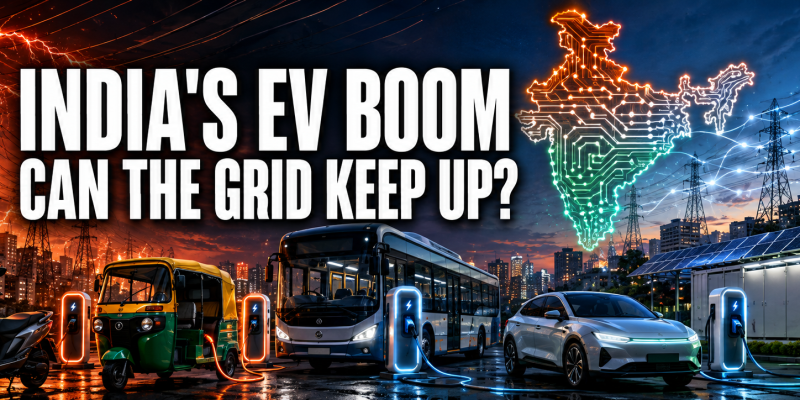
More than 3.27 lakh electric vehicles were registered in July 2026. Nearly one in every eight vehicles sold during the month was electric. But the real danger may not be a shortage of electricity. It may be millions of vehicles demanding power at the same time
India’s electric vehicle revolution has suddenly shifted into top gear. In July 2026, the country registered an astonishing 3,27,901 electric vehicles-the highest number ever recorded in a single month.
That was 66% higher than in July 2025. Nearly one in every eight vehicles sold during the month was electric. And this was not a one-month wonder. June had already set a record, with more than 3.06 lakh EV registrations.
India registered approximately 22.7 lakh electric vehicles in 2025. During the first seven months of 2026, another 18.7 lakh were registered. If that pace continues, India could add around 32 lakh EVs in 2026 alone. Some of the July rush may have been caused by buyers purchasing electric scooters before a government subsidy ended. But the bigger picture is impossible to ignore.
Electric vehicles are arriving much faster than many people expected. And that creates a worrying question:
Is India’s electricity system ready for them?
No, India is not about to “run out” of electricity
The obvious fear is that millions of EVs will consume so much electricity that India’s power grid will collapse. But that is not quite the problem.
Imagine a city with a giant water tank. The tank contains enough water for every home. But if millions of people open every tap at exactly the same moment, the pipes may not be able to carry the water fast enough. The problem is not the amount of water. It is the sudden demand on the pipes.
Electricity works in much the same way.
India may be able to generate enough electricity over the course of a year. But can its transformers, cables and substations deliver that electricity when thousands of vehicles in the same neighbourhood are charging together?
That is the real danger. The challenge is not simply producing enough electricity. It is delivering enough power to the right place at the right time.
India’s EVs may already be using far more power than we realise
Nobody knows exactly how much electricity India’s EVs consume. That sounds surprising. But there is a simple reason. When you charge a car at home, the electricity is recorded as household consumption. When an electric bus charges at a depot, the power may be recorded as commercial consumption.
There is no giant national meter counting only EV charging. A government expert committee recently tried to estimate the real figure. It calculated that India’s approximately 89.7 lakh electric vehicles may already consume around 20.07 TWh of electricity every year. A terawatt-hour, or TWh, is simply a very large unit used to measure electricity. That 20.07 TWh is equal to around 1.1% of India’s total electricity generation.
The number is an estimate, not a perfect measurement. The government says better information is still needed. But it gives us an idea of how large EV electricity demand may already be. The Indian Express reported the committee’s findings.
And if India’s EV population rises to three or four crore vehicles by 2030, electricity consumption will rise sharply.
Think electric cars are the biggest problem? Think again
When most of us imagine EV charging, we picture people returning from work and plugging their cars in at home.
But India’s EV revolution is not mainly being driven by cars. Almost 89% of the EVs registered in July 2026 were two-wheelers and three-wheelers. Electric cars represented only around 10%. India currently has approximately 43.7 lakh electric two-wheelers and 41.4 lakh electric three-wheelers. Together, they make up around 95% of the country’s EV population.
But here comes the surprise. Electric scooters may be everywhere, but they do not consume the most electricity.
Electric rickshaws do. Many e-rickshaws operate for long hours every day. They carry passengers and goods, sometimes travelling tens of thousands of kilometres each year. The government committee estimates that electric three-wheelers are responsible for approximately 61% of India’s total EV electricity demand.
Then there are electric buses and trucks. They represent only around 0.4% of the country’s EV population – but may consume almost 22% of all EV electricity. That is because a bus or truck is much larger than a scooter and travels far greater distances.
So India’s biggest charging problems may not appear in the driveways of private homes.
They may appear at:
- E-rickshaw charging areas
- Battery-swapping stations
- Bus depots
- Delivery-company hubs
- Logistics parks
- Truck stops
- Highway charging stations
- Large apartment complexes
One scooter plugged into a wall socket is unlikely to cause a crisis.
But hundreds of electric buses charging at the same depot could require an entirely new electricity substation.
The 8 PM charging problem
Now imagine a typical Indian evening in 2030.
The sun begins to set, reducing solar-power generation. Millions of people return home. Air conditioners, televisions, lights, washing machines and kitchen appliances are switched on. Electric cars and scooters are plugged in. Delivery vehicles return to their hubs. Electric buses arrive at their depots. Trucks stop at highway charging stations. Suddenly, electricity demand rises in hundreds of places at once.
India may still have enough total electricity.
But the transformer serving one apartment complex may not have enough capacity. A local electricity cable could become overloaded. A bus depot might require more power than the nearby grid connection can supply.
This is how a local power problem can occur even when the country has enough electricity overall.
A manageable annual demand can become a frightening peak
The government committee estimates that India’s existing EV fleet consumes approximately 20 TWh of electricity annually.
Spread evenly across every hour of the year, that would create an average load of only about 2.3 gigawatts. But people do not charge evenly throughout the day. If most of the day’s charging were squeezed into a four-hour period, the load could rise to nearly 14 gigawatts during those hours.
And that is based on today’s EV population.
By 2030, the number of electric vehicles could be several times larger. The Central Electricity Authority expects India’s peak electricity demand to reach approximately 364 GW in 2030–31. Nationally, the extra EV demand may be manageable.
Locally, however, the effect could be enormous.
That is why India must start preparing its neighbourhood transformers, apartment connections, bus depots and charging hubs now-not after millions of new EVs have already arrived.
The surprisingly simple answer: Don’t charge everything at once
India does not need to build a new power plant every time somebody buys an electric car. The first solution is much simpler.
Make charging intelligent.
A car may be plugged in from 8 PM until 7 AM. But it may need only three hours to recharge. It does not have to start charging immediately. A smart charger could wait until electricity demand falls. Some cars could begin charging at 10 PM. Others could start after midnight. Another group could charge early in the morning.
Bus, taxi and delivery companies could also stagger their vehicles instead of charging every battery at the same time. Electricity prices could encourage this behaviour.
Charging could be cheaper when the grid has spare capacity and more expensive during the busiest hours.
An International Energy Agency study found that managed charging could dramatically reduce the costs caused by EV-related demand peaks. Charging during the day could also reduce pollution by using more solar electricity and less coal-generated power. The IEA study shows how important charging times will become.
Why your office car park could become a miniature power station
India is installing solar panels at extraordinary speed. Solar panels produce their maximum electricity during the day. But what are millions of vehicles doing during those hours? They are sitting in office, factory, college and shopping-centre car parks. That creates a huge opportunity. Businesses could place solar panels over parking spaces and install chargers underneath.
Employees could charge their vehicles while they work.
The panels would provide shade for the vehicles while also producing the electricity needed to charge them. Instead of waiting until evening, when solar production disappears, vehicles could absorb clean electricity during the day. It is a remarkably simple idea.
But solar power cannot solve everything because vehicles are not always parked near solar panels when they need charging.
That is where giant batteries enter the picture.
The giant “power banks” that could protect the grid
A Battery Energy Storage System, or BESS, is basically a giant power bank. It stores electricity when plenty is available and releases it when demand rises.
During the day: Solar power charges vehicles and the BESS.
During busy evening hours: The BESS supplies chargers and supports the local grid.
These battery systems could be extremely useful at highway charging hubs, bus depots, logistics parks, factories, delivery centres and large apartment communities.
If a highway charging station suddenly has ten vehicles using powerful fast chargers, a BESS could provide part of that electricity without placing the entire burden on the local grid.
But batteries are not magic. They do not create electricity. They only store electricity and deliver it later. Some energy is lost during that process, and batteries are expensive. That means India should not install giant batteries everywhere.
Smart charging should come first. Battery storage should be added where it solves a genuine local problem.
India faces a staggering storage challenge
India’s National Electricity Plan projected a requirement of 208 GWh of battery storage by 2030, mainly to manage the rapid growth of solar and wind power.
But in March 2026, government data showed only around 798 MWh of large operational battery-storage projects. Another 35.8 GWh was under construction. Ministry of Power data shows how large the gap remains.
The country must move from less than one GWh of operating large-scale storage to well over 100 GWh within a few years. That is not merely an engineering challenge.
It is also one of India’s biggest business opportunities.
A new industry worth building
The EV revolution will create far more than electric-car and scooter companies.
India will need:
- Millions of charging points
- Smarter transformers
- New electricity substations
- Solar-powered car parks
- Battery-storage systems
- Charging-management software
- Battery-swapping stations
- Battery-recycling plants
- Skilled electricians and engineers
- New ways of financing charging infrastructure
India had approximately 52,718 public charging stations in July 2026. Only 16,561 had fast chargers suitable for electric cars. The government has allocated ₹2,000 crore to expand public charging infrastructure. Government figures show that expansion is already underway.
But putting up chargers is only half the job. Every charger must be supported by cables, transformers, substations and electricity generation.
Installing thousands of chargers without strengthening the system behind them would be like installing thousands of taps without checking whether the water pipes can cope.
And here is the final twist
Electric vehicles may eventually help the grid instead of damaging it.
A parked electric car contains a large battery. With special technology, millions of parked cars could send small amounts of electricity back to the grid when demand is high. They could then recharge when electricity becomes cheaper.
This technology is called vehicle-to-grid. India is not yet ready to use it widely. It will need special chargers, new rules and a way to pay vehicle owners for sharing their battery power. But one day, millions of EVs could work together like an enormous national power bank.
An unmanaged EV is another demand on the grid. A smart, connected EV could become part of the solution.
The revolution behind the revolution
India is not simply replacing petrol and diesel vehicles with electric ones.
It is building an entirely new system: Solar power + Smart charging + Stronger electricity networks + Battery storage + Digital technology
The EV revolution will not automatically bring down India’s electricity grid. But millions of vehicles charging without proper planning could overwhelm local transformers, depots and charging hubs.
India has a choice. It can wait for the pressure to arrive and then struggle to catch up. Or it can begin building the intelligent electricity network that the EV age will require.
Electric vehicles are no longer coming. They are already here.
The question is whether India can deliver clean electricity to the right vehicle, at the right place-and at exactly the right time.
Karnvir Mundrey is the Editor of TheFutureOfPR.com. Reach out at tfofpr@gmail.com or at +918296303806.
Subscribe to TheFutureOfPR.com to get great ideas on life, education, health & fitness, real estate, glamour, jewelry, movies, and podcasts! Share this article with people who you think might benefit. They will thank you for it!
Follow TheFutureOfPR.com on Facebook & Twitter.
Karnvir Mundrey is also the producer and host of 4 YouTube channels. Finest Fintalk brings you the latest in Finance, LitInMin for Books, The Health Tips Podcast for health and Atharva Marcom for leadership talks.









Comments