
 By
By 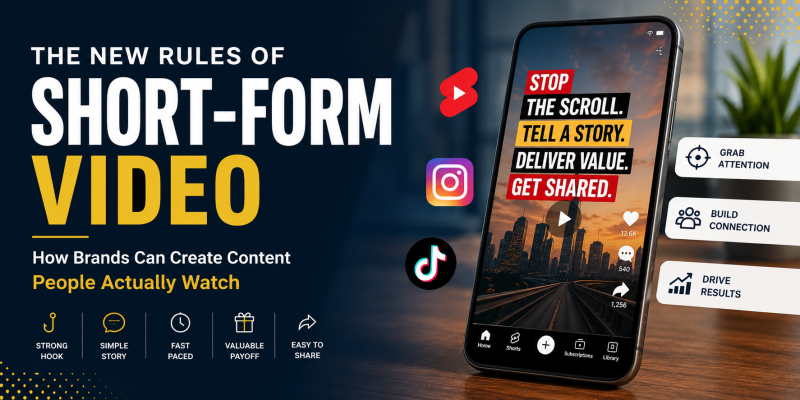
.Short-form video has become one of the most powerful communication tools for brands, founders, creators and public relations professionals, but it is also one of the most misunderstood. Many organisations assume that creating a Reel, Short or TikTok is simply a matter of recording a quick video, adding captions and posting it across platforms. In reality, short-form video demands far more discipline than most long-form formats because the audience decides almost instantly whether the content deserves attention.
The modern viewer is not patiently waiting for a brand message to unfold. They are scrolling quickly, often while distracted, and they will leave the moment a video feels slow, confusing or self-important. This means brands must rethink the way they communicate. A video cannot begin like a corporate presentation, a press release or a formal announcement. It must begin with a reason to stop, a reason to care and a reason to continue watching.
The best short-form videos are not necessarily the most expensive or highly produced. They are the clearest. They combine a strong opening, a simple idea, a visual hook, a clear story and a satisfying payoff. The lesson for brands is important: short-form video is not about compressing a long message into fewer seconds; it is about finding the sharpest version of the message and presenting it in a way that feels immediate, useful and emotionally engaging.
The First Frame Must Stop The Scroll
In short-form video, the first frame is often more important than the first sentence because many viewers decide whether to stay before they have properly heard anything. A strong opening should be visual enough for the viewer to understand the basic idea even without sound, which is why effective hooks often work almost like a title and thumbnail combined. The transcript used for this article makes this point clearly: a good short needs a strong hook, and that hook must be visual, simple and easy to understand immediately.
This is where many brands make their first mistake. They begin with a logo, a greeting, a generic introduction or a line such as “We are excited to announce,” all of which may be acceptable in a corporate email but are too slow for a fast-moving feed. A stronger opening begins with tension, curiosity or a result. Instead of saying that a company offers marketing services, the video could begin with the line, “This small business spent ₹50,000 on ads and got no leads.” Instead of announcing a new product, the brand could begin by showing the problem the product solves.
The viewer must know immediately why the video matters. If the first frame does not create curiosity, the rest of the video may never get a chance.
Story Is More Powerful Than Information
Most brands have information, but very few brands know how to turn that information into a story. This is why so much corporate content feels forgettable. It may be accurate, but it does not create tension, emotion or curiosity. Short-form video works best when there is a problem, a goal, a challenge or a surprise.
A product feature by itself is rarely interesting. A customer problem is far more powerful. For example, “Our software helps restaurants improve operations” sounds like a brochure, while “This restaurant was losing customers every weekend and did not know why” immediately creates a reason to watch. The second version has a story inside it, because there is a problem that needs to be solved.
The source material makes a useful point here: almost any subject can be made interesting when it is given a story, a personal reason and a twist. Even a simple idea becomes more engaging when the audience understands why it matters and what is at stake.
For brands, this means the starting point should not be “What do we want to say?” but “Why should the audience care?” Once that question is answered, the content becomes much easier to shape.
Simple Language Wins On Social Media
Short-form video does not reward complicated language. It rewards clarity. A viewer scrolling through Instagram, YouTube Shorts or TikTok does not want to decode corporate jargon, especially when hundreds of other videos are competing for attention.
This is especially important for B2B brands, consultants, agencies and professional service companies, because they often use language that sounds impressive inside a boardroom but feels empty on social media. Phrases such as “scalable transformation solutions,” “stakeholder-centric innovation” or “integrated growth architecture” may sound polished, but they do not help a viewer understand the value quickly.
A better approach is to write as if the audience is intelligent but busy. Instead of saying, “We enable scalable digital transformation solutions for enterprise stakeholders,” say, “We help large companies save time by replacing manual work with simple digital tools.” The second version is not less intelligent; it is more useful.
The transcript notes that high-performing short-form scripts are often checked for readability and kept extremely simple, with the most successful examples frequently using language that is easy enough for a young viewer to understand.
For brands, this is not a call to dumb down ideas. It is a call to remove friction from communication.
Every Second Must Have A Purpose
Short-form video is unforgiving because even a single unnecessary second can affect performance. If the opening is slow, people leave. If the middle repeats itself, people leave. If the ending drags after the promise has been fulfilled, people leave.
The discipline of short-form content lies in removing everything that does not move the video forward. This includes long introductions, unnecessary pauses, repeated explanations, decorative transitions, slow logo reveals and weak closing lines. A video should move from hook to story to payoff with as little waste as possible.
The transcript gives a striking example of how trimming just one second from the end of a video improved retention and helped the video perform better, which shows how sensitive short-form content can be to even tiny moments of delay.
This is a major lesson for brand teams. The edit is not a technical afterthought; it is part of the strategy. A good short-form video is not only written well and shot well, but cut with discipline.
A Clear Structure Keeps People Watching
A short video should not feel like a random collection of points. It needs a structure that helps the viewer understand where the story is going and why they should stay until the end. One of the simplest ways to do this is to use a clear mechanism, such as three mistakes, three lessons, three steps, three changes or three things to check.
This works because the audience can feel progress. Once viewers have seen the first point, they are more likely to continue to the second and third because the structure promises completion. A video titled “Three mistakes killing your media pitch” creates a clearer viewing journey than a vague video about “how to improve PR.”
The transcript describes this kind of mechanism as a way to push viewers toward the end by giving them a clear expectation of what they are watching and what will be completed by the end of the video.
For brands, this structure is extremely useful because it turns expertise into a format people can follow. A PR agency can explain three reasons a pitch is ignored. A finance creator can explain three mistakes new investors make. A founder can explain three lessons from a failed launch. A real estate company can explain three checks before buying a property. The format is simple, but it gives the video direction.
The Payoff Must Justify The Hook
A strong hook creates attention, but a strong payoff creates satisfaction. If a video opens with a promise, the ending must deliver that promise clearly. If the hook says, “This one mistake cost the company customers,” the video must reveal the mistake. If the hook says, “We tested five tools,” the video must show the result. If the hook says, “This founder changed one sentence and got media coverage,” the video must reveal the sentence.
Many videos fail because they create curiosity but do not close the loop. This leaves the viewer feeling cheated, which can damage trust even if the video gets initial attention. A good payoff does not need to be dramatic, but it must feel complete.
For brands, this is especially important because trust matters more than temporary reach. A misleading hook may get a view once, but a clear and useful payoff builds credibility over time.
Shareability Matters More Than Vanity Views
Views are useful, but shares often reveal whether a piece of content has real value. A video becomes powerful when someone sends it to a colleague, friend, client or team member because it feels useful, surprising, funny, emotional or highly relevant.
Before posting a short-form video, brands should ask whether someone would actually share it. Would a founder send it to another founder? Would a marketing head send it to a team member? Would a customer send it to someone facing the same problem? Would an employee feel proud to share it on WhatsApp or LinkedIn?
A video that simply announces a service may be watched and forgotten. A video that explains a common mistake, reveals a useful insight or captures a relatable business problem has a better chance of travelling beyond the original audience.
The best content is not merely consumed. It moves from person to person.
Each Platform Needs A Different Treatment
YouTube Shorts, Instagram Reels and TikTok may all use vertical video, but they do not behave in exactly the same way. A video that works on one platform may need a different edit, pace or visual treatment to work on another. The source transcript also notes that short-form content is not the same across platforms, which is a point many brands still ignore.
YouTube Shorts may reward a clearer story arc and stronger retention. Instagram Reels may reward visual polish, relatability and shareability. TikTok may reward speed, cultural timing and a more informal tone. This means brands should not blindly post the same file everywhere and expect the same result.
A better strategy is to develop one strong idea and then adapt it for each platform. The YouTube version can be more story-led, the Instagram version can be more visually polished, and the TikTok version can be faster and more conversational.
The format may be vertical video, but the audience behaviour is not identical.
Brands Should Start With Clarity, Not Virality
The wrong starting question is, “How do we make this go viral?” The better question is, “Why would anyone care?”
Virality is usually the result of several things working together: clarity, timing, emotion, structure, usefulness, surprise and shareability. A brand cannot control all of these factors, but it can control the quality of the idea and the discipline of the execution.
Before producing a short-form video, a brand should be clear about the hook, the problem, the story, the structure, the payoff and the reason someone might share it. If these are unclear, the video is not ready.
Short-form video is not an excuse to create shallow content. It is a demand to communicate with greater precision.
The Future Of Brand Communication Is Clear, Fast And Human
The rise of short-form video is not just a trend in social media; it is a sign of how communication itself is changing. Audiences are rewarding brands that can explain ideas quickly, visually and emotionally, while ignoring those that hide behind long introductions, vague messaging and corporate jargon.
For PR professionals, marketers and founders, this is a major shift. The old model of communication was built around announcements, press releases and polished corporate narratives. The new model rewards stories, useful insights, strong openings, simple language and content that respects the viewer’s time.
The brands that win will not necessarily be those with the biggest production budgets. They will be the ones that understand the audience fastest, explain the value clearest and create content that people actually want to watch and share.
Short-form video is difficult because attention is scarce. But that is exactly why it matters. In a world where the viewer does not owe a brand even 30 seconds, the brands that learn to earn attention immediately will have a serious advantage.
Karnvir Mundrey is the Editor of TheFutureOfPR.com. Reach out at tfofpr@gmail.com or at +918296303806. Get in touch for creative communication solutions!









Comments