 By
By 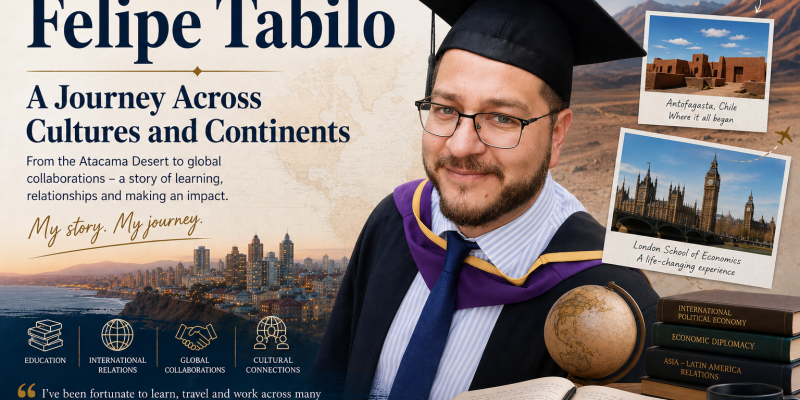
By: Karnvir Mundrey
Introduction: Why Chile Matters More Than Ever in the 21st Century
When people think about the countries shaping the future of the global economy, Chile is rarely the first nation that comes to mind. Yet this remarkable South American country sits at the centre of some of the world’s most important conversations about critical minerals, renewable energy, international trade, education, innovation, and geopolitics. Few people understand this better than Felipe Tabilo, whose life journey from the Atacama Desert to international diplomacy, the London School of Economics, and academia offers a fascinating lens through which to understand both modern Chile and the forces shaping our world.
Growing Up in the Atacama Desert: Life in One of the World’s Most Extraordinary Places
Felipe Tabilo was born in Antofagasta in northern Chile, a city surrounded by the vast Atacama Desert, widely regarded as the driest desert on Earth. For many people around the world, Chile remains a distant and mysterious country, yet the Atacama Desert is one of the most strategically important regions on the planet because it contains some of the world’s largest reserves of copper and lithium, minerals that are essential to electric vehicles, batteries, renewable energy systems, and the technologies that will power the future.
Growing up in this unique environment gave Felipe an appreciation for both the beauty and the strategic importance of his homeland. The endless horizons, dramatic landscapes, and immense natural wealth of northern Chile would later influence the way he viewed economics, international relations, and the role that resource-rich countries can play in the global economy.
How a Childhood Move to the United States Changed Everything
One of the most significant moments in Felipe’s life occurred when he was just five years old. His father received a scholarship to pursue a Master’s degree in Industrial Engineering in the United States, prompting the family to relocate to New Mexico.

For a young boy from northern Chile, the experience was transformative. Suddenly he found himself immersed in a different culture, a different language, and a completely different way of life. He experienced traditions such as Halloween, attended school in an English-speaking environment, and developed an early comfort with cultural diversity that would later become one of his greatest strengths.
This experience taught him something that would remain central throughout his life: the world is far larger than the place where you are born, and understanding different cultures is one of the most valuable skills a person can develop.

Why Studying History Became the Foundation for a Global Career
After returning to Chile, Felipe attended a Jesuit school before pursuing a degree in History at Adolfo Ibanez. In an era where many students focus exclusively on technical or vocational qualifications, history may appear to be an unconventional choice. Yet for Felipe, history became the foundation upon which his entire career would be built.
History taught him how societies evolve, why nations rise and fall, how political systems develop, and why economic decisions often have consequences that extend across generations. It gave him perspective, analytical thinking skills, and a deep appreciation for the complexity of global affairs.
These interests naturally expanded into Political Science (He studied at the Catholic University of Chile), International Relations, and Asian Studies, eventually leading him to develop a particular interest in the growing relationship between Latin America and Asia, especially China.

Chile and China: Understanding One of the Most Important Relationships in Global Trade
Long before China became a dominant topic in global economic discussions, Felipe was studying its growing influence and its relationship with Latin America. Chile was one of the first Latin American countries to establish strong economic ties with China, and today China is Chile’s largest trading partner.
This relationship has enormous implications for the future of Chile. From copper exports and lithium production to investment, technology, and infrastructure, the connection between Chile and China will continue to shape economic opportunities across the region for decades to come.
Felipe’s academic interest in this subject eventually became one of the defining themes of his professional and teaching career.

Building International Partnerships: Connecting Chile to the World
Felipe’s professional journey took a major step forward when he joined the international office of Adolfo Ibanez University. His role involved developing partnerships with educational institutions around the world, creating opportunities for students, researchers, and academics to collaborate across borders.
During this period, he travelled extensively across Europe, Asia, North America, and Latin America, gaining firsthand exposure to different educational systems and cultures.
One of his proudest accomplishments was helping establish the first partnership between his university and Manipal University in India. While such agreements may appear administrative from the outside, they have a profound impact on future generations by creating opportunities for student exchanges, collaborative research, and international learning experiences.
Throughout this period, Felipe effectively became an ambassador for Chilean education and culture, helping people from around the world discover a country that remains relatively unknown despite its growing global importance.

Studying at the London School of Economics: A Turning Point in His Life
For anyone interested in economics, politics, diplomacy, or international affairs, the London School of Economics represents one of the most respected institutions in the world.
When Felipe was accepted into the MSc in International Political Economy at LSE, he entered an environment that brought together future leaders, policymakers, diplomats, and thinkers from every corner of the globe.

The experience expanded his understanding of global economic systems, international trade, diplomacy, and public policy. One course in particular, Economic Diplomacy, would later prove invaluable in his professional life.
What began as academic study would eventually become practical knowledge used in international negotiations involving governments and global organisations.

Representing Chile on the Global Stage Through International Diplomacy
After completing his studies, Felipe joined Correos de Chile and eventually became Head of International Relations. This position gave him the opportunity to represent Chile internationally and participate in discussions affecting global postal, logistics, and trade systems.
His work took him to Switzerland and the Universal Postal Union, a specialised agency of the United Nations responsible for coordinating international postal services.
Working alongside representatives from countries including China, Germany, Spain, Hong Kong, and many others, Felipe experienced diplomacy at the highest levels. These negotiations required cultural awareness, strategic thinking, relationship building, and a deep understanding of international cooperation.
The experience reinforced an important lesson: in an increasingly interconnected world, success depends on the ability to build bridges between nations rather than barriers.

Why Education and Critical Thinking Matter More Than Ever
Today, Felipe serves as a professor at Adolfo Ibáñez University, where he teaches International Relations, Political Philosophy, Literature, and Humanities.
His students come from diverse backgrounds, including engineering, psychology, business, and military studies. Regardless of their future professions, Felipe believes they all need the same fundamental skill: the ability to think critically.
In a world overwhelmed by information, misinformation, social media, and political polarisation, critical thinking has become one of the most valuable competencies a person can possess. Through the works of Plato, Aristotle, Adam Smith, Karl Marx, Hannah Arendt, and other influential thinkers, he encourages students to understand not only what people believe, but why they believe it.

The Future of Chile: Opportunities, Challenges, and Global Importance
Chile faces many of the same challenges confronting countries around the world, including inequality, public security concerns, economic diversification, and political uncertainty. Yet it also possesses extraordinary advantages.
The country enjoys strong institutions, a stable democratic tradition, world-class universities, vast natural resources, and a growing reputation as a hub for innovation and renewable energy.
With some of the world’s largest reserves of copper and lithium, Chile is positioned to play a crucial role in the global transition to clean energy. However, Felipe believes the country must move beyond simply exporting raw materials and instead focus on creating higher-value industries built around innovation, technology, and advanced manufacturing.
Lessons from Chile: What the World Can Learn from Felipe Tabilo’s Journey
Perhaps the most inspiring aspect of Felipe’s story is not his professional success, his international experience, or his academic achievements.
It is his enduring curiosity.
Throughout his life, he has consistently chosen learning over certainty, exploration over comfort, and understanding over prejudice. Whether moving to the United States as a child, studying at one of the world’s leading universities, negotiating international agreements, or teaching the next generation of leaders, he has remained committed to understanding how people, societies, and nations can work together.
His journey demonstrates that education is about far more than qualifications. It is about expanding horizons, challenging assumptions, and developing the ability to engage thoughtfully with an increasingly complex world.
Conclusion: A Story About Curiosity, Chile, and the Power of Global Thinking
Felipe Tabilo’s story is ultimately about the transformative power of curiosity. It is a story that begins in the Atacama Desert, travels through the United States, London, Switzerland, India, China, and countless other places, and arrives in a university classroom where the next generation is learning to think critically about the future.
At the same time, it is also the story of modern Chile: a nation rich in resources, ideas, talent, and opportunity, yet still striving to define its place in a rapidly changing world.
In an age increasingly dominated by division and uncertainty, Felipe’s life offers a powerful reminder that progress often begins with a simple willingness to learn from others, explore unfamiliar places, and remain open to new ideas. Those lessons have shaped his journey, and they may ultimately help shape the future of Chile as well.
Karnvir Mundrey is the Editor of TheFutureOfPR.com. Reach out at tfofpr@gmail.com or at +918296303806.




Comments