 By
By 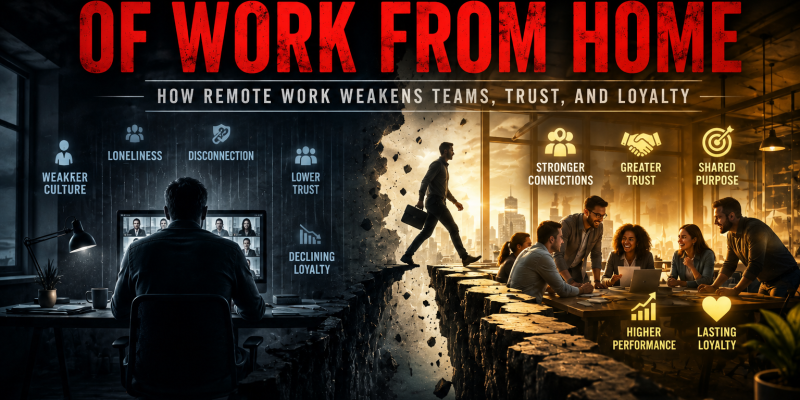
The Hidden Cost of Working From Home: What Science Says About Human Synchrony and Organizational Culture
The modern debate around remote work usually revolves around productivity, flexibility, commuting time, and employee satisfaction. But beneath those visible conversations lies something much deeper — the science of human synchrony.
Emerging research in psychology and behavioral science suggests that human beings are biologically wired to connect through shared physical experiences, coordinated movement, and synchronized activity. According to this perspective, the widespread shift toward work from home may be weakening organizations and interpersonal relationships in subtle ways that many people do not immediately recognize.
One of the simplest examples of synchrony can be seen in military marching. Armies around the world spend enormous amounts of time training soldiers to move in step. At first glance, the practice appears ceremonial or symbolic. In reality, it serves a powerful psychological purpose.
Studies have shown that synchronized activities strengthen trust, cooperation, generosity, emotional alignment, and group identity. When people move together in rhythm – whether through marching, dancing, rowing, singing, or clapping – their minds and bodies begin aligning psychologically. Researchers have even found that synchronized movement can increase pain tolerance and deepen social bonding.
Humans are not the only species capable of synchrony. Bottlenose dolphins leap through the air in unison, while certain fireflies synchronize their flashes. What makes humans unique is the sheer variety of behaviors through which synchrony appears. It exists in religion, sports, music, celebrations, protests, military drills, and even casual daily interactions.
Scientists have discovered that even subtle forms of synchronization can change how people relate to one another. Two individuals walking in step often feel greater connection. People sitting beside each other in rocking chairs unconsciously begin moving together. Concert crowds naturally clap in rhythm. Couples strolling together frequently synchronize their footsteps without noticing it.
Research also suggests that synchronized movement can reduce prejudice and increase empathy between people from different social or ethnic backgrounds. Emotional states themselves appear capable of synchronizing. This is why passionate sports coaches can energize entire teams before major games. Their emotional intensity spreads across the group, creating collective psychological momentum.
One of the most fascinating real-world examples of synchrony occurred during the opening of the Millennium Bridge Wobble Incident in London in the year 2000.
Thousands of pedestrians crossed the newly opened bridge across the River Thames. Initially, everything appeared normal. Then the bridge began to sway. As people adjusted their footsteps to maintain balance, they unintentionally synchronized their walking patterns. Those synchronized movements amplified the motion of the bridge until pedestrians were forced to walk awkwardly just to remain upright.
The bridge was closed almost immediately. Engineers later installed dozens of dampeners to absorb the effects of synchronized human movement.
Interestingly, militaries have understood this phenomenon for generations. Soldiers are traditionally instructed to “break step” while crossing bridges because synchronized marching can generate enough force to damage structures.
This brings us to the modern workplace.
Traditional office environments naturally create synchrony through shared schedules, face-to-face meetings, collaborative problem solving, shared meals, casual conversations, and simply working in the same physical space. These everyday experiences create subtle psychological alignment between employees.
When people work together physically, they unconsciously develop stronger emotional bonds, greater empathy, and deeper trust. They begin understanding each other not just through words, but through body language, shared energy, timing, and collective experience.
Remote work interrupts many of these synchronizing mechanisms.
Video calls can transfer information efficiently, but they often fail to recreate physical presence, spontaneous interaction, emotional contagion, or collective momentum. Over time, this may weaken organizational culture and reduce the sense of belonging employees feel toward their teams.
There is now growing statistical evidence supporting these concerns.
According to Gallup research, 48% of hybrid managers identify communication as their biggest challenge, while 44% cite collaboration difficulties as a major issue in distributed workplaces. Gallup also found that nearly half of hybrid workers say their teams have never discussed a formal plan for collaboration.
The emotional effects are becoming harder to ignore. Gallup’s 2025 global workplace research found that fully remote employees were more likely to experience loneliness, sadness, anger, and stress than hybrid or on-site workers. Around 45% of fully remote employees reported experiencing significant stress during the previous day.
The same report revealed another troubling trend: 57% of fully remote workers were actively looking for new jobs or watching for opportunities elsewhere. Gallup linked this partly to weaker emotional connection and organizational belonging.
Younger workers appear especially vulnerable to isolation. A 2025 Gallup survey found that 27% of Gen Z employees reported feeling very lonely during the previous day — almost double the rate seen among Gen X workers. Many younger professionals increasingly prefer hybrid or in-office work because they fear missing out on mentorship, relationships, and social development.
Research into remote collaboration has also produced interesting findings. A large-scale study examining work-from-home behavior during the pandemic found that remote work often reduced genuine collaboration while increasing isolated “focus time.” The study concluded that digital communication could not fully replace the natural collaborative dynamics created by physical proximity.
Even organizations themselves appear increasingly concerned about cultural fragmentation. Gallup reported that remote employees’ emotional connection to their company’s mission and purpose has steadily declined in recent years.
Perhaps the clearest comparison comes from the military itself. Soldiers often develop extraordinary loyalty toward one another despite having known each other for relatively short periods of time. That connection is not built through digital communication. It emerges through shared hardship, synchronized routines, common environments, and collective experience.
Wearing the same uniform, eating together, sleeping in the same barracks, training together, and facing danger together create what many describe as brotherhood.
Organizations function through similar psychological principles, even if in less extreme forms. Strong companies often build culture through shared rituals, physical collaboration, and collective identity.
This does not necessarily mean work from home is entirely harmful. Remote work offers real benefits, including flexibility, reduced commuting stress, lower operational costs, and access to global talent. Gallup data even suggests that remote employees can sometimes report higher short-term engagement because of increased autonomy and flexibility.
But engagement and emotional wellbeing are not always the same thing.
A person may feel productive while simultaneously feeling disconnected.
That may explain why many organizations are now moving toward hybrid structures rather than fully remote models. According to Gallup, 52% of remote-capable employees now work in hybrid arrangements, while only 26% work fully remotely.
The deeper question may not simply be whether people can work remotely. The more important question is what forms of human connection disappear when physical synchrony disappears alongside them.
That may explain why some fully remote organizations struggle with long-term culture, creativity, mentorship, loyalty, and emotional cohesion even when short-term productivity appears stable.
If synchrony truly plays a central role in trust and collaboration, then the future workplace may need to become far more intentional about creating shared experiences. Companies may increasingly rely on retreats, collaborative workshops, team rituals, and in-person gatherings to rebuild the psychological alignment that physical workplaces once created naturally.
Because human beings are not simply information-processing machines.
We are social organisms shaped by rhythm, movement, shared emotion, and collective experience.
And perhaps the biggest lesson from the science of synchrony is this: people do not merely work together. They bond together first – and then work better because of it.
Karnvir Mundrey is the Founder of Atharva Marcom, a public relations and content firm. This is an episode from The Health Tips Podcast, India’s oldest continuously running show, since 2006. Karnvir Mundrey is today the founder of three other YouTube channels: Finest Fintalk on Finance, The Health Tips Podcast on Health and LitinMin on books! He also helps clients create successful content strategies including podcasts and channels.








Comments