
 By
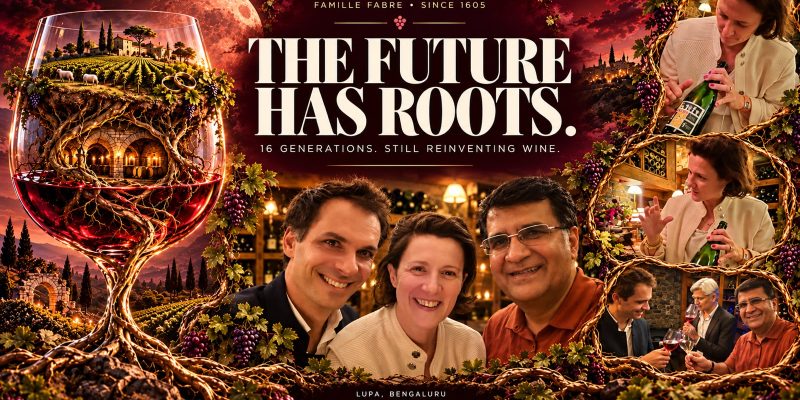
In a Bengaluru wine cellar, a 16th-generation French family poured the sparkling wine that missed their wedding. The stories that came with it ran from sunscreen for vines to an Indian goddess of wine.
The first wine poured that evening had missed a wedding.
In 2017, two of the Fabre children were getting married in the same summer, Clémence among them. Somebody was going to have to provide the bubbles, and someone suggested buying Champagne. The family would have none of it. “We are winemakers, and we’re going to buy Champagne? It’s wrong,” as Louis-Jacques Ramin, the man Clémence married, tells it.
Clémence is the 16th generation of Famille Fabre, which has made wine in France’s Languedoc since 1605. Louis-Jacques is the man who married into all that history, and who spent much of the evening gently teasing it. The producer’s own account ties their sparkling wine to the couple’s 2017 wedding year.
Over five wines, the conversation wandered from weddings to sheep, and from grape skins to government warehouses. Again and again, the Fabres’ story turned out to echo much older ones.

Support good writing by scanning the image and sending us Rs. 500 as appreciation!
A name that means maker
Before the cellar filled, Clémence told me where the family came from. The name itself is a clue. Fabre comes from the Latin faber, “maker”. Across southern France, blacksmiths took the name, so plenty of Fabres share it without sharing any family tie.
The philosopher Henri Bergson once suggested that, if we set our pride aside, we might call our species not Homo sapiens but Homo faber, the maker. A family named for making has spent four centuries proving his point.
Their own record begins in the attic. Clémence’s father, a keen genealogist, found an old notary document up there naming an ancestor, Jean Fabre, as a farmer, probably tending vines alongside other crops. It is a lovely image: a business forever looking ahead, with part of its past waiting upstairs.
Each generation since has changed something. Her grandfather was the first to concentrate fully on winemaking. Her father, Louis Fabre, took the family into bottling and, in 1991, into organic farming. Today the family farms five estates covering 150 hectares across Corbières, Corbières-Boutenac, Languedoc and Minervois, all certified organic. Since 2022, the business has been owned and managed by Clémence, who runs it with Louis-Jacques.
The couple came to it by a long road. They lived in Hong Kong before taking over. Louis-Jacques had studied in Kolkata as an exchange student some 20 years earlier and always meant to come back, and Clémence’s sister has spent time in Bengaluru. Roots deep enough to give them an identity; experience wide enough to question it.
The sparkling wine in my glass was the newest of those changes. It had taken three tries.

Three tries and a good nose
Louis-Jacques told the story of those tries.
The first belonged to Clémence’s father, who tried to capture the carbon dioxide released during fermentation and put it back into the wine. The bubbles came out very light. “Like Coca-Cola,” Louis-Jacques said. “Nothing special. No vibration, no emotion.”
The second was a blend of Sauvignon Blanc, Pinot and Viognier. “Very nice, but heavy. You drink one glass.”
Then Louis-Jacques arrived in the family. His strategy, he joked, was to stand in the corner and watch everything before saying a word. When he finally spoke up, it was to suggest Sauvignon Blanc with Colombard.
The Colombard was already in the ground. More than ten years earlier, Clémence’s father had planted it because summers were getting warmer and the wines needed freshness. It is a grape from Armagnac country that gives an acidic juice and copes well with heat. A decision made for the climate ended up rescuing a wedding wine.
How does a winery decide what to try next? Louis-Jacques drew a contrast with tech. A tech company sets an objective, studies the market, writes a business plan and models the cost. “None of this,” he said. “We work with our nose.” Fine-tuning comes later. “We make what we want to drink.”
The nose still has to be tested. New ideas start as batches of about 2,000 bottles, Clémence said, before anyone thinks of making more. And every test is slow. Imagine, she said, a chef allowed to cook only one dinner a year: months of preparation, then ingredients shaped by weather you cannot control. More rain, less rain, hotter nights, a different harvest date. If the dish fails, the next attempt is a year away.
The Bhagavad Gita has a line every winegrower lives by: karmaṇy evādhikāras te mā phaleṣu kadācana, “your right is to the work alone, never to its fruits.” The grower controls the pruning, the picking and the patience, but never quite the vintage. It is also why the Fabres insist they are growers, not négociants who buy in grapes. They tend the vines all year, so every bottle begins long before fermentation.

What is actually in the bottle
L’Instant Bulle is sold as a pét-nat, short for pétillant naturel, but its method is more particular than the shorthand suggests. The producer’s technical sheet describes a first fermentation with native yeast, a cold stop that keeps some natural sugar, and a second fermentation in the bottle after yeast is added. It is left “not disgorged, not filtered, not fined”, so the sediment stays in and gives the wine its slight haze. The 2025 sheet lists 60% Sauvignon Blanc and 40% Colombard, and reviews of earlier vintages describe the same pairing under the Vin de France label.
Vishal was openly proud of it. “Super experimental, super cool,” he told the room. When he first drank it at the estate, he said, he knew he was bringing it to India. Clémence placed it somewhere “between the beer world and the wine world”.

The bubbles were here first
There is a pleasing irony in a Languedoc family refusing Champagne, because their region may have got there first. In 1531, Benedictine monks at the abbey of Saint-Hilaire, in the same Aude département as the Fabres’ home village of Luc-sur-Orbieu, wrote the first known record of blanquette, a white wine they distributed in cork-stoppered flasks. Wine historians believe it was the world’s first sparkling wine.
Its descendant, Blanquette méthode ancestrale, is still made around Limoux: lightly sweet, usually under 7% alcohol and, like L’Instant Bulle, never disgorged. Local lore claims Dom Pérignon learned the trick at Saint-Hilaire, which historians consider almost certainly false. Champagne’s own legend about him is no sturdier. His famous cry, “Come quickly, I am tasting the stars!”, first appears in a late-19th-century advertisement, and the claim that he invented champagne was first put about by a successor keen to burnish his abbey’s name. Some of Pérignon’s own rules were in fact designed to prevent the second fermentation that makes bubbles.
Languedoc, in other words, has always done things its own way. That, Vishal said, is exactly why he went looking there.
Why Languedoc
France is famously strict about wine. Champagne, Bordeaux and Burgundy run on rules. Languedoc-Roussillon, the country’s southernmost wine region, has appellations and rules of its own, but Vishal finds more room there to try things. “When sometimes the rules are relaxed, it gives birth to innovation,” he said. “Freedom is the birth of creativity.”
The region paid for that freedom. As Clémence tells it, Languedoc spent long years making mass-market, big-volume wine, until overproduction forced a rethink. The low point came in 1907, when collapsing prices drove its winegrowers to revolt. A single protest in Montpellier that June drew an estimated 600,000 to 800,000 people. Out of those years of crisis grew the region’s cooperative wineries. The cellar at Maraussan, one of the first, still bears its motto: “All for everyone, everyone for all.”
Today much of the region’s energy goes into smaller-scale organic wine, and the Fabres work on two tracks. Their appellation (AOP) wines follow strict rules, which the family is nudging towards lighter reds and new grape varieties for a hotter climate. Their Vin de France wines, L’Instant Bulle among them, carry fewer rules and more experiments. “Innovation is also adaptation,” Louis-Jacques said.
The old cooperative spirit survives, too. In regions like Burgundy, the couple said, growers compete; in Languedoc, they need each other. “There is no sense being organic if your neighbours are not,” Clémence said, “because they are going to spread the pesticide” onto your vines.
Freedom, though, does not extend to the weather. That arrived with the second glass.

The second glass
The Sauvignon Blanc came with a map on its label: a sun shape crossed by a stripe. It tells the story of the vineyard. In Roman times, Clémence explained, the land was a lake; in the Middle Ages it was drained through a little channel. What remains are soils of clay and marl that hold the night’s coolness into the day. That is a difference of 2–3°C, and it matters enormously for freshness.
Freshness is the whole fight now. In Languedoc, Clémence said, temperatures can touch 45°C in June, and this August passed 40°C. In August 2025, a wildfire tore through their own Corbières hills, France’s largest in decades.
So the vines get sunscreen. During intense heat, the family dusts them with white clay powder to protect them from sunburn. It is the kind of detail that makes climate change visible at the scale of a single leaf.
The rest of the toolkit is just as practical. Grapes are harvested at night, as cold as possible, so they don’t start to macerate in the heat and release unwanted aromas. The family has almost stopped trimming, keeping more foliage to shade the fruit and accepting the extra humidity and disease risk that brings. The Sauvignon then rests for three to four months to gain a creamier texture.
They also took apart a cliché I had heard many times: that a vine must suffer to make good wine. In heat, a grape can lose water and reach the right sugar while its skin, seeds and flesh stay unripe, which gives green, tannic flavours. Making the vine struggle guarantees nothing. The task is to help the fruit ripen well.
To Vishal, the result tasted of “fresh lemon and stone”. Someone suggested oysters. As it happened, the couple had just tried their first Indian ones.

The region has adapted before
Languedoc has faced worse than heatwaves. In 1863, phylloxera, a root-feeding aphid that had crossed from America, was first recorded in France in the Languedoc village of Pujaut. Over roughly 15 years it devastated more than 40% of French vineyards. The answer came from Montpellier, where botanist Jules-Émile Planchon and local growers identified the insect in 1868. Growers then saved their vines by grafting them onto resistant American rootstock. Adaptation is one of the region’s oldest traditions.
A guest asked how the family was adapting this time. The answer turned out to be mostly about water.
Old answers to new weather
Rain in their part of France now comes in violent bursts after long dry spells; Clémence spoke of half a metre falling in a day and a half. Water that races down a slope takes the soil with it, all the way to the river and out to sea.
So the family slows it down. Drains are fitted with obstacles so the runoff soaks into the vineyard instead. A canal network built about 150 years ago helps refill underground aquifers, letting the vines draw water naturally; they chose not to build a reservoir. Organic soils help too, because their microorganisms hold a lot of water. “It’s funny,” Clémence said, “because we reuse techniques that were used more than 2,000 years ago.”
That became the refrain of the evening. The future kept leading back to the past.
Take the sheep. When old vines come out, the land now rests for 20 years instead of five. On it, the family grows fodder for a local livestock farmer, whose 200 to 400 sheep graze the vineyards each year and leave their manure behind. The vineyard gets grazing and fertility; the farmer gets feed. Trees are coming back too, and the estate now describes itself as farming in agroforestry.
It is a return to how the family farmed in 1605, when it grew raisins, kept sheep and planted trees alongside its vines: the kind of mixed farm Jean Fabre would have recognised. “Everyone got professional,” they said, “and now we need to go back.” Not all the way, though. Louis-Jacques has no wish to keep sheep himself. “It’s a never-sleeping business. But finding synergies with the guys that do it, that is great.”
The Atharva Veda’s Bhumi Sukta has a line for this: Mātā bhūmiḥ putro ahaṃ pṛthivyāḥ, “the Earth is my mother, I am her child.” Clémence put it in a winemaker’s words: “It’s not only about making the wine, but also about taking care of the environment.”
Not every return to old ideas goes to plan. Louis-Jacques had a confession.

The vine they killed
It concerned biochar, a porous charcoal that acts like a sponge in the soil. Facing a very dry year, the family hoped it would help the vines find water and nutrients. They put it into the ground without preparing it first. “We completely killed the vine with this,” he said.
The family now believes the charcoal must be charged with nutrients before it goes in, and is still working out how. It is one grower’s account of one trial, not a verdict on biochar. What struck me was the candour. Here were producers presenting their wines to a room of potential customers, openly describing the time they killed their own vines.
There is an old phrase for evenings like this: in vino veritas, in wine there is truth. The idea goes back to the Greek poet Alcaeus, and Pliny the Elder recorded it as common wisdom in Rome. Around a good table, people tell you what didn’t work.
They were just as frank about the moon.
By the light of the moon
Biodynamic farming traces back to the Austrian philosopher Rudolf Steiner, whose agriculture lectures of 1924 launched the movement. The Fabres use some of its principles, including lunar calendars for planting and for bottling their low- and no-added-sulphite wines.
Not all of it convinces them. Practices such as burying preparations underground struck them as “a bit esoteric”, something “you cannot really scientifically explain”. What they embrace is its core idea: “You don’t treat, you anticipate.” Make the plant strong before trouble arrives.
Here I couldn’t resist an Indian connection. Hindu festivals follow the moon, not a fixed date like 25 December; Diwali and Holi move with the lunar calendar every year. In my own reading on biodynamics, I had come across the advice to harvest near the full moon and to work on roots at the new moon.
Europe once farmed by the sky as well. Around 700 BC, the Greek poet Hesiod told his brother in Works and Days to cut the grapes “when Orion and Sirius are come into midheaven” and dawn sees Arcturus, in September, then lay them in the sun for ten days and nights before making wine.
The couple pushed back, usefully. A full moon can change the weather; if the nights are hot and the grapes unripe, the moon won’t help, and you may wait another 10 or 15 days. “The most important is taste,” they said. Their beliefs are part of the story, but a conversation can’t prove that lunar timing changes a wine. What persuaded me more was their insistence on paying attention: watch the vines, taste, and respond to what is actually happening. A calendar cannot do that for you.
By now the talk had grown thoroughly technical, and the winemakers noticed.
How much do you need to know?
“The most important is: do you like it? Does it make an emotion?” they asked the room. “It’s like when you are going on a bridge. Do you really want to know how the bridge is made?”
Another guest argued the opposite: knowing a bridge’s story, and the challenges behind it, makes you appreciate it more. Vishal took the middle road. At his tastings he keeps things “very light and easy and fun”, because many Indians are only now discovering the difference between white and red. Jump straight to soil hydrology and you lose them. “Even water is getting technical now,” he joked.
I suspect the answer is both, in the right order. You fall for a wine first, then want to know why. The wedding gets you to pick up the bottle; the clay sunscreen and the night harvest make you look at it twice.
Someone at our table had simpler advice for anyone new to wine: “You never like anything the first time. Try it 10 times.”
Then came the question the room had been waiting for: “Are you ready to move to the rosé?”
Drinking less, drinking better
The rosé and the reds that followed are being poured into a shrinking market. The International Organisation of Vine and Wine estimates world wine consumption at 208 million hectolitres in 2025, down 2.7% from 2024, and blames structural shifts in mature markets, changing consumer behaviour and pressure on purchasing power. “In Europe now the wine consumption is decreasing,” Clémence said. What customers want instead, she thinks, is simple: “People want to drink much less but drink much better.”
The ancient Greeks would have nodded. They almost always drank wine diluted with water, usually one part wine to between one and a half and three parts water, which would have come to roughly 3–6% alcohol. Drinking it neat was considered a barbarian’s habit. In a fragment preserved by Athenaeus, the comic poet Eubulus has Dionysus himself prescribe three bowls for sensible guests: one for health, one for love and pleasure, one for sleep, after which the wise go home. The fourth, he warns, belongs to hubris. Moderation is not a new idea. It is wine’s oldest etiquette.
The Fabres are making wine for the modern three-bowl drinker. Le Rendez-Vous is a Muscat whose fermentation is stopped cold to keep a little sweetness. It then travels to Germany, because France lacks the equipment, to have its alcohol removed by vacuum distillation. It is marketed as alcohol-free, and its technical sheet specifies under 0.5% alcohol by volume. This year brought a low-alcohol wine infused with plants, and Languedoc’s blending tradition makes lighter wines easier too.
Then there is orange wine, made by full-berry maceration. “It’s got nothing to do with oranges,” Vishal explained. White grapes are fermented with their skins, the way red wine is made, which adds colour, texture and tannin; the Australian Wine Research Institute calls it amber winemaking. It may be the oldest style of all. In Georgia, where skin-fermented whites remain a regional speciality, residues in clay jars hold the earliest chemical evidence of winemaking yet found, from around 6000–5800 BC.
For a family whose identity is wine, an alcohol-free bottle is a substantial statement. Wine keeps its seat at the table; more people simply get to join in.
The road to India
None of this would be in a Bengaluru cellar without Vishal. He started Wine Park in December 2006, after a degree in the US and a few years working in Boston, by importing a single wine from Spain. “Nobody was drinking wine,” he recalled. “It was a tiny market.” Today the company sells in 11 states, “and each state is like a different country”. Asked whether he spends more time in vineyards or in government offices, he joked that he now has a team for the offices, which frees him for the vineyards.
He found the Fabres the way he finds most of his producers. “There is no formula really,” he said. “It’s like touch and feel.” He met Louis-Jacques in Paris and felt an instant connection. Two years ago he visited the estate, tasted widely and shared a long lunch, and the two sides agreed to work together. The family’s organic farming sealed it; Wine Park’s portfolio leans on small-batch wines from family-owned vineyards and unusual regions.
Getting the wine here is less romantic. Vishal had warned the couple that imported bottles can sit in government warehouses, which Clémence said is “not the best” for natural wines. It is one reason the family aims for “very clean and clear wines”. That is the speakers’ experience, not a verdict on every warehouse in India, but it is a reminder that a wine’s journey matters too.
The couple’s view of India was warmer than their view of its logistics. They ate their first Indian oysters, and a lunch of pork belly with peppery spices and curry. “We love Indian hospitality,” they said. Louis-Jacques, back at last in the country he had known as a student, added: “I believe in a very strong future for wine in India.”
Their pairing suggestions were conversational rather than rules:
| Wine or style | How the couple suggested enjoying it |
|---|---|
| L’Instant Bulle | A relaxed celebration with friends |
| Sauvignon Blanc | Oysters and fresh seafood |
| Rosé | A versatile choice across different dishes |
| Light red, discussed as Pinot | Alongside Indian meals |
| L’Instant Rouge | With spicier dishes |
Asked for a favourite, they refused to pick one. Different wines suit different meals, moods and company, they said. It was an inviting answer for anyone who feels wine requires passing an examination first.
India’s older wine story
Wine may feel new at many Indian tables, but India’s relationship with drink is ancient. The Arthashastra, the treatise on statecraft attributed to Kautilya, gives a whole chapter to a superintendent of liquor, who licensed home brewing for festivals and collected a toll on liquor not made by the king. It also names two grape wines by their places of origin, kāpiśāyana and hārahūraka. Scholars link the first to Kapiśa, near Begram in today’s Afghanistan. That is appellation thinking, written in Sanskrit, and a reminder that India’s state-by-state rules on drink have a very long pedigree.
Closer to Bengaluru, the Mānasollāsa, a 12th-century encyclopedia by the Kalyani Chalukya king Someshvara III, who ruled from present-day Karnataka, describes how to prepare wine from grapes.
Indian mythology even has a goddess of wine. When the gods and the asuras churned the cosmic ocean, Varuni rose from the waters carrying her drink. In the Ramayana’s telling, those who accepted her became the suras, the gods, and those who refused her the asuras; the Bhagavata Purana gives her to the asuras instead. Either way, wine enters Indian myth as one of the treasures of the churning.
The last glass
Before the evening ended, someone asked the couple what they hoped people would take home. “We want our wines to bring emotion,” they said. “The most important thing is how people feel when drinking it.”
The Greeks, fittingly, gave wine and theatre to the same god. Dionysus ruled the vine and the stage, and Athens staged its great dramas at his festival. Wine and story have always travelled together. Back in France, the family’s wine tourism invites visitors to walk the vineyards and meet the people behind the bottles. At Lupa, we got a little of that without leaving Bengaluru.
Which brings us back to where we started. The wine that missed the wedding took three tries, a grape planted for a hotter climate and a new son-in-law who knew when to watch from the corner. Nine years later it reached a cellar in India, carrying a family celebration and a small piece of southern France.
After 16 generations, the Fabres still have something new to pour.
Support The Future Of PR
TheFutureOfPR.com explores the stories behind business, reputation, leadership, investment and global trade-especially the ideas that conventional media often overlooks.
If you enjoy independent reporting, thoughtful analysis and stories from the ground, you can support my work. Your contribution helps fund the continued development of TheFutureOfPR.com.
Click here: buymeacoffee.com/tfofpr to appreciate this writing.
Thank you for helping independent ideas travel further.
Karnvir Mundrey is a narrative strategist and media entrepreneur who helps founders, institutions and international businesses turn complex ideas into influential public stories. He is the Founder of Atharva Lifesciences Consulting Pvt. Ltd. , Atharva Marcom and Founder Editor of TheFutureOfPR.com. He has also authored a book on Nutraceuticals (available on Amazon). Karnvir Mundrey is also the producer and host of 4 YouTube channels. Finest Fintalk brings you the latest in Finance, LitInMin for Books, The Health Tips Podcast for health and Atharva Marcom for leadership talks He is also recognized as India’s longest running podcast host, continuously running since 2006!
Reach out at tfofpr@gmail.com or at +918296303806.
Subscribe to TheFutureOfPR.com to get great ideas on life, education, health & fitness, real estate, glamour, jewelry, movies, and podcasts! Follow TheFutureOfPR.com on Facebook , Twitter and Linkedin!
Join the WhatsApp Group at: https://tinyurl.com/ynj8pyn9
Share this article with people who you think might benefit. They will thank you for it.










Comments