
 By
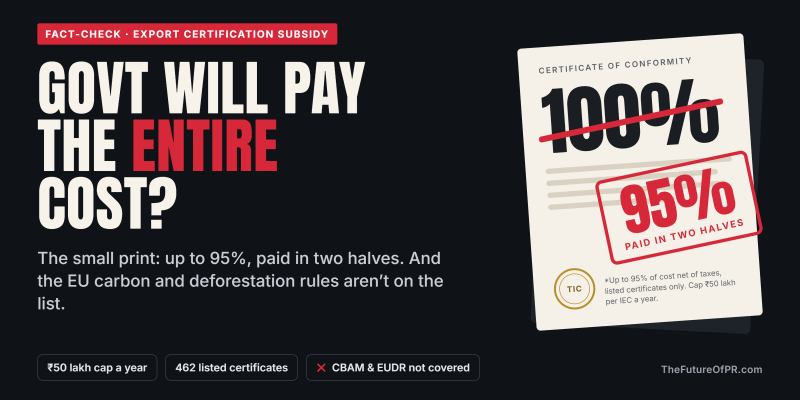
- Commerce Minister Piyush Goyal told reporters in Berlin that micro and small exporters would have their certification bills covered
- But the rules in force pay back 95 per cent at most, and only after the firm has paid the whole bill itself
- None of the 462 certificates on the official list covers the EU’s carbon border tax or its deforestation law
- Only about 100 firms applied in the scheme’s first six months, according to one report
Published: 28 October 2026
It sounded like the best news India’s small exporters had heard all year.
Speaking in Berlin on Friday, Commerce and Industry Minister Piyush Goyal said the government was ‘willing to literally take care of the entire cost of certification’ for micro and small enterprises (PTI via Business Standard).
News agencies and the state broadcaster All India Radio carried the pledge. Reports said it would even cover the European Union’s feared carbon border tax and its new deforestation rules.
Exporters, old and new, were told to go straight to the Directorate General of Foreign Trade (DGFT).
But the official rulebook tells a very different story.
TheFutureOfPR.com went through DGFT’s trade notices, its claim manuals and its official FAQ. We found no notification that pays 100 per cent of anyone’s certification bill.
The scheme that actually exists is a little-known programme called TRACE. It refunds up to 95 per cent, and pays it in two halves.
The second half arrives only after the firm has exported and the payment has reached India.
The two EU rules the minister highlighted are not on the government’s own list of 462 approved certificates.

Liked our research? Support us with a small payment of Rs. 99 or more!
‘ALMOST’ THE ENTIRE COST
The minister’s words on the EU rules were more careful than the headlines suggested.
On the EU’s carbon and deforestation regulations, he said the government would cover ‘almost the entire cost’ (ANI).
He also said India was still exploring whether Indian agencies could be approved to do the checks (KNN).
That is a statement of intent. It is not a rule an exporter can claim under.
There is also a twist. Some of the October news reports used figures that were out of date.
The PTI copy quoted refunds of 60 and 75 per cent with a ₹25 lakh cap. Those were the February rules, and they were scrapped on 1 July (Trade Notice 09/2026-27).
WHAT THE MINISTER SAID – AND WHAT THE RULES SAY
| The promise | The reality |
|---|---|
| ‘Entire cost’ covered for micro and small firms | Up to 95%, after tax is stripped out, capped at ₹50 lakh a year per exporter code (IEC) |
| EU carbon tax (CBAM) and deforestation (EUDR) costs included | Not one of 462 listed certificates mentions either |
| ‘Graded’ support for everyone else | 80% for medium firms. Big companies get nothing under TRACE |
| Just approach DGFT | True, but you must apply before you get the certificate, or you may lose the claim |
| Help for new exporters | Yes, but the second half is paid only after you export and the money comes home |
THE CATCH: YOU PAY FIRST, AND WAIT
Here is how TRACE works in practice. First, the exporter pays the certifier’s bill in full, plus 18 per cent GST.
Once the certificate is issued, the firm files its first claim, known as RC-1. It gets back half of the approved amount. The firm then has to ship goods using that certificate and wait for the e-BRC, the bank record showing export payment received.
Only then can it file a second claim, RC-2, for the remaining half (TRACE FAQ, Q4 and Q8).
If the firm misses that step within two years, the second half disappears. And the government ‘may’ claw back the first half (TN 09, para 5(a)).
There is a second trap. The firm must register its ‘Intent-to-Claim’ online before it gets the certificate (TN 26/2025-26, Annexure-II para 3(b)).
Confusingly, DGFT’s own user guide describes the form as being for certificates already ‘obtained’ (Intent user guide).
The trade notice is the binding rule. File first.

HOW MUCH WILL YOU REALLY GET BACK?
Take a hypothetical micro firm making organic cotton T-shirts for a German buyer. All figures below are illustrative assumptions.
- GOTS organic certification and audit: ₹2,50,000
- OEKO-TEX lab testing: ₹1,50,000
- GST at 18 per cent: ₹72,000 (not refunded)
- Consultant to handle the paperwork: ₹75,000 (not refunded)
Cash out of the owner’s pocket before a single rupee comes back: ₹5,47,000.
TRACE refunds 95 per cent of the ₹4 lakh certification bill, which is ₹3,80,000.
That comes as ₹1,90,000 after the certificate, and ₹1,90,000 only after the first export payment lands.
The owner is left ₹1,67,000 out of pocket, or ₹95,000 if the GST can be claimed back as input credit.
That is a long way from ‘entire cost’.
For a small medical-device maker, the picture is worse. Say FDA, EU CE marking and ISO 13485 work adds up to ₹65 lakh in one year. The ₹50 lakh annual cap kicks in, leaving at least ₹15 lakh unpaid unless a government sub-committee agrees to go higher.
NOT ON THE LIST: THE EU RULES EVERYONE IS WORRIED ABOUT
The EU’s Carbon Border Adjustment Mechanism (CBAM) has applied in full since 1 January 2026. It covers steel, aluminium, cement, fertilisers, electricity and hydrogen (European Commission).
Legally, the carbon charge is paid by the EU importer. Importers start buying CBAM certificates from 1 February 2027 (Regulation (EU) 2025/2083).
In practice, the Indian steel mill or fastener maker is asked to supply verified emissions data, and often to absorb the cost.
Only verifiers accredited by an EU or EEA national body can sign off those emissions (Commission). Indian accreditation alone does not count.
Verification has been reported to cost about ₹10 lakh per company (FPJ citing Moneycontrol).
In July, that same report said CBAM costs were not specifically covered by TRACE. A plan to pay up to 90 per cent was to go before a government committee. No notification has been found since. The EU Deforestation Regulation (EUDR) applies to coffee, cocoa, wood, rubber, palm oil, soya and cattle products. It starts on 30 December 2026 for large and medium EU companies, and 30 June 2027 for smaller ones.
It demands GPS coordinates for every plot of land the goods came from, plus proof of no deforestation after 31 December 2020 (Regulation (EU) 2023/1115, Art. 9).
There is no such thing as an ‘EUDR certificate’.
TRACE lists FSC, PEFC and Rainforest Alliance, but none of the mapping, tracing or due-diligence work the law actually requires.
One piece of good news for leather exporters: hides, skins and leather were removed from the EUDR in July (Commission).
BIG FIRMS GET NOTHING
Despite the minister saying ‘others also’ would be helped, the rules cover MSMEs only.
- Micro and small firms: up to 95%
- Medium firms: up to 80%
- Large companies: no provision at all
- Traders (merchant exporters): only for 1,483 listed product codes, mostly food, textiles, leather and footwear. Engineering, electronics, furniture, rubber goods and medical devices are excluded
- Supplies to SEZs and deemed exports: excluded
To qualify, firms need an active Importer-Exporter Code (IEC), a valid Udyam registration, and a certificate that appears on the list for their product and their export country (FAQ, Q14).
‘RECURRING’ GLITCHES AND A TRICKLE OF APPLICANTS
The scheme launched on 20 February. Take-up has been slow.
About 100 firms applied for testing and certification support in the first six months, according to a Business Standard report. About 10,000 applied for the export-credit interest scheme over the same period.
Exporters reportedly want at least 150 more certificates added to the list. DGFT’s own FAQ describes errors when filing the first form as ‘a recurring, commonly reported technical issue’. It also covers forms that will not fill in, blank claim screens and full portal outages.
No official figures have been published showing how many claims have been approved or paid.
₹25,060 CRORE – BUT NOT ALL FOR CERTIFICATES
The headline figure is the whole Export Promotion Mission, spread over six years from 2025-26 to 2030-31 (PIB).
It pays for export credit, market access, logistics, warehousing, branding and more.
This year’s Budget gives the entire mission ₹2,300 crore (Expenditure Budget 2026-27).
How much of that goes to certification support has never been published.
THE TRAPS THAT COULD COST YOU
- Filing late: get your Intent in before the certificate, or risk losing the claim
- Picking ‘Others’ on the form: it does not make an unlisted certificate eligible
- Wrong country: some list entries name a single country, and eligibility follows it
- Consultants: their fees are not on the eligible list, whatever some advisers tell you
- Failed tests: pay nothing back
- No export within two years: you lose the second half and may repay the first
- Double-dipping: you cannot also claim the same bill under a state scheme
HOW TO CLAIM: THE EIGHT STEPS
- Check that your certificate, product and country match an entry on the official list
- Get quotes with GST shown separately
- Register on trade.gov.in and set up a digital signature or Aadhaar e-sign
- File the Intent-to-Claim before the certificate
- Pass the test or audit, and pay
- File RC-1 within two years of the Intent and get the first half
- Export, and wait for the e-BRC confirming payment received
- File RC-2 within two years of the first payment and get the second half
WHAT TO DO THIS WEEK
- Do: check your Udyam category and IEC, and make sure your bank account is linked
- Do: ask your buyer to name required certificates in writing
- Do: file the Intent before booking any audit
- Don’t: sign a CBAM verification contract or buy EUDR tracing software expecting a refund, until DGFT confirms it in writing
- Don’t: budget on ‘100 per cent’
Certificates missing from the list can be proposed through DGFT’s inclusion form.
Queries go to trace.epm-dgft@gov.in. Portal problems go to tradeconnect-dgft@gov.in.
Until the minister’s promise is put in writing, the rule for every small exporter is simple: file first, spend second, and don’t count on 100 per cent.
Support The Future Of PR
TheFutureOfPR.com explores the stories behind business, reputation, leadership, investment and global trade-especially the ideas that conventional media often overlooks.
If you enjoy independent reporting, thoughtful analysis and stories from the ground, you can support my work. Your contribution helps fund the continued development of TheFutureOfPR.com.
Click here: buymeacoffee.com/tfofpr to appreciate this writing.
Thank you for helping independent ideas travel further.
Karnvir Mundrey is a narrative strategist and media entrepreneur who helps founders, institutions and international businesses turn complex ideas into influential public stories. He is the Founder of Atharva Lifesciences Consulting Pvt. Ltd. , Atharva Marcom and Founder Editor of TheFutureOfPR.com. He has also authored a book on Nutraceuticals (available on Amazon). Karnvir Mundrey is also the producer and host of 4 YouTube channels. Finest Fintalk brings you the latest in Finance, LitInMin for Books, The Health Tips Podcast for health and Atharva Marcom for leadership talks He is also recognized as India’s longest running podcast host, continuously running since 2006!
Reach out at tfofpr@gmail.com or at +918296303806.
Subscribe to TheFutureOfPR.com to get great ideas on life, education, health & fitness, real estate, glamour, jewelry, movies, and podcasts! Follow TheFutureOfPR.com on Facebook , Twitter and Linkedin!
Join the WhatsApp Group at: https://tinyurl.com/ynj8pyn9
Share this article with people who you think might benefit. They will thank you for it.









Comments