
 By
By 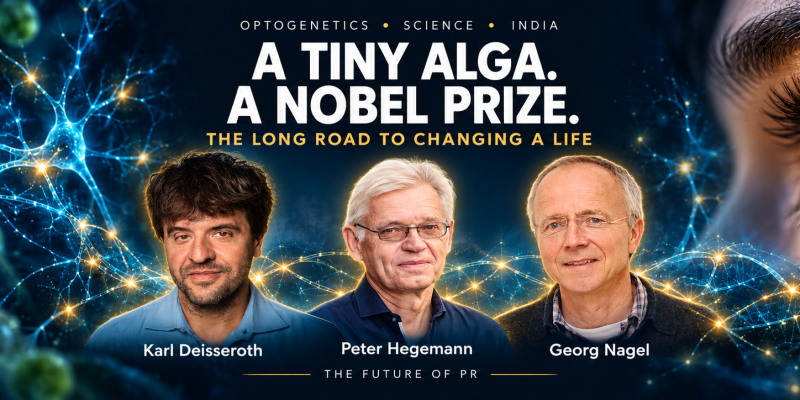
By: Karnvir Mundrey
In rural South India, about one person in every thousand has retinitis pigmentosa, an inherited disease that slowly destroys sight. On 5 October 2026, three scientists whose work could give some of that sight back won the Nobel Prize in Physiology or Medicine.
Karl Deisseroth, Peter Hegemann and Georg Nagel were honoured for discovering light-gated ion channels and turning them into optogenetics, a way to switch chosen cells on and off with light. Most coverage will tell it as a story about Stanford, Berlin and Würzburg. I think it is also an Indian story, for three reasons:
- The disease. The first optogenetic therapy, now awaiting an FDA decision, treats a condition far more common in South India than elsewhere.
- The science. Bengaluru trained some of India’s earliest optogenetics researchers, and a lab at NCBS still uses the technique to study memory.
- The economics. ImmunoACT and CMC Vellore have shown that gene therapy can be built in India at a fraction of Western prices.
In the Bhagavad Gita (2.47), Krishna tells Arjuna that his right is to the work alone, never to its fruits. Optogenetics began with a question about how a pond alga swims, decades before anyone imagined a prize or a therapy. This story follows that idea in three parts: the work, the gap and the fruit.

If you like what we do, don’t just scroll past! Support the publication!
Part one: The work
What optogenetics is
Optogenetics lets scientists switch chosen nerve cells on or off with light, within milliseconds. They insert the gene for a light-sensitive protein, called an opsin, into one type of cell. The two classic opsins come from microbes, and they do opposite jobs.
Channelrhodopsin-2 is a channel: blue light opens it and the neuron fires. Halorhodopsin is a pump: yellow light drives it and the neuron goes quiet.
Inside each opsin sits retinal, a vitamin A derivative and the same light-catcher our own eyes use. A photon bends it in femtoseconds, and that tiny movement reshapes the protein around it.
The precision comes from genetics, not from the light. A harmless virus carries the opsin gene, and genetic switches make sure only the chosen cell type uses it. In animal studies, a thin optical fibre then delivers light deep into the brain. For the first time, neuroscientists could ask not just which cells are active during fear or hunger, but whether switching them on causes it.
A relay race across three labs
The prize honours a relay, and the three laureates share the 12 million Swedish kronor equally.
Peter Hegemann asked the question. Now at Humboldt University in Berlin, he wanted to know how the alga Chlamydomonas swims towards light. In 1991 his group showed that its eyespot responds almost instantly, which suggested the light sensor and the ion channel were one protein. In 2001, his colleague Suneel Kateriya found the genes in an algal DNA database. His lab later became the field’s protein workshop, solving the channel’s structure and designing faster, more sensitive and differently coloured versions.
Georg Nagel proved it. Working in Ernst Bamberg’s group at the Max Planck Institute of Biophysics in Frankfurt, he made the protein inside frog eggs and measured what it did. Papers in 2002 and 2003 showed that channelrhodopsin opens directly in response to light and proposed it as a tool. In 2005, with Alexander Gottschalk, he made roundworms respond to light. At Würzburg he has since built light-controlled enzymes and applied the tools to plants.
Karl Deisseroth made it a tool. A Stanford psychiatrist who still sees patients, he first switched neurons on with channelrhodopsin in July 2004 and published in 2005. He gave reagents and training to labs worldwide, which is a big reason the method spread so fast. His own lab then used it to probe the circuits behind mental states:
- Parkinson’s (2009): clarified how deep brain stimulation actually helps.
- Depression (2013): silencing midbrain dopamine neurons produced depression-like behaviour in mice; switching them on relieved it.
- Dissociation (2020): traced ketamine’s detached state to a slow 1 to 3 Hz rhythm in one cortical region.
- Heart and mind (2023): an optical pacemaker that sped up a mouse’s heart made it more anxious, but only in risky settings.
His 2013 method, CLARITY, also turns brain tissue transparent so whole circuits can be seen at once.
The work, not the fruit
A Nobel can go to at most three people, and optogenetics had more than three parents. Ed Boyden was first author of the landmark 2005 paper, and the US National Academy of Sciences credits him with co-inventing the method as a side project during his PhD. Gero Miesenböck made neurons light-sensitive first, in 2002, using a multi-protein system from fly eyes. Ernst Bamberg led the Frankfurt group where Nagel did the decisive experiments. The 2013 Brain Prize, which has no three-person cap, honoured all six.
Read as a communications story, the prize rewards more than discovery:
- Naming is ownership. The field was named “optogenetics” in 2006, and the name fixed who it belonged to in public memory.
- Generosity is strategy. Giving tools away freely built the field and the laureate’s standing in it at the same time.
- Visibility compounds. Deisseroth explained the work on lecture tours worldwide, including India in 2016.
- Silence is also a message. Boyden did not respond to reporters after the announcement, so others are framing his omission for him.
For Indian scientists and institutions, the lesson is practical: good work is necessary, but it rarely speaks for itself.
A Nobel is the scientists’ fruit. For patients, the fruit is a therapy, and the first one is aimed at a disease that strikes South India hardest.
Part two: The gap
Between a prize in Stockholm and a patient in rural Andhra Pradesh lie four gaps: a heavy disease burden, a steep price, a wave of hype and the science’s own limits.
Why the first therapy matters most in South India
Retinitis pigmentosa (RP) slowly kills the retina’s light-sensing cells. It usually begins with night blindness in the first two decades of life, and many patients are legally blind by young adulthood.
Hyderabad’s L V Prasad Eye Institute (LVPEI) has documented how heavily it falls on South India:
- Prevalence: about 1 in 1,000 people in rural South India, against 1 in 3,000 to 7,000 elsewhere, a gap the institute links to consanguineous marriage.
- Impact: RP is the second most important cause of new blindness in South India.
- Progression: in a 15-year follow-up of rural Andhra Pradesh, 5 of 9 RP patients went blind, most of them of working age.
That follow-up, from the Andhra Pradesh Eye Disease Study, was led by Deepika Parameswarappa with Rohit Khanna, Subhadra Jalali and Srinivas Marmamula, and tracked 7,771 rural participants from 1996 to 2016. LVPEI’s Kallam Anji Reddy Molecular Genetics Laboratory is one of the few Indian centres with a dedicated RP focus, and the institute was a participating site in a US National Eye Institute study on the genetics of retinal degeneration. Its researchers have called for cheaper genetic testing, more counselling and, in the long run, affordable gene or stem cell therapy.
That is where optogenetics fits. RP can be caused by mutations in many genes, and the only approved RP gene therapy, Luxturna, works for just one of them, RPE65. Nanoscope Therapeutics’ MCO-010, branded Mogenry, sidesteps the problem. A single injection into the eye makes the retina’s surviving bipolar cells sensitive to light, whatever mutation caused the disease, so patients need no genetic testing.
Its RESTORE trial in 27 adults, who started with vision of about 20/3200, met its main goals, with better visual acuity at 52 and 76 weeks and no treatment-related serious adverse events. The FDA has accepted Nanoscope’s application, with a decision due in the first half of 2027. For South India’s genetically diverse patients, one treatment that works regardless of mutation is worth more than another gene-specific fix.
The price wall
Gene therapies are among the most expensive medicines ever sold. US CAR-T cell therapies cost several hundred thousand dollars per dose before hospital care, and optogenetic therapy shares their cost drivers: costly viral vectors, specialised manufacturing and small numbers of patients. If Mogenry follows Western pricing, it will be out of reach for almost every RP patient in rural South India, the very people who need it most.
Light therapy is not optogenetics
Expect sellers of red-light masks and panels to borrow the Nobel headlines. Three very different things are about to be blurred together:
| Category | How it works | Status |
|---|---|---|
| Optogenetics | A gene therapy adds a light-sensitive protein; light then switches cells on or off | Clinical trials; first FDA decision due in the first half of 2027 |
| Photobiomodulation | Red and near-infrared light is thought to boost the cell’s energy production; no genes involved | One FDA-authorised eye device; evidence still debated |
| Consumer red-light gadgets | Panels and masks sold with broad wellness claims | Mostly without clinical evidence for those claims |
Photobiomodulation deserves a fair hearing. The FDA authorised one such device, Valeda, for dry macular degeneration in 2024, after its pivotal trial showed a modest gain in visual acuity over sham treatment at 13 months. But retina specialists still dispute the evidence. The simple test for readers: optogenetics always involves changing genes. If something promises “optogenetic” benefits from light alone, it is not optogenetics.
The honest limits
Light can heat brain tissue enough to change how neurons fire, and few studies have shown clear effects in monkeys, whose brains are far larger than mice’s. That is why the eye, small and easy to reach, is going first. Optogenetic therapy also changes a patient’s cells permanently, which makes consent weightier than for a drug. And MIT experiments that planted false fear memories in mice, and recovered “lost” memories in mice with an Alzheimer’s-like disease, have led the scientists involved to call for public debate before such tools reach people.
That is the gap. The encouraging part is that India has already started the work of closing it.
Part three: The fruit
India’s part in this story did not begin with the Nobel. It began in a Bengaluru teaching lab in 2009, and it has gathered pace since.
India’s first optogenetics course came four years after the first neurons were switched on with light. Its gene-therapy milestones arrived just before the prize.
The Bengaluru connection
In July 2009, the National Centre for Biological Sciences (NCBS) hosted a Harvard–NCBS optogenetics course that participants called the first of its kind in India. It trained students from NCBS, IISc, NIMHANS and AIIMS, with Upinder Bhalla, Sumantra Chattarji and K. VijayRaghavan among its teachers. Seven years later the future laureate came to the city himself: in January 2016, Deisseroth visited NCBS during his Cell Press–TNQ lecture tour.
Upinder Bhalla, a computational neuroscientist at NCBS since 2002, asks how the brain recognises sequences: how a neuron picks one meaningful pattern out of thousands of inputs. His team projects patterns of light onto light-sensitive neurons in one part of the hippocampus, called CA3, and records how single neurons in the next region, CA1, respond. The hippocampus is central to learning and memory, so this lets him watch memory-relevant computation one connection at a time.
The lab has found that excitation and inhibition stay balanced even across a handful of inputs, which lets a neuron attend to just a few signals. It has trained individual CA1 neurons to recognise light patterns, and found activity sequences emerging in the hippocampus of mice learning a timed task. The Department of Biotechnology funded the work with about ₹1.77 crore from 2017 to 2022, and a follow-on grant running to 2026 names neurodegeneration and memory disorders among the conditions the work could eventually inform.
This is basic science, with no product or patient attached. It is the work, not the fruit, and exactly what the Nobel rewards decades later.
Getting past the price wall
Optogenetics is a gene therapy, so whether Indians benefit depends on Indian gene therapy. Two institutions have already shown the way.
ImmunoACT, spun out of IIT Bombay in 2018 by Rahul Purwar and Atharva Karulkar, makes NexCAR19, a CAR-T therapy that re-engineers a patient’s own immune cells to fight blood cancers. Built over a decade with Tata Memorial Centre, where Hasmukh Jain and Gaurav Narula led trials in 60 patients, it was approved by CDSCO in October 2023 as India’s first home-grown CAR-T. In trials, 26 of 38 lymphoma patients and 10 of 15 leukaemia patients responded, and it costs about ₹30 to 40 lakh, roughly a tenth of the international price. ImmunoACT has also tackled payment, partnering with Mango Sciences in December 2025 to offer interest-free bridge loans of up to ₹10 lakh. A second Indian-made CAR-T, from Bengaluru’s Immuneel Therapeutics, has since joined it on the market.
Christian Medical College, Vellore has delivered two firsts. India has the world’s second-largest haemophilia burden, about 136,000 cases. CMC’s Centre for Stem Cell Research, a unit of Bengaluru’s BRIC-inStem, ran India’s first-in-human gene therapy for haemophilia A, led by Alok Srivastava. A lentiviral vector, developed with Emory University, inserts a working clotting-factor gene into the patient’s own blood stem cells. All five men treated had zero bleeding episodes, and no one developed inhibitors. The results appeared in the New England Journal of Medicine in December 2024; the trial was small, so a larger phase 2 study is next.
CMC’s VELCART trial then showed that CAR-T cells can be made on-site, next to the patient. Ten patients with leukaemia or lymphoma received fresh cells, collected and infused within nine days.
| Model | Who | Cost per patient |
|---|---|---|
| Commercial CAR-T, US | Multinational manufacturers | US$503,580 to 605,404 per dose |
| NexCAR19 | ImmunoACT, Mumbai | About ₹30 to 40 lakh for the therapy |
| VELCART, point-of-care trial | CMC Vellore | US$35,107 to manufacture, excluding the viral vector, plus a median US$12,724 in hospital care |
India now has a regulator that has approved gene-modified products, institutions that can run first-in-human trials, and companies that have cut prices by an order of magnitude. The pieces needed to make optogenetic therapy affordable already exist.
What comes next
The next nine months will decide whether optogenetics becomes a medicine, not just a laboratory tool.
Everything before the FDA decision is preparation; what follows depends on whether the first optogenetic therapy is approved. Indian readers should watch four things:
- The FDA decision on Mogenry, and whether anyone then seeks approval from CDSCO.
- Trials in India, where LVPEI and other eye institutes are natural sites.
- Manufacturing, where viral vector production is the next bottleneck.
- Basic science funding for labs like Bhalla’s at NCBS.
Hegemann was trying to understand how an alga swims, and the fruit arrived 35 years after his first recordings. For India, the work is now clear: run the trials, build the manufacturing and fund the basic science. The fruits, in Stockholm or in a clinic in Hyderabad, will follow.
Sources
The prize and the Bengaluru connection
- The Nobel Prize in Physiology or Medicine 2026
- Optogenetics in India: the 2009 Harvard–NCBS course
- NCBS: Optogenetics 2009 course page
- TNQ Distinguished Lectures: Karl Deisseroth, 2016
- NCBS: Karl Deisseroth visits NCBS
Upinder Bhalla
- Upinder Singh Bhalla, Wikipedia
- Bhalla lab research, NCBS
- OIST seminar: patterned optical stimulation and E/I balance
- Synaptic input pattern learning in CA1 neurons (Mightex)
- DBT project: Optogenetic analysis of memory formation
- ANRF/SERB project: Pattern learning in individual hippocampal neurons
L V Prasad Eye Institute and optogenetic eye therapy
- LVPEI: 15 years of retinitis pigmentosa
- LVPEI: Retinitis pigmentosa
- NEI study on the molecular genetics of retinal degenerations
- Models for AAV gene therapy in inherited retinal diseases (Cells, 2024)
- Retinal Physician: FDA accepts MCO-010 application
- Glance: Nanoscope begins rolling BLA submission
- Retinal Physician: The potential of optogenetic therapy
ImmunoACT and CMC Vellore
- Down To Earth: NexCAR19 gets market authorisation
- BioSpectrum Asia: Startup of the year 2024, ImmunoACT
- NexCAR19 cost and how families pay for it
- Vajiram & Ravi: India’s own CAR-T cell therapy
- ClinicalTrials.gov: CMC Vellore haemophilia A gene therapy
- World Federation of Hemophilia: NEJM features new gene therapy
- Medical Dialogues: First human gene therapy for haemophilia A
- VELCART trial (Molecular Therapy)
- VELCART abstract, ASH 2024
- Haematologica: point-of-care CAR-T costs
Light therapy
- EyeWiki: Photobiomodulation in retina diseases
- Retinal Physician: Can photobiomodulation regulate dry AMD?
Support The Future Of PR
TheFutureOfPR.com explores the stories behind business, reputation, leadership, investment and global trade-especially the ideas that conventional media often overlooks.
If you enjoy independent reporting, thoughtful analysis and stories from the ground, you can support my work. Your contribution helps fund the continued development of TheFutureOfPR.com.
Click here: buymeacoffee.com/tfofpr to appreciate this writing.
Thank you for helping independent ideas travel further.
Karnvir Mundrey is a narrative strategist and media entrepreneur who helps founders, institutions and international businesses turn complex ideas into influential public stories. He is the Founder of Atharva Lifesciences Consulting Pvt. Ltd. , Atharva Marcom and Founder Editor of TheFutureOfPR.com. He has also authored a book on Nutraceuticals (available on Amazon). Karnvir Mundrey is also the producer and host of 4 YouTube channels. Finest Fintalk brings you the latest in Finance, LitInMin for Books, The Health Tips Podcast for health and Atharva Marcom for leadership talks He is also recognized as India’s longest running podcast host, continuously running since 2006!
Reach out at tfofpr@gmail.com or at +918296303806.
Subscribe to TheFutureOfPR.com to get great ideas on life, education, health & fitness, real estate, glamour, jewelry, movies, and podcasts! Follow TheFutureOfPR.com on Facebook , Twitter and Linkedin!
Join the WhatsApp Group at: https://tinyurl.com/ynj8pyn9
Share this article with people who you think might benefit. They will thank you for it









Comments