
 By
By 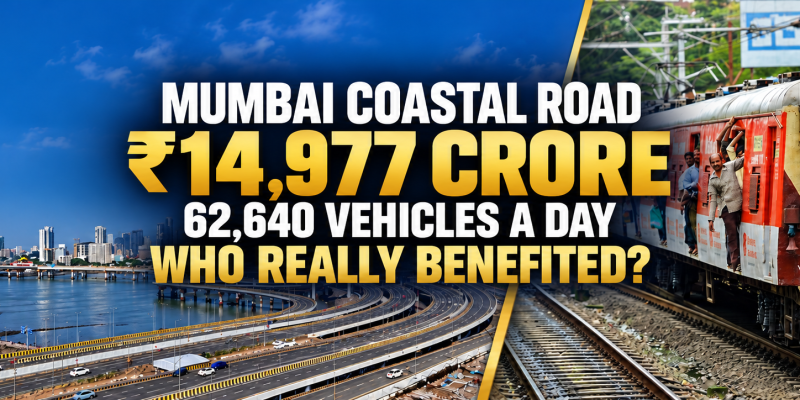
By: Karnvir Mundrey
It is not obviously a construction scam. The more uncomfortable question is whether Mumbai paid a credible price for the wrong transport priority.
Two journeys, one bill
Picture two Mumbaikars leaving home at half past eight on a weekday morning.
The first pulls onto the Coastal Road at Worli. The sea glints to one side, the car dips into a tunnel beneath Malabar Hill, and it surfaces beside Marine Drive in under ten minutes. A trip that once took forty minutes, sometimes fifty, is now over before a cutting chai goes cold.
The second squeezes onto a BEST bus in the traffic the first driver has just escaped. Mumbai’s buses have averaged 8 to 10 kilometres an hour, roughly the pace of a jogger. If she takes the local train instead, she joins a system on which nearly 2,300 people died in 2025, more than 500 of them after falling from trains.
Only one of them uses the Coastal Road. Both of them paid for it.
The road cost ₹14,977 crore, about ₹11,500 for every resident of the city. On a typical day it carries 62,640 vehicles. At 1.5 people per vehicle, that is roughly 94,000 journeys, or about 47,000 people making a round trip. That is fewer than one Mumbaikar in 250.
This is a story about those two journeys, and about why the gap between them should trouble everyone, whichever side of the argument they are on.

If you like our writings, Cmon, support us! Scan the image to show your appreciation!
The temple and the moving body
Some eight centuries ago, the reformer Basavanna answered the rich men who built temples. He could not afford one, he said, so he would make his own body the shrine. What stands will fall; what moves will endure. He called the first sthavara, the fixed, and the second jangama, the moving.
Mumbai is a jangama city. It runs on 75 lakh train journeys a day, 32 lakh bus rides and the tired feet of millions of walkers. The Coastal Road is its newest and most photogenic sthavara.
This is not an argument that the temple was badly built. It was built well, and, as its fiercest critics may be surprised to hear, probably not at a scandalous price. The real question is harder: did a city of moving bodies most need a temple?
To answer that, follow the money.
A price tag that kept growing
Line up the cost estimates and the story looks like a heist.
In 2015, a draft economic appraisal put the South section at ₹2,999 crore. By 2017, an environmental brief said ₹5,303 crore. At tender stage in 2018, BMC’s engineers estimated ₹6,851 crore. Then contractors bid, and orders worth about ₹9,615 crore were signed. The approved project envelope was ₹12,721 crore. By opening, the figure had reached about ₹13,984 crore. After seven revisions, it stands at ₹14,977 crore.
That is five times the first number. Surely someone pocketed the difference?
Look closer, and the villain changes shape. The early figures were not suppressed truths. They were sketches of a smaller, different project, priced for a different year, and they left out important risks, quantities and owner costs. The market knew it. When the bids arrived, they landed far above BMC’s internal estimates. HCC’s joint venture, for one, bid about 30% above the corporation’s reserve price for its package.
The national auditor noticed too. A 2021 CAG inspection report traced the cost per kilometre from ₹252 crore in 2011 to ₹1,274 crore at sanction. It said the jump needed justification, and it queried ₹200 crore of the ₹2,100 crore spent between 2016 and 2020. When Hindustan Times reported on it, the report had not been made public. I could not find a published version.
Haste carried its own price. The environmental case was challenged in court, and by one civic official’s estimate the 2019 stay cost about ₹750 crore, or ₹5 crore for every day the machines stood still.
After approval, though, the overrun is modest. The rise from ₹12,721 crore to ₹14,977 crore is 17.7% in nominal terms over eight years, barely 2% a year.
So the real culprit is not a thief. It is an immature estimate, approved in a hurry and changed after the contracts were awarded. It has never been followed by a published final account, broken down package by package.
The price, then, may not be the scandal. What about the product?
A busy road with a narrow door
The Coastal Road is not empty. Of its 62,640 daily vehicles, 33,077 head south and 29,563 head north. That is real traffic.
It is also well short of the roughly 136,000 daily vehicles, counting both directions, that was once promoted: about 46% of that benchmark. Defenders have a fair reply. After fresh surveys, BMC’s peer reviewer concluded that the South sections would need at least four lanes each way by 2034. Eight lanes, on that view, were not madness.
But the road has a narrow door. Its eight lanes squeeze into two running lanes, plus an emergency lane, inside each tunnel. In March 2024, when the road opened only twelve hours a day, its busiest southbound hour already carried 2,943 vehicles. Two tunnel lanes can handle roughly 3,200 to 3,800 an hour. Whatever the 2034 forecast promises, traffic growth into South Mumbai will hit that pinch point first.
And vehicles are not people. At present use, the city has committed about ₹15.94 lakh of capital for each daily passenger journey, or ₹31.88 lakh for each regular user.
Who are those users? The carriageway bars pedestrians, two-wheelers and auto-rickshaws. Only two BEST routes used it in 2026. A Breach Candy residents’ forum found that more than 60% of vehicles leaving at Amarsons Garden head for Nepean Sea Road or Malabar Hill. Mumbai’s own Comprehensive Mobility Plan found that cars carried just 11.6% of motorised trips in 2014, against 61.2% for public transport.
It did not have to be this way. The design included two lanes for bus rapid transit, and HCC’s own 2018 stock-exchange filing said they would encourage public transport. Today there is no bus lane.
Mumbai has seen this film before. The Bandra–Worli Sea Link opened in 2009 with two lanes meant for buses. BEST’s services on it were later discontinued.
The temple was built. The door for the moving body was left off.
The ledger
Sooner or later, every public project faces a plain test: does it return more than it costs?
I modelled the road over 30 years at a 5% real discount rate. Capital, routine maintenance and a modest renewal reserve come to about ₹1,067 crore a year. For benefits, I assumed 1.5 people per vehicle, 25 minutes saved per trip, time worth ₹150 an hour, and ₹40 of fuel and running-cost savings per trip.
The answer: about 29 paise of direct benefit for every rupee of cost.
Give the government every reasonable correction and it rises to about 34 paise. That means stripping out GST and other transfers, and crediting the tunnels and seawall with value beyond year 30. Now stack every optimistic assumption at once: two people in every car, 40 minutes saved, time worth ₹300 an hour. On those terms the road scrapes past break-even at about 1.16. So the road is not incapable of paying off. But that case needs measured evidence, not a few showcase journeys.
Growth will not easily rescue it. Even 5% traffic growth every year for 30 years, with no loss of speed, lifts the ratio only to about 0.53. Standard appraisal practice gives trips the road itself generated only about half the value of trips diverted from other routes. If half of today’s trips are of that newly generated kind, the ratio falls to about 0.215. For each regular user, the lifetime cost exceeds the direct benefit by roughly ₹25 lakh.
Here defenders play their strongest card: the road is also a park and a seawall.
The project’s own 2015 urban design report valued reclaimed public land at ₹60 crore a hectare. For 70 hectares, that is ₹4,200 crore. Credit all of it to the road today, and the ratio still rises only to about 0.54, leaving a gap of roughly ₹488 crore a year. Closing it through the park alone would take about 134,000 visits every day, each worth ₹100. That is possible in Mumbai, perhaps. But by October 2025, only about five of the planned 7.5 kilometres of promenade had opened, and nobody publishes footfall.
The seawall’s value is just as unproven. Protection has to be modelled: surges, waves, overtopping and the odds of failure. The project’s studies assumed sea levels would rise 1.27 mm a year, based on records from 1878 to 1993. Critics point to about 3.4 mm a year observed, and IIT-Bombay studies suggest the city is also sinking about 2 mm a year. The sea has already tested the work. A 2019 cyclone washed away newly reclaimed land, and a 4.75-metre tide in June 2025 damaged the promenade.
The ledger also has a line nobody fills in. In 2019, the Central Marine Fisheries Research Institute told the Bombay High Court that the reclamation zone was an oyster bed on which Worli Koliwada’s fisherwomen depended. In rupees, that loss is small, which is exactly why appraisals forget it.
The road not taken
Every rupee in the Coastal Road had another claimant.
The 2018 budget was the first time BMC dipped into its fixed deposits, for this road and the Goregaon–Mulund Link Road. The same budget raised charges at civic hospitals. Those deposits have since fallen from above ₹91,000 crore in 2021–22 to about ₹81,000 crore, of which ₹44,826 crore is committed to pensions and similar obligations. The ₹36,623 crore left free must stretch across ₹2.44 lakh crore of projects already under way.
So imagine the same ₹14,977 crore spent on the second commuter instead.
| What ₹14,977 crore buys | Daily journeys | Lifecycle cost per journey |
|---|---|---|
| The Coastal Road | ~94,000 | ~₹311 |
| Metro, at Lines 2A and 7’s observed productivity | 315,000–404,000 | ₹86–₹150 |
| A bus service funded for 30 years | 730,000–1,180,000 boardings | ~₹23–₹37 per boarding |
Metro Lines 2A and 7 together cost about ₹12,600 crore and carry 265,000 to 340,000 journeys each weekday. At that productivity, the Coastal Road’s budget would carry 3.3 to 4.3 times as many people. The comparison even flatters the road. The Metro figure includes trains and operations, while the road figure ignores the fuel, depreciation, insurance and parking of every car on it.
Not every train is a good bet, though. The underground Aqua Line cost ₹37,276 crore and carried about 1.48 lakh passengers a weekday in December 2025, against projections of 13 lakh or more. On current use, it is no more productive than the Coastal Road. The case is for well-used public transport, with feeder buses and walkable stations, not for anything that happens to run on rails.
Buses need honest arithmetic too, because buying 5,000 electric buses is not the same as running them for 30 years. So spread the road’s ₹14,977 crore over three decades, which comes to ₹974 crore a year. Set aside 15% for depots, bus priority and administration. Spend the rest on service at BEST’s reported lease rates of ₹48 to ₹78 per kilometre.
That funds about 1,450 to 2,360 buses. At 500 boardings per bus per day, they would carry 0.73 to 1.18 million boardings, 7.7 to 12.6 times as many people as the road carries. Put differently, ₹14,977 crore equals about seven years of BEST’s annual transport deficit of ₹2,131 crore.
That is what the road not taken looked like: not a sleeker ride for a few, but a shorter wait for many.
The twist: was it a scam?
Here the story refuses to go where many expect.
A cost-conscious private owner would have paid about ₹13,000 to ₹14,500 crore for the same output, with ₹13,700 crore as the central estimate. That figure uses competitive orders, comparable tunnel and marine-bridge rates, and normal allowances for design, risk and tax. A purely bottom-up build at efficient rates lands lower, near ₹9,500 crore. But that is below what contractors bid for the core works alone in 2018, so it is a theoretical floor rather than a fair benchmark.
That puts the premium at roughly ₹500 to ₹2,000 crore, with a central estimate of ₹1,277 crore, or about 8.5%. It is a serious audit target. It is not evidence that half the money vanished.
By world standards, Mumbai even built cheaply. It paid roughly $1.6 to $1.8 billion for 10.58 kilometres, while Seattle spent $3.3 billion on a waterfront programme centred on a single 3.2-kilometre tunnel. The difference lay in what Seattle built around the concrete: tolls that vary by time of day, and transit funded in the same package.
The audit should start with two lines among the ₹2,254 crore of later additions.
The first is ₹922 crore for a 120-metre navigation span at Worli, 41% of all additions. Fishermen had asked for a wide gap as early as 2019. This was a foreseeable change that arrived after the contract was awarded, which is when changes cost most.
The second is ₹749.29 crore for underground parking at Haji Ali. BMC has described the facility as a four-storey structure for about 1,235 vehicles, including 70 buses. That works out to roughly ₹61 lakh per space. BMC has also estimated ₹3,000 crore for coastal parking at three sites, without saying how much of it sits outside the ₹14,977-crore headline. A temple, it turns out, with a very expensive car park.
One allegation also remains open. In 2021, BJP leader Ashish Shelar alleged a ₹684-crore fraud in the reclamation work, including fill from unlicensed quarries and 35,000 fake truck trips. BMC denied it, and I found no published outcome of any inquiry. It belongs on the audit list, not in the headline.
Three numbers that cannot all be true
The carbon story reads like a subplot, but it shows how public claims get made.
The project has promoted an operational saving of about 1,826 tonnes of CO₂ a year, and it has also advertised a 34% fuel saving. If both are true, each trip used just 0.10 litre of fuel before the road opened, enough for barely a kilometre of driving.
Then, at the March 2024 opening, the municipal commissioner at the time, Iqbal Singh Chahal, said the road would save nearly $100 million a year in fuel. That is about ₹830 crore of fuel, or roughly 3.6 litres per vehicle trip at today’s traffic. That is more than a car burns over the entire route.
Meanwhile, the steel and cement in the early environmental quantities alone embody roughly 248,000 tonnes of CO₂. At 1,826 tonnes saved a year, repaying that takes about 136 years.
Different boundaries and assumptions may explain some of this. That is exactly why BMC should publish the workbook instead of repeating three incompatible headlines.
The temple becomes a cathedral
The next chapter will not wait for that evidence.
The northern extension runs 26.3 kilometres at an estimated ₹22,000 crore. It affects about 45,675 mangroves, roughly 9,000 of which are to be felled permanently, and the Supreme Court declined to intervene in March 2026. Add the ₹11,333-crore Versova–Bandra Sea Link, and the western corridor comes to about ₹48,000 crore.
I found no published appraisal comparing that corridor with a bus or rail alternative. The temple is about to become a cathedral. The questions asked here about the South should be answered for the North before the money is committed, not after.
Tomorrow morning
The verdict, then, is neither the government’s nor the opposition’s.
The Coastal Road is an impressive engineering asset. It is not demonstrably a ₹15,000-crore scam, and its eight lanes may prove defensible by 2034. But engineering achievement is not public-policy success. As a way to move people, it serves too few at too high a cost. As a park and a seawall, its value rests on evidence that has not yet been published.
The capital is sunk, so the task now is to make the temple serve the moving body:
- Run a high-frequency coastal bus service, with the bus priority the design promised and a Sea Link toll waiver for BEST.
- Price peak-hour use modestly, and reserve every rupee for that service.
- Publish the evidence: traffic in 15-minute intervals, occupancy, conditions on parallel roads and promenade footfall.
- Model the seawall against current sea-level projections, and disclose the 30-year renewal plan.
- Open the books: release the CAG report and the final account package by package, and send the ₹922-crore span and the ₹749-crore car park for independent review.
- Share the gains through a betterment levy on redevelopment near the road.
Basavanna never said temples were wicked. He said that what moves outlasts what stands.
Tomorrow morning, the first commuter will glide beneath Malabar Hill again and be at Marine Drive in minutes. The second will stand at a bus stop on a road the Coastal Road was supposed to relieve, waiting.
Mumbai did not necessarily pay an absurd price for the structure it built. It may simply have spent ₹14,977 crore solving the travel problem of too few people, while millions kept waiting for a better bus, a less crowded train and a footpath that works.
Sources and methodology
Official records: BMC project scope and cost · 2015 Draft DPR · Peer Review Phase I and Phases II & III · Urban Design Report · Comprehensive Mobility Plan · HCC’s 2018 NSE filing
Cost and audit: Seventh revision and variation schedule · CAG inspection report · Cost of the 2019 stay · Package 2 bid · Haji Ali parking · Fraud allegation and denial · Seattle SR 99
Traffic and users: Daily traffic and bus routes · Peak-hour count · Tunnel lanes · Breach Candy exit study · Rail deaths in 2025
Alternatives and finance: BEST ridership and deficit · Aqua Line ridership · BMC’s 2018 deposit drawdown · BMC reserves 2026–27
Environment and Phase 2: Public realm and CSR plan · Fisheries report · Sea-level assumptions · Subsidence · Tide damage · $100-million claim · US EPA carbon factor · Phase 2 cost · Mangrove ruling · Versova–Bandra Sea Link
Support The Future Of PR
TheFutureOfPR.com explores the stories behind business, reputation, leadership, investment and global trade-especially the ideas that conventional media often overlooks.
If you enjoy independent reporting, thoughtful analysis and stories from the ground, you can support my work. Your contribution helps fund the continued development of TheFutureOfPR.com.
Click here: buymeacoffee.com/tfofpr to appreciate this writing.
Thank you for helping independent ideas travel further.
Karnvir Mundrey is a narrative strategist and media entrepreneur who helps founders, institutions and international businesses turn complex ideas into influential public stories. He is the Founder of Atharva Lifesciences Consulting Pvt. Ltd. , Atharva Marcom and Founder Editor of TheFutureOfPR.com. He has also authored a book on Nutraceuticals (available on Amazon). Karnvir Mundrey is also the producer and host of 4 YouTube channels. Finest Fintalk brings you the latest in Finance, LitInMin for Books, The Health Tips Podcast for health and Atharva Marcom for leadership talks He is also recognized as India’s longest running podcast host, continuously running since 2006!
Reach out at tfofpr@gmail.com or at +918296303806.
Subscribe to TheFutureOfPR.com to get great ideas on life, education, health & fitness, real estate, glamour, jewelry, movies, and podcasts! Follow TheFutureOfPR.com on Facebook , Twitter and Linkedin!
Share this article with people who you think might benefit. They will thank you for it!










Comments