
 By
By 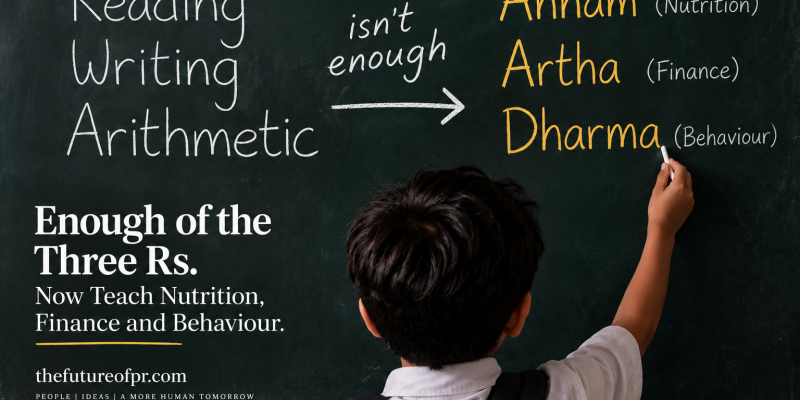
By: Karnvir Mundrey
In the age of AI, children need to learn how to eat, how to manage money and how to behave. Our schools are still teaching them for a world that no longer exists.
Enough of the three Rs
For two hundred years, schools have been built on the three Rs: reading, writing and arithmetic. They served the industrial age well. That age is over.
A child’s phone now holds a mathematician, a writer, a translator and a tireless tutor. AI can solve the equation, draft the essay and explain the chemistry in seconds. What it cannot do is live the child’s life. It cannot choose what she eats. It cannot stop her gambling her savings. It cannot make her honest when nobody is watching.
So education needs a new foundation. Three subjects every child must master, from kindergarten to college:
- Nutrition and cooking: how to feed your body well.
- Finance and investing: how to earn, save and grow money wisely.
- Ethics and behaviour: how to be decent, honest and self-controlled.
Indian thought named them long ago: Annam, Artha and Dharma.
These are not extras for a free period. They deserve the same weight as physics, chemistry and biology, with practicals and real marks.
This is not an argument to abolish maths or science. Engineers need calculus, and every citizen needs enough maths to question a claim. But heavy rote in trigonometry and formulas can shrink. The time it frees should go to the subjects that decide how a life actually turns out.
In 3 Idiots, Rancho tells his friends:
“Kaabil bano, kaamyabi jhak maar ke peeche aayegi.”
Become capable, and success will follow you.
Rancho meant real understanding over rote. In the age of AI, being kaabil means something more: knowing how to eat, how to handle money and how to behave. Everything else, a machine can help with.
Why I believe this
I learned this the hard way.
I arrived at the London School of Economics to study finance with an MBA from the University of Mumbai already behind me. On paper, I was well educated.
But I couldn’t cook. I knew what a balance sheet was, but far less about a balanced meal. I ate whatever was quick, and I gained weight. The second irony was stranger. I was studying finance, yet I wasn’t confident investing my own money. It took me years.
Two degrees, hundreds of exams, and nobody had made sure I could feed myself or act on what I knew about money.
My story is common. The next generation’s will be harder.

If you like our writings, support us! Scan the image to show your appreciation!
The exam nobody prepares us for
Meet Meera. She is fictional, but you know her. She is seventeen, lives in Bengaluru and has just finished her Class 12 boards. She can differentiate a function and draw a mitochondrion. Her report card says excellent.
Now give her a different exam. Here is ₹1,000: feed four people well today. Here is your first salary: what will you save and invest? Here is an instant loan, a stock tip, a “guaranteed” 24 percent return. Then make it harder. Her friend cheats. Her boss asks her to lie. Someone offers a bribe. A driver cuts her off. And nobody is watching.
Which exam will decide the next sixty years of her life? And which one have we spent twelve years preparing her for?
The roboticist Hans Moravec noticed that computers find calculus easy and moving around a kitchen hard. The skills we treated as the summit of schooling are the ones machines do best. The ordinary ones are the most human. Our ancestors knew this.
The Taittiriya Upanishad preserves what may be the world’s oldest graduation speech. The departing student hears no formulas, only this:
Satyaṁ vada. Dharmaṁ cara.
Speak the truth. Practise dharma. (1.11.1)
In the gurukul, even Krishna, a prince, gathered firewood beside Sudama, a poor boy. We kept the textbooks and dropped the life lessons.
One: Nutrition and cooking
Hungry? Tap: pizza. Tap: biryani. Tap: dessert.
Meera’s generation can eat without ever learning to cook. If she doesn’t understand food, advertisers, influencers and algorithms will decide for her, and all of them want one thing: Order Again. She can write the formula for glucose but can’t tell you the sugar in her afternoon drink.
The pizza arrives today. The bill arrives in twenty years.
- The WHO estimates over one billion people lived with obesity in 2022.
- NFHS-5 found about one in four Indian adults aged 15–49 overweight or obese, up sharply in five years.
- ICMR-INDIAB (2023) estimated 101 million Indians with diabetes and 136 million prediabetic.
- A 2025 Lancet study projects India’s overweight and obese adults could reach 450 million by 2050.
- Yet 35.5 percent of Indian children under five are stunted. Hunger and excess, often under one roof.
By share of obese adults, India still trails countries like the US. But by sheer numbers and speed, it is among the fastest-growing problems in the world, and nearly half of Indian adults are not physically active enough.
And India is still poor. Income per person is about a fifth of the world average. Rich countries grew wealthy first and heavier later. India risks growing sick before it grows rich. The bill arrives decades later, as diabetes, heart disease and lost working years, paid by families, employers and the nation.
What the epics say
Krishna put it simply:
Yuktāhāra-vihārasya… yogo bhavati duḥkha-hā.
For one balanced in food, recreation, work and sleep, discipline destroys sorrow. (Gita 6.17)
Food, movement, work, sleep: the things we now pay smartwatches to track. The principle is older: govern your appetites.
In the Mahabharata, a Yaksha asks Yudhishthira who is truly happy. He answers:
Śākaṁ pacati sve gṛhe, anṛṇī… sa modate.
The one who cooks even simple greens at home, and is free of debt, is happy.
Cook for yourself. Owe no one. Two of the three new subjects, spoken millennia ago.
Every child should cook
Japan made food education, shokuiku, national law in 2005. Children serve each other lunch and clean up afterwards, and Japan has among the lowest adult obesity rates in the developed world.
Imagine a Class 12 practical where Meera gets ₹1,500 to feed a family of four for a day, one of them diabetic, one an athlete. It tests biology, chemistry, maths and responsibility at once. Why is that worth less than identifying a salt in a test tube?
Two: Finance and investing
In the hall at Hastinapura, Yudhishthira sits down to dice. Vidura warns him. He plays anyway, losing his wealth, his kingdom, his brothers, himself and Draupadi, betting bigger after every loss. He wasn’t foolish. He lacked the temperament to stop.
Now the same game runs on phones. In 2024, SEBI found that 93 percent of over one crore F&O traders lost money between FY22 and FY24, over ₹1.8 lakh crore in total. More than three-quarters of losers kept trading.
Swap the dice for an app, and the Sabha Parva becomes a SEBI report.
Knowing finance is not doing finance
With an MBA and an LSE finance degree, I still took years to invest. Academic finance and personal financial judgement are different skills. You can understand compounding and still start too late, or master portfolio theory and still panic in a crash.
Money is emotion wearing numbers: fear, greed, envy, impatience. Technology puts them on steroids. Trading app: swipe. Instant loan: swipe. Buy now, pay later: swipe.
We teach percentages, not credit-card interest. Algebra, not EMIs. In the OECD’s PISA 2022, about 18 percent of 15-year-olds lacked basic financial literacy, yet most already had a bank account or card. We create financial consumers before financially educated adults.
India’s stakes are higher. Only about a quarter of adults are financially literate. Household net financial savings fell to about 5.3 percent of GDP in FY23. UPI frauds and “guaranteed” schemes keep spreading. And in a country with modest incomes, every rupee lost to ignorance hurts more.
Wealth within dharma
Indian thought honours wealth as a legitimate aim, but always within dharma. So the questions change: not just how do I make money? but how should I? And the hardest: how much is enough? When Bharata visits Rama in the forest, Rama asks whether spending stays within income and whether the ministers are honest. Budgeting and clean governance, in one breath.
The Gita describes the trader’s trap precisely:
Dhyāyato viṣayān puṁsaḥ…
Brooding on desire breeds attachment, craving, anger, delusion and ruin. (2.62–63)
And its cure:
Karmaṇy evādhikāras te mā phaleṣu kadācana.
Your right is to the action, never to its fruits. (2.47)
Control your process. The market owes you nothing. Never confuse outcome with wisdom.
The Dunedin study, following about 1,000 children from birth, found that childhood self-control predicted adult income, savings and debt, regardless of IQ. Self-control can be taught, and habits compound like money.
Imagine Meera managing a simulated ₹10 lakh from Class 9 to 12, through a crash, inflation, a hot tip and a medical emergency. Top marks go not to the biggest portfolio, because luck makes fools look brilliant, but to the best answer to one question: why did you decide that? A student who survives a simulated crash at fifteen won’t freeze, as I did, years later.
Three: Ethics and behaviour
This is the most important of the three.
Someone cuts across you. Your pulse jumps. You lower the window.
Road rage is now a daily scene in India. The country recorded 1,68,491 road deaths in 2022, nineteen every hour. Every driver knows the rules. The failures are of patience and respect.
Corruption tells the same story. Transparency International found 39 percent of Indian public-service users paid a bribe in the previous year, Asia’s highest rate. India scored 38/100 on the 2024 corruption index; Singapore scored 84.
We respond with cameras, police and fines, but twenty years too late. The man shouting on the road didn’t discover anger that morning.
Behaviour has a history. Character has a childhood.
Corruption begins not with “give me ten lakh,” but with the rules don’t apply to me. Papa knows someone, so skip the queue. Cheat, and get praised for the marks. Lesson learnt. Children learn values less from what we say than from what we get away with.
That is why good governance and the fight against corruption must begin in kindergarten, not in a government office.
What the epics teach
Asked what makes a person worthy, Yudhishthira told the Yaksha that conduct matters more than birth or learning. Yet our report cards read Maths 96, Physics 94, with no mark for integrity or self-control. We measure what’s easy, not what matters.
The scholar who failed. Ravana knew the Vedas and worshipped Shiva. He’d top our boards. But he couldn’t master desire or pride, and his knowledge made him more dangerous. Gandhi called this knowledge without character. Rama, by contrast, is called vigrahavān dharmaḥ, dharma in human form. Not memorised. Lived.
The whisper. Yudhishthira tells Drona “Ashwatthama is dead,” then whispers “the elephant” too softly to hear. In the traditional telling, his chariot, which always floated above the ground, drops to earth. Honesty means refusing the clever half-truth, corruption’s favourite tool.
The silence. When Draupadi is humiliated in the assembly, Bhishma and Drona look down. Only Vidura and young Vikarna speak. Wrongdoing survives because respected people stay silent. Children must learn to speak up.
Behaviour can be taught
A 2019 Science study “lost” over 17,000 wallets in 40 countries. Wallets with more money came back more often. People didn’t want to see themselves as thieves. Honesty is identity, and identity is built through practice:
Abhyāsena tu kaunteya… gṛhyate.
The mind is mastered through practice. (Gita 6.35)
Aristotle agreed: we become just by doing just acts. You can’t lecture a child into honesty any more than into swimming. The Gita even names the driver’s skill: withstanding vega, the surge of anger (5.23).
This is where India should learn from East and Southeast Asia. Japanese children clean their own classrooms and toilets, and moral education is a formal school subject. In India, where cleaning is tied to caste, that habit alone could quietly break a prejudice. Singapore puts character and citizenship at the heart of a world-class system. Character and excellence aren’t rivals.
Behaviour practicals, with real marks
We have physics, chemistry and biology practicals. Why not a behaviour practical in Class 12, carrying real marks?
No child should get 92 in “Goodness,” and no teacher should cut marks for being argumentative. That would reward conformity. So don’t measure whether a child is good. Measure whether she can demonstrate ethical competencies, just as science practicals test skills, with a viva, a marking scheme and an external examiner.
Picture Meera’s practical, with trained actors:
- The ₹500 test. A shopkeeper hands her too much change. The examiner then probes: what if you badly needed it? What if nobody would know?
- Road rage. In a simulator, a driver cuts her off and shouts abuse. Marks go to staying calm and refusing to escalate.
- The friend who cheated. There is no single right answer. An examiner can disagree with her conclusion and still give full marks if her reasoning is sound.
- The bribe. “Madam, just to clear this faster.” In some versions, a “senior” orders her to accept. Respectful refusal scores well; obedience doesn’t. Bhishma would fail. Vikarna would pass.
- The viva. What if it were your brother? And finally: what would you do if nobody would ever find out?
When Meera pushes that envelope back across the desk, she is living a line every Indian knows. In Deewaar, Amitabh Bachchan’s Vijay says:
“Main aaj bhi phenke hue paise nahi uthaata.”
Even today, I don’t pick up money that’s thrown at me.
That is dignity no rulebook can enforce. It has to be built, one practised choice at a time.
The examiner scores five things: did she recognise the problem, see other perspectives, reason clearly, act proportionately, and reflect when facts changed? Part of the marks comes from a year of verified community service, including feedback from canteen staff and cleaners. How a young person treats those who can do nothing for her is the truest test of character.
The Indian risk is obvious: coaching centres will sell “30/30 guaranteed” moral answers. So scenarios must come from a large confidential bank, drawn at random. The only way to prepare is to practise being good.
Is it perfectly objective? No. Neither is essay marking. Two examiners and recorded sessions can make it reliable enough. And no marksheet should ever read Ethical: 92%. Life will test the rest.
Misidentify a salt and you lose five marks. Never learn to handle anger, money or power, and you may lose a career, a reputation, even a life.
We examine what we value.
The humanities must rise
AI excels at calculation, coding and analysis. What rises in value? Philosophy asks should we? History asks what happened last time? Literature asks how does the world look to someone else? AI will answer how. Society still needs people who ask why. The humanities, long treated as the stream for those who “couldn’t get into science,” deserve far more focus.
The objections
“Schools can’t end corruption.” True. Japan and Singapore pair character education with strong institutions. But institutions are run by people.
“Isn’t this religious?” The epics are India’s shared literature, as Homer is the West’s. Add the Thirukkural, Buddhist, Jain, Sikh and Sufi ethics and the Constitution. We teach how to reason, not what to believe.
“Won’t science suffer?” Cooking is chemistry. Investing is maths. Ethics is rigorous argument. Only rote shrinks.
From kindergarten to college
Imagine a child learning to cook, to save and to behave well from the age of five, with each subject growing harder every year, just like mathematics. Imagine Class 12 practicals in all three that count as much as a science lab. Imagine it continuing into college and beyond.
Now imagine tens of millions of children doing it. What would India look like in twenty years? Healthier. Wealthier. More honest.
The change must start with adults:
Yad yad ācarati śreṣṭhas tat tad evetaro janaḥ.
Whatever the best do, others follow. (Gita 3.21)
The new three Rs
Reading, writing and arithmetic built the modern world. The age of AI needs three more: Annam. Artha. Dharma.
AI can count your calories. It cannot stop you eating the cake. It can build your portfolio. It cannot stop you panic-selling. It can write a magnificent essay on integrity. It cannot return the wallet.
Knowledge is easy to find. Judgement is not. Information explodes. Wisdom does not. I learned cooking, nutrition and investing late, through life. Today’s children shouldn’t have to wait.
Enough of the three Rs. Teach them to eat well, manage money and behave well. Kaabil bano, and the rest will follow.The real final exam doesn’t happen in Class 12.
It begins the morning after the results, and it lasts the rest of your life.
Support The Future Of PR
TheFutureOfPR.com explores the stories behind business, reputation, leadership, investment and global trade-especially the ideas that conventional media often overlooks.
If you enjoy independent reporting, thoughtful analysis and stories from the ground, you can support my work. Your contribution helps fund the continued development of TheFutureOfPR.com.
Click here: buymeacoffee.com/tfofpr to appreciate this writing.
Thank you for helping independent ideas travel further.
Karnvir Mundrey is a narrative strategist and media entrepreneur who helps founders, institutions and international businesses turn complex ideas into influential public stories.
He is the Founder of Atharva Lifesciences Consulting Pvt. Ltd. , Atharva Marcom and Founder Editor of TheFutureOfPR.com. He has also authored a book on Nutraceuticals (available on Amazon). He is also recognized as India’s longest running podcast host, continuously running since 2006!
Reach out at tfofpr@gmail.com or at +918296303806.
Subscribe to TheFutureOfPR.com to get great ideas on life, education, health & fitness, real estate, glamour, jewelry, movies, and podcasts! Follow TheFutureOfPR.com on Facebook , Twitter and Linkedin!
Karnvir Mundrey is also the producer and host of 4 YouTube channels. Finest Fintalk brings you the latest in Finance, LitInMin for Books, The Health Tips Podcast for health and Atharva Marcom for leadership talks
Share this article with people who you think might benefit. They will thank you for it!









Comments