
 By
By 
By: Anand Singh, Correspondent.
Vietnam’s Ministry of Industry and Trade runs this, with Adpex JSC organising. It is an export-promotion platform, not a consumer fair. Projections: 400+ businesses, 12,000 sqm, 3,000+ arranged B2B meetings, buyers from 60+ countries.
The catalogue carries 203 company profiles:
| Segment | Profiles | Share |
|---|---|---|
| Food & Beverage | 147 | 72% |
| Home & Houseware | 38 | 19% |
| Lifestyle & Personal Care | 13 | 6% |
| Export Supply Chain | 5 | 2% |
Bottom line: this is a food show with three small satellites. Rice appears in 38 portfolios, coffee in 29, coconut in 19, cashew in 10, chocolate in 9. Furniture and textiles barely register, and most of the Home & Houseware hall is packaging and plastics.
In food, your problem will be choosing. In hard goods, your problem is finding anything at all.
Why this year matters
Reliance Retail is coming. It wants agriculture, processed foods, seafood, coffee, cashews, pepper – and also furniture, appliances, textiles, footwear. The floor serves the first half well and the second half hardly at all.
Also attending: Walmart, Amazon, Target, H&M, AEON TopValu, Central Retail, TikTok, Lulu Group, and Pagoda – the Chinese fruit chain with 6,000+ stores, which has said publicly that traceability and food-safety credentials are its screen.
The politics have shifted too. In May 2026, India and Vietnam upgraded to an Enhanced Comprehensive Strategic Partnership and set a USD 25 billion trade target for 2030. India opened to Vietnamese durian; Vietnam opened to Indian grapes.
But look at what actually moves today. India’s imports from Vietnam are electrical machinery, boilers, steel, copper, plastics. Coffee, tea and spices together come to just over USD 200 million – a rounding error.
The food and consumer corridor is essentially unbuilt. That is the opportunity.
Vietnam is not a shortcut. It is a filter.
Before the tactics, the mental model. Get this wrong and nothing else in this guide will save you.
Vietnam is not the next China. It is a disciplined market economy with strong institutional and regulatory controls. Capital is welcome. Long-term intent is respected. The assumption that speed and aggression win is misplaced.
That changes the question you should be asking. Not how cheaply can I manufacture there but where does Vietnam have a capability, market gap or strategic need that my business can address?
Don’t enter “Vietnam.” Enter a Vietnamese opportunity.
The country is not one market. The North sits close to China and is where semiconductor and high-technology activity is emerging. The South is a different industrial ecosystem entirely – Binh Duong alone has clusters in furniture, electronics and supporting industries, with thousands of factories and deep subcontracting capacity. One industrial group there operates 33 parks and has hosted over 4,000 foreign investors across three decades.
A relationship in Ho Chi Minh City does not automatically open a door in Hanoi. History, culture and business networks differ. If your plan needs national distribution, budget time for both.
Ho Chi Minh City is the commercial and financial centre. Hanoi is the political capital. You will probably need both, in that order.
Relationships are not a soft issue. They are infrastructure.
Vietnamese business runs on trust and established circles. A stranger arriving with a product and a proposal finds it hard to break through. This is exactly why introductions, delegations, chambers and trusted intermediaries carry real weight – and why the chamber section below matters more than it looks.
The first meeting is not for closing. It is for establishing whether two sides trust each other enough to build something. Coffee matters. Dinner matters. Repeated conversations matter. The personal relationship can end up stronger than the commercial one.
The partner test
A Vietnamese company with a website, a factory and a plausible product range is not automatically the right partner. As N. S. Srinivasa Murthy, Honorary Consul of Vietnam in Karnataka, has put it bluntly: you need someone with relevant entrepreneurial experience, industry knowledge, and the ability to guide you through the local environment.
Most failed market-entry strategies look identical. Identify a distributor. Sign an agreement. Ship the product. Wait. Vietnam does not reward that sequence.
And the hardest thing to hear about this exhibition
A trade show should be the beginning of a market-entry process, not the end of one.
A large exhibition presence generates publicity. Publicity is not business. The value sits in what happens before and after: who the buyers are, whether meetings were scheduled, whether products are compliant, whether pricing is understood, who follows up, whether there is a local partner, what happens after everyone flies home.
Three days at SECC is reconnaissance. Treat it as the whole strategy and you will come home with catalogues and nothing else.
First: decide what you actually are
Different roles need different meetings. Pick one before you book anything.
Importer-distributor. You buy, import, and sell into Indian retail. Highest margin, highest risk – duties, inventory, expiry, retailer credit. Start with the right question: what can Vietnam supply that India cannot make more cheaply? Freeze-dried fruit, Vietnamese sauces, fine Robusta, coconut ingredients, unusual oils. Not generic juice or rice.
Private-label buyer. You own the Indian brand; a Vietnamese factory makes it. This is the strongest opportunity here, because the person paying you is Indian and already knows you. Buying someone’s brand makes you a distributor. Buying their capacity makes you a principal.
Sourcing intermediary. Capital-light, but fragile – you introduce, they transact, and next time they skip you. It only works if you hold something: the FSSAI licence, verified supplier files, an ongoing quality role.
India representative. Never take nationwide exclusivity on commission alone. That transfers the cost of developing a continent-sized market onto you. Insist on a defined pilot: territory, retainer, budget, targets, exit terms.
Market connector. Interviews, reports, delegations. It won’t pay directly. What it does is buy access – you can’t cold-call a sourcing head, but you can interview one. It’s also the cheapest diligence available.
The uncomfortable number
Of 147 food and beverage profiles, here is what companies chose to declare about themselves:
| Certification | Mentions |
|---|---|
| HACCP | 26 |
| FDA registration | 20 |
| ISO 22000 | 13 |
| Halal | 13 |
| BRC | 11 |
| ISO 9001 | 8 |
| VietGAP | 2 |
| GlobalGAP | 0 |
Roughly one in five makes any export-grade claim in the one document designed to attract foreign buyers.
This doesn’t prove the rest are uncertified. Many hold valid certificates and simply didn’t lead with them – a marketing failure, not a compliance one. But from your seat the result is the same: you don’t know.
So: ask for the certificate at every booth, not the acronym. Check the legal entity name, factory address, scope, products covered, expiry date, certifying body. Photograph it. Verify later against the certifier’s register.
Darlac Farms (V24–25) opens its profile with BRCGS, HACCP, ISO 22000, FDA and Halal. Whatever else you conclude, that is a company that has met a serious buyer before.
The wall at the Indian port
Three product categories, three different agencies, three different clocks. Get this wrong and the container sits.
There is a cautionary case that gets told in Bengaluru trade circles: an Indian entrepreneur had a product manufactured in Vietnam and wanted to bring it into India. The product existed. The buyer existed. The commercial opportunity existed. Certification and regulatory issues held it up for a prolonged period, and the transaction simply never happened.
Regulatory due diligence happens before the deal, not after it. That is the whole of this section.
Food → FSSAI
You need a Central FSSAI licence regardless of turnover. One small consignment a year requires the same licence as a multi-container operation. No exemption. Plus an Importer-Exporter Code.
Four things that catch people:
- The FSSAI number on the pack must be yours. The Vietnamese manufacturer’s registration doesn’t substitute.
- Their factory may need Indian registration too – ReFoM portal, for nutraceuticals, dairy, meat, infant food.
- Vietnamese additive approval means nothing here. Non-permitted additives are held pending approval regardless of foreign status. This is the likeliest reason your first container is detained.
- Two rulebooks govern the label – FSS Labelling 2020 and Legal Metrology 2011. Products have passed one and failed the other on font size alone.
Screen the formulation before you negotiate price.
Appliances → BIS, and check the calendar
The Electrical Appliances Quality Control Order 2026 takes effect 1 October 2026. Over 90 categories need BIS certification and the ISI mark. Battery and cordless products are included.
For a foreign factory that means FMCS: testing, an Authorised Indian Representative, a BIS audit in Vietnam. Roughly 180 days.
Do the arithmetic. The show opens 3 September. The order bites 1 October. Any Vietnamese appliance maker who hasn’t already applied cannot be compliant.
So at Minh Anh IPAT (A3, fans and heaters), Hoa Phat (C2/C4, small appliances and purifiers) or GPPD Energy (D17/D19, batteries), only one question matters: do you hold a BIS licence for this model?
If not, ask the better question – will you undertake FMCS, and will you appoint us as your Authorised Indian Representative? Almost nobody on that floor will be having that conversation.
Check current DPIIT notifications before acting. QCO deadlines do get deferred.
Cosmetics → CDSCO
Separate route, more navigable. SUGAM portal, Form COS-1 to apply, roughly USD 1,000 per category plus USD 500 per variant, valid five years. You’ll need a power of attorney and a Vietnamese free sale certificate.
Relevant if Vision Aura’s coconut bio-cellulose masks (D13) interest you – Indian D2C beauty currently buys most of its sheet-mask manufacture from Korea and China on poor terms.
The FTA is not free money
Form AI gets you preferential duty. Wholly-Vietnamese goods qualify directly; everything else needs 35% regional value content plus a tariff-heading change.
Then CAROTAR 2020 makes you liable. A certificate of origin alone is no longer enough. You must hold Form I information, declare it, and keep records five years. If customs doubts origin, they ask you – not Vietnam. Ten working days to respond, or you lose the rate.
The rules exist to catch Chinese content transiting ASEAN. If your supplier assembles Chinese inputs, you carry that risk. Ask for the bill of materials at the booth.
The institution nobody mentions
If you are going to do this more than once, join the chamber. Given everything above about trust circles and introductions, this is not administrative housekeeping. It is how you get past the front door.
The Indo-Vietnamese Chamber of Commerce and Industry (IVCCI) was set up in 1990, following an MoU signed on 14 July 1989 between the IMC Chamber of Commerce and Industry in Mumbai and the Vietnam Chamber of Commerce and Industry (VCCI) in Hanoi. It is headquartered in Mumbai, at IMC, and is recognised by both governments as a nodal agency for promoting trade between the two countries.
It was also the first bilateral chamber in India dedicated to Vietnam, and remains Asia’s only Vietnam-focused chamber.
Its track record is more interesting than its brochure. The India-Vietnam Joint Business Council exists because IVCCI pushed for it in 1992. The Vietnamese Consulate in Mumbai exists because IVCCI pushed for that in 1993. It has signed six MoUs, led business delegations alongside a Presidential state visit, and runs an “India Calling” conference in Hanoi and Ho Chi Minh City.
The man who has already answered your questions
Mr. Ajoykaant Ruia has led IVCCI for over a decade — Vice-President by 2015, President since. That continuity matters more than the title. Bilateral chambers tend to rotate leadership annually and lose their thread; this one has not.
He has already been asked about this exact show. Ahead of VIS 2025, Mr. Ruia gave a detailed interview naming four areas of Indian opportunity: food industry and export support solutions, including turnkey freezing plants, cold storage and ice plants; food and beverage; home and houseware; and lifestyle essentials.
Read that against the floor plan and you will notice it maps almost exactly onto the four halls. Someone did this homework, publicly, a year before you.
He is currently working on the durian corridor. Mr. Ruia spoke recently at a seminar on India-Vietnam agricultural trade, alongside the Vietnam Fruit and Vegetable Association, on India opening to Vietnamese durian – quarantine requirements, logistics, air-freight timing for fresh fruit. Not a ceremonial appearance. Operational work on the most concrete market-access change of the past year.
The correction his framing offers
Mr. Ruia’s framing runs in both directions. Yes, Indian importers for stainless steel, kitchenware and home textiles. But also Indian exporters – spices, tea, coffee, rice, processed foods – looking for joint ventures.
He has also pointed to a wider set: IT partnerships, automobiles and urban development, VinFast’s entry into India, and film production and tourism as underexploited.
And the sector list runs further than trade. Vietnam’s healthcare needs create openings for Indian pharmaceutical manufacturers. Its agricultural economy – coffee, cashew, rice, pepper – needs technology for productivity, processing, traceability and supply chains, not just buyers. Its SME segment needs SaaS, cybersecurity and fintech. Its education market has room for Indian capability in English-language content.
One warning attached to all of it: localisation is not optional. Vietnam has strong domestic IT capability. Vietnamese is the language of the mass market. An Indian product transplanted unchanged will not travel.
So walk the floor with a second question. Not only what can I buy here, but what does this room need that I can supply. You are standing among Vietnamese food processors. India is one of the world’s largest spice, rice and coffee producers. Some of these manufacturers are buyers, not just sellers – and nobody at their booth expects an Indian to say so.
That conversation costs nothing, and almost no other visitor will have it.
What the chamber gets you, and what it doesn’t
A counterpart on the Vietnamese side. IVCCI’s institutional relationship is with VCCI, the body most Vietnamese exporters belong to and which issues certificates of origin. To verify a supplier is what it claims, that channel beats emailing a sales manager you met at a booth.
Inbound delegations. Vietnamese provincial authorities – Da Nang, among others – present through IVCCI in Mumbai. Provincial officials know which factories in their jurisdiction are export-ready, and they will tell you, because getting them exported is their job. Better filter than a catalogue.
Standing you cannot manufacture alone. A first-time Indian buyer emailing a Vietnamese manufacturer is a cold contact. The same email routed through a chamber recognised by both governments is not.
But understand the limit. A chamber is a network, not a service provider. It will not clear your consignment, screen your additive list, or hold your FSSAI licence. Treat it as the layer above the transaction and hire specialists for everything in the section above.
Contact IVCCI before you fly, not after.
Where the opportunities are
Freeze-dried fruit – Darlac Farms (V24–25), Lương Gia (E9–16), Caritas (E6), Vinafruit (K5/K7), Westfood (V13), Anvan (K2). The bigger play is B2B ingredients, not retail packets: bakeries, granola brands, hotels, airlines, caterers. Ask for water activity, microbiological limits, pesticide residue reports.
Sauces and Vietnamese flavours – DH Foods, Cholimex, Tomato T&P (L10), Tomcare (Q4), Daesang (H9-12), Nhu Khue (K3). India doesn’t need another chilli sauce. It may have room for a lemongrass marinade that works with paneer. Sauces are also the regulatory trap – they can carry a non-permitted additive.
Coffee and chocolate – Me Trang (Q2/Q3), Tam Trinh (N31), Aeroco (P7), Village Coffee (N3), Coffee Concept (G3), Legendary Viet Nam (F30). Vietnam is a defining origin that Indian consumers barely know. Sell origin, ritual or format – not commodity.
Coconut and natural oils – Wana (K10), Phuong Huynh (P4), Nguyen An (G31/G33), Pharvina (Q10), Charmna (D23–32). More attractive as ingredients for Indian wellness, food and cosmetics than as unknown retail brands.
Powders and concentrates beat liquids. Shipping water across the South China Sea is a poor use of capital. Import concentrated, finish in India: better freight, less labelling exposure, value-add onshore.
Contract manufacturers worth the meeting – Wana Beverage (K10, BRCGS/FDA/Halal), Rita Food & Drink (F27, claims 15m cases annually), Caritas (E6), Pharvina (Q10), Vision Aura (D13), Heritage F&B (L11–16).
Don’t skip the infrastructure. Tinh Dieu (V6), Leepak (C19), Vinh An Sticker (N12), Green Dragon Logistics (D22), VinaSources (D21). A good factory price fails if the carton collapses in humidity.
Ten questions for every serious booth
Don’t open with “tell me about your company.” You’ll get the brochure.
- Which countries do you export this exact product to?
- Have you shipped to India before – through whom?
- What’s your MOQ, and what’s the smallest paid pilot you’ll accept?
- FOB price, and indicative CIF to Nhava Sheva or Chennai?
- Which HS code, and can you issue Form AI?
- Where do your major inputs come from?
- Which certifications cover this factory and this product – may I photograph them?
- What shelf life remains on arrival in India?
- Do you do OEM? Who owns the formula and artwork?
- Who manages this account after the show?
For appliances, add: do you hold a BIS licence for this model?
Write answers down immediately. By day two, every pitch sounds identical.
Score them, don’t collect them
| Criterion | Weight |
|---|---|
| Fit with a defined Indian customer | 20 |
| Landed-price potential | 15 |
| Compliance and certification | 15 |
| Export experience | 10 |
| MOQ flexibility | 10 |
| Production capability | 10 |
| Product differentiation | 10 |
| Responsiveness | 5 |
| Packaging capability | 5 |
And model the full landed cost before anyone mentions exclusivity: FOB, inland transport, freight, insurance, duty on the exact HS line, IGST treatment, broker and port charges, testing, warehousing, expiry allowance, distributor and retailer margin, working capital.
Three days, three jobs
Before you go. Pick two categories. Shortlist 25 exhibitors. Book at least 12 meetings on the B2B platform – with the show days away, this is the first thing to do today. Calculate your maximum viable FOB price.
Day one – eliminate. Start with the retailers, AEON TopValu and Central Retail. They’ll teach you more about price points in an hour than manufacturers will in a day. Then work your categories. Cut the list in half by evening.
Day two – test. Return to the survivors with hard questions. Meet packaging and logistics firms. Ask for export managers, not exhibition staff.
Day three – commit to something dated. Not “we’ll stay in touch.” A sample dispatch, a quotation for defined volume, a certificate pack, a factory video, a private-label brief.
Leave with five real follow-ups, not fifty cards.
And book the second trip before you leave the first one. One visit is a look. Two visits are a relationship. The most useful advice anyone gives about this market is also the simplest: go there, meet companies, visit industrial parks, have dinner with potential partners, ask difficult questions – and then go back again.
Red flags
- Certificates that don’t match the entity, factory or product
- Won’t name existing export markets
- Prices that move within one conversation
- Pressure for immediate exclusivity
- Large MOQ before sampling
- Health claims unusable in India
- A trader presenting as a manufacturer
- No named person for post-show follow-up
- For appliances: no BIS licence and no plan to get one
None proves a bad company. Each means more verification.
Enthusiasm is not export readiness.
Disclosure, and an invitation
A guide that tells you which questions to ask should tell you who is asking them.
Atharva Marcom will be at VIS 2026, represented by our founder and editor, Karnvir Mundrey. This piece was researched from the official show catalogue and from Indian regulatory sources ahead of the event. We are attending as media and as practitioners, not as buyers, and we have no commercial relationship with any exhibitor named here.
What we do
Atharva Marcom is a communications and marketing firm, founded in 2006 and based in Bengaluru. Two parts of our work bear directly on this guide.
MSME communications. Most companies on that floor are small and mid-sized manufacturers. So are most Indian firms that will end up buying from them. We work with that segment on positioning, market entry, and the unglamorous business of explaining a technically competent company to a buyer who has ninety seconds. The certification gap described above – one in five exhibitors leading with export credentials – is not a compliance problem. It is a communications problem, and it is the one we spend our days on.
International trade and commerce. Cross-border work has its own vocabulary. A supplier’s credentials, a buyer’s compliance anxieties, a trade body’s institutional language and a regulator’s notification all have to be reconciled into something a commercial decision-maker can act on. That reconciliation is the job.
On the record about Vietnam
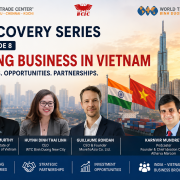
Our founder spoke in the eighth episode of the Discovery Series, . Much of the framing in the section above – the filter, the North-South distinction, the partner test – comes from that discussion and from the diplomats, industrial developers and market-entry advisers who joined it.
We are continuing that work at VIS 2026: recorded conversations with the people who actually move goods between these two countries – Vietnamese manufacturers, Indian buyers, retail sourcing heads, trade officials, logistics operators, chamber leadership. It builds on nearly two decades of interview production across our media properties, including Finest Fintalk.
The questions we are taking to Ho Chi Minh City are the ones a catalogue cannot answer:
- Which Vietnamese products can actually survive Indian pricing?
- What do Vietnamese manufacturers misunderstand about India?
- What does an Indian buyer need to see before approving a supplier?
- What turns a promising sample into a repeatable transaction?
- Who has already tried this, and what did it cost them?
A catalogue tells you what a company claims. A recorded conversation tells you whether they can explain it under a follow-up question. Over a corridor this thin, the second thing is worth more.
If you are at SECC between 3 and 5 September – buyer, exporter, trade body, anyone working this corridor – we would like to talk to you. Some of those conversations become published episodes. Some become useful introductions.
Practical notes
SECC is at 799 Nguyễn Văn Linh, District 7 – well outside the centre. Staying in District 1? Budget forty minutes each way, more in rain.
Early September is the tail of the wet season. The hall will be aggressively air-conditioned. Bring more cards than you think.
English varies enormously, and here’s the thing worth sitting with: the firm that can’t pitch you may still be the firm that can make your product. Use the organiser’s interpreters.
Apply for the e-visa now if you haven’t.
What success looks like
Not booths visited. Within 30 days, do you have three supplier comparisons, one landed-cost model, samples with real Indian buyers, a pilot proposal, and a clear record of why you rejected the rest?
India sees Vietnam as a manufacturing rival. Vietnam sees India as a large, confusing market it never learned to address.
The gap between them isn’t a market failure. It’s the opportunity – and Reliance’s arrival says the big players have read the same brief.
So: go with a category. Ask for the certificates. Check the BIS deadline before you fall in love with an appliance. Calculate landed cost before discussing exclusivity. Don’t come back with twelve kilos of catalogues.
But understand what you are walking into. The Indian entrepreneur who arrives in Ho Chi Minh City thinking I know how this works will leave with samples and no supplier. The one who arrives asking help me understand how this works here may leave with something durable.
Vietnam is not a shortcut. It is a filter. The companies willing to understand the filter tend to find that what lies on the other side is worth the patience.
Exhibitor counts, booth numbers and certification mentions are drawn from the official show catalogue and reflect what companies chose to declare. Indian regulatory requirements are summarised from FSSAI, BIS, CDSCO, DGFT and CBIC guidance current as of August 2026. Rules move quickly — nothing here substitutes for qualified customs and regulatory advice before committing a consignment.
Karnvir Mundrey is the Editor of TheFutureOfPR.com. Reach out at tfofpr@gmail.com or at +918296303806.
Subscribe to TheFutureOfPR.com to get great ideas on life, education, health & fitness, real estate, glamour, jewelry, movies, and podcasts! Share this article with people who you think might benefit. They will thank you for it!
Follow TheFutureOfPR.com on Facebook & Twitter.
Karnvir Mundrey is also the producer and host of 4 YouTube channels. Finest Fintalk brings you the latest in Finance, LitInMin for Books, The Health Tips Podcast for health and Atharva Marcom for leadership talks







Comments