
 By
By 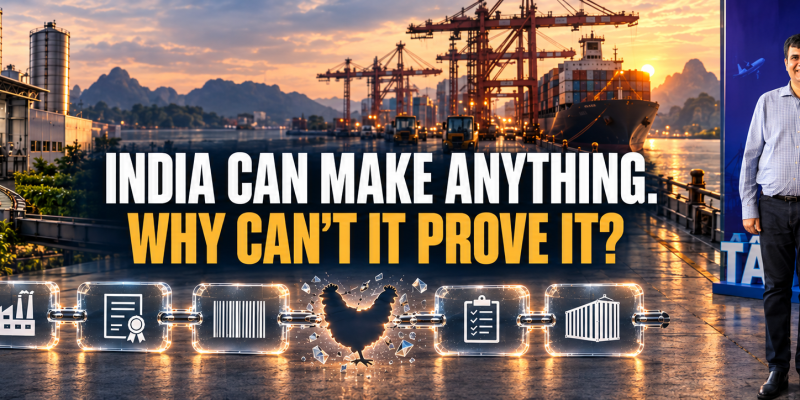
By: Karnvir Mundrey
The world stopped taxing goods and started taxing records. We are not ready, and it is already costing us.
Two Vietnamese exporters shipped a million dollars of honey to the same American buyer in the same month of the same year. The honey was chemically indistinguishable. One paid US$67,200 in duty at the border. The other paid US$600,300.
The gap – US$533,100, roughly ₹4.7 crore, on a single container-load – had nothing to do with bees, hygiene, cost base or buyer relationships. One firm had filed a submission of a few dozen pages with the US Department of Commerce. The other had not.
That is the exchange rate between paperwork and money in 2026. It is not an anomaly. It is the ordinary operation of a system now governing 8,742 trade remedy investigations worldwide, of which Vietnam alone faces 326 and India is among the most active initiators.
And in July, it stopped being a problem for individual firms and became a problem for entire countries.

On 24 July 2026, the United States imposed tariffs on sixty economies – India among them – under Section 301 of the Trade Act. The investigations that produced them had not examined what those countries export. They had examined whether each country enforces a prohibition on forced-labour goods entering its own market: its customs procedures, its inspection regime, its records.
Sixty investigations into sixty filing cabinets. Duties stacked on every consignment from every sector, regardless of whether the product had anything to do with the finding.
Every Indian export leaving for America this morning is dearer because of documentation held in New Delhi that the exporter has never seen and cannot influence. There is no reclassification that escapes it, no input that can be re-sourced around it, no carve-out to be negotiated. Three weeks before the ruling that triggered all this, India had agreed a deal cutting its tariff from 25 per cent to 18. That number evaporated in an afternoon when the statute beneath it was struck down.

We negotiated a number and received a finding.
This is the crisis nobody in Indian industry is staffing for. We have spent two decades building capacity – plants, ports, PLI schemes, industrial corridors, 1,500 showrooms going up in Jebel Ali – while the thing that determines whether any of it can be sold has quietly migrated somewhere else. Not to the factory floor. To the file.
And the file, in most Indian exporting firms, is handled by the cheapest competent person in the building. Often a junior in accounts who also does something else. On the arithmetic above, that person holds the single largest lever on the company’s landed price – larger than the plant manager’s, larger than the sourcing head’s.
The margin no longer lives in the factory. It lives in the record, and we staff the record like a stationery cupboard.
None of which was on the agenda at a provincial trade conference in southern Vietnam on 5 September 2026. But it was, in the end, the only thing anyone talked about.
On that morning, a Dutch feed executive named Johan von Linden walked the exhibition floor looking for chicken.
He runs De Heus across Vietnam and Asia – in the country since 2009, four million tonnes of feed a year, and in March the completed acquisition of CJ Feed & Care from CJ CheilJedang, seventeen mills across five countries. He knows what a poultry chain looks like from the inside. He was standing in a province that advertises its agricultural strength, at an event built to sell that strength to 170 foreign buyers from 25 countries.
He found no chicken product on display. Not one.
He said so from the podium later, almost in passing, and the room let it go. It was the smallest observation of the day and the one that explained everything else. The province has the birds. It has the feed mills, the farms, the processing capacity and a border two hours from a deep-water port. What it did not have was a chicken presented as something a foreign buyer could actually purchase – specified, certified, packed, traced, documented.
The bird was never the problem.
What follows is what a dozen strangers, none of whom had coordinated and several of whom were there to sell something, independently concluded about why.

The province that acquired a shape
Until July 2025 this conference could not have been held.
There was a Tây Ninh – Cambodian frontier, the Mộc Bài crossing, industrial parks. And a Long An – manufacturing belt pressed against Ho Chi Minh City, waterways, a deep-water port. Two provinces, neither of them a corridor.
Then Resolution 202/2025/QH15 collapsed Vietnam’s 63 provincial units into 34 and merged the two. Overnight the province had a shape it had never had: land frontier at one end, deep water at the other, factories in between. Roughly US$31.4 billion in trade in 2025, US$17.8 billion of it exports, reaching some 150 countries, with 1,400-plus hectares of investment-ready land still unoccupied. (VietnamPlus)
So the province arrived selling geography. Border gates, deep water, serviced hectares, growth rates. An honest pitch, and the numbers behind it are real.
Then the guests spoke, and the subject changed.
A trade remedies official, a diplomat posted to Washington, von Linden, a Gulf distributor, a Chinese industrialist, a materials scientist. Different countries, different agendas. Every one of them talked about records.
Chairman Lê Văn Hẳn had set the test himself, more honestly than most hosts do: success is not how many people are in the room, but how many orders exist afterwards. Eleven memoranda were signed by the close. An MoU is an intention. A purchase order is evidence.

Why the honey costs what it costs
The Trade Remedies Authority session explained the mechanism behind that half-million-dollar gap, and it is worth understanding precisely, because Indian exporters will meet it.
An anti-dumping case begins when producers in the importing country complain that foreign goods are arriving too cheaply. The US Department of Commerce calculates how far below “normal value” an exporter sells and converts the gap into a duty. Sixty per cent means the American buyer pays an extra 60 per cent at the border.
Three features decide who survives.
Rates are re-examined annually, in what is called an administrative review, and they move in both directions. Commerce cannot examine everyone, so it selects two or three “mandatory respondents” for full calculation and derives everyone else’s rate from theirs. And – the decisive one – the United States still treats Vietnam as a non-market economy. Commerce therefore begins from an assumption that every Vietnamese exporter belongs to a single state-controlled bloc, paying one punitive bloc-wide rate. A company escapes that assumption only by filing a separate-rate application: documents proving it sets its own prices, controls its own export earnings and takes its own commercial decisions.
Get the filing right and you are an independent business. Get it wrong, file it late, or fail to answer the follow-ups, and you are absorbed back into the bloc.
The sequence tells the rest. April 2021, petitions filed against Argentina, Brazil, India and Vietnam. Late 2021, the preliminary rate on Vietnam lands above 410 per cent – at which the business simply stops. April 2022, Vietnam contests the calculation method and wins: 58.74–61.27 per cent, a sevenfold reduction achieved entirely through argument, with no change to the product. April 2025, the first annual review goes the wrong way, to 100.72–156.96 per cent. June 2026, the second review: mandatory respondents at 6.72 and 21.55 per cent, twelve separate-rate companies at 14.14.
And the bloc rate, for anyone who did not clear the filing: 60.03 per cent.
Which is where the ₹4.7 crore comes from. Two firms, same review, same product, same period, one file between them.
India was in that same case – same petition, orders issued the same day. Indian respondents came out dramatically lower, Allied and Indocan carrying single-digit margins, one as low as 2.31 per cent. We won it on procedure. Very few of the firms involved could tell you why, which means very few of them could repeat it.

The tariff that taxes paperwork
If the honey shows what a document is worth to a firm, what happened in Washington this year shows what records are worth to a country.
One piece of background makes it legible. An American president cannot simply set tariffs. Congress holds that power and lends it out through specific statutes, each with its own conditions. Which statute is in play determines what can be taxed, for how long, and whether anyone can negotiate about it. For four years almost nobody outside trade law paid attention to which one was being used. That turned out to matter enormously.
20 February 2026. The Supreme Court rules in Learning Resources, Inc. v. Trump that IEEPA – the emergency-powers statute underpinning the entire reciprocal tariff programme – does not authorise tariffs at all. The framework collapses immediately. Some US$90 billion in collected duties falls into refund contention, and India’s freshly negotiated 18 per cent goes with it.
24 February. A stopgap: 10 per cent on everything under Section 122, a 1974 provision never used before, expiring by law after 150 days and not extendable by the president. A fuse, not a policy.
12 March. The replacement begins. USTR opens sixty simultaneous Section 301 investigations.
Section 301 is a different animal from anything most exporters have dealt with. An ordinary tariff taxes a product. An anti-dumping duty taxes an exporter’s pricing, firm by firm. Section 301 targets a country’s conduct – an act, policy or practice judged unreasonable – and then permits duties on that country’s goods whether or not the particular product has anything to do with the conduct complained of.
A finding about your labour inspectorate can produce a tariff on your ceramic tiles.
2 June, all sixty found actionable: fifty-four had neither imposed nor enforced a forced-labour import prohibition, six had one they were not enforcing. 24 July, tariffs in force, stacking on MFN. India in the flat 10 per cent tier alongside Bangladesh, Cambodia, Pakistan and Sri Lanka. Vietnam at 12.5, with two further 301 tracks open against it – an excess-capacity investigation across sixteen economies, and an intellectual property investigation opened after Vietnam was named a Priority Foreign Country in April.
India is among those sixteen too.
You cannot negotiate your way out of an evidentiary determination. You can only answer it – and answering it is a documentary capability that either exists before the questionnaire arrives, or does not exist at all.

Your weakest supplier sets your price
Võ Quốc Huy of Long An International Port gave the most practical presentation of the day, and its virtue was that it refused to be inspiring.
The freight problem, he said, is not a shortage of trucks. Cargo is fragmented across companies. Vehicles run loaded one way and empty back. Containers are short in-province. Every firm arranges its own transport. His fix was consolidation along a corridor, with factories, hauliers, warehouses, customs and the port all reading the same data.
Von Linden, from the European end, reduced market access to four words – quality, transparency, traceability, cooperation – and gave the fourth its sharpest form: if one link in the chain cannot meet the standard, none of the other links can export. European buyers no longer purchase the object. They assess the system that produced it.
Huy thought he was solving a cost problem. Von Linden thought he was solving a trust problem. They had described the same machine.
Shared visibility across a chain is exactly what an origin audit requires. The infrastructure that fills a backhaul is the infrastructure that answers a customs questionnaire inside a thirty-day statutory clock. Build one without the other and you pay twice for half the benefit.
And here is the part that should genuinely alarm Indian exporters. Traceability cannot be achieved alone, and it fails at the worst node, not the average one.
A firm can run an immaculate plant, hold every certification, price honestly and still be destroyed by a job-work unit three tiers down that keeps no record of where its yarn came from. Under an origin inquiry the question is not whether you documented your inputs. It is whether the chain can prove, link by link, where the material originated. One undocumented link and the whole chain is unprovable – and unprovable, in a trade remedy proceeding, is functionally the same as guilty.
Tiruppur, Morbi, Panipat and Ludhiana are dense webs of small job-work units with informal, frequently rotating supplier relationships. That structure is a genuine competitive strength in flexibility and cost. It is close to a worst case in traceability. Most Indian export chains have never been mapped to the second tier, let alone documented to the third – which means most Indian exporters do not know where their ceiling sits, and will find out only when someone asks.
The instruction is unglamorous and urgent: map to tier two, document to tier three, and treat that map as a commercial asset rather than a compliance cost. It is the same map that lets you consolidate freight. It is the same map that answers the questionnaire.

The leaf is worth more than the fruit
If documentation is the missing work at the border, processing is the missing work at the farm gate. Two speakers made that argument in unrelated sectors without noticing they agreed.
The Hangzhou delegation put it in margins. Manufacture to someone else’s specification and you earn a production margin. Add research and design – OEM to ODM – and value capture reaches 30 to 40 per cent. Own the brand, channel and after-sales, and it passes 50.
A materials scientist put it in pineapples, with better arithmetic. A kilogram of fruit yields roughly three kilograms of discarded leaf. The fruit fetches about VND 5,000 a kilogram; fibre extracted from the leaf fetches around VND 400,000 domestically and, he claimed, US$8 in India. The waste is worth more than the crop, by orders of magnitude, and it is thrown away. Producers who have mastered biochar at VND 6 million a tonne are stopping one rung short of activated carbon at nearer US$1,000.
That reframes the green transition entirely. Sustainability is normally sold to business as a burden – an audit, a cost, a standard. He treated it as product development. Don’t ask how cheaply the residue can be disposed of. Ask what can be extracted from it.
India grows a great deal of pineapple and discards a great deal of leaf. The question is not whether our agriculture generates value it throws away. It is which rung we are stopping on, across every sector, and why.

The buildings arrive. The work does not.
The most useful thing said all day was an argument against the conference it was said at.
Around 77 per cent of goods entering the UAE are re-exported onward, the Gulf speaker noted, so Dubai is a gateway rather than an eleven-million-person market. The UAE–Vietnam CEPA entered into force 3 February 2026, cutting tariffs on 95 per cent of Vietnamese lines – which is precisely why his list of remaining obstacles contained no tariffs at all. Which SKU travels. What halal certification actually requires. How the pack must change. Who the importer of record is. How to test demand without committing capital.
Every item on that list is a document.
No SME answers them alone, and seminars do not help. So: stop convening and start piloting. Take a handful of genuinely ready firms, adapt the product, meet the standard, find the buyer, secure a real first order – then publish the completed case, because a firm holding a purchase order recruits imitators far better than a conference does.
Start small. Do it correctly. Prove it in the market. Then scale.
India has built the hardware version of this and skipped the paperwork.
Bharat Mart opens in Jebel Ali late this year: 1,500 showrooms in a free zone already hosting 2,300 Indian companies. Districts as Export Hubs covers 770-plus districts – with draft export plans for 590 and only 249 formally adopted. The Export Promotion Mission was announced with a ₹25,060 crore outlay across six years; actual allocations run ₹2,250 crore and ₹2,300 crore, roughly 18 per cent committed two years in. Under its collateral support window, 140 exporters have registered against 8,459 for interest – a gap that reached the Board of Trade in July 2026, after which DGFT asked state governments to tell exporters the scheme exists.
When the government must instruct banks to inform exporters that support is available, the scheme is not the problem.
And the numbers say what the gap costs. India–UAE trade reached US$101.25 billion in FY2025-26. India’s exports rose about 2 per cent, to US$37.36 billion. Our CEPA has been in force since May 2022, four years longer than Vietnam’s. The corridor is enormous, utilisation is real, and the export line is flat.
Ten firms walked to ten documented purchase orders would move that line further than a hundred more showrooms.

We already know this. We prove it annually.
Here is the part that cannot be filed as somebody else’s problem.
India does not need persuading that paperwork determines outcomes. We demonstrate it to our own exporters every year, at scale, with public money.
Under RoDTEP, claims die on the same rock annually. Eligible product. Eligible exporter. Correct HS code. Goods shipped, buyer paid, everything in order – and no benefit, because a declaration was not ticked on the shipping bill and cannot be added retrospectively. The substance was fine. The filing was not. The money is gone and no appeal recovers it.
A tick box. That is our domestic version of the separate-rate application. Same logic, same finality, same total indifference to whether you deserved the outcome.
So we are not naive about this system. We run one. We have simply never accepted that the firms failing our tick box are the same firms who will face a foreign questionnaire on a thirty-day clock, with half a million dollars a container riding on the answer.
Three things, none of which requires new money.
Publish the honey arithmetic through every export promotion council – 6.72 against 60.03, with India’s own respondents in the same case as the control, and the rupee figure attached. That single pair teaches response capability better than any circular yet written.
Fund questionnaire response instead of exhibition stalls. The EPM’s non-financial arm already covers testing, certification and audit. Reweight it. A standing panel of trade remedy counsel for MSMEs facing a first questionnaire costs a fraction of the uncommitted 82 per cent – and pays for itself on one saved container.
Put a pathway team inside Bharat Mart before it opens. Ten firms, ten products, a named officer each, documented to a purchase order, published. Otherwise it is 1,500 showrooms running the model the Gulf desk had just declared dead.
One caution before anyone books a sourcing trip. India was named at the conference as a market actively investigating Vietnamese exports, and the DGTR currently has an anti-dumping case open into solar encapsulants from South Korea, Thailand and Vietnam. A product whose origin cannot be proved is not a sourcing opportunity. It is a future dispute in which you are the respondent.

The bird was never the problem
A province came to sell a location. A dozen strangers explained, one after another and for entirely unrelated reasons, that location has stopped being the scarce input.
What has replaced it is the record. The certificate, the origin file, the audit trail, the separate-rate application, the tier-three supplier map, the halal documentation, the ticked box on the shipping bill. Every speaker described a different face of the same thing, and none of them named it, because it is too dull to name. It is the least glamorous work in any exporting business, and it is now the work that decides which businesses have a price and which do not.
Four months before they gathered, the United States settled the argument by building a tariff that taxes exactly this layer, applies it to entire economies, and refuses to negotiate about it.
Half a million dollars a container. A tick box on a shipping bill. Sixty investigations into sixty filing cabinets.
We know all of this in India. We prove it to our own exporters every year, and then we count the losses.
We have simply never connected the two.
Somewhere in a hall in Tây Ninh, a Dutchman went looking for chicken in a province full of chickens, and came back with nothing. Not because the birds were missing.
Because nobody had written it down.
Karnvir Mundrey attended the conference at Tay-Ninh. Atharva Marcom helps companies trade better.
Based on the author’s notes, cross-checked against national media and primary sources: the US Federal Register for anti-dumping determinations, USTR notices for the Section 301 sequence, Resolution 202/2025/QH15 for the merger, and DGFT and Budget documents for Indian scheme data. Duty comparisons are the author’s arithmetic applied to published rates on an illustrative consignment. Translated remarks lightly edited; where interpretation and the public record diverged, the correction is noted in the text. Some provincial statistics reported at the conference contain internal inconsistencies and should be verified against Vietnamese sources before citation.
Part of TheFutureOfPR.com’s ongoing India–Vietnam trade and sourcing coverage.
Karnvir Mundrey is the Editor, and the Founder of Atharva Marcom and TheFutureOfPR.com. Reach out at tfofpr@gmail.com or at +918296303806.
Subscribe to TheFutureOfPR.com to get great ideas on life, education, health & fitness, real estate, glamour, jewelry, movies, and podcasts! Share this article with people who you think might benefit. They will thank you for it!
Follow TheFutureOfPR.com on Facebook & Twitter.
Karnvir Mundrey is also the producer and host of 4 YouTube channels. Finest Fintalk brings you the latest in Finance, LitInMin for Books, The Health Tips Podcast for health and Atharva Marcom for leadership talks










Comments