
 By
By 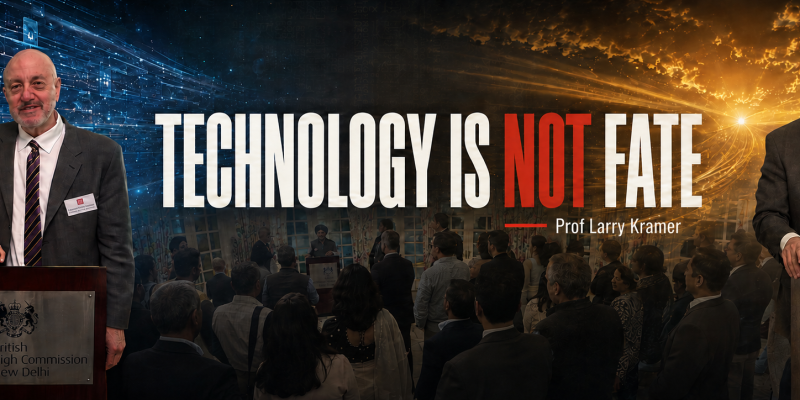
By Karnvir Mundrey, Chapter Leader, LSE Alumni Bangalore Chapter
LSE’s Prof. Larry Kramer, President and Vice Chancellor of the London School of Economics and Political Science, came to Delhi to talk about artificial intelligence. What he actually described was a university rebuilding itself in real time – and a warning about who gets to write the future.
I attended as Chapter Leader of the LSE Alumni, Bangalore Chapter. Here is what was said, and why I think it matters well beyond the LSE community.

First, the India business
India is LSE’s fourth-largest alumni community, after the UK, China and the United States – around 5,000 people. He wants it higher, and he was explicit that the constraint is partly LSE’s own.
Admissions, he said, had for years sat inside the registrar’s division, which made running it a relatively junior job. It has now been pulled out as a standalone division under a new, more senior appointment. Among that person’s first briefs: examine entry requirements that Prof. Kramer described as simultaneously too narrow and, in places, strangely over stringent.
This is the sort of thing university heads normally do not say out loud to a room of alumni. He said it, and then asked the room to send more applicants.
He also spoke about Lord Meghnad Desai, whose death this past year the school is still absorbing. Prof. Kramer’s tribute contained a small heresy: at many institutions, he said, there is a constant push to get people to retire, which he has never understood, because you cannot replace people like that. The Lord Desai Student Support Fund has been created to carry the legacy forward by funding students doing the kind of work Desai stood for.
On the campaign: £615 million raised against a £750 million goal by 2030, and 160,000 alumni volunteer hours logged against a target of 300,000. Kramer said he hopes the financial goal gets raised. He closed the section with the line he now uses at every graduation, borrowed from Churchill – this is not the end, nor the beginning of the end, but the end of the beginning.

The frame: not a problem, a rebuild
Then he widened out, and the speech changed character.
We are living, he argued, through one of the most dramatic periods of disruption in recorded human history – and he does not think that is overstatement. The only comparable episode within reachable memory is the late nineteenth century: the rise of communism, electricity, the automobile and the telephone arriving more or less at once.
His list of what is breaking: democracies failing or at least under challenge; an inability to manage economies in ways that make people feel their needs are being met; systemic inequalities that have proved stubbornly sticky; a wave of technologies creating enormous opportunity and enormous uncertainty; and beneath all of it, a collapsing post-war multilateral order that leaves the global system fragile.
Systems that have been failing us for some time are now sufficiently broken, he said, that we have a responsibility to rebuild them – which makes this an opportunity to build them better than they have been in a very long time.
He did not reach for the obvious precedent, but it was sitting in the room with us. William Beveridge ran the School for eighteen years before he wrote the 1942 report that built the British welfare state, and he opened it by insisting that a revolutionary moment in world history is “a time for revolutions, not for patching.” Kramer’s entire operating thesis – that thirty years of institutional deferred maintenance should be rebuilt rather than repaired – is Beveridge’s sentence applied to a university instead of a nation.
That is the frame within which everything he said about AI should be read.
Three fronts: infrastructure, research, teaching
Prof. Larry Kramer divides the university’s AI problem into three, and is candid that LSE’s answers on each are at very different stages of maturity.
Infrastructure turned out to be an accident of good fortune. When he joined, he was told some things needed fixing. Rather than keep patching pain points, LSE asked what it would build if it were starting the university from scratch today, and is now doing that under an Operations Excellence Programme.
The advantage is not subtle. Most institutions are trying to squeeze AI into legacy systems they have no intention of fundamentally changing. LSE is designing the systems and the AI together.
Two components sit inside this. AI Foundations is about universal access: LSE struck agreements with Anthropic for students and Microsoft Copilot for staff, covering the cost centrally so that capability does not become a function of who can afford a subscription. Prof. Kramer said LSE was the first university to approach the companies about this. Training is bundled in: the commitment is that 100% of staff and students are trained within a year.
Research compute is handled differently, because the tail is expensive. There is a baseline that covers the vast majority of people and all teaching; projects needing substantially more must build it into their grant applications.
AI Accelerator is the physical piece – the long-unused NatWest building on the corner of campus, converted by a donor’s gift into a digital skills laboratory. Video and podcast production kit, collaboration space, a sandbox for people who just want to experiment, and meeting rooms designed to pull industry onto campus.
I loved that, considering I’m India’s oldest continuous podcaster. The show I started in 2006 still runs 20 years later!
Research, he said, is the easy one, because faculty need no persuading. Access plus training plus decentralisation gets you most of the way, and LSE now has people working on AI in literally every department. What gets centralised is everything an individual researcher cannot do alone: the Data Science Institute is being reprogrammed into a Global Institute for Frontier Technologies in Society – a deliberately wider remit, because quantum computing, nanotechnology and robotics are queued directly behind AI.
To run it, LSE hired Helen Margetts from Oxford, latterly running public policy at the Alan Turing Institute. Prof. Kramer’s recruitment method was, by his own account, to call her when he heard she was returning to Oxford and ask her to spend a year in London first. She stayed. The institute’s first major theme is AI and labour markets, anchored by a new annual Global Forum for AI – the inaugural edition is weeks away.
Teaching is where he admitted LSE does not have the answers. Three questions, in ascending order of difficulty: what should we teach now, how should we teach it, and how do you incentivise faculty to find out?
On the third, Prof. Kramer was disarmingly honest about why academics resist. He taught constitutional law for years, loved his classes, took forever to get them where he wanted them – and resented the Supreme Court for handing down decisions that forced him to change anything. He would squeeze the new case in while preserving as much as possible of the 1947 material.
LSE’s answer is an internal fellowship: a faculty member can buy out a term of teaching to rebuild a course around AI. Grants go only to the most ambitious proposals, and the price of the grant is that the materials and a written account of what was tried and why go onto an open-source site. As the library grows, the biggest obstacle – not knowing where to begin – shrinks. The design logic is straight off the innovation curve: visionaries do not move the world, early adopters do, and if you get far enough up the curve the rest follows.
There are also new dual and joint degrees in planning, some potentially across institutions – he floated engineering at Imperial or Stanford paired with economics or sociology at LSE.
What employers actually say
The most quotable exchange of the evening was one that has not happened yet.
LSE has been asking employers what graduates now need. The answer comes back uniformly: we do not need the technical skills any more, the AI does that – teach critical thinking, problem solving, learning to learn, communication, collaboration. To which Kramer’s response is, in effect: we have always taught those. But you do not teach them in the abstract. They are taught through materials. If the materials we have been using are no longer the right vehicle, tell us what is.
Employers, he said, do not yet know.
The one consistent signal is that graduates must be able to build with AI, not merely prompt it. That has immediate downstream consequences: assessment may shift toward giving students a challenge and grading what they construct – which also, conveniently, cannot be outsourced to the model alone.
LSE is now fielding a comprehensive employer survey, repeated every year or two, feeding results back to individual departments to adjust courses and degree requirements as they go.
The end of front-loaded education
Then the part I have not stopped thinking about.
All of us were educated on a front-loaded model: spend the first twenty-odd years of life being taught, then have a career. Prof. Kramer does not think that is the future. People already change roles every six to eight years; re-skilling and up-skilling will be continuous. LSE is building out a lifelong learning division on the premise that these learners are students in exactly the same sense as an undergraduate. In the longer run, he expects the front-loaded portion to compress – finish school, do a year or two, start working, and educate yourself across the arc of a life.
His worry about that world was that education has already been reduced to career preparation, which is understandable given what it costs and the returns people need. But a society also requires people who are liberally minded – and he was careful to strip the word of politics. Liberal in the sense of open-minded. Liberal in the sense of understanding that many people think very differently from you and you must engage with them. Liberal in the sense of grasping that the world is complicated and demands critical thought.
If lifelong learning becomes nothing but discrete professional modules bolted on as needed, he said, our societies change. That is not a curriculum problem. It is a civilisational one.
Tagore got there in 1916, in a single line of Stray Birds: “A mind all logic is like a knife all blade.” It makes the hand bleed that uses it. A generation trained only in what is instrumentally useful – and now competing against machines that are instrumentally superb – will be all blade and no handle. Prof. Kramer’s argument, translated, is that the handle is the thing universities have to keep making.
Finally, a task force – has been asked for a comprehensive, university-wide AI strategy.
His claim, offered without much modesty, is that LSE is a year or two ahead of almost any university in the world on this. His caveat, offered immediately after, is that everything described so far is still fundamentally reactive.
What I took away
The line that will stay with me was not about strategy at all.
Prof. Kramer told this year’s graduating class that technology is not fate. Every new technology forces us to ask again who we are and what role we want to play. What it does to us is what we choose to allow it to do. We let ourselves get captured by the phone. We could see this one coming.
And then the part aimed squarely at anyone who feels this is happening to them: you are still citizens. You can vote. You can speak. In whatever job you hold, you will make decisions about how this technology gets used. You can decide you are powerless and do nothing – in which case the choices get made for you – or you can take the chance of engaging. Either way, the future of this is not written, and you have the chance to write it.
Sitting in Delhi, listening to Prof. Kramer tell a room of Indians that outcome and action have come apart, I could not help hearing the older formulation. “Karmaṇyevādhikāraste mā phaleṣu kadācana.”
Your claim is on the action; never on its fruits.
Prof. Kramer had just spent thirty minutes explaining that nobody – not the labs, not the employers, not his own task force – knows how this ends, and then argued that this is precisely not a reason to stand still.
That is the Bhagwad Gita, with a strategy deck attached. You act because the action is yours to take, not because you have been shown the result in advance.
For an alumni community of 5,000 in India, several thousand of whom sit in exactly the seats where those decisions get made, that is not a graduation-day flourish.
It is a work order.
The LSE Alumni Bangalore Chapter convenes alumni across South India for professional, intellectual and social engagement with the School. If you are an LSE alum in Bengaluru and not yet connected, get in touch.










Comments