
 By
By 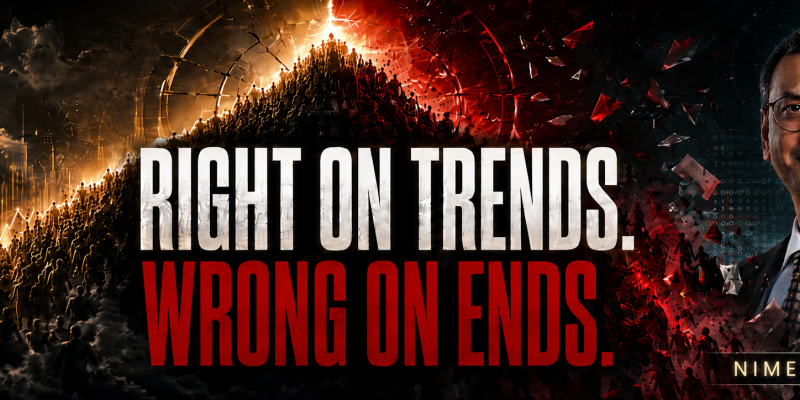
By: Karnvir Mundrey
What a Nobel physicist, a Greek bandit, and eight horse-racing handicappers can teach you about your own portfolio – from a talk by Nimesh Chandan, CIO, Bajaj Finserv AMC.
A party, and a confession
Max Planck – father of quantum theory, Nobel laureate, a man who could describe the behaviour of subatomic particles – once found himself at a party talking to John Maynard Keynes.
At some point Planck admitted that as a student he had considered studying economics, and decided against it.
Keynes was startled. If a mind like yours had come into our field, he said, think how far it might have pushed us. Why didn’t you?
Planck’s answer: it was too difficult.
Now consider what that means. Here is a man who could have read every economics textbook then in existence over a long weekend, calling the subject too hard. His reason was not the mathematics. It was this: physics does not deal with objects that react emotionally. Economics deals with people. And people react. Cause and effect stop behaving.
That, in one anecdote, is the whole problem. And the tragedy of modern finance is that ever since, it has tried very hard to be physics anyway.
The bandit in your head
Greek mythology gives us Procrustes, who kept a house on a sacred road and invited weary travellers in for food and a bed. He was also a murderer. Guests shorter than the bed were stretched until they died. Guests taller had the overhang cut off.
Everybody fit the bed. That was the point of the bed.
There is a Procrustes in every skull. Once a belief is installed, evidence gets stretched or amputated to fit it. This is confirmation bias, and in markets it has a very specific shape: after making an investment, people seek out those who agree with them and quietly collect facts that raise conviction rather than test it. Bring them a genuine negative and watch the reflex – no, no, you don’t understand this business.
Many investors avoid learning the risks because they fear they’d never invest at all. Chandan reverses it: if you don’t know the risk in what you’re buying, that is precisely the reason not to buy it.
He extends the warning to a habit Indian investors have made a ritual – watching management on television and feeling reassured. Of course they sound bullish. They’re in the business, they care about the share price, and they have a longer horizon than you do. Your job is to worry about your investment.
The handicappers who knew too much
The psychologist Paul Slovic assembled professional horse-racing handicappers and forty years of race data – eighty-eight data points per horse. He replayed historic races and asked the experts to pick the winner, and to state how confident they were.
Round one: choose any five of the eighty-eight. Average confidence, 19%. Average accuracy, 17%. Beautifully calibrated.
Then ten data points. Then twenty. Then forty.
By the final round the experts were 43% confident – roughly one race in two.
Their accuracy was 17%.
Past a certain small number of variables that genuinely matter, you are no longer collecting information. You are collecting noise, and noise does something worse than nothing: it inflates your conviction while leaving your judgement exactly where it was. High confidence plus low accuracy is the fastest known route to losing money. Consider the average F&O trader.
But Chandan is careful to close the other door too. Chronic diffidence is also a failure. Successful investors bet, and bet with conviction. There is research comparing men’s and women’s investing – women turned out to be the more accurate forecasters, and the less frequent participants. Being right and never acting on it pays nothing.
The option nobody chooses
Try this. The Economist offers you three subscriptions: web-only for $59, print-only for $125, or print and web for $125.
Almost nobody picks print-only. So delete it – it’s a useless option that no one was choosing. Now offer just web at $59 and the bundle at $125.
Preferences collapse. Without the decoy, most people take the cheap web option. Dan Ariely’s experiment, and it works on rooms full of finance professionals just as reliably as anywhere else.
The useless option wasn’t useless. It was a ruler. And that is what anchoring does: valuing a stock is genuinely hard, so the mind grabs whatever nearby number will hold still.
The cost price is the favourite anchor of all. Amos Tversky once handed a stockbroker a list of his holdings and the amounts invested, and asked which to keep and which to sell. The broker asked for the purchase prices.
Why? Tversky asked. Does the future of the company change according to what I paid for it?
It doesn’t. But watch what your purchase price does to you. Buy at ₹100, watch it reach ₹120, and let someone lean in and murmur that he’s hearing something unpleasant about the company – you sell that afternoon. Buy at ₹100, watch it fall to ₹90, hear precisely the same murmur, and you’ll wait for it to come back to ₹100 first.
Until then, you are a long-term investor.
(Chandan notes the murmuring is not incidental. People discussing stocks lower their voices, because volume destroys credibility. Say “buy stock A” across a room and nobody believes you. Say it leaning close and it becomes information.)
Two pockets
Imagine you receive twelve lakh rupees. Three versions: it lands in your account tomorrow; it arrives as one lakh a month for a year; it’s locked in a deposit and comes to you in five years with interest.
You have just planned three different lives for the same money. That’s mental accounting.
Gamblers do it visibly. Money brought from home sits in one pocket; winnings sit in the other, and the second pocket is played far more recklessly. What’s the harm – it’s profit, let him take a swing?
The harm is that wealth doesn’t compound that way. If every gain is followed by a lower standard of diligence and a bigger risk, you will oscillate around the average forever. The investment you make after a win deserves exactly the same work as the one before it.
The same accounting produces the most expensive habit in retail investing: booking profits is easy, booking losses is unbearable. So people go into the garden and cut the roses, leave the weeds – and are then astonished to find themselves standing in a field of weeds.
Tie me to the mast
Odysseus, sailing home to Ithaca, had to pass the island of the Sirens – beautiful creatures whose singing drew sailors onto the rocks to be killed and eaten. He wanted to survive. He also wanted to hear the song.
So he ordered his crew to lash him to the mast and, whatever he said afterwards, not to release him. The crew plugged their own ears with beeswax and rowed.
When the singing started he fought the ropes and screamed to be let go. The ropes held. They sailed on.
This is the hot-cold empathy gap: the calm version of you cannot imagine the hot version of you, and the hot version is the one who gets to make the decision.
Chandan’s own illustration is disarming. He writes, he says, the finest diet plans in the world. Anyone in his team will confirm it. He has never once lost weight – because he attends conferences like this one, and somewhere near the tea counter there is a chocolate mud cake, and as he walks past it calls out to him by name. Tomorrow, he decides. He’ll start tomorrow.
The Gita maps the same descent, and maps it with more precision than most behavioural literature manages, in two verses:
ध्यायतो विषयान्पुंसः सङ्गस्तेषूपजायते।
सङ्गात्सञ्जायते कामः कामात्क्रोधोऽभिजायते॥
क्रोधाद्भवति सम्मोहः सम्मोहात्स्मृतिविभ्रमः।
स्मृतिभ्रंशाद्बुद्धिनाशो बुद्धिनाशात्प्रणश्यति॥dhyāyato viṣayān puṁsaḥ saṅgas teṣūpajāyate / saṅgāt sañjāyate kāmaḥ kāmāt krodho ‘bhijāyate
krodhād bhavati sammohaḥ sammohāt smṛti-vibhramaḥ / smṛti-bhraṁśād buddhi-nāśo buddhi-nāśāt praṇaśyatiDwelling on an object breeds attachment. From attachment, desire. From desire, anger. From anger, delusion. From delusion, the confusion of memory. From ruined memory, the destruction of judgement – and with judgement destroyed, the man himself is destroyed. (2.62–63)
Two things in it are worth more than the whole modern vocabulary of bias.
First, where the chain begins: dhyāyato viṣayān – merely dwelling on the object. Not buying it, not wanting it. Looking at it. Refreshing the app, watching the candle form, letting the ticker sit in a corner of the screen all afternoon. Nothing has been decided and the descent has already started.
Second, where it ends. Not in ruin directly – the second-last link is smṛti-vibhrama, memory going wrong. Buddhi, the faculty that discriminates, dies only after memory has already been corrupted. The sequence is exact and it is not the one we assume: your record of events is falsified before your judgement collapses, which is why the collapse feels perfectly reasonable from the inside. Hold that thought; it returns at the end of this article, in the form of a notebook.
Try the supermarket experiment: shop once when you’re ravenous and once straight after a heavy meal. Same person, same budget, different trolley.
We are excellent planners and mediocre executors, and markets are engineered to catch us in the hot state – FOMO on the way up, fear on the way down. The remedy is not more willpower. It’s rope, tied in advance.
The last thing in the jar
Zeus, unable to punish Prometheus for stealing fire, went after humankind instead. He had the gods create Pandora — the name means all gifts — married her to Prometheus’s less cautious brother, and handed over a sealed jar with an instruction not to open it.
Give a curious person something beautiful and forbid them to look inside. She looked. Out came war, disease, every evil, into human homes. She slammed it shut with one thing still inside.
Hope.
Mythologists have argued ever since about whether hope was trapped in the jar as another evil, or left behind as a mercy.
In the stock market, Chandan says, there’s no ambiguity. Hope is an evil.
The distinction he draws is precise, and useful. When your IPL team needs an impossible run rate with wickets gone, your assessment that they’ll lose is expectation. The feeling that a miracle might still happen is hope. Both can coexist in one head. Only one of them belongs in a portfolio.
If you are holding a position on hope rather than expectation, you already know something is wrong.
What fear costs
After the September 11 attacks, Americans stopped flying. They drove instead – long distances, on highways, for the better part of two years. Road traffic surged, and so did fatal accidents. Researchers later estimated that the additional road deaths ran to roughly sixteen hundred people.
Out of fear, they chose. And the choice killed them.
Textbook risk is a probability multiplied by a consequence. Nobody actually calculates it that way. What people do is feel the vivid danger and ignore the quiet one. Fear of a 20% market fall keeps a saver out of equities altogether – while inflation removes six percent a year, every year, in perfect silence.
The full restaurant
You’re in a foreign city, it’s evening, you’ve settled on a cuisine, and there are two restaurants side by side serving it. One is empty. One is packed.
You know which one you’re walking into. All these people can’t be wrong.
For dinner, that’s a decent heuristic. For films and hotels it works well. Solomon Asch showed what it does when the crowd is wrong: groups of eight shown two cards and asked which lines match, with seven of the eight secretly instructed to give a preposterous answer. Show them an elephant, have seven people say cow, and roughly three-quarters of genuine subjects went along at least once. A third conformed every single time.
Asch then varied it, and the variations are the part that matters for markets. Conformity rose when the group was larger. It rose when the question was genuinely uncertain – on easy questions people held their ground; on hard ones they folded. And it rose when the group appeared to contain experts.
The Sanskrit tradition had identified the problem long before Asch built a laboratory for it – and, more interestingly, had endorsed the heuristic. In the Yaksha Prashna of the Mahabharata, a disguised yaksha holds Yudhishthira’s four brothers dead by a lake and interrogates him. Asked how one determines the path of dharma, Yudhishthira answers:
तर्कोऽप्रतिष्ठः श्रुतयो विभिन्ना
नैको ऋषिर्यस्य मतं प्रमाणम्।
धर्मस्य तत्त्वं निहितं गुहायां
महाजनो येन गतः स पन्थाः॥tarko ‘pratiṣṭhaḥ śrutayo vibhinnā / naiko ṛṣir yasya mataṁ pramāṇam
dharmasya tattvaṁ nihitaṁ guhāyāṁ / mahājano yena gataḥ sa panthāḥReasoning finds no firm ground. The scriptures contradict one another. There is no single sage whose opinion settles the matter. The truth of dharma lies hidden in a cave – the path is the one the great have walked.
Read the first three lines and you have Asch’s experimental conditions written out: uncertainty, conflicting authorities, no resolution available from logic alone. Read the fourth and you have the human response, stated not as a weakness but as the only workable rule.
But look closely at the word. Mahājana – the great, those who have already walked the road and arrived somewhere. Not jana. Not the crowd.
The market’s particular cruelty is that it erases that distinction hourly. Look at your screen. The crowd is enormous and the media reports its mood to you continuously. Uncertainty is total, because nobody can reliably value a business or predict an asset’s direction. And there is a permanent, well-lit supply of eminent people telling you what to do – Chandan pauses here to plead guilty, since he is on television himself.
All three of Asch’s amplifiers, running at once, all day. And every one of those voices is jana in the costume of mahājana, with the costume at its most convincing precisely when uncertainty is highest – which is exactly when Asch found people fold. Yudhishthira’s rule survives only if you can tell the two apart, and the screen is engineered so that you cannot.
Herd in a market and you will swing with the pendulum and collect ordinary returns at best.
Please don’t invade Russia
In 1708 a formidable Swedish army marched into Russia. Winter arrived. The Russians used scorched earth – burning what lay in the invader’s path, poisoning wells with dead animals, destroying anything usable. Men and horses sickened. Supply lines froze. At Poltava the survivors were annihilated.
A century later Napoleon walked in with roughly half a million men. Winter arrived. Scorched earth. Retreat. Slaughter.
A century after that, Hitler’s army went in so confident of finishing before the cold that the troops weren’t issued proper winter kit. Winter arrived. Scorched earth. Defeat.
Two lessons, Chandan says. First, don’t attack Russia. Second, people who don’t read history repeat it.
The market has its own hundred-year cycle of the same folly, and the striking thing is how identical the conclusions are across the centuries.
Charles Mackay, writing in 1841 about the tulip and South Sea manias, described crowds seized by delusion in seasons of excitement and recklessness, paying absurd prices, then suddenly gripped by doubt as the whole thing collapsed – before being deluded all over again by something else.
A hundred years on, the chronicle of Jesse Livermore’s career reached the same verdict: Wall Street doesn’t change. The pockets change, the players change, the securities change. Human nature doesn’t. That is why there are cycles.
After 2008, Reinhart and Rogoff surveyed centuries of financial crises in This Time Is Different and concluded – countries change, institutions change, human nature doesn’t.
Three books, three centuries, one finding.
The cycle that exaggerates every other cycle
There are economic cycles, business cycles, profit cycles, credit cycles. Chandan’s argument is that the sentiment cycle sits on top of all of them and amplifies each one, in both directions.
It has two halves: momentum and reversal.
Jegadeesh and Titman’s 1993 study found that over intermediate horizons, winners keep winning and losers keep losing. They tested the combinations – three-month formation with three-month holding, six with three, three with six – and found the effect held from roughly three to twelve months, with six-and-six the strongest pairing. Most momentum strategies still cluster around it.
Academic finance had no explanation. Behavioural finance did.
A company posts one unexpectedly good quarter. Most investors shrug – one quarter, let’s see. A few take a half-percent position, promising themselves they’ll add if it continues. The next quarter confirms it. The early holders scale up. New investors, now convinced, arrive. Conviction and allocation climb together, and the price climbs with them.
That is momentum: not irrationality, but belief revising in instalments across a large, slow crowd.
It runs until expectations become extreme. Then the other half takes over.
De Bondt and Thaler looked at the long horizon – three- and five-year winners against three- and five-year losers – and found the losers outperforming. The efficient-markets answer was that losers are riskier, so you’re merely being paid for risk. De Bondt and Thaler checked: measured by volatility or beta, the loser portfolios were less risky. It wasn’t compensation.
The real mechanism is exhaustion. After years of underperformance, holders get tired. It becomes embarrassing to own the worst stock in the portfolio. They sell at any price, at the lowest valuations, because the position hurts. And the survivors get so cheap that a scrap of good news is enough to turn them.
At the other pole, the five-year winners become glamour stocks. Valuations high, expectations higher, everyone wants one in the portfolio – including people who didn’t apply at the IPO and now need to be seen holding it. Then one piece of bad news arrives and the exits jam, because everyone tries to leave at once.
That is the sentiment cycle. And it is the reason contrarian investing exists at all.
What they actually do about it
Chandan closes with the practices used at Bajaj Finserv AMC. They are unglamorous, which is the point.
Have a process, so that when you succeed it isn’t luck – so successes are repeatable and mistakes are catchable.
Think long term. That’s the entry ticket, not a strategy.
Research properly, including the risks. Knowing what can go wrong is not a reason to stay out; not knowing is.
Keep an investment journal. Asked how anyone improves their decisions, Daniel Kahneman’s answer was a notebook and a pen: write down why you decided what you decided, on the day. Come back in a year. Your mind will have quietly rewritten the reasoning to match the outcome.
This is smṛti-vibhrama, arriving on schedule – memory corrupted one link before judgement fails. Kahneman’s notebook is not a productivity habit. It is an external memory, laid down while buddhi is still intact, for the use of a man who will no longer be able to trust his own.
Write scenarios. The future doesn’t do what you expect. Have a bull case, a base case and a bear case ready before you need them.
Choose a strategy that fits your goals – not your friend’s. Chandan mentions the friend who advised buying on Monday and selling on Friday, and who is currently blaming Trump.
Network with the right people. If you’re a long-term investor spending your days among day traders, you’ll lose sight of your own horizon. And when you take a contrarian position, everyone can see the numbers – what you need is a small circle of people who’ll tell you this is a passing phase and you should hold.
That circle is Yudhishthira’s answer, deliberately assembled. You cannot escape following someone; the question is only whether you have done the work of identifying the mahājana before the uncertainty arrives and the screen starts shouting.
Use a checklist. At Bajaj Finserv AMC, seventy-four questions must be worked through before entering any company.
Back to the party
Planck was right, and he was right for a reason that hasn’t aged.
Physics does not deal with objects that react emotionally. Finance does – which is why the field’s most decorated theorists lost their houses, blew up their funds, and quietly invested their own money fifty-fifty so they could sleep.
The Procrustean bed, the forty data points, the decoy subscription, the two pockets, the cake by the tea counter, the crowded restaurant, the third army marching into a Russian winter – these are not curiosities at the edge of investing. They are the material investing is made of.
You cannot remove them. Odysseus didn’t. He heard every note of that song.
He just made sure, while he was still calm, that his hands wouldn’t be free when it started.
Based on a talk by Nimesh Chandan, Chief Investment Officer, Bajaj Finserv Asset Management. Studies referenced include Slovic on handicappers, Ariely on decoy pricing, Asch on conformity, Jegadeesh and Titman (1993) on momentum, De Bondt and Thaler on long-horizon reversal, Mackay’s Extraordinary Popular Delusions, and Reinhart and Rogoff’s This Time Is Different. Sanskrit verses from the Bhagavad Gita 2.62–63 and the Yaksha Prashna, Vana Parva, Mahabharata. For education and general information — not investment advice or a recommendation of any security, strategy or fund.
Karnvir Mundrey is the Editor of TheFutureOfPR.com. Reach out at tfofpr@gmail.com or at +918296303806.
Subscribe to TheFutureOfPR.com to get great ideas on life, education, health & fitness, real estate, glamour, jewelry, movies, and podcasts! Share this article with people who you think might benefit. They will thank you for it!
Follow TheFutureOfPR.com on Facebook & Twitter.
Karnvir Mundrey is also the producer and host of 4 YouTube channels. Finest Fintalk brings you the latest in Finance, LitInMin for Books, The Health Tips Podcast for health and Atharva Marcom for leadership talks










Comments