 By
By 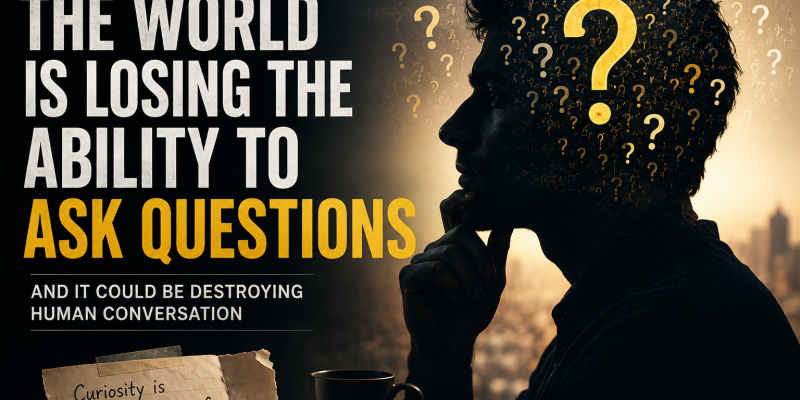
Something strange has happened to humanity.
We live in the most connected age in history. Human beings can communicate instantly across continents. Artificial intelligence answers questions in seconds. Social media platforms never stop talking. News channels scream opinions twenty-four hours a day. Podcasts multiply endlessly. Everyone has something to say.
And yet, despite all this noise, modern society may be quietly losing one of the most important human abilities ever developed:
The ability to ask meaningful questions. Not clever questions designed to impress people. Not aggressive television-interview questions designed to trap people. Not social media “gotcha” questions meant to humiliate opponents.
But genuine, curious, deeply human questions asked with humility, openness, and the willingness to actually listen to the answer. It sounds simple. But perhaps that ability is becoming endangered.
In a fascinating conversation on LitInMin, author Sam Knowles argues that modern life has become obsessed with answers while quietly forgetting the power of questions.
And the more he speaks, the more uncomfortable the realization becomes. Because suddenly you begin to notice it everywhere.
At school, children are rewarded for getting the “right answer.” At university, students are examined through answers. In offices, promotions often go to the people who sound most certain. Politicians are expected to project absolute confidence even when they are guessing. Television debates reward confrontation instead of understanding. Social media punishes nuance and rewards instant outrage.
Questions have become weakness. Certainty has become performance. And somewhere along the way, curiosity quietly began to die. Which is tragic, because human beings are born as question-asking machines.
Knowles references author Warren Berger’s astonishing observation that by the age of five, children may have asked the question “why?” approximately 40,000 times.
Forty thousand.
Just pause and think about that number for a moment.
Children constantly interrogate reality. They want to know why the sky changes colour. Why birds fly? Why adults cry? Why rules exist? Why something hurts? Why people fight? Why the world behaves the way it does?
Curiosity is their natural state. And yet adulthood slowly crushes that instinct out of people. Questions become interruptions. Curiosity becomes “disruptive.” Silence becomes professionalism. And eventually many adults stop asking real questions altogether because they are terrified of appearing uncertain.
Perhaps that is why modern conversations feel increasingly hollow. People no longer speak to understand each other. They speak to win.
And that difference changes everything. One of the most fascinating moments in the interview arrives when Knowles explains the “TED Formula” used by police investigators across several countries.
TED stands for:
Tell.
Explain.
Describe.
It sounds deceptively simple. But psychologically it changes human interaction completely. Instead of aggressively demanding closed answers, investigators encourage narrative and emotional detail.
Not:
“Were you at the restaurant at 10:30 PM?”
But:
“Tell me what it was like when you entered the restaurant.”
One seeks information. The other invites humanity. And perhaps that distinction explains why modern discourse feels increasingly broken. Today, most people are not listening. They are preparing their next attack.
Social media has transformed conversation into performance art. Political debate has become tribal warfare. Television interviews resemble combat sports. Even ordinary relationships are increasingly infected by the need to appear right rather than genuinely curious.
Knowles repeatedly returns to one uncomfortable truth throughout the conversation:
The smartest questions often begin with admitting we may not fully understand something ourselves. Referencing the ancient Socratic paradox — “All that I know is that I know nothing” — he argues that real intelligence begins with intellectual humility rather than intellectual arrogance.
That idea feels almost revolutionary today. Because modern culture worships confidence.
Not reflection. Not doubt. Not humility. The loudest voice in the room often wins, even when it is completely wrong. And perhaps that explains why public discourse feels so emotionally exhausting.
Nobody wants to understand anymore. Everyone wants victory. But perhaps the most powerful part of the entire discussion is not actually about questioning. It is about listening.
Real listening.
The kind of listening that modern civilization seems to be rapidly losing. Knowles speaks about how many interviewers, politicians, and professionals prepare their next question before the previous answer has even finished.
The result is not conversation. It is collision.
Human beings talking past each other while desperately waiting for their turn to speak. And when listening disappears, empathy disappears shortly afterwards. One remarkable story shared during the interview captures this beautifully.
Knowles references a TED Salon talk by Julia Dhar describing how her father travelled across America after the 2016 US election speaking with Donald Trump supporters despite being a Democrat himself.
In today’s world, most people would approach such conversations with immediate hostility.
Arguments.
Condemnation.
Moral superiority.
But instead, Dhar’s father asked something astonishingly simple: “What can you tell me that would help me see things from your point of view?”
Imagine hearing that sentence on social media today. It almost feels unnatural. Because modern society increasingly rewards outrage over empathy. The result, Dhar explained, was extraordinary. Despite enormous political and cultural differences, people walked away smiling because for perhaps the first time in a very long time, they felt genuinely heard.
That may ultimately be the deepest crisis of modern civilization. Not technology. Not politics. Not artificial intelligence. But the slow collapse of meaningful human conversation itself.
Because once people stop listening to each other, societies eventually stop understanding each other. And when understanding disappears, conflict quietly rushes in to fill the vacuum. Perhaps that is why this conversation feels far bigger than a discussion about communication techniques or interview strategy.
It feels like a warning.
A warning that in an age drowning in endless opinion, instant certainty, performative outrage, and algorithmic noise, curiosity may become one of the rarest human qualities left.
And maybe the smartest people in the world are not those who always have answers.
Maybe they are the people who still know how to ask “why?” like a child.
LitInMin is a YouTube channel created by Karnvir Mundrey for people who still believe books can change lives. Through powerful 14-minute conversations, the channel explores books, authors, ideas, and extraordinary human journeys – transforming complex stories into emotional, thought-provoking experiences for a fast-moving world still searching for wisdom, meaning, and inspiration.









Comments